
Summary: Waugh’s war, through a glass slightly smudged
In 1939 Guy Crouchback returns to Britain from Italy, where he has been nursing a broken heart since his wife, Virginia, left him. His intention is to play some part in the looming war against the totalitarian alliance of Nazi Germany and the Soviet Union. As he prepares to depart Italy he prays at the grave of a fallen knight, known locally as the “English Saint”, who on his way to Palestine to fight in the Crusades, was killed in a local squabble between Italian warlords.
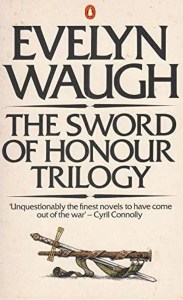
Guy hopes that his war will not be as abject a failure as that. As it transpires his career substantially replicates that of Evelyn Waugh himself: involvement in a dangerous and confused raid on Vichy France at Dakar in Senegal; experience of retreat and defeat in Crete; years of desk jobs in Britain before posting as a liaison officer to the partisans in Yugoslavia.
Along the way he encounters an array of colourful comic characters including Richie Hook, a psychopathic old officer; Trimmer, a charlatan and chancer who the army decide would make a useful national hero; and, almost inevitably, Virginia, his ex-wife, still beautiful but falling on increasingly hard times.
Waugh’s account of all of this is frequently extremely funny, but always shot through with a profound melancholy, as the compromises of war and realpolitik lead to a growing realisation that this is not the glorious crusade that Guy had hoped for. But then neither were the Crusades.
Throughout it all though, Guy remains a sympathetic, almost tragic, protagonist. His courage is rarely acknowledged and never rewarded with responsibility. Nevertheless, his Catholic faith, as his father reminds him, is about something eternal. This he tries to stay true to it by being a decent man even though, as he discovers, he lives in a world in which decency, as easily as callousness, is something that can get people killed.
Waugh’s Sword of Honour trilogy is not so much about the horror of war as of the disillusionment of politics. It is an exquisite work: a classic for a reason.
 aidanjmcquade
Your review has encouraged me to read this trilogy.
Pingback: Some stocktaking – 3 | aidanjmcquade