
Summary: A thoughtful rumination on Empire masquerading as a scurrilous romp… or is it the other way round?
I read my first Flashman book in the 1990s when I was working in Afghanistan. That book, George McDonald Fraser’s first dealing with the character, described his experiences in the retreat from Kabul. In the market of the town in which I was living, Jalalabad, it was still possible to buy buttons cut from the uniforms of the British dead of that retreat.
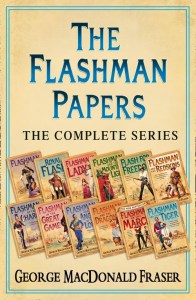
The Flashman books are rigorously researched historical novels, and so a great introduction to aspects of British imperial history which are little remembered in Britain, but which still reverberate in the global South.
They are also exceptionally filthy and extremely funny, though much of the humour, drawing on the racist attitudes of Victorian England – and indeed of McDonald Fraser’s own day – can sometimes be hard to stomach. It is as if the boorish bores of Foster’s Passage to India are given centre stage to opine on the imperial order and revel in the privilege of being top dog in it, albeit with much more interesting lives to narrate.
By the end of his life, Flashman has attained the rank of Brigadier General, been awarded the Victoria Cross and a knighthood, and is regarded as one of the heroes of Victorian Britian. He has met some of the greatest luminaries of his age, including Lincoln and Bismarck, and been witness to some of the epoch-making events of his days, including the Charge of the Light Brigade, the burning of the Summer Palace in Beijing, and the Battle of Little Bighorn.
Throughout all of this Flashman remains what he was when expelled from Rugby in Tom Brown’s Schooldays: an utter and selfish coward. And so, his reputation as a Victorian hero is built upon a reality of luck, murder, rape, deceit and pillage. In other words, Flashman is probably the most honest exemplar of British Empire in all of literature.
Indeed, it is honesty – at least as a memoirist – that is one of Flashman’s few redeeming qualities, though he is also proud of his gifts with languages, women and horses. It is an impressive achievement that McDonald Fraser never softens the character across the decades of the books.
However, readers continue to be seduced by Flashman. He is undeniably charming when he wants to be. His humour can be enough to make the reader forget on occasion that these are the memoirs of a monster, someone prepared to sacrifice the lives and liberty of everyone who has ever trusted or helped him, with the possible exception of his canny and perpetually under-estimated wife, Elspeth, if it can advantage him.
Because of the painstaking historical research, Flashman can be highly opinionated on the events and individuals involved. Flashy is never reticent about what he thinks of the good sense or otherwise of the unfolding events and those involved in them. Some of the opinions are uncontentious: he is in justifiable awe of Lincoln, for example. But some of his conclusions are much more questionable: for example, he is mightily impressed by the venial betrayer of the Navajo, Kit Carson. But then as an inveterate Judas himself, Flashman may have sensed a kindred spirit in Carson.
McDonald Fraser states in an introduction to these books that all he was interested in was writing adventure stories. But, he writes, readers insist on finding in them works of satire, moral tales, indictments of Empire, handbooks for leadership. He was once even dumbfounded to find the books compared to Proust in a German review.
I’ve not read Proust, but tend to agree with the critics who have found all those things that McDonald Fraser said he never put there. I have also read some Tolstoy and, for my tuppence worth, would suggest that taken together these books are literature worthy of serious comparison with the great Russian writer’s ruminations on the Napoleonic wars: a sort of 18-certificate Carry On British Colonialisim, if you will.
They are a remarkable achievement, and gloriously entertaining. Try them.
 aidanjmcquade
Pingback: Quartered Safe Out Here by George MacDonald Fraser | aidanjmcquade
Pingback: My best reads of 2024 | aidanjmcquade