
Summary: Recovering a forgotten Jewish history, vital for our times
At the end of the nineteenth century, Zionism emerged both as a response to European antisemitism and, in a fundamental way, as an acceptance of one of antisemitism’s central claims: that Jews could never truly belong in Europe. Its answer was a Jewish “homeland,” ultimately to be established in Palestine, with catastrophic consequences for the people already living there. After the briefly entertained East Africa scheme, the Balfour Declaration gave imperial force to this idea, helping to condemn Palestinians to dispossession in the name of Jewish refuge.
Among the earliest and most strenuous opponents of this idea were European Jews themselves. For example, Edwin Montagu, Secretary of State for India in Lloyd George’s British government, while perhaps not an opponent of colonialism per se, was a fierce opponent of Zionism, viewing it as an antisemitic concept that would jeopardize the status of Jews in Britain.
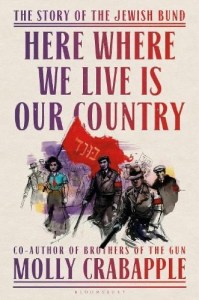
In Here Where We Live Is Our Country, Molly Crabapple focuses on a different group of Jewish anti-Zionists: the Bund – the name translates from German or Yiddish as “union” – a Jewish social democratic movement that grew in Eastern Europe, particularly in the old Pale of Settlement of the Russian Empire. The Bund, as Crabapple shows, was fiercely opposed to colonialism and rejected Zionism’s plain implication that Jews should answer European exclusion by displacing others. Instead they insisted that their culture, including the Yiddish language and literature, should be nourished and respected in the countries in which they lived. For decades they organized to achieve this.
There is an echo of Mark Kurlansky’s Basque History of the World in Crabapple’s gripping work. Both books show how a people often treated as peripheral profoundly shaped wider political history.. In the case of the Bund, Crabapple traces their influence from the Russian Revolution, where they allied with the Mensheviks, to resistance against the Nazis alongside the Polish Socialist Party, and finally to the radical Jewish politics of New York City that formed part of the coalition behind Zohran Mamdani’s mayoralty..
Like Ron Chernow’s Alexander Hamilton, it is also a book that made me rethink large portions of history that I had previously thought myself relatively familiar with. For example, no other history of Eastern Europe that I have read – even Timothy Snyder’s superb Bloodlands – has quite so forensically itemized the scale of antisemitic atrocity that plagued Eastern Europe from the end of the First World War to the destruction of Warsaw.
But, in describing all of this, Crabapple’s purpose is not special pleading to show antisemitic atrocity as something unique. Rather she strives to show, as Seamus Heaney reflected, that all “Human beings suffer,/ They torture one another./ They get hurt and get hard.” And so, Zionism was born as a result of European violence and, as the Jews suffered in Europe, so the Palestinians now continue to suffer at the hands of the state and settlement project that Zionism produced. Palestinian armed groups have also committed atrocities, sometimes with comparable levels of cruelty, though without comparable power. This will inevitably continue until the cycle of violence can be broken.
The Bund sought to break this cycle through solidarity. That they lost, in the face of the monstrousness of the Soviet Union and Nazi Germany does not negate their message. As Crabapple writes, “solidarity is fragile and frequently betrayed, but it is all we have. It is the only thing that can save us. There is no other earth after all. We are trapped together on this one. It belongs to us all as an inheritance and prison.” The alternative is the morality of the bully with the strong doing what they wish, while the weak endure what they must.
Molly Crabapple’s book is an outstanding work of narrative history, elegantly written, compelling and deeply moving – it made me cry more than once. It is a fierce assertion that another world is possible in which we all try to take care of each other instead of honouring the worst instincts of the cruel and the greedy.


Thanks very much for this book review. Excellent. I know the author’s not Canadian, but The voice of Canadian Jews who are critical of Israel is growing. We have a large national organization, Independent Jewish Voices Canada — please see my pro palestinian messages in my free newsletter. judyhaiven.substack.com
Always appreciate your writing Judy. And many thanks for the comment. Keep safe and keep fighting.