
Summary: a vital work of British history that does much to explain why one protracted crime against humanity reverberates into the present.
Britain’s Slave Traders is an elegantly written and deeply researched work of history, chronicling Britain’s role in one of the most shameful episodes in human history: the Trans-Atlantic Slave Trade.
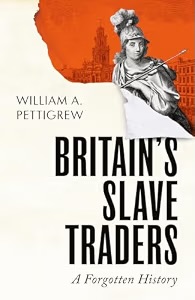
It is also a deeply unsettling book. For Pettigrew identifies slave trading not merely as an important contributor to British economic development, but as deeply implicated in the development of the British civil society that subsequently came to regard itself as fundamentally opposed to such barbarities.
A statue of Edward Colston, for example, was not erected to celebrate the inhumanities he inflicted as a trafficker of enslaved Africans. It was erected to celebrate his philanthropy: the wealth he distributed through schools, hospitals, almshouses and other charitable causes. The origins of that wealth were progressively displaced from the civic memory that celebrated its benefits.
Colston was far from alone. London, Edinburgh, Glasgow and Liverpool all have their counterparts. Slave-trading wealth flowed into institutions, infrastructure and philanthropy across Britain.
The trade also helped generate and entrench racial ideologies that rationalised the enslavement of Africans. Racism was not some unfortunate phenomenon that happened elsewhere while Britain innocently engaged in commerce. It became intertwined with a system from which British traders, institutions and the state derived enormous advantage.
Paradoxically, many of those who eventually campaigned successfully against the slave trade were themselves beneficiaries of educational and charitable institutions established with slave-trading wealth. Pettigrew argues that abolitionists made a deliberate strategic choice not to dwell upon how thoroughly the traffic had been embedded in British society. To build a mass movement, they instead presented the slave trade as fundamentally un-British and its practitioners as monstrous aberrations from traditions of British liberty, Christianity and decency.
In doing so they – and, given that I used to be Director of Anti-Slavery International, perhaps I should say we – helped enable a sort of national amnesia. Consequently, many people in contemporary Britain know little of the role slave trading played in the development of British institutions, social cohesion and economic power in the seventeenth and eighteenth centuries. More importantly, they frequently do not know that they do not know.
Pettigrew shows how thoroughly Britain’s slave-trading project became entangled with the development of the state itself. It contributed to the growth of British naval and commercial power. After the civil wars of the 17thCentury it offered common economic interests across old political divisions. After the Act of Union it provided commercial opportunities through which Scottish merchants participated in an expanding British imperial economy. Slave traders helped finance wars, develop ports and canals and provide some of the capital from which industrialisation grew.
This is therefore a particularly timely book, appearing amid renewed Commonwealth demands for reparatory justice and following severe British cuts to international aid.
One familiar objection to reparations is that the people who perpetrated slavery and the slave trade are long dead. But Pettigrew demonstrates why that cannot dispose of the argument. Individuals die; states, institutions, accumulated capital and infrastructure persist. The advantages that Britain derived from slave trading did not vanish with the slave traders themselves. They became incorporated into the economic, political and institutional development of the country.
That does not, by itself, settle what reparations should mean, who should receive them or who should pay. Those are difficult political and moral questions. But it does make historical ignorance a poor basis upon which to answer them.
So, from this day forth, anyone wishing to utter a credible word on the reparations debate should first read this book.

