
Summary: on trying to learn how to take a photograph
In 2004, the Finnish-American photographer, Arno Minkkinen, presented to the world his Helsinki Bus Station Theory of Photography. In summary, he argued that just as all the buses from the Helsinki bus terminal stop at the same first three stops before going to wildly different places, that the work of any photographer, over the first three years of their career, is going to be derivative of the work of somebody else. This is irrespective of what genre the photographer chooses to specialise in, from nudes to landscape to war photography: somebody will have been there before. Originality only emerges after persistence and practice over years. Or, as Minkkinen put it, if you “stay on the fucking bus,” rather than give up as soon as you recognise who your work is aping.
That is all well and good if you know which bus you want to get on in the first place. That is why people read Susan Sontag and John Berger: to work out what sort of photographer they want to be.
For me, John Berger provided an initial inspiration with his observation that some photographers work with “emancipatory” intent. After half of my professional career in humanitarian response and development, and the other half in human rights and anti-slavery work, this idea struck a chord with me, but still left me short of ideas of how to proceed.
Sontag’s photography books, paradoxically lacking any photographs, are not short of ideas. She writes of the philosophy of photography and photographers. Both of her books are enormously rich and challenging affairs. In particular, I found that On Photography required more than one reading to come anywhere close to fully appreciating the depth of her thought on the subject. Regarding the Pain of Others, perhaps because I have some experience of living and working in war zones, perhaps because I had read On Photography first, I found much more accessible.
Photography, Sontag observes, like sex, cooking and dancing, is a democratic art form that anyone can participate in. But just because anyone can press a button does not mean that anyone can take a good photograph. So, Sontag explores why some photographers not only take good photographs but take photos that are sometimes deemed worthy of putting in a museum.
And, there appear to be as many answers to this question as there are such photographers. Nadar reckoned the best portraits he took were of people he knew. Avedon reckoned his best portraits were of people he did not know. Cartier-Bresson reckoned you should think before and after taking a photograph, but definitely not during.
That successful photographers work to such diverse, sometimes mutually exclusive, ideas is one of the paradoxes of good photography. Perhaps I found an explanation from Berger’s own reflections on Sontag, “The camera saves a set of appearances from the otherwise supersession of further appearances…before the invention of the camera nothing could do this, except in the mind’s eye, the faculty of memory.”
So, perhaps what makes a photographer good is when they learn to capture with the camera that which they would wish to remember, or perhaps wish others to remember.
That gave me an idea.
One of my first experiences working in Africa was a visit to a poor neighbourhood in Addis Ababa, Kebele 37. Amidst the open sewers and crumbling mud houses densely packed together amidst a warren of streets I saw that someone had planted a geranium outside their door, in a salvaged cooking oil tin from a food distribution. There was something about that telling detail which seemed to me to encapsulate the indomitability of humanity, even in the midst of such dire poverty.
As a student of photography, that is the sort of image – the telling detail – that I want to capture, to emancipatory purpose when I can.
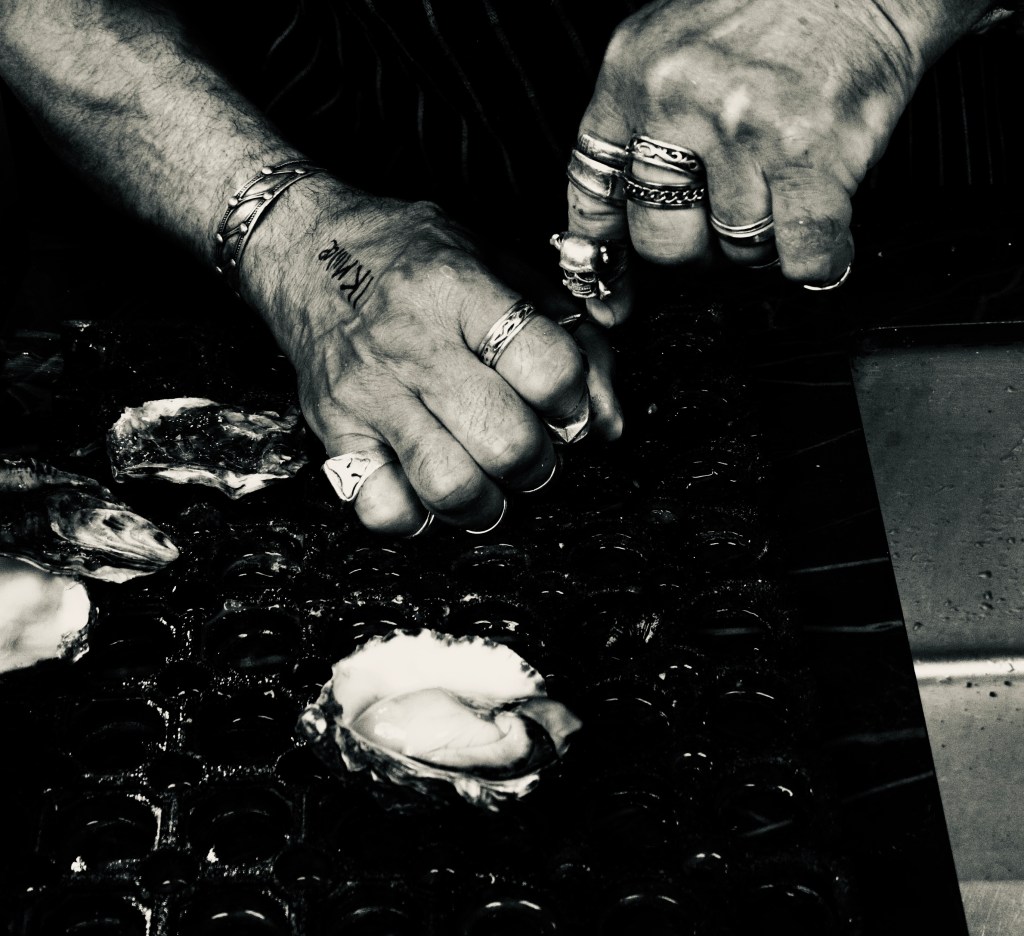
With that thought in mind I went for a walk in Borough Market and took the first photo that I think begins to express the sort of photographer I want to be.
Of course, after looking at it a while I thought, “That’s rather derivative of Salgado.” But that’s okay. I think that is the bus I want to be on. Let’s see where it takes me now.
 aidanjmcquade