
Summary: So… it was everyone’s fault… but mostly Serbia.
The historian AJP Taylor in his celebrated BBC lectures, How Wars Begin, stated that everyone knows why the Second World War began, but not when, and everyone knows when the First World War began, but not why.
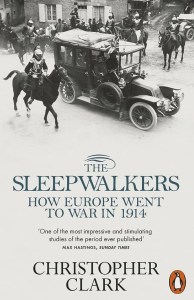
The Sleepwalkers, Christopher Clark’s detailed examination of the origins of the First World War clears up some of that “why” question, but not in any simple way. He describes an interconnected system of “great” European powers – and Serbia – who all took for granted their right to interfere in the affairs of other nations and which developed enormously complex systems of alliances and interests to allow them to do so.
Bizarre imperial attitudes to other countries were not the only strange notions to infest the chancelleries of Europe pre-1914. Many of the denizens of these corridors of power talked seriously of the idea of “preventative war”, which remains, to put it crudely, as much a contradiction in terms as the idea of fucking for virginity.
Hence at the outset of the 20th Century, Europe represented not so much a house of cards destined to collapse sooner rather than later, but a tangle of explosive devices being randomly hit with hammers by supercilious poshos with Napoleonic delusions.
The spark that finally triggered to conflagration was, of course, the assassination of Archduke Franz Ferdinand and his wife, Sophie, in Sarajevo, by the young Serbian nationalist Gavrilo Principe. This was done at the behest of elements in the Serbian government which feared Franz Ferdinand’s intent to increase Slavic representation in the Austro-Hungarian empire. This, Belgrade felt, threatened their dream of a greater Serbia. Franz Ferdinand’s assassination also removed one of the most pacific members of the Austro-Hungarian government and made their impetus towards a war of vengeance all the more assured. From the rubble, of course, Yugoslavia was fashioned, so maybe some Serbs felt the price was worth paying. And didn’t that turn out well.
Some of the dangerously fanciful notions that sparked the cataclysm may have dissipated from Europe, particularly since the rise of the European Union, which was fashioned to make war “not only unthinkable but materially impossible.” However, Clark notes that other dangerous impulses are still at play. Referencing the Euro crisis of 2009/10, Clark describes how, just as in 1914, some countries were prepared in negotiations to use the risk of catastrophic failure for all to advance local interests for some. Similar short-term, selfish interests threaten progress on the climate crisis, which may yet dwarf the carnage of the First World War.
So, a bleak book, but an engaging and thought provoking one, snappily written and frequently gripping.

 aidanjmcquade