
Thomas Cromwell: a revolutionary life, by Diarmaid MacCulloch

Summary: sure what are a few dead human beings when you consider cultural influence?

Undoubtedly the greatest of Peter Seller’s Inspector Clouseau films is A Shot in the Dark. In it Clouseau falls in love with a murder suspect, housemaid Maria Gambrelli, played by the luminous Elke Sommer. Even when apprehended holding a set of bloody hedge clippers that have been used to kill yet another victim, Maria drifts through the film with an ethereal innocence, somehow untouched by the squalidness and violence that surrounds her. 

Perhaps bizarrely, it was Maria Gambrelli that I was most reminded of by Diarmaid MacCulloch’s portrait of Thomas Cromwell, such is the sympathy and indulgence that MacCulloch affords him. Maria, of course, was not a murderer, whereas Cromwell was. But for MacCulloch, this is not the most important thing about him.
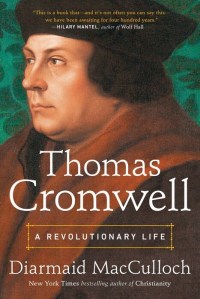
Rather it was Cromwell’s role in the establishment of Anglicanism that for MacCulloch is the most significant thing about his career. For this, he almost forgives the occasional burning of a Protestant heretic or the public dismemberment of a Catholic, and such killings are skated over with considerable blink-and-you’ll-miss-them rapidity.

MacCulloch argues that Cromwell’s Protestant convictions were genuine. Hence his role in the dissolution of the monasteries, a vast act of cultural vandalism amongst other things, was not just the legalised theft of their property for the crown. It was also an effort to advance the reform of religion in which he truly believed. In this vein, for MacCulloch Cromwell’s greatest lasting achievement was obtaining an authorised translation of the bible into English. 

MacCulloch makes a case that Cromwell was a complex figure, and that the depth of this complexity is obscured by an absence of sources: many of his papers were likely destroyed by his servants when he was arrested.  So, Cromwell was not wholly the monster that some of his actions might suggest. Government in Tudor times, for which Cromwell had a prodigious flair, was, after all, a bloody business and, Cromwell’s sainted Catholic antagonist, Thomas More, did not have clean hands either.

But there is a danger of whataboutery here. Just because everyone else was doing it, we should not casually excuse the horror in which a person was implicated. Amongst other atrocities, Cromwell played a pivotal role in the judicial murder of Anne Boleyn and those falsely accused of being her lovers. 

Dozens of other Catholics and “heretics” – Protestants who Henry VIII and Cromwell regarded as too extreme – followed. MacCulloch reckons that Cromwell’s introduction of parish registers to record baptisms, deaths and marriages was a way of identifying Anabaptist “extremists”. This was part of a broader intelligence system in which the theocratic government of which Cromwell was a central part, monitored and condemned people for crimes of conscience alone. 

Cromwell’s bloody trail continued right up to his own judicial murder. This was engineered by high officials jealous of his influence. They were empowered to act against him by the king’s fury at his role in arranging Henry’s fourth marriage to Anne of Cleves. For some reason, the diseased and festering Henry found that he could not manage to have sex with her. So, fortunately for Anne the marriage was never consummated, and a quiet annulment was arranged.

Taken in their totality, when considering Cromwell’s achievements in government and religion he must be seen as a major figure in British history. But there is a saying in the Talmud: “He who saves one life, saves the world entire.” In recognising the scale of his influence, for good and ill, in the making of the modern world, it is remiss to downplay the countless little domestic worlds that Cromwell helped condemn to the fires of fanaticism in the course of Henry’s monstrous reign. 
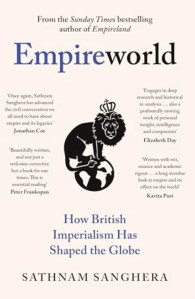
Empireworld, by Sathnam Sanghera

Summary: an elegantly written exploration of the contemporary impact of the British Empire on the world.

Empireworld, Sathnam Sanghera’s follow up to his brilliant, Empireland, expands on the theme of that earlier work, exploring the impact of the British Empire beyond Britain’s shores. 

Sanghera does not cover everything. If he did he would still be writing. But also, as he acknowledges, there are some subjects which have been so comprehensively dealt with that he feels he has little new to add.

The history he does recount here is a mixture of the thematic – for example, the role of botany in Empire, and the imperial and anti-imperial history of British NGOs – and geographic – for example, Nigeria and Mauritius. His discussion of anti-slavery is a mixture of the two, with a principle focus on Barbados and the West Indies.

The result is engrossing, illuminating, and on occasion engagingly contentious: For example, is the anti-slavery image “Am I not a man/woman and a brother/sister?” so clearly a patronising and racist one as he seems to conclude? The anti-racist sports people who have adopted the pose in recent years have shown it can be now, as many interpreted it at the end of the 18th Century, a sign of fraternity rather than subservience.

Across the book Sanghera shows how every idea carries with it the seed of its own opposite: racism and slavery generated anti-slavery and anti-racism; imperialism gave rise to anti-imperialism. This leads to a very complex history, allowing the discernment in some places of many positive legacies of Empire – rule of law, parliamentary democracy, tea – alongside many negatives – partition, civil war, corruption, impoverishment. 

This complexity leads Sanghera to be careful in his conclusions, seeking with this book to promote nuance, understanding, and dialogue, rather than judgement. 

This is a hugely laudable objective, particularly for a country that needs to recognise, as Sanghera rightly notes, that other peoples’ – foreigners! – perspectives on Empire are vital for a proper understanding. 

One such foreign perspective that Empireworld put me in mind of, was the 1916 speech from the dock by the great Irish anti-slavery activist and anti-imperialist, Roger Casement, who observed, “For [the English Establishment], there is only “England”; there is no Ireland; there is only the law of England, no right of Ireland; the liberty of Ireland and of an Irishman is to be judged by the power of England.

For Ireland, one could substitute the name of any country of Empire. Empire was positive for subject peoples if it was in England’s interest. If it was not, then, as Sanghera describes, they could be starved, enslaved, shot with dum-dum bullets or subject to any other expedient or abuse that the British government chose to mete out.

This principle remains true to this day, it seems to me, for Scotland and the North of Ireland, the last vestiges of Empire.

Sanghera does not discuss Ireland, or Scotland, much in this book. But he does not have to. There are plenty of others who have and continue to do so. Instead, Empireworld is another superb study of frequently unacknowledged and unexplored history. A visit to Kew is never going to be the same again. 

Brotherhood: when West Point rugby went to war, by Martin Pengelly

Summary: an important insight into American war-making

Before 9/11, Martin Pengelly, with his amateur English rugby team, played against West Point in a friendly game when they toured the UK. Pengelly’s team won. In subsequent West Point legend Pengelly’s team was described as “semi-professional”. They were not.

Rugby in West Point is something of an outsiders’ sport. So, the West Point rugby team was populated by students who, by and large, were not quite good enough to get on the American football team. Still, some disadvantages turn out to be advantages by introducing these young men to a much finer sport.

Over twenty years since his on-pitch encounter with these young men Pengelly revisits them and explores how they fared in the subsequent “9/11wars” in which they fought.

The book is an interesting study of a subculture – rugby – of a subculture – West Point, and of American officers’ experiences in twenty-first century war and counter insurgency.

It is perhaps churlish to note that there is negligible consideration of the impact of these wars on Iraqi and Afghan civilians. Pengelly was not a combatant and the politics and humanitarian consequences of US policy, whether astute or blundering, does not seem to be at the forefront of the minds of any of those whose story he is telling. So, there is little of the sort of empathy and soul searching that Tim O’Brien, for example, brought to his writings on Vietnam.

Still, it would take a heart of stone not to be moved by the waste of life, in training and in combat, that Pengelly describes his subjects enduring.

Overall, this is an elegantly written book, and an important insight into what goes into the make-up of a revered portion of American society, one that will continue to exert its influence nationally and internationally into the foreseeable future.

Fairly Smooth Operator, by Caroline Walsh

Summary: a thoughtful rumination on leadership from the experience of, on occasion, being badly led

Caroline Walsh’s book, Fairly Smooth Operator, is something of a memoir, recounting her experiences, first as a member of the US Coast Guard, and later as an analyst with the CIA.

Her theme is not, however, derring do, military morality or historical scandals. Rather Walsh’s focus tends towards the more mundane aspects of life in these organisations and particularly the “chickenshit” of military life. With humour and considerable generosity of spirit she explores the petty abuses of power meted out on weaker or more junior colleagues, because the abuser is a bully or an idiot. She reflects on the damage this does to both individuals and the organisations of which they are parts, because bad leadership invariably results in the injury and loss of good people.

So, Fairly Smooth Operator is a useful book for anyone concerned with the world of work in general and, in particular, with the challenges of management and leadership in teams and in big, bureaucratic organisations.

Walsh is now studying for a PhD in the area of ethical leadership. Judging on this book, she will doubtless have many more useful and important things to say on this subject in years to come.