Prague: getting medieval on you

Summary: some say that a djinn is imprisoned for all eternity beneath the Charles Bridge, and troubled times might yet stir the Golem once more

St Nicholas
The rooftops of old Prague
Passageway by Malostranská Beseda
Beneath the castle
Approach
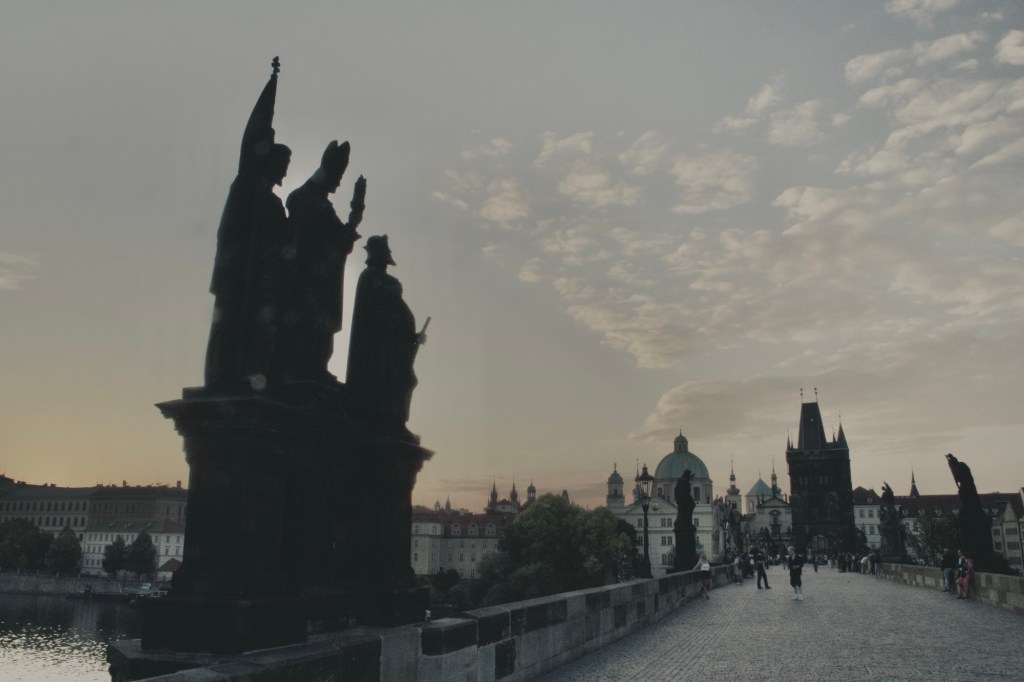
Sunrise on Charles Bridge
Entering the Old Town

Gerry McQuade

In memorium – February 2024

When we were discussing the funeral arrangements the other night, our Brian said to me, “You need to say something … something from Seamus Heaney.”

So, I suppose for my Da there can only be one Heaney poem, and that is “Whatever you say, say nothing.”

It’s not just that, as our Geraldine and Eilis will tell you, his mantra through life was “tell them nothing”, a habit developed, no doubt, growing up in mid-Armagh during some of the vilest years of this statelet, “besieged within the siege,” as Heaney put it. 

And, it’s not just because that poem is about the Troubles which overshadowed so many of our lives and shaped his politics. 

It is more that, I think, my father’s philosophy was to let your deeds, your life, speak for itself. 

We’ve gotten all sorts of very kind messages over the past couple of days from people my Da taught, telling us how much he affected their lives, how he gave them the confidence to become the people they are today. 

That was his politics: it was practical non-violence. In the face of state and paramilitary atrocities his response was not to meet like with like, but to teach kids to work hard, to do their sums and become in themselves the new Ireland for which we all hope and strive. 

Our father could barely speak English towards the end there. As the poem says, that voice of sanity really had grown hoarse. But it doesn’t matter now. Because we still have his life. 

His deeds live on in the kids he taught and in others who teach children to read even in these bleakest of days. 

And, no matter how little he would ever say about himself, or could say towards the end, those are things that truly do speak for themselves. 

Some stocktaking – 3

Summary: well, what have I been up to

About 12 months into lockdown, during the plague, I thought it would be a good idea to think about what if anything I had achieved during that period of enforced isolation. A year or so later I repeated the exercise and found it quite therapeutic. About 18 months later, I thought it was about time to have another reflect. So, what have I achieved?

  1. My father died in February 2024. I managed to deliver his eulogy – mostly – without crying.
  2. Having read Susan Sontag’s On Photography (A LOT!!!) I think I worked out how to, occasionally, take a decent photograph
  3. I had received an honorary OBE in 2017 for services to the eradication of slavery. I sent it back in protest at the British government’s and Opposition’s clear repudiation of the ideals of the Universal Declaration of Human Rights, most notably for migrants and Palestinians. 
  4. Probably the British government paid no attention, I mean they have a state to plunder and a genocide to facilitate: those things don’t happen by themselves. But, at time of writing, no deportation flights to Rwanda have taken off. 
  5. Best books I read? Well, My Father’s House, by Joseph O’Connor is just outstanding. Evelyn Waugh’s Sword of Honour Trilogy is wonderful: it’s a classic for a reason. James Kestrel’s Five December’s is an empathetic and original take on the detective in war-time sub-genre. My pal Lara Pawson’s book, Spent Light, is an extraordinary and intimate examination of everything from toasters to love to war and atrocity, to the joys of a good broom.
  6. And then there is Ellen McWilliams’ Resting Places, an exquisite exploration of the author’s people and her place, the Bandon valley, where the blood of Protestant neighbours, murdered in 1922, still cries from the ground. A remarkably courageous work on how the political and personal interplay. 
  7. Roger Casement once said, “… we all on earth have a commission and a right to defend the weak against the strong, and to protest against brutality in any shape or form”. So I wrote on Gaza, in a vain attempt to prick the racist mindset of the war criminals.
  8. Published my second detective in war-time novel, Some Service to the State. It is about the repercussions arising from an enquiry into the fate of a missing girl in a newly partitioned Ireland.
  9. My pal, Fergus, said it was over-didactic. I said you mean political. He said, I mean over-didactic. 
  10. “Didactic” means “intended to teach, particularly in having moral instruction as an ulterior motive” Example, “a didactic novel that set out to expose social injustice”. Except he didn’t seem to mean it that positively. “Didactic” also means “in the manner of a teacher….” Or, sometimes, “patronising”. 
  11. Well, I didn’t mean to be patronising. But my father was a teacher. So, if being didactic means I’m a bit like him then that is okay.