
Summary: “Ever try. Ever fail. No matter. Try again. Fail again. Fail better.”
As a means to educate, stories are as old as humanity. And the best ones endure. That is why, for example, the wisdom of the parables of Jesus still resonates.
Philip Gourevitch, in his book “A Cold” Case, explored the importance of stories in mentorships, as a way in which leaders share their experience with the next generation of “apprentices”. That is a tradition that Martin Farrell enters with his book, “Good Leaders in Turbulent Times: How to Navigate Wild Waters at Work”.
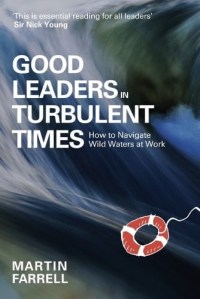
As well as having led organisations himself, Farrell has a long background mentoring leaders: he was a particular help to me during one nightmarish phase of my career. So, he has deep understanding that even the best leaders often have to endure reversals and “the slings and arrows” of those who have never experienced the grinding responsibilities of choice-making that leadership entails.
In other words, he has heard, if not all the stories, a great many of them. He recounts these here in the intertwined stories of a group of fictional not-for-profit CEOs at various stages of their careers each enduring their own professional crises. As resources for learning they are a reminder to other leaders going through their own trials that they are not alone. Others have passed this way and endured… or at least survived. Here are some of the ways they managed to cope.
Farrell understands that beneath the latest fads and fashions, which come and go and come back again, leadership is a human process and it takes a human toll. That is a truth that is often underappreciated by new leaders when they take up their roles. More unforgivably it is too often forgotten by board members who blunder in their organizational stewardship as a result, often in ways that they are never held accountable for.
Because of this, Farrell’s book is a vital one and should be required reading for CEOs. It should also be required reading for board members, particularly those who have never been CEOs. It is book that the for-profit as well as the not-for-profit sectors can usefully learn from.
Good Leaders in Turbulent Times is an accessible, humane book, imaginatively designed and wonderfully illustrated by Steve Appleby. It is an important contribution to leadership literature.
 aidanjmcquade