The Voyage Home, by Pat Barker

Summary: a fine novel of Cassandra that suffers in comparison with Barker’s initial foray into the stories of Troy

The Voyage Home continues Pat Barker’s feminist retelling of the tales of Troy, following the return of Agamemnon to Mycenae with the enslaved Cassandra in tow. This guarantees that the reunion with his wife Clytemnestra is going to be awkward. Just how awkward Agamemnon, even if he was a cleverer man, could not imagine.

But Cassandra, gifted with prophesy, but cursed that no one ever believes her, knows. In the bloodshed that she foresees she also discerns some measure of justice for the genocide that the Greeks have inflicted on her homeland. 

For this story, Barker replaces Briseis, the narrator of her previous Trojan books, with Ritsa, Cassandra’s maid: slave to a slave, or, as she describes her lowest of the low status, a “catch-fart.” 

The Voyage Home dealing with the beginning of the Oresteia, is, I think, a considerably better book than its predecessor, The Women of Troy. But neither of these books say much additional thematically to the stunning originator of this series, The Silence of the Girls.

Still, it is elegantly written, and Barker’s continuing focus on how war affects civilians and the sexual violence endured by women is important. In addition, Cassandra is always a compelling figure, and Ritsa is a fine creation. 

The Handmaid’s Tale, and The Testaments, by Margaret Atwood

Summary: “You tried to bury us, but we were seeds.”

When Margaret Atwood published The Handmaid’s Tale in 1985 it was quickly recognized as a classic. An all too believable dystopian thriller, it is set in a United States that has been transformed into a theocratic dictatorship of the sort imagined in the fevered dreams of the legions of Trump’s incel supporters. 

It is told in the first-person, recounting the experiences of a young woman enslaved under the name Offred as the mistress of a leader of that state, Gilead. Such mistresses are prized because environmental devastation has rendered so much of the population sterile and it is a chance for the elite to reproduce. 

The compelling world that Atwood created in this book, and the open-ended nature of its ending could have seduced a lesser writer into a commercially successful career with spin-offs and sequels galore. However, Atwood waited over 30 years before returning to this fictional universe. That is, she waited until she finally had something new to say about it. 

The Testaments has stylistic similarities to The Handmaid’s Tale, but this time with three first-person narrators, including Lydia, a former judge now an “Aunt” – an older woman tasked with helping Gilead oversee and control its young women. In her deepest conscience however, Lydia is part of the Resistance, and The Testaments tells the story of how she plots to strike a blow to the heart of the dictatorship. 

Both books are gripping, building considerable tension as the protagonists strive to assert some aspects of freedom and free will in the cause of a more moral future, and hence place their fates in the balance. Both books are also deeply satisfying complements to each other, with Offred’s grim struggle for survival given context by Lydia’s more strategic overview of the battlefield. 

Lydia doesn’t have a cat. But she is doubtless the stuff of JD Vance’s nightmares. Such a brilliant character was well worth the 30 year wait. 

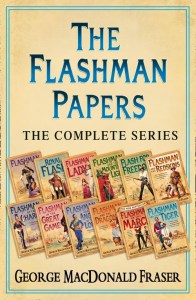
The Flashman Papers, by George McDonald Fraser (Flashman; Royal Flash; Flash for Freedom!; Flashman at the Charge; Flashman in the Great Game; Flashman’s Lady; Flashman and the Redskins; Flashman and the Dragon; Flashman and the Mountain of Light; Flashman and the Angel of the Lord; Flashman and the Tiger; Flashman on the March)

Summary: A thoughtful rumination on Empire masquerading as a scurrilous romp… or is it the other way round?

I read my first Flashman book in the 1990s when I was working in Afghanistan. That book, George McDonald Fraser’s first dealing with the character, described his experiences in the retreat from Kabul. In the market of the town in which I was living, Jalalabad, it was still possible to buy buttons cut from the uniforms of the British dead of that retreat.

The Flashman books are rigorously researched historical novels, and so a great introduction to aspects of British imperial history which are little remembered in Britain, but which still reverberate in the global South. 

They are also exceptionally filthy and extremely funny, though much of the humour, drawing on the racist attitudes of Victorian England – and indeed of McDonald Fraser’s own day – can sometimes be hard to stomach. It is as if the boorish bores of Foster’s Passage to India are given centre stage to opine on the imperial order and revel in the privilege of being top dog in it, albeit with much more interesting lives to narrate.  

By the end of his life, Flashman has attained the rank of Brigadier General, been awarded the Victoria Cross and a knighthood, and is regarded as one of the heroes of Victorian Britian. He has met some of the greatest luminaries of his age, including Lincoln and Bismarck, and been witness to some of the epoch-making events of his days, including the Charge of the Light Brigade, the burning of the Summer Palace in Beijing, and the Battle of Little Bighorn. 

Throughout all of this Flashman remains what he was when expelled from Rugby in Tom Brown’s Schooldays: an utter and selfish coward. And so, his reputation as a Victorian hero is built upon a reality of luck, murder, rape, deceit and pillage. In other words, Flashman is probably the most honest exemplar of British Empire in all of literature. 

Indeed, it is honesty – at least as a memoirist – that is one of Flashman’s few redeeming qualities, though he is also proud of his gifts with languages, women and horses. It is an impressive achievement that McDonald Fraser never softens the character across the decades of the books. 

However, readers continue to be seduced by Flashman. He is undeniably charming when he wants to be. His humour can be enough to make the reader forget on occasion that these are the memoirs of a monster, someone prepared to sacrifice the lives and liberty of everyone who has ever trusted or helped him, with the possible exception of his canny and perpetually under-estimated wife, Elspeth, if it can advantage him. 

Because of the painstaking historical research, Flashman can be highly opinionated on the events and individuals involved. Flashy is never reticent about what he thinks of the good sense or otherwise of the unfolding events and those involved in them. Some of the opinions are uncontentious: he is in justifiable awe of Lincoln, for example. But some of his conclusions are much more questionable: for example, he is mightily impressed by the venial betrayer of the Navajo, Kit Carson. But then as an inveterate Judas himself, Flashman may have sensed a kindred spirit in Carson.

McDonald Fraser states in an introduction to these books that all he was interested in was writing adventure stories. But, he writes, readers insist on finding in them works of satire, moral tales, indictments of Empire, handbooks for leadership. He was once even dumbfounded to find the books compared to Proust in a German review. 

I’ve not read Proust, but tend to agree with the critics who have found all those things that McDonald Fraser said he never put there. I have also read some Tolstoy and, for my tuppence worth, would suggest that taken together these books are literature worthy of serious comparison with the great Russian writer’s ruminations on the Napoleonic wars: a sort of 18-certificate Carry On British Colonialisim, if you will. 

They are a remarkable achievement, and gloriously entertaining. Try them.

Bread and puppets museum: the stuff that dreams are made on

Summary: images from an extraordinary Vermont institution that is like no place else on earth

Museum is on Route 122, Glover, Vermont
The Birdcatcher in Hell: a response to the disgrace of My Lai atrocity
Bread and Puppets continues to raise its voice for the victims of war including of the genocide in Gaza
A central principle of Bread and Puppets is that art should be as basic as bread to life
My wife particularly liked this one
Not much to laugh about any more
A unicorn for the Brexiters
I’m seeing Alec Guinness
“This virtual dumb show is as contemporary as tomorrow’s bombing raid,” Time reviewer T E Kalem in 1971

Monsters: what do we do with great art by bad people? by Clare Dederer

Summary: a fascinating exploration of the relationship between the audience and the monstrous artist

As a reader, a viewer of movies, a “consumer” of art, Clare Dederer realized young a particular problem: some great artists whose work she loved, whose work helped her understand her own life, were utter arseholes… or as she, an American type of person, puts it, “Assholes!”

Picasso, Woody Allen, Polanski, Hemmingway – the authors of some of the finest art in the Western traditions had done dreadful things to other human beings. Polanski – survivor of the Holocaust, bereaved husband of a murdered wife, was also a child rapist. And yet the quality of their art was still so overwhelmingly seductive it was impossible to resist. 

Do they make great art in spite of being arseholes or because of it?

Plainly you do not have to be a dreadful human being to be a great artist. That’s why God made Dolly Parton – so we don’t forget.

But Martha Gelhorn, Hemmingway’s third wife, herself a legendary war correspondent – way better than Hemingway at that profession – made an interesting observation: perhaps some of these arseholes might be working to produce great art in an effort to justify their otherwise mean and squalid existences. Even the arsehole can be self-aware. 

In a world in which getting read is such a struggle, perhaps some of them have worked out that being a “bad boy” is a way of getting attention for their work. It is also of course possible that they are overindulged, and that is a bad thing to do to any man. I mean, most of us are still basically 14. 

Robert Caro has observed that power does not corrupt, it reveals. Hence the power that comes with being a successful artist can truly reveal the nature of the personality. 

So, it is also a percentages thing. There are a lot of arseholes about. Odds are some of them must be geniuses. 

This book has been criticized for some lack of intellectual coherence – most of the female artists Dederer discusses are hardly in the same category of monstrousness as some of the men, and there is no evidence that Nabokov ever hurt a fly – though the monster he created is an outstanding literary exploration of the banality of the evil that some of her other subjects represent. It has also been criticized for limited research. But how much more research do you really have to do to demonstrate that Stephen Fry can be an awful eejit on frequent occasion? And it is still an entertaining introduction to some great art and artists: for example, I have never wanted to read Lolita, and now I feel don’t have to.

In the end, Dederer concludes, the problem of loving great art, great artists, is but a subset of the problem of loving other human beings: we are all flawed, some of us dreadfully. Yet we still undeservedly love and are loved. 

And, even if I can still do without Manhattan, then, as Dederer rightly, I think, concludes, art such as Chinatown, Crimes and Misdemeanours, and Guernica all make our own flawed existences a little richer.