My speech to the Third Global Conference on Child labour
Video
Reply

First of all many thanks for the opportunity to speak here.
We are meeting here, as everyone is aware, as the ILO are engaged in a process of standard setting in relation to ILO 29, the 1930 forced labour convention. This is an important process because, as many of the interventions here have indicated, forced labour has moved on considerably since that convention was first drafted.
It is also appropriate that we meet here at the European Economic and Social Council because, as Mrs Myria Vassiliadou, the EU Anti-Trafficking Coordinator, remarks indicated there is much that that this process can and should learn from the EU, and most particularly from the EU anti-trafficking directive, on the struggle against forced labour.
I would like in particular to highlight the strong emphasis in the Directive on the reduction of “demand that fosters all forms of exploitation” and the Directive encouragement to Member States to enact “measures to reduce the risk of people becoming victims of trafficking in human beings.”
In contemporary Europe the “legal persons”, to use the language of the Directive, most responsible for the demand for trafficked people are some of our transnational businesses.
For example as we speak today European clothes retailers are transacting deals with clothing manufacturers in southern India where the use of the forced labour of girls and young women is routinized. Indeed many of these enslaved young women will be spinning into thread cotton that has been gathered by forced labour and child slavery in Uzbekistan while, for all intents and purposes, the EU stands idly by while these abuses go on on our doorstep. Ongoing research by Anti-Slavery also finds that forced labour of vulnerable migrants in SE Asia is a huge and systematic feature of the export orientated industries of Thailand many of which find lucrative markets in Europe perhaps most notoriously the fisheries that keep us supplied with prawns.
If history shows us one thing it is that voluntary measures are woefully inadequate as a means to address systemic problems. The most popular voluntary measure of the moment is that of social or ethical auditing. Frankly we should recognise that this approach has not brought any notable change to labour rights abuses in supply chains. Rather it is used as a fig leaf by companies to indicate social concern without involving any of those companies in the necessary scale of appropriate social and political action to end the problems. Indeed in many instances the purpose of ethical auditing is to find nothing: repeatedly we see the failings of ethical auditing exposed in Bangladesh by lethal fires which have previously been given clean bills of ethical health.
Hence a binding Protocol to ILO 29 is essential. The EU directive is an excellent example of an effort to obtain pan-European systematic response. Yet as Mrs Vassiliadou’s remarks indicated also the implementation of the Directive by member states still leaves much to be desired – I would highlight in particular the failures of member states to introduce extraterritorial measures to hold to account their “legal persons”, their businesses, who recklessly endanger vulnerable workers to forced labour in their supply chains.
One of the reasons for the failure of member states to fully implement the EU directive is because of the fragmentary nature of the government of many member states: for example in the UK it is the Home Office which has primacy on the EU directive, but some of the measures that the Directive advocates do not fall within the remit of that ministry, but rather should be undertaken by the aid and trade ministries.
Replication of key measures from the EU Directive in a binding Protocol to the forced labour convention, particularly those related to the supply chains of “legal persons”, would help address this question of fragmentation by requiring other currently negligent ministries to pay attention to their obligations in the struggle against forced labour internationally. It would also promote good practice more internationally, which is also in Europe’s interest by extending rule of international law to prevent other regions of the world from deriving unfair competitive advantage from the enslavement of vulnerable workers.
Forced labour and the trafficking of human beings requires an international response. Too many countries, including member states of the EU, feel that their domestic law will provide sufficient response to the challenges of forced labour. Such an attitude shows little more than a profound lack of understanding of the realities of forced labour and trafficking in a globalising political economy. But this complacent attitude is prevalent in many government ministries across Europe and it must be challenged.
The EU Directive rightly emphasises the gendered aspects of human trafficking. There are additional factors that render people vulnerable to trafficking for different forms of enslavement. These include prejudice against caste, ethnicity or age, vulnerability through poverty, relative physical weakness or limited access to education, failures in the rule of law as a result of limited resources, corruption or both, and failure of governments to protect and support their citizens at home or abroad.
In citing this list I do not want to make the struggle to prevent human trafficking sound as if it is an unwinnable one. Each one of these problems was created by human beings and like all human constructions they can be changed by human action.
Simply put we can begin to address the challenge of preventing human trafficking by aligning justice policy with aid, trade and diplomacy. Currently national policies across Europe and the rest of the world march to their own tunes with little consideration of how they may contribute to the reduction of trafficking.
Trade policy is a particularly important example of this. As I mentioned the cotton harvest of our trading partner Uzbekistan is routinely gathered through forced labour and child slavery. This is a dreadful indictment of EU trade policy. Increased challenges from Europe as a whole and from Member States on the sufficiency of the law and policy of trading partners in protecting their own citizens from forced labour abuses should also be an important component of trade diplomacy.
Aid policy is also an area where there is surprisingly little consideration on how to reduce the supply of vulnerable workers to traffickers. Increased focus of aid policies on communities vulnerable to forced labour and trafficking would, quite simply, reduce trafficking. For example increased attention on education, including business and vocational education, for low-caste, “Dalit”, girls in South Asia would remove considerable risks of trafficking from their lives. Increasingly our private and governmental aid agencies should be asked to consider how their work contributes to the prevention of trafficking: There needs to be a wider engagement by these organisations with developing solutions to these problems if there is ever to be an optimal response by human society to this human rights abuse.
As an aside I feel strongly that there will never be a solution to poverty until there is an end to slavery and so this should be made an explicit Development Goal.
I hope all of you here will recognise that that none of the tripartite parties responsibilities end at the borders of national territory. Businesses have responsibilities in their global supply chains. Unions also have interests, for example in ensuring decent work in those same supply chains. And governments responsibilities for their citizens do not end at national borders.
So I hope you will support the idea that a new binding instrument should recognise the realities that many of the risks of forced labour in the contemporary world emerge from the gaps in national practice and international rule of law in the globalising economy. If a new instrument can provide clear direction on how to respond to these risks, for example in the ways I have just described, then it will be well worth the effort.
From a speech to the Management and Leadership Network (MLN) Belfast, 27th Feb 2014
There is a story from French history of a populist leader sitting in a café one afternoon and spotting a passing mob on their way to some unknown destination for some unknown purpose. So he jumps up after them shouting “There go the people. I must follow them, for I am their leader.”[1]
That story may well be apocryphal but it does paradoxically represent an aspect of leadership, but only one aspect. And if this is the only aspect of leadership displayed by someone then that person is not truly a leader. Instead they are a mere panderer to popular sentiment, something to which the most craven of politicians are prone, as we know in this part of the world to our cost.
I’d call what our French friend was at maintenance of legitimacy. This is something that all leaders have to do whether that is upward management to a superior or a board, or in the case of a political figure like this French chap, to a constituency.
But there are two other components to leadership. First there is staff development and with that the attendance to the key management functions that drive an organisation. Then there is strategic choice.
Strategy is one of those terms, a bit like leadership, which a lot of people use but meaning sometimes quite wildly different things. So just to be clear about what I mean by strategic choice it is about the allocation of resources to priorities in order to obtain immediate term survival or long-term success of an organisation.
One of the other things I’ve noticed over the years is that it is immensely difficult to do all three well over a given period. I’m not quite sure if that is a matter of personal aptitude, lack of time, or difficulty of circumstances.
When I was working in Angola at the end of the Civil War there I felt I did two of the three well. I made the right strategic choices to build the operation to provide humanitarian assistance to over a quarter of a million people and I helped mentor and train a cadre of staff who have become, in my opinion, outstanding leaders in their own right.
But I was poor at upward management in large part because of distance from head office, changing personnel there and the simple stress of working in wartime. This meant that when I left many of the achievements, particularly in relation to learning and management, which we had made were insecure and many of them eroded quite quickly afterwards.
I beat myself up a lot over that for some years but began to forgive myself a little when I read a biography of Hannibal a few years ago and found that he was pretty lousy at upward management too: a significant reason why Rome not Carthage won the Punic Wars was because Hannibal was so alienated from the Carthaginian Senate that they refused to reinforce him at a crucial moment and so his Italian campaign failed.
That brings me to another point I wanted to make:
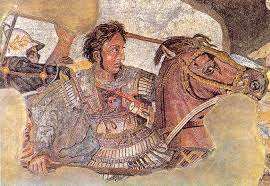
In Western Europe Alexander, the Macedonian king who conquered so much of the known world, is usually known as “the Great”. But in Iran he is known to this day as “Alexander the Accursed” because there he is remembered for devastating one of the great flowerings of Persian civilisation.
I told a Greek friend once about this dichotomy and she got very angry, shouting about how no one could say that, it wasn’t true: Alexander was the greatest of men.
I said “But why are you getting angry? He wasn’t even Greek!” and our relationship never really recovered.
Now I tend to have more sympathy for the Iranian rather than the Greek, or Macedonian, view of Alexander. But my point here is that it is intrinsic to leadership to have enemies. This is obvious when you think about political or military figures from Alexander to Theresa May. But this polarisation of opinion is also inevitable in other leadership environments. This is because strategic choice – the allocation of resources to priorities – is such a fundamental aspect of leadership. In such choices there will always be winners and losers and this will bred resentment.
Lincoln is today regarded as the greatest president in US history. But Shelby Foote, a historian of the American Civil War, told the story of how when he was writing his Magnus Opus, he contacted a descendent of the vile Nathan Bedford Forest, the most brilliant Confederate cavalry general of the Civil War, and subsequent founder of the Klu Klux Klan.
Foote told her that he regarded Lincoln and Forest as the only two authentic geniuses to emerge from the war. “Well”, she replied, “my family never cared much for Mr Lincoln”.
That sentiment was widespread in Lincoln’s lifetime. One gets a sense of this from the film Lincoln. He was vilified in Congress and by large swathes of the Northern press let alone the Southern. His treasury secretary, Salmon Chase, plotted what was in essence a coup d’état against him. Most of his cabinet colleagues thought they were much more qualified than him to be president.
In her book Doris Kearns Goodwin makes a strong argument that Lincoln’s niceness was a fundamental factor in enabling him to lead and manage though the crisis of the Civil War. I think that is important to remember when all the tales of hard-nosed management are told and management ideals are presented to us on television who are clearly selfish, self-serving and obnoxious individuals. Lincoln was able to hold together his fractious cabinet in part because of his warmth, humour and generosity of spirit, something that still echoes down the ages.
But I think there was something deeper too which was Lincoln was a person of immense moral courage. By this I mean he had that uncommon capacity to take personal responsibility for hard, sometimes terrifying, decisions, through the consideration of mature and selfless personal principles in interaction with the leadership challenge he found himself presented with. And he was open to the growth and evolution of his principles and values from experience.
Just how uncommon that capacity is is starkly indicated by consideration of one of the most shameful episodes of human history. Christopher Browning in his book Ordinary Men noted how only a relatively few members of the SS murder squads operating in eastern Poland during the Second World War relished their work. The majority disliked it intensely and went along with the protracted routine of murder, even of children and infants, for reasons of unit loyalty and belief in the legitimacy of their orders.
Only a very few, maybe 10% refused to participate in massacre. Pre-war politics was no predictor: German Social Democrats and Communists participated in slaughter along with Christian Democrats and Nazis. And some Nazis like Oscar Schindler and John Rabe were spectacularly heroic in their rescue efforts during the war.
Christopher Browning makes the chilling observation in his book that anyone who wasn’t in the same situation who says they would not have participated in the killing had they been there is simply saying one thing: that they do not know what they are talking about.
I think there is considerable truth in that assessment but I don’t agree with it entirely. Hugh Thompson Jr was an American helicopter pilot in Vietnam who intervened in the My Lai massacre because prior to ever seeing Vietnam and all through his time there he had engaged in mature reflection on what, literally, it meant to be a Christian soldier in such a war: what was acceptable and what was unacceptable. So when he saw fellow Americans involved in the butchery of unarmed civilians, much as SS troops and police had done 25 years before, he interposed is helicopter between them and the civilians and told the American troops bluntly that if they went any further he and his crew would personally kill them all. His moral courage enabled him to save the lives of 11 civilians.
You don’t have to be a Christian like Hugh Thompson to demonstrate moral courage. And even if you are a Christian, or any religion or none, it is no guarantee that you will ever have it. What you do need is ownership of your beliefs and principles.
Given the scarcity of moral courage even in the face of the most incontrovertible and horrific instances of human history this is clearly an uncommon phenomenon. And without deliberate consideration it is much less likely to be achieved in the face of, by those measures, the relatively trivial cases that so many of us more routinely face in the course of our lives as professional leaders.
Lincoln showed his profound moral courage in the most dramatic terms in preserving the Union and abolishing slavery. Collins showed it in signing the Treaty, something he knew at the time was likely to be his “own death warrant”.
It is this quality I believe more than anything else that is the most fundamental qualification for leadership: that stark moment of social isolation where you are prepared to raise your voice against the prevailing orthodoxy and vested interests to assert a different way irrespective of the personal cost.
I remember in my first or second year at Queen’s studying civil engineering one of my lecturers, Harry Ferguson, giving a lecture on professional practice. One of the things that he said which had a perhaps surprisingly profound impact on me was “A professional will always sign his or her name to their reports”. It seems like a relatively mundane thing but it is a good indicator, though not a universal rule: if you are not prepared to put your name to something, if instead you seek the anonymity of a crowd – or a mob – you should first question your professionalism in the matter and then your moral courage in relation to your leadership.
Lincoln putting his signature to the Emancipation Proclamation, Collins to the Treaty are among the starkest examples of moral courage and I am sure that each of you can think of additional examples from history, or personal or professional experience.
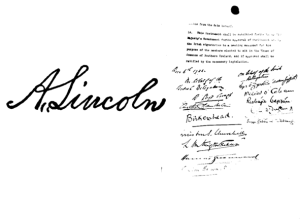
Abraham Lincoln’s signature, and those of the signatories to the Anglo-Irish Treaty of 1922, including Michael Collins
The leadership challenges that we face are unlikely to cost most of us our lives. But how we respond to them is still an important measure of our conscience and soul. And the quality of life of others, and sometimes their very lives, depends upon them, sometimes more than we care to remember. Bear in mind that in this contemporary globalising economy with business’s perpetual search for cheap production and rare commodities we are often ensnared in unjust systems such as the ongoing atrocities of contemporary slavery. This makes us accomplices whether we want to be or not to things such as the enslavement of vulnerable workers in Thai fisheries, to make sure we have cheap prawns in our supermarkets, the enslavement of girls and young women in the garment factories of Southern India to provide cheap clothes for our high streets, and the child slavery used for the excavation of the minerals cobalt and coltan for our mobile phones.
It is true that these practices by business, particularly international business, are enabled by the failure of governments to act to protect vulnerable workers across the world. But they can also be a very real expression of failure of leadership by individual human beings – business executives and politicians – who may pay lip service to ideals of leadership and the memory of people like Lincoln but fail utterly to emulate even a modicum of his moral courage.
For that reason it is important for each of us to reflect on the sort of leader we want to be and the sort of moral courage and selfless principle we want to bring to the task.
It is often a thankless and generally a painful process. But it matters: very often the first step on the path to transforming the world is transforming ourselves. Then if some of us, at some time, maybe even tomorrow, find ourselves in a situation where we have the power to reform and emancipate rather than simply acquiesce in injustice, we may find we have the courage to grasp that opportunity and change a moment of history for vulnerable people across the world.
[1] Attributed to Alexandre Auguste Ledru-Rollin 1807-74
First of all, I’ve got to say what an overwhelming and totally unexpected privilege it is for me, a long time movie fan, to be here this evening to receive this award on behalf of Steve McQueen someone I regard as one of the greatest directors of his generation, for a movie that I believe will be regarded as an all-time masterpiece.
With 12 Years A Slave Steve has stripped away all the comforting myths that are still sometimes peddled about US slavery and exposed that system for the archipelago of concentration camps that it was, maintained through violence and racism for the purpose of the dehumanisation and exploitation of other human beings.
I’m deeply proud that Steve has agreed to become a patron of Anti-Slavery International because he recognises that that slavery archipelago which he so forensically exposes is still with us
Today a minimum of 21 million people across the globe are subject to the violence of slavery: from the mines of Congo which enslave children to excavate coltan for our mobile phones, to the garment factories of South Asia which enslave girls and young women to produce clothes in such volumes for the global North that each of us here tonight is probably wearing a garment tainted by such slavery, to the World Cup building sites of Qatar, to the private homes of Europe where vulnerable migrant domestic workers often toil in servitude in the midst of our cities.
Slavery is still with us, trapping and brutalising vulnerable people who have sought nothing but decent work. And that blunt fact indicts us all. Poverty will not be ended until slavery is ended, and yet the international community fails to recognise slavery eradication as a fundamental development goal. All our ideals of human rights are challenged by our failure to complete the first great human rights struggle, that to end slavery.
Today across the world there are 21 million Solomon Northrups still struggling for freedom: if those of us who already have that right will only fulfil our responsibility to stand with them then truly, finally we can
overcome.
Thank you.

A street in Roque Santeiro market, Luanda, Angola
The Bottom Billion is well worth reading for presenting some very powerful insights into the causes of conflict and poverty from some imaginative economic analysis. However Prof Collier does rather overegg his argument with the tiresome use of straw men: assigning to his imagined opponents views which almost no one holds. For example how many leftist political scientists would regard the Lord’s Resistance Army as anything other than a manifestation of murderous craziness? Prof Collier suggests at one point that there is some latent sympathy for them in vast swathes of academia.
He also asserts support for his analysis from some dubious historical examples: for example he argues that UNITA’s welcome demise in Angola arose from the imposition of effective measures against blood diamonds, which reduced UNITA’s natural resource wealth.
I worked in Angola when some of these measures were put in place and certainly was a vocal supporter of such sanctions as a means of reducing UNITA’s capacity to kill. But I think most people who know a little of the Angolan conflict would feel that the provision of American intelligence to the Angolan Armed Forces had more of an impact on the destruction of UNITA’s armed insurrection, leading ultimately to the killing of their psychotic leader Jonas Savimbi.
So overall a book worth reading for the important insights drawn from fine research, but requiring of something of a strong stomach to get over Prof Collier’s irritating tendency in this book to suggest that he is the only wise thinker on conflict in the world.
 Hanging on the wall of my very messy office are two portraits, one of Abraham Lincoln, and the other of Nelson Mandela. This is because they both showed that even the most entrenched and hateful systems based on discrimination, violence and racism could be overcome with courage, determination and decency.
Mandela rightly pointed out that “Like slavery and apartheid, poverty is not natural. It is man-made and it can be overcome and eradicated by the actions of human beings.” But, unfortunately poverty cannot be overcome until slavery and apartheid have been eradicated: Mandela dealt with apartheid in South Africa, but it endures against Dalits and minorities in India and other parts of South Asia, and slavery endures across the world.
We need people at the top to draw inspiration from Mandela to take political action to eradicate slavery. Unfortunately, many politicians pay lip service to his achievements but lack the guts to emulate them, preferring bland platitudes to effective action on issues like slavery.
Still, even when things seem bleakest and the brutality of contemporary slavery practices most intractable I sometimes reflect on the odds which Mandela overcame in ending apartheid and re-forging a new nation in South Africa. We also must endure in the struggle and trust that decency and courage will ultimately triumph over the greed and racism that keeps 21 million people enslaved across the world.
Speech to RMT Union meeting to mark the International Day for the Elimination of Violence against Women and Girls
25 Nov 2013
Thanks very much for having me here. I’ve very honoured to be here and just wanted to say a few words on just one of the issues that sustains violence against women and girls in this country and in the rest of Europe.
A month or so ago the Guardian ran an expose of the use of forced labour in Qatar to build the infrastructure for the World Cup. At the root of the problem there is what is called the Kafala system, which is a sponsorship system that ties workers to their employers to such an extent that even in the most abusive employment relationships, up to and including forced labour, the workers cannot changes jobs or even go home.
It is a cynical system to facilitate medieval levels of exploitation.
It is also essentially the same system that the UK government has in place for migrant domestic workers to this country.
All slavery is violence. It affects more women than men, though not disproportionately so: as I mentioned the thousands of forced labourers bleeding and thirsting to death in Qatar are mostly men. But domestic slavery and servitude is a sector where women are overwhelmingly enslaved and abused.
And it is a sector were the trafficking of women and girls, and by trafficking I mean specifically the movement of women and girls into systems of forced labour and exploitation, is frequently legal. The UK has its system of domestic workers visas tied to employers, and this de facto legalises the trafficking of people for forced domestic work. It does this by explicitly saying to migrant domestic workers that if they leave the employment of the person to whom their visa is tied, no matter how abusive or exploitative that employer may be, they will be deported. And that places in the hands of unscrupulous employers an enormously powerful threat to hold over the head of any vulnerable worker hoping to improve their own life and that of their family through hard work.
The British Prime Minister David Cameron, to his credit employed a domestic worker who had previously escaped from an abusive employer and he sometimes makes reference to how this gives him an insight into contemporary slavery. But if the same domestic worker today was to escape from an abusive employer, following the changes in regulations regarding migrant domestic workers’ visas brought into being by Mr Cameron’s government, she would probably be deported rather than protected.
The system of tying domestic worker visas to employers is common place across the Gulf states as well as in the UK. As with the construction workers of Qatar this system is in place to facilitate the abuse and enslavement of vulnerable domestic workers. A year or so ago an Indonesian domestic worker was executed in Saudi Arabia without having had either legal representation at her trial or consular support. Referring to this case, one colleague asked me “Imagine for a moment that woman was guilty of whatever capital offence she was accused of. Can you imagine the level of abuse that someone like her, from one of the gentlest communities in the world, must have gone through to drive her to some act of violence”.
Consequent of this Indonesia stopped its nationals from travelling to Saudi for work. Saudi now seeks to source its slaves from East Africa, principally Ethiopia and Kenya, though Ethiopia has just recently also introduced a travel ban for its nationals.
Ensuring decent work for domestic workers is an essential challenge in the wider struggle of ending violence against women and girls. Yet the UK, along with the government of Sudan, refused to support a new international convention on decent work for domestic workers when it was formulated at the ILO a year or so ago: and when you are on the same side as the government of Sudan on a human rights issue, you are probably on the wrong side.
The UK’s failure to support decent work for domestic workers runs contrary not just to its proposed anti-slavery and anti-violence agendas. It also runs contrary to its development and anti-poverty agendas. Across the globe women are struggling for better lives for themselves and their families by travelling the world in search of work, frequently domestic work. The remittances they send are vital not only for the future of their families but for the development of their countries. In the months and years to come the remittances of Filipino domestic workers are likely to be more important than the efforts of foreign aid agencies in the reconstruction of their country following the devastation caused by the typhoon there.
David Cameron must see how vital the work of such domestic workers is to all of us in Europe following his employment of a migrant domestic worker to help him care for his family while he carried on the hectic schedule of leading the British Government. For many other people across Europe such workers provide essential support without which they would also find it difficult to cope.
It’s time to start valuing domestic workers not by mere words but by actions, and this country, and all of Europe can start by removing the systems that facilitate the routinized use of violence against them.
I am sure that in the course of this conference there will, rightly, be recognition of the significant progress in the struggle to end child labour across the world.
The ILO’s recent estimate, that child labour has reduced by 78 million since 2000, representing a one third decline overall which encompasses a 50% reduction in children in hazardous work is, indeed, an enormous achievement.
But in parallel with this there is a much darker statistic. Specifically the ILO 2012 estimate that there are around 5.5 million children in forced labour and that this figure has not varied significantly since 2005.
I do not think that we will do anyone any favours, least of all the children who find themselves in slavery across the globe, by not recognising this figure as anything other than a stark failure. Plainly whatever is being done right to address child labour, including its most hazardous forms, it is not enough to address child slavery.
26% of all forced labourers are children, the majority found in Asia and the Pacific, and Africa, but every country and region of the world is affected by child slavery, from the cannabis factories of the UK which typically enslave trafficked Vietnamese boys, to the Indian Sumangali system that uses the forced labour of girls to produce the clothes many of us attending this conference today are wearing, to West Africa, where boys and girls are routinely and endemically trafficked into forced labour in agriculture, most well known into cocoa production, domestic work and fisheries.
To consider what must be done to address this most egregious form of child exploitation let us first begin by being clear about what we are talking about. Too often many people use the terms child labour and child slavery interchangeable.
But here I am not seeking a rhetorical effect. The 1956 Supplementary Convention on Slavery defines child servitude as the handing over of a child with a view to exploitation.
It is important to be clear on this point because it means when we are talking about child labour that however hazardous is that labour it tends to be undertaken when the child is still in the care of their parents, and the parents generally have the best interests of the child at heart, even if they may be profoundly mistaken as to what those best interests are
Nevertheless when engaging in the struggle to end child labour there is that potential commonality of purpose with parents who will often be open to new ideas about how to do better by their children.
No such potential exists when we are discussing the issue of child slavery. For example consider for a moment children who have been handed over from their parents for things such as trafficking for forced labour or sexual exploitation, or forced child labour by a 3rd party, such as the govt of Uzbekistan’s slavery programme for cotton harvesting, or conscription in armed conflicts, or trafficked as child domestic workers.
While these represent diverse practices in a variety of different socio-economic contexts they all have one thing in common: in not one of them, nor any other child slavery situation, do the adults doing the exploiting of the children care one iota for the best interests of the child.
So in addition to the efforts being undertaken by governments, trades unions, businesses and non-governmental organisations on child labour a new set of initiatives are necessary to begin to tackle child slavery properly and systematically.
There are a number of elements to a credible programme against child slavery and I will briefly outline them now.
At the very outset such a programme should acknowledge explicitly the difference between child labour and child slavery and recognise that a new departure is required to address the more egregious abuse of child slavery. Its must be a key lesson of the past 10 years that the approaches of the past to address child labour, even in its most hazardous forms, are woefully insufficient in addressing child slavery.
Second a credible global programme against child slavery must, of course, include education ensuring that school is affordable, accessible and a safe environment particularly for girls.
But it is not enough to presume that the expansion of universal education even on these terms will be enough to protect children who are vulnerable to slavery. Very often those who are most vulnerable do not obtain education because they come from a discriminated against group, such as Dalits and other minorities in South Asia. Hence a credible global response to child slavery must mean the adoption of measures, including relevant anti-slavery and anti-discrimination laws and increased court capacity, that will advance rule of law by preventing bigoted public officials from arbitrarily excluding any section of citizenry from their rights as citizens.
And children must also be directly involved in the struggle against child slavery: In West Africa for example a recurrent reason why children become trafficked into the Ivorian agricultural sector from countries such as Burkina Faso and Mali is their tragically banal dream of owning a bicycle. Given their current circumstances they can’t see how they would ever afford such a thing if they were to stay in school and so fall for the false promises of traffickers. Appropriate vocational and entrepreneurial education that takes accounts of these children’s aspirations could help them imagine a better long term future for themselves that avoids them falling into the abuses of slavery.
It is also important to remember the 2005 research of Lise Rende Taylor in Thailand who found that completion of education was a causal factor of young women and girls being trafficked: because their families had put such efforts into getting these girls and young women educated they expected a return on that investment and hence there was considerable pressure on these girls and young women to leave home to seek work, unintentionally driving them into being trafficked.
There may always be some negative consequences for some to interventions aimed at advancing positive social change for the many. So it is important to move away from the idea of responding to child labour or child slavery as the search for a magic bullet, a simple solution, that will end all problems and instead view any response as a learning process that openly acknowledges any mistakes and seeks to rectify them.
A credible global programme against child slavery must include also elements relating to law enforcement and child protection so that cops in the countries most affected by child slavery can identify children who are in slavery, understand their responsibilities towards them, and know the best methods and partners with whom to work to remove children from slavery. Developing such responses, police force to police force, and child protection specialist to child protection specialist should become a significant component of post 2015 aid programmes.
A credible global programme against child slavery must also include working in and with the very communities where child slavery and slavery-like practices prevail. Only by fully understanding the complex causes behind harmful social norms and turning them around together with the support of the communities that commonly practice them will child slavery ultimately be eradicated on the large scale required.
This is one area where the business community can play an enormous role by casting a cold eye honestly on its supply chains, recognizing, particularly in agriculture and south Asian garment manufacture, that slavery, and the slavery of children are brutal realities of those supply chains and more robust and open approaches to dealing with them are needed.
I understand that tomorrow the international confectionary company Mondalez is announcing its new policy on child labour which does just this and articulates approaches and expectations of its staff and suppliers in how they will deal with these issues. I believe this radical new approach breaks the old, discredited paradigms of businesses employing dubious “ethical auditors” to assure the world that there are no human rights issues in their supply chains when it is an open secret that there are. Mondalez should be congratulated on adopting such a visionary new approach, which I hope will inspire others to follow suite.
One of the biggest failures in the struggle against child slavery, and indeed all slavery in the world today, is that the development and humanitarian communities are largely absent. It seems that they are hoping, if they ponder the subject of child slavery at all, that the programmes they undertake, blind to non-gender based forms of discrimination, will be sufficient to remove the causes of slavery in general and child slavery in particular.
They won’t be. So it is necessary in order to obtain comparable progress on child slavery that we have seen on child labour, that child slavery eradication must be recognized as a fundamental development goal and included in the post 2015 agenda as such.
Aid policies of governments, international and not-for-profit agencies have to be formulated explicitly stating how they seek to contribute to ending child slavery. For example basic questions should be asked such as “How would UNICEF’s partnering with the Government of Uzbekistan to access funds from the Global Partnership for Education contribute to the ending of that government’s systematic use of forced child labour in cotton harvesting, which, by the way, brings more revenue into Uzbekistan, mostly for private benefit, than would be accessed from the Global Partnership for Education?”
Similarly governments need to consider the roles that trade and diplomatic policy can play: will the community of nations continue to be happy to build commercial links with countries such as Qatar and the Gulf states or Uzbekistan which formulate much of their economic and other policies on being able with impunity to enslave children and other vulnerable workers.
Finally we must have a serious consideration of the relationship between child slavery and child marriage. Work undertaken by Anti-Slavery International, Girls Not Brides and others have shown that child marriage can be slavery of the most distressing kind, as children are in essence traded with the thinnest of veils of respectability for sexual exploitation. That hypocrisy should no longer be tolerated and child forced marriage treated as unacceptable as any other form of child sexual exploitation.
The struggle against child labour should give us hope that we can advance also the struggle against child slavery. But in order to do so we must attack child slavery directly and not merely hope that it might somehow go away. This conference must take up challenge of child slavery if it is to be serious about addressing child labour. If we do not we will return again to some gathering like this in the future with the same figure of 5.5 million children enslaved indicting our failure.
First of all it is as always a pleasure and privilege to be here. And I would like to take the opportunity to congratulate Gulnara Shahinian on her tenure as Special Rapporteur on Slavery. In her term Gulnara has raised the profile of slavery in the UN and made crucial interventions on on particularly reprehensible forms of slavery such as bonded labour, domestic servitude and servile marriage. Her interventions have helped move forward understanding of and action on these issues.
I am also grateful to have the opportunity to pay tribute directly to the UK ambassador for the role of the UK in establishing this mandate. In doing this the UK keeps faith with the historical tradition of British leadership in the international struggle against slavery since the time of the great British abolitionists such as Clarkson and Equiano.
Anti-Slavery International also can trace our origin back to the end of the 18th Century when Thomas Clarkson was my most illustrious predecessor. As the oldest international human rights organization in the world we have a longer, historical, perspective on the issue than most and also a broader, geographical perspective than many.
So in considering the challenges in combating contemporary forms of slavery there are a couple of matters we would particularly highlight.
First through the history of the struggle against slavery there has been an erroneous belief in “silver bullets”. That is there has been a belief that we just need one particular thing to end the problem, whether that is ending the trans-Atlantic Slave Trade or making slavery itself illegal. Each of these achievements has confined slavery further and further to the margins of society, but none of them have completely managed to eradicate slavery in any single country let alone the world. This is simply because slavery evolves faster than the systems hitherto established to eradicate it. What is needed is a more dynamic and permanent set of processes that will aim to progressively reduce the scope of slavery and contribute to the empowerment of those vulnerable to slavery.
Slavery is a diverse matter. The term slavery may describe situations as varied as that of a young woman in domestic servitude in a diplomatic household in London, to a family born into chattel slavery in Mauritania, to the young women and girls who are kept in forced labour in India, the world’s largest democracy, to produce garments for the high streets of Europe and North America.
Each of these diverse situations requires a different set of response to ameliorate it.
But if we look more closely at these various forms of slavery as we have in Anti-Slavery over the years through both qualitative research and programmatic work we can see that slavery emerges at the conjunction of three broad factors: individual vulnerability usually this is poverty but it can simply be about physical weakness; social exclusion; and failure of government and the rule of law.
The issue of social exclusion and with it discrimination is a fundamental one in slavery: In Latin America today many in forced labour are indigenous people. In Western Europe most people in slavery are migrants workers. In South Asia most people in slavery are Dalits or from other scheduled castes or minority groups.
This is important for a variety of reasons, not least that it inhibits the issue from becoming a political one: if this is being inflicted upon groups and individuals who the wider society simply does not like, then that wider community is more likely to tolerate the abuses if they see them and not raise their voice to demand that governments do their jobs to stop the problem.
And slavery is very much a failure of government and the rule of law. Child labourers enslaved in the garment workshops of Delhi tell how when the workshop owners fail to pay bribes to the police, the police come, arrest the children and hold them hostage, stopping work, until the bribes are paid. The appalling lack of capacity of Indian courts exacerbates further these factors. Generally Indian courts rule progressively when slavery cases come to trial. But the backlog of cases in those courts means that few do come to trial, effectively making a nonsense of the promises of that country’s laws and constitution.
So a central front in the struggle to end slavery must relate to building the capacity of states to effect rule of law. There must be sufficient judges properly trained in human rights in general and in anti-slavery rights in particular to ensure that rule of law pertains within the states borders for all its citizens. And beyond those borders states should ensure that they deploy labour attaches to every country that their citizens travel to for work to press for the respecting of their rights and the building of the rule of law where their citizens seek decent work.
Of course there remains a huge lacuna with regards to international rule of law and this is the question of how, in this globalising political economy, international businesses and individual business executives can be held to account on human rights issues in their supply chains. This is a central requirement in the struggle against contemporary slavery, particularly as they extend their operations into countries where extant evidence shows slavery is rife and regularly pollutes business supply chains.
The UK just last week became the first country to publish an action plan on the Ruggie principles. We would urge other Governments to follow this lead, and to introduce extra-territorial legislation to establish legal accountability of international business entities and their executives in relation to slavery in their supply chains. If history shows us one thing it is that a request for voluntary initiatives to respond to systemic abuses such as slavery do little to dent the system. What is needed is a change in the system such as that which the UK has pioneered on bribery.
The second major challenge that I wanted to consider was the comforting myth that slavery is a thing of the past. Such a belief is perhaps forgivable for the mass of ordinary people who live their lives beyond the challenges of reducing poverty and advancing human rights. But this myth is bought into by the mass of major humanitarian and development actors and here it is unacceptable because it threatens to fatally undermine the stated aspirations of those very actors. As development and anti-poverty work is currently practiced it is blind to the continuing atrocity of a minimum of 21 million people in slavery. Hence development practices often threaten to either absolutely or relatively worsen the situations of those in slavery. For example in 2005 during the west African famine our colleagues in the organization Timidria noticed that slaves were being used in food for work programmes: they were being sent to these schemes by their masters who would then confiscate the ration card they received for their labour. In other words an important and well meaning humanitarian programme was contributing to the absolute worsening of their lives.
This is not an isolated case. Hence the imperative of reducing slavery needs to become a central focus of the entire international development sector. This can be obtained by two principle means. First slavery eradication must be made a post 2015 development goal recognising the fundamental constraint that slavery is on poverty reduction as well as the continuing human rights atrocity that it is. Second, and to advance this development goal, all aid actors must be required to state how their programmes address the challenges of slavery and non-gender based discrimination in their operations. It should be an acceptable response to say that it will have no impact, some programmes will necessarily respond to other priorities. But the requirement should be that at least they consider this matter in the same way as they are now rightly required to consider gender in programming.
Slavery is a human institution and like all human institutions it can be changed by human action. But we must stop just tinkering at its edges and instead aim to destroy it utterly.
 aidanjmcquade
