Chimes at Midnight: Brexit and the demise of rule of law in the UK

Summary: the increased threat of terror brought by the UK’s decision to withdraw from European security cooperation mechanisms actually plays into the central purpose of the Brexit project: erosion of rule of law

The idea of rule of law is not a new one. It is frequently dated as far back as Aristotle, who said “It is better for the law to rule than one of the citizens.”  But the idea is at least a hundred years older. Sophocles dramatized it in his play, Oedipus the King, in which, as a result of his own investigation, the King finds himself responsible for the plague on Thebes and realises that he must be held accountable, just as anyone else would be, to his prior judgement.
daily-mail

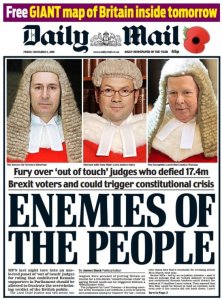
The Daily Mail reminds readers of its long-standing association with fascism

Rule of law then is the idea that it is the law, independently administered, that governs a people not the whims of any monarch or minister or mob, and that no one is above the law. So, when the mob gathers with flaming torches and pitchforks outside the “witch’s” hovel, or the minister wants rid of his mistress’ husband, the law should protect the basic human rights of the wise-woman and the cuckold, and restrain human excesses, or punish them when they transgress the law.

It is this concept, one that in British law can be traced back as far as Magna Carta, that is most fundamentally under attack with Brexit. It began with press and political denunciations of the independence of the judiciary. It has continued with British government proposals to use the excuse of Brexit and the “will of the people” to grant sweeping Henry VIII powers to ministers. If these powers are granted they will permit ministers to make law without reference to parliament.

img_0940

Tom Bingham, Baron Bingham of Cornhill, who served as Master of the Rolls, Lord Chief Justice, and Senior Law Lord

In his magisterial book on the subject, Tom Bingham sets out the fundamental principles of rule of law, noting that these include a requirement for compliance of the state with its obligations in international as well as national law. Bingham quotes Professor William Bishop as describing the international rule of law as including, “the realization that law can and should be used as an instrumentality for the cooperative international furtherance of social aims in such a fashion as to preserve and promote the values of freedom and dignity for individuals.”

But this ideal has long been anathema to powerful sections of the Conservative party. In 2015 David Cameron removed from the ministerial code the requirement for ministers to adhere to international law. Theresa May has never been shy about her wish to remove the UK from the jurisdiction of the European Court of Human Rights, an entity separate to the EU.

Brexit furthers this ambition to remove the constraints of international law from the UK government. As part of the Brexit process, the Government intends to remove the UK from the jurisdiction of the Court of Justice of the European Union. This, if it happens, will further remove constraints on ministerial power. A side effect of this will be to put in jeopardy the UK’s continued law enforcement and intelligence cooperation in Europe. But while this would undoubtedly increase the risks of terrorism for ordinary UK citizens, there is little that the pathetic foot soldiers of Islamic State can do that will pose an existential threat to the nation. However, the cynical might comment that, as in the past, an upsurge of terrorist attacks on the civilian population would provide a convenient excuse for a further concentration of power in the hands of ministers and further erosion of the civil rights of the British people.

Since the Brexit vote in 2016, the British Government have sought to find common ground with some of the most unsavoury governments and anti-democratic leaders on the planet. As well as Theresa May’s supplication to Donald Trump and the leaders of the bloodthirsty Saudi Arabian government, she has also proven herself a ready apologist for the governments of Poland and Hungary as they also strike at the foundations of human rights and rule of law in their own countries. Disgraced former Defence Secretary Liam Fox, gave more away than he intended with his declaration of “shared values” with Rodrigo Duterte, the Philippines leader whose repudiation of rule of law is so absolute that he promotes indiscriminate murder as a central tenet of his so-called “war on drugs”.

But all this should not be surprising. Because, for the empire-dreaming elite whose money and lies obtained the soiled “mandate” for Brexit, the diminution of rule of law is their central purpose. It will facilitate an environment in which ecological and safety standards, workers’ and consumers’ rights are negated. Capital will once more be given pre-eminence over labour, as newly empowered ministers ensure that the wealthiest are permanently put above the law, at least as far as their tax affairs are concerned. No matter what fantasies are spun by the leadership of the British Labour party about the possibilities of a “People’s Brexit”, they will not alter, one iota, the vital essence of this project, irrespective of who is in government.

So, the prospects of Brexit for the UK are not simply of economic decline, international isolation and irrelevance. British democratic standards and human rights, a tradition that can be traced back to Runnymede, are themselves under threat as the UK continues to seek its future alliances with new dictatorships and old autocracies.

As Shakespeare’s Falstaff reflects while Prince Hal prepares to repudiate their friendship and put him back into his lowly place, these are the “chimes at midnight”. They ring again today for any British subject not wealthy enough to indulge in tax avoidance. The lower orders have had their day. Now they must know their place.
On the value of conspiracy theories: the Kennedy assassinations and “official versions”

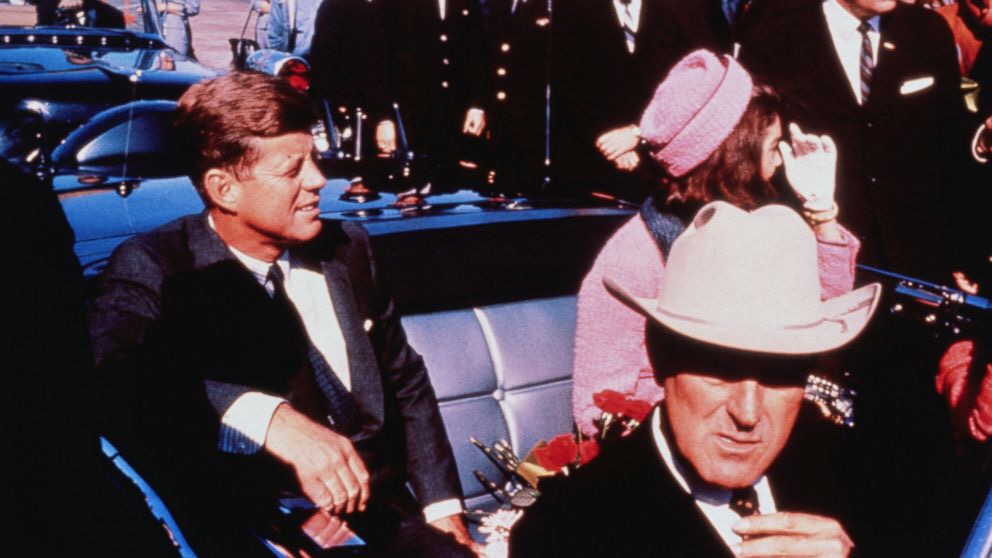
For many Gerald Posner’s book, Case Closed, is the definitive word on Jack Kennedy’s assassination. Posner concludes that Lee Harvey Oswald acting alone shot Kennedy on 22 Nov 1963 in Dallas Texas. It is a widely shared conclusion. Vincent Bugliosi, a distinguished prosecutor who put Charles Manson in jail, concluded the same in his own consideration of the case. And this is of course the official verdict of the Warren Commission established by Lyndon Johnson to investigate the assassination.

And yet as the US gets ready to publish another trove of documents relating to the Kennedy assassination, a clear majority of Americans – in 2013 the Economist reported 61% – still believe that Jack Kennedy was killed in a multi-person ambush organised by high officials in the US government.

David Talbot’s 2007 book Brothers, goes some way to explaining why so many still think this way. Talbot recounts how two of Kennedy’s closest advisers, Dave Power and Kenny O’Donnell, both veterans of World War 2, both travelling in the same car behind Kennedy when they saw him killed, were both under the clear impression that their convoy was under fire from multiple directions, including the infamous Grassy Knoll ahead of them, as well as the Book Depository behind them where Oswald was located.

Furthermore the subsequent killing on live television of Oswald by Jack Ruby, a mob-connected Dallas night-club owner, reeks of cover-up: Ruby’s story, that he wanted to protect Jackie Kennedy from the trauma of a protracted trial, is as fantastical as any Brexit bus slogan.

Talbot alleges that a pivotal figure behind the assassination of Jack Kennedy was Howard Hunt, someone who became infamous in the Seventies for his part in the break-in to the Democratic National Headquarters in the Watergate Building in Washington and the subsequent Nixon administration cover-up.

Talbot notes that in a memoir, American Spy, that Hunt wrote shortly before his death in 2007, Hunt included a “speculative” section on how the CIA would have gone about the killing IF it had been involved. In connection with the publication of that book Rolling Stone interviewed Hunt’s son who claims that, when he thought he was dying, Hunt described to him in some explicit detail the architecture of the conspiracy, which allegedly involved both Lyndon Johnson and senior CIA officials.

Talbot also claims that in spite of public statements that he believed Oswald was the lone assassin, Bobby Kennedy had been privately investigating Jack’s killing for years. Indeed, Talbot believes that, with the help of an FBI investigator, Bobby Kennedy had actually cracked the case, and it was his intention to have it officially reopened if elected president. That dream, of course, came to a bloody end in the Ambassador Hotel, Los Angeles, California in June 1968 when Bobby was himself assassinated.

Robert Vaughn, the scholar and actor, was with Bobby that night, and Vaughn has noted that there were more bullets fired than Sirhan Sirhan, the convicted killer, had in his gun. So, he concludes, there must also have been a conspiracy to kill Bobby. Perhaps this was a further measure to ensure that the truth of Jack’s death never emerged?

Perhaps it is far-fetched to believe in a conspiracy behind the killings of Jack and Bobby Kennedy. And it is improbable that whatever the contents of the papers to be released this week that they will shed much new or definitive light on those awful days. But at a moment in history when it appears that Donald Trump won the White House as a consequence of a Russian backed coup, and when a cynical campaign of lies has been used to strike at the foundations of a strong and united Europe, then perhaps the Kennedy assassinations still have important lessons for us. Not least they show that, whatever the official versions of events, that power and the powerful must be constantly questioned by the citizenry because it is only upon a foundation of doubt and skepticism that democracy, human rights and the rule of law can safely rest.

Gerry Adams: An Unauthorised Life, by Malachi O’Doherty

Summary: An impressive attempt to cut through Adam’s lies, obfuscations  and pseudo-intellectualism to understand more properly his role in war and peace-making
In her book, Every Secret Thing, Gillian Slovo’s magisterial memoir of her parents, Ruth First and Joe Slovo, she reflects on the nature of clandestine life, how deceit becomes an all pervasive thing, a way of existence and a habit of living rather than something that can be easily compartmentalised.

This phenomenon may go some way towards explaining the inscrutability of Gerry Adams, a man who has lived much of his life clandestinely: while he has always denied even membership of the organisation most observers of the North of Ireland, myself included, believe him to have been a long-time leader in the IRA, including a period up to the atrocious La Mon bombing as Chief of Staff.

Malachi O’Doherty makes a serious effort with this book to understand what makes Gerry Adams tick. While he follows a straightforward biographical narrative the book is also something of a philosophical and psychological reflection upon the man and his choices to make war and to make peace.

Throughout his entire career there seems to be one constant with Adams: his belief in the IRA as a moral absolute. Any individual who had committed themselves to this is therefore entitled to unquestioning respect irrespective of what they have done, whether it is murdering a young woman teacher like Mary Travers, or a single mother like Jean McConville, or burning civilians alive, such as at the La Mon Hotel. Anyone who criticises the perpetrators and their actions renders themselves politically suspect and morally indefensible in Adams’ eyes. It is as if Pope Urban’s promise of forgiveness of all sins for those who went on Crusade in the Eleventh Century has been purloined wholesale by Adams in his perspective on those who waged his armed struggle.

Other leaders and generals, Adams’ own description of himself, have similar perspectives on their troops. Theresa May’s stated intent to remove the British military from the scrutiny of the European Convention of Human Rights suggests a similar attitude to another group of professional killers.  Perhaps they share the understanding that, as Sherman pointed out, “war is cruelty”. So, having asked men and women to wage it, it is perhaps hypocritical to demand limits on their cruelty once it has been unleashed in what one regards as noble purpose.

I don’t agree that war should ever be unconstrained and believe that those who make war criminals of themselves should be held accountable. But this book does remind us how many of those who were caricatured as evil villains during the Troubles were enormously courageous and self-sacrificing. But courage is not the highest of human virtues – I would say compassion is. And a further thing that this book reminds us is that the dark side of courage is how it can facilitate atrocity.

I was never an admirer of Adams during the Troubles. I found his thinking at best shallow and at worst cock-eyed. I found his justifications for war glib. Adams never seems to have recognised that having claimed for his army a quasi-divine right to wage war that this may give rise to a culture in which individual members regarded their personal right to use violence as a logical continuation of that mystical claim. Nor yet does he seem to have recognised that such a culture might have some relationship to the “unauthorised” operations – murdering civilians and covering up those murders – and the sexual violence that some members indulged in, and in which the leadership seems to have acquiesced.

img_1326

John Hume and Gerry Adams

I know that Adams has the reputation of being an intellectual amongst the IRA. But true intellectualism resides in rigorous engagement and testing of your ideas with alternative concepts and perspectives. Adams never had this until he began to sit down with John Hume in a protracted dialogue that gave rise to the peace process.

O’Doherty shows that Adams was indispensable in making the peace. So in spite of all his sins and flaws he does indeed deserve the gratitude of the peoples of Ireland and Britain. Certainly when history judges him, it should be more favourable to him than to those self serving clowns in the British Establishment who, at time of publication of this gripping and elegantly written book, have put the peace at risk with their thoughtless blundering.

Finally: The Benefits of Brexit

Over the past months I have noticed a recurrent question on social media asking users to name a single benefit of Brexit.

I have managed to think of a few. In future there will be access to duty free in Dublin Airport for the flights to London. And, when the UK government inevitably betrays the DUP and sets the border between UK and Ireland down the middle of the Irish Sea, as the desperate price they must pay to get a trade deal with the EU, that will be a significant step towards the reunification of Ireland. Though, of course, given that the path towards a reconciliation amongst the Irish people was already set by the Good Friday Agreement this particular benefit could probably have been happily forgone.

But aside from these the search for Brexit benefits has been a forlorn quest. Brexiters have long been flummoxed when challenged to name which particular European laws they objected to. And even the dimmest seem finally to have realised that the stories of bendy bananas were preposterous myths and the promises of £350 million a week for the UK’s National Health Service were cynical lies.

But of course there are enormous benefits of Brexit for some, though not of course the vast majority of those deceived into voting for it, or even the racists and xenophobes for whom economic concerns are secondary to ones of hatred.

No, those who will benefit are an entirely different stripe of ideologue. They are a political and social elite who campaigned against the EU to concentrate power more firmly into their hands, irrespective of the social and economic cost to the majority.

For all their talk of the sovereignty of parliament the first fruits of their labours will be obtained if the Repeal bills currently before parliament are enacted into law and they are granted the sweeping Henry VIII powers those bills request. Such powers will enable ministers, for years to come, to make law without recourse to parliament.

And these powers are then likely to be used to enable the political elite to reward some of their most cynical backers: those who have chaffed against the regulations from the EU that have protected workers’ rights, environmental standards and food safety. They will get the regulatory bonfire they have long craved and that leading Brexiters have been promising.
As the proportions and specific horrors of the catastrophe that will be Brexit become clearer by the day, it seems beyond rationality that the UK government still seems intent on embracing the disaster. But for some at the most senior levels of government this seems a price worth paying for supreme power in the devastated aftermath.

That the opposition Labour Party, wrapped up in its fantasies of some post-Trotskyist “People’s Brexit”, is so pusillanimously facilitating this careening towards disaster is even more bizarre. But then the careers of those, Left and Right, who are facilitating this mess, will naturally have come to an end as the reality bites, and they will be in comfortable retirement as the next generation scrambles to pick up the pieces.

PT 109: An American Epic of War, Survival, and the Destiny of John F Kennedy, by William Doyle

Summary: A gripping war story that gets to the heart of important truths about both war and Jack Kennedy

In 1945 John Ford made a cracking war movie called “They Were Expendable” about the exploits of a motor torpedo (PT) boat unit, including, of course, John Wayne, defending the Philippines against the Japanese onslaught.

The thing about the movie though, was that the capabilities of the PT boat therein portrayed were horseshit. The PT boat was a lousy weapon. Its torpedoes were close to useless as, due to technical flaws in their design, they rarely hit their targets let alone detonated. Few of the PT boats were equipped with radar though they were expected to fight in the darkest of nights. And these mahogany constructions were sent into conflict against much more heavily armed and steel armoured destroyers. This was only slightly more hopeful, in military terms, than sending a mime troupe to attack a panzer division, to borrow from Milan Kundera. Indeed in this book William Doyle notes that of the three confirmed sinkings of major ships by PT boats during the Second World War, one of them was American.

This was the branch of the Navy that Jack Kennedy, millionaire son of the former US ambassador to the Court of St James’s and best selling author of Why England Slept, joined in the Solomon Islands in 1943. It made him president.

Dave Powers, a friend and aide to Jack, once commented that, “Without PT 109 there would never have been a President John F Kennedy.” The legend of Jack’s fortitude and leadership following the sinking of his boat during a small battle in which 15 ill-equipped PT boats were sent to ineffectually attack a convoy of Japanese destroyers, was the foundation upon which Jack’s political career was built. But the story of this relatively brief episode in Jack’s relatively brief life is more important for a number of reasons, not least, after over half a century of muck raking and character assassination, it has proven pretty close to impossible to tarnish this truth of his heroism during those days.

Certainly it has been tried. Doyle notes the simmering accusation that it was Jack’s incompetence as a boat skipper that led to his boat being sunk, the only PT boat to have been sunk by ramming during the course of the war. However Doyle’s account of the ill-conceived battle in which the sinking occurs offers evidence that this is an unfair charge and that it was ill-luck on Jack’s part exploited by an imaginatively aggressive Japanese commander, Kohei Hanami, that led to the sinking. Later Kennedy, in a comment that gains enormous retrospective poignancy, noted his thoughts just before the moment of impact: “This is how it feels to be killed.”

He didn’t die then and went on to play a decisive role in saving the lives of his surviving crew. Doyle notes: “The longest Olympic swimming event staged before then, the men’s 4,000 metre freestyle race, was held only once, in 1900. Fourteen of the twenty-eight competitors… “did not finish” and the distance was promptly retired. On the afternoon of August 2, 1943, John F. Kennedy covered the same distance, plus a mile more, over open water, behind enemy lines in broad daylight…All the while he bit on a strap and towed a badly burned sailor along with him. Simultaneously … leading nine other men.. towards safety… it was an astonishing feat his crewmen never forgot.”
Once rescued with the crucial help of courageous Solomon Island scouts and an Australian Coastwatcher, he refused the option to return to the States but remained in the combat zone for months more. During that time he helped save the lives of 10 more Americans before ill-health forced him home.

For all his other flaws, these events, and those of the Cuban Missiles Crisis, more starkly than any others, show the greatness at the heart of Jack Kennedy. Indeed, it was almost certainly his experience of the chaos of warfare in the Solomons that stiffened Kennedy’s moral courage to face down the hawks in his administration and save the world from nuclear annihilation during that Crisis.

PT 109 is a gripping book about war, endurance and a young man leading in the most horrendous of circumstances.

Another fine mess: politics since the Brexit vote

Also published in Left Foot Forward 

When I worked in Angola in the late 1990s, towards the end of the Civil War, I discovered an important truth: just when you think things can’t get any worse, they can. So has it proven with British politics since the 23 June 2016 when the UK narrowly voted to leave the European Union.

Before the 2017 UK General Election I had thought that a hung parliament was probably the best possible outcome, to force some sanity and compromise into the UK’s intent to exit the European Union. Instead, Theresa May has sought a de-facto coalition with the Irish Democratic Unionist Party, a group so extreme that for them the witch burning scene in Monty Python and the Holy Grail is not so much comedy, but a utopian ideal.

For many observers the UK’s attitude to the EU in general and to its putative departure from the Union seems profoundly irrational. The government’s stated intention to leave both the Single Market and the Customs Union, ignores the vast economic cost of such moves. Instead Brexiteers fall back on the slogan “take back control”, dreams of a British Empire 2.0, and cooked-up alternative numbers that have little basis in reality. This is a position that has gone broadly unchallenged by the opposition Labour Party who promise the fairytale of a “People’s Brexit” if the electorate were only to entrust them with the levers of government.

To “take back control” of what the government has never really been clear. Certainly immigration, in spite of the UK’s need for immigrants, in order to satisfy the xenophobic amongst the government and its voters.

The government is also intent to “take back control” from the jurisdiction of the Court of Justice of the European Union, in spite of the threat that this poses to security and justice cooperation in Europe at a time of rising tensions and increasing violence across the continent. This perhaps gets to the nub of the matter. Because it suggests that rather than the government’s approach to Brexit being only economically incompetent and politically delusional it rather suggests that the government’s intent is profoundly ideological.

Taken alongside the antipathy of Theresa May to the European Court of Human Rights, and the former Prime Minister David Cameron’s decision to remove from the Ministerial Code an obligation for ministers to comply with international law, the UK’s intent to quit the European Union indicates an enduring colonialist instinct in the government that still bristles at the idea of international rule of law. They seem to regard it as an affront to the primacy of the UK parliament, which some seem to believe still should rule the waves.

But, of course, the supremacy of the UK parliament has already taken a kicking in the Brexit process as dozens of MPs, contrary to their judgment as to what is best for their country, voted to uphold the notional “will of the people” as expressed through a blood-stained and, it now increasingly appears, a corrupted referendum.

But this is as nothing to the intent of the Great Repeal Bill, to invest ministers with Henry VIII powers that will enable them to make vast swathes of law for years to come without reference to parliament. In other words the intent of the Great Repeal Bill appear less to do with withdrawal from the EU and more to do with a significant repeal of democracy itself.

The UK may appear to be blundering towards the exit of the EU like a drunk staggering towards the door of a bar. But all citizens must beware that the pantomime shenanigans of Davis, Johnson and Fox, the three Brexit Stooges, mask a much more sinister domestic agenda. And Labour needs to stop being the government’s poodle on Brexit.


Yeats’ question

For England may keep faith
For all that is done and said

– Easter 1916

With the triggering by the British Government in March 2017 of Article 50 to remove the UK from the European Union, Yeats’ question receives, perhaps, a rather definitive answer.

The foundations of Irish peace are European. Ireland’s and Britain’s common membership of the European Union allowed for some of the most corrosive aspects of the relationships between the two islands, and within the island of Ireland, to be finessed and for relationships to be recast in more constructive ways. Now that the Troubles are taking on the aspect of history it is too easy to forget how ghastly they truly were, and the sort of concerted, painful political effort that was necessary to bring them to some sort of conclusion.

But the careful progress that has been made towards a more enduring peace has been cast aside by the English political establishment as something of no account. So intent are English nationalists now on their dreams of reclaiming some long past imperial “glory” they plan to devastate the foundations of that peace with no thought of the consequences.

England won’t ever keep faith with Ireland, it seems. Ireland’s interests, Ireland’s peace, will always be subordinate to English prejudices and xenophobia.

Prisoners of Geography: Ten maps that tell you everything you need to know about global politics, by Tim Marshall

Summary: We’re all trapped, and since Trump inveigled his way into the Oval Office, probably going to die

Recently I was at a meeting with a pro-Brexit member of the British parliament who, six months after the referendum on Britain’s future in Europe, still did not understand the difference between the European Court of Justice and the European Court of Human Rights. Not everyone has to know that of course. But when the person in question is taking decisions that they promise will lead to a better tomorrow, one does expect them to have a firm grasp of the basic facts of today.

Prisoners of Geography is about some of those key and immutable facts. It is about the imperatives that are imposed upon political leaders by the geography within which they find their countries and how they feel compelled to respond.

For example Russia needs a warm water port for its navy. This allows it to project its military power across the oceans and be recognised as a world power. So, when Ukraine displayed a desire to move towards the European Union and Nato it did what it felt was necessary and reclaimed the Crimea and with that Sevastopol, the only warm water port available to it.

Similarly the historical Russian habit of extending its empire into Eastern Europe as far as the borders of Germany is explained by the vulnerability of Moscow to attack from the West across the Northern European Plain. Occupying Poland where the plain is at its narrowest, as it has frequently done, therefore increases Russia’s security from attack.

Another area of potential risk is the artic where Russia’s wish to control the energy sources there could put it on course for a clash with Nato.

Reading this book in the aftermath of 2016 US presidential election was a sobering experience. Marshall reminds us that the United States has a treaty with Taiwan which requires it to go to war if Taiwan is invaded. Something that would spark an invasion by China would be formal recognition by the US of Taiwan as an independent country. Fortunately “there is no sign of that”. Or at least there wasn’t until the US’s gerrymandered electoral system put a narcissist with a disinterest in facts and a xenophobia about China into the Oval Office.

Prisoners of Geography is illuminating not just on these contemporary geopolitical issues, but also on a range of developmental issues: why have Africa and South America developed, or failed to develop, as they have; how geography shaped European history and why the peace the continent has experienced over the past 70 years is not inevitable but the result of conscious political choice in the shape of the European Union. It also throws light on contemporary conflicts in the Middle East, between India and Pakistan, and in the Korean Peninsula.

I was mildly disappointed that there was no chapter on the geopolitics of Britain and Ireland, particularly as Brexit threatens to dangerously reshape the relations between the two islands once again. But, as Brexit also shows, as so much of the UK population and political class is utterly disinterested in reality at this moment in history perhaps there is no point.

Prisoners of Geography is a lucidly written and compelling book. It reminds us why the world is still a dangerous place. It is more dangerous still when power is put into the hands of the intellectually lazy, utterly disinterested in the facts.

Keeping the flame: the anti-slavery agenda in a bleak contemporary world

Speech to Annual General Meeting of Anti-Slavery International, 12 Nov 2016 

A few weeks ago I visited Côte d’Ivoire with the confectionary company Mondelez. We have been working with Mondelez for a number of years now, since they bought Cadbury’s and with that Cadbury’s nascent work on trying to tackle the issues of child labour and child slavery in their supply chains.

Both these sets of abuses are rife in agriculture in the global South, often concealed behind the operations of agricultural traders or wholesalers. The reality, however, was revealed at the start of the century with a documentary, Chocolate’s Secret Slaves. This caused a particular shock to both consumers and companies alike and drew attention to the issue, including from the US congress. This in turn forced a rethink by most of the chocolate retailers as to how they were going to manage their supply chains to sustain production and to eliminate the abuses within it.

The response by Mondelez bears Anti-Slavery’s distinct stamp: Anti-Slavery’s work with Mondelez led to their adoption and publication of a new child labour policy that puts transparency and pro-active efforts to identify risks and instances of abuse, at its heart. The effectiveness of this was demonstrated this year by the publication of two independent reports, which we were directly involved in commissioning, on child labour in Mondelez supply chains in Cote d’Ivorie and Ghana. This was the first time to our knowledge that a large company had the courage to publish a report that they commissioned on slavery in supply chains. The recommendations of these reports are now being translated into actions by the coalition of NGOs and businesses involved in the Mondelez “Cocoa Life” programme. A third investigation on Indonesia is underway.

I was able to see the direct impact of this work myself when I visited Ivorian communities where child labour has been reduced, girls’ education boosted, and women’s empowerment helped to establish new community governance structures to ensure that progress is sustained.

I wanted to start with a positive story given the bleakness of the past year. I had some sense we were in for a bad year when David Bowie died on my birthday in January. But just how bad I really could not imagine.

We meet in the aftermath of an election in the US that has brought to power a man who has openly espoused racism and boasted of sexually assaulting women. Closer to home Brexit represents a repudiation of the European ideals of working together bound by common commitments to democracy, human rights and the rule of law.

Brexit poses a more immediate set of challenges to Anti-Slavery. We were the first and only anti-slavery organisation to highlight, before the referendum, the serious risks that Brexit posed to law enforcement cooperation across Europe in anti-slavery operations, and of reductions of human rights protections to non-UK nationals in Britain that can increase their vulnerability to slavery. Further as Brexit withdraws the UK from the Council of Ministers this restricts radically the UK’s ability to influence Europe wide law and policy against slavery.

But the threats are more profound than that. Brexit certainly represents the UK turning its back on Europe. But it also represents a repudiation by the UK of the ideals of rule of law: certainly of the international variety as Brexit represents a desire to be unbound from the international treaties that have drawn Europe together so successfully for so long. But, with the recent attacks on High Court judges for having the temerity of doing their jobs by ruling that parliament is paramount in UK law, we see a repudiation by powerful and vocal sections of the UK population of the ideal of rule of law itself.

Advancing rule of law, particularly obtaining adequate human rights protections in national and international law, is an essential front in the struggle against slavery. The absence of such protections leads to the sort of slavery abuses we see from the brick kilns of northern India to the international trafficking of vulnerable workers to the building sites of Qatar and the servants’ quarters of London.

An immediate threat to the work of Anti-Slavery International is the UK government’s indication that they wish to repeal the Human Rights Act and withdraw from the European Court of Human Rights.

Amongst other human rights issues, over the past decade the European Court of Human Rights have repeatedly held accountable European Governments on their failure to protect vulnerable workers from slavery.

This year the threat of referral to the Court forced the British Government to halt the deportation of a client of Anti-Slavery who had come to us with a credible account and substantial documentary evidence of forced labour in the UK, which the British police had refused to investigate when he approached them in two different UK cities.

This year we have also made a submission to the Court on a case from Greece where a group of Bangladeshi agricultural workers were enslaved with the collusion of the Greek police, a matter that the Greek Government has failed to resolve in spite of the entreaties of the Greek Ombudsman.

Over the past decade, several key judgments highlighted the obligations of the state in relation to slavery – in particular that it is the authorities duty to act on indications of trafficking. Without the Greek government being bound by the European Court of Human Rights there would be no legal recourse for their abject failure to protect the most basic rights of these enslaved migrant workers. Let us hope that Greece is not inspired by the UK’s contempt for the Court to also seek to remove itself from the jurisdiction of the Court.

In the bleakness of the current historical moment I recall how Abraham Lincoln would comfort himself in the midst of another crisis by reflecting on the sentence, “And this too shall pass away.”

There will be brighter days ahead. But we will not be a passive actor awaiting those days. We represent the oldest and deepest tradition of European human rights – remember the Committee for the Abolition of the Trans-Atlantic Slave Trade was formed by a bunch of awkward Quakers in London in 1787, two years before the French Revolution.

So we will be working for better days. Anti-Slavery will place itself at the forefront of the struggle to protect the Human Rights Act. We will continue to strive with our friends and colleagues in the anti-slavery movements of the global South, for stronger national and international action against slavery and for practical measures to empower those vulnerable to slavery, forced and child labour, in both East and West Africa, in South Asia, in Europe and in the Americas.

That is another reason why I began these remarks with a brief discussion of our work with Mondelez. It represents the real progress for tens of thousands of people that can arise from our sustained work, without artificially imposed timetables, with people of good will from non-traditional partners as well as with the more traditional variety that we work with. That is also part of the Anti-Slavery tradition, stretching back to Thomas Clarkson’s original organising and campaigning against slavery with all sections of society from business leaders to trade union organisers.

The UK’s modern slavery act, which Anti-Slavery played a decisive role in making more fit for purpose than the government’s underwhelming original draft of the Bill, contains a Transparency in Supply Chains clause. This has led to an increased attention by business to the risks of slavery in their supply chains and increased requests from businesses for Anti-Slavery to work with them to help mitigate the risks and hence open greater opportunities for decent work to those currently enslaved.

As we grasp these opportunities we fulfil, I believe, the imperative identified by Roger Casement in 1894, that “… we all on earth have a commission and a right to defend the weak against the strong, and to protest against brutality in any shape or form”. And, in fulfilling that commission, we will keep the flame of human rights alive, and continue to change the world for the better.

The Modi Effect, by Lance Price

Summary: A Spinner gets spun.

img_1032

Lance Price presents his book to Prime Minister Modi

The first and most important thing that Lance Price wants you to know from his book The Modi Effect, is that he, Lance Price, is a BIG DEAL. He has worked for Tony Blair as his Director of Communications. He has met Margaret Thatcher and Barack Obama. He even once had a 10 minute conversation with Nelson Mandela.

So it is only natural that Narendra Modi should chose him, Lance Price, to write this book on Modi’s successful 2014 election campaign. Price suggests this is an act of particular self confidence on Modi’s part, because someone who is as BIG a DEAL as Lance Price is not to be trifled with. “You can’t spin a spinner“, Price informs us early on, because he is a BIG DEAL, and used to work for Tony Blair.

To which I thought, “Hmmm… lets see.”

The thing is though Price is not really interested in India, per se. Price is interested in elections. So he is only interested in India insofar as it relates to his story of the conduct of this election. And he is interested in Modi because he won an overwhelming electoral victory in the world’s largest democracy.

Hence we get extensive passages on Modi’s personal fashion sense, branding, merchandising, manifesto writing, use of social media and technology, including the tour through rural areas of his hologram so he could make speeches to communities with no electricity or television. The deeper question, of what Modi really believes and represents is addressed in only a fragmentary fashion

Price discusses some of the key controversies relating to Modi, in particular his relationship with the RSS, the ideological parent of the BJP that many progressive Indians accuse of neo-fascism, Hindutva – the ideology of Hindu nationalism, and the 2002 Gujarat riots in which a thousand people, mostly Muslims, were killed on his watch as Chief Minister of the state. But Price insists on casting these issues in the most benign light possible. The RSS, he suggests, may be no more sinister than the UK’s trade union movement. Hindutva as espoused by Modi, shouldn’t really be seen as that antagonistic towards India’s non-Hindus.

As for the Gujarat riots of 2002, the Indian Supreme Court itself found that Modi couldn’t be held culpable. This may be true. Nehru should not be held directly culpable for the atrocities during the partition of India. But then Nehru spoke loudly against the bloodshed, personally faced down Hindu mobs to protect the lives of Indian Muslims, and ultimately managed to bring Nepalese and southern Indian troops into place to stop the killing. The best that Modi, that master of language, could bring himself to say regarding the bloodshed was if “someone else is driving a car and we’re sitting behind, even if a puppy comes under the wheel, will it be painful or not? Of course it is.”

Price notes that following the 2002 riots Gujarat has been peaceful and economically prosperous under Modi’s rule. Perhaps that shows his enlightenment? Perhaps it shows an effectively terrorised minority? Rather than deign to talk to Gujarati Muslims, Price is content that the carnage of the Gujarat riots “pains” Modi “greatly“.

But the fact that Modi has never been forceful in his denunciation of the 2002 or other alleged Hindu atrocities indicates, at best, a profound cynicism on Modi’s part, that he is not prepared to alienate even his most fratricidal potential supporters. The conduct of the 2014 election in Uttar Pradesh, in which Modi’s BJP stirred up caste and sectarian prejudices to win the election is further evidence that his BJP is less benign than Modi would like to portray. In two of the more interesting chapters towards the end of the book Price finally seems to recognise Modi’s silence on these issues cannot be excused as a mere political calculation, but rather they indicate a profound moral failure, that as elected leader of India Modi is making no effort to confront some of the darkest and most atavistic aspects of Indian society that have disfigured the world’s largest democracy since independence.

Overall The Modi Effect has some interesting information, but it would have benefited from a greater interest by Price in Indian politics instead of just Indian elections. And it would have benefited even more if Price had perhaps been a little more interested in the lives and experiences of the millions of Indians who are not so nearly as BIG a DEAL as he is.