Cries unheard: the barriers to ending child labour

Speech to semi-plenary session of Global Conference on Child Labour, The Hague, May 2010 

I will try to be brief as I am very aware that three quarters of the way through a conference on child labour with this sort of audience there is little that I can say that you do not already know.

I was very struck by the comment from the speaker Ms Nyunguna in the last session who stated quite bluntly the harsh truth that “We do not own this problem” of child labour. This I think is core to the world’s failure to eliminate child labour. However I would put Ms Nyunguna’s important insight slightly differently. It is that we would sooner own just about every other problem rather than that of child labour.

This is because as individuals and organisations we have to relate to a multiplicity of stakeholders and we will tend to privilege those most immediate to us, those who are the loudest and those who have the most power to advance or impede our own most favoured interests. Tragically for the child labourers of the world they rarely are in a position to make their voices heard to the powerful, hence their needs are most easily ignored amongst the clamour of other interests. And, when decision-makers privilege the priorities of powerful stakeholders over those of children in labour they will find no lack of stories to tell themselves that what they are doing is not only necessary but morally good.

The most common excuses for failing to act on such fundamental issues of human rights are economic. Paul Whitehouse, Chair of the Gangmasters’ Licensing Authority in the UK notes how the introduction of ships’ loading lines was opposed in the 19th Century by the British Government department responsible for trade because while it recognised that it would unquestionably save the lives of sailors it would also impinge upon the profits of ship owners. I do not deny for a moment that economic concerns are vital issues in the modern world. But if we allow them to become fundamental they will define us, in whole or in part, as a singularly unattractive sort of people, the sort who are prepared to tolerate the sufferings of others in the name of our selfish interests.

Some of the finest moments in human history have occurred when decision makers have unshackled their minds from the primacy of economic concerns. Modern historians recognise, for example, that Britain’s abolition of the trans-Atlantic slave trade cost the nation millions of pounds, a loss the nation was prepared to bear such was the society’s revulsion at the human cost of the country’s economic success. In the modern world child labourers are generally disorganised and distant from the powerful, obscured from view by the complexity of the global market and hence easily forgotten. Even domestic labourers in our own midst in Europe and America are sufficiently out of sight to have their rights generally ignored.

The last British Government, progressive on many issues, declared that it saw no need for a new international convention on domestic labour, despite cases such as Patience versus the UK demonstrating how easily, even for an adult, domestic labour can degenerate into slavery. The vulnerability of children is even more pronounced. And yet such risks are discounted in the face of the principle of minimising regulation.

In the coming months many other stakeholders may find reasons that they find morally convincing to oppose an international convention on domestic labour, or other measures to combat other forms of child labour, particularly in agriculture. But if we as a human society, as a community of nations and employers and civil society, allow such arguments to triumph in relation to child domestic labour and all the other forms of child labour it will be a terrible indictment of all of us.

A New Europe Forum? Plotting a path to peace in a time of war

Also published in Left Foot Forward http://leftfootforward.org/2016/07/a-new-europe-forum-could-help-tackle-islamist-terrorism/ 

It is plain now that we are in the midst of a civil war in Europe. It has been going on for some time with Europeans butchering fellow Europeans in London, Paris, Brussels and most recently Nice.

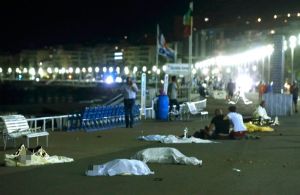
Nice-Attack-1

Aftermath of the 14 July 2016 Nice attack

It is difficult for those of us who lack the murderous impulse of the deluded and inadequate perpetrators of such recent horrors to obtain any empathetic understanding of them. But perhaps one obvious but important truth is that those who aspire to mutilate their fellow human beings are alienated from the communities that they live among, and from the values of the societies that they seek to terrorise.

If this is indeed the case then the necessary security measures which the governments of Europe are scrambling to put in place will be inadequate in addressing the underlying causes of this alienation. Furthermore if clumsily managed, security measures can exacerbate the situation, accentuating the sense of alienation of some who come to the attention of the security services and driving them into the ranks of the fratricidists who live amongst us.

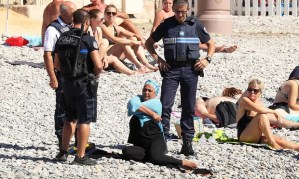
image

Not winning hearts and minds: French police force a burkini clad woman to strip

So what is needed, in addition to more police and intelligence operations to thwart aspiring killers, is a political response to the situation. It is difficult for an outsider to say specifically what measures would be necessary to counter the alienation of the communities from which the killers spring. But Europe could take a lesson from Irish history here.

In the dark days of the 1980s when the violence in the North of Ireland was taking on a permanent complexion in the absence of any credible political initiatives, the leader of the Social Democratic and Labour Party, John Hume, suggested the establishment of the New Ireland Forum as a means by which Irish leaders committed to non-violence could begin to plot a new political path towards a peaceful future. From these modest beginnings a new political process emerged which led, ultimately, to the Good Friday Agreement, and the first durable peace Ireland has seen in hundreds of years – at least until it has come under threat from the delusional aspirations of English nationalists to hack apart the European basis of this peace.

Following this lead the European Parliament should establish an inquiry into the causes of European jihadism and to propose political, economic and social responses to the alienation of the European communities from which this murderous jihadism springs. The inquiry should seek to take evidence not only from fellow politicians and academics, religious and community leaders, but also from ordinary people from all parts of Europe.

The evidence, as well as the analysis and conclusions from this inquiry should be published and European governments should be required to report on how they have responded to the recommendations.

Some measures to blunt the threat may be straightforward: people tend to be less likely to seek to destroy their society if they see plainly that the society is providing them with decent jobs and housing. Some measures may relate to addressing some of the chaos which certain European nations have helped create in the Middle East, such as establishing peace in Syria, Iraq, Palestine and Israel: Geography dictates that Europe simply cannot be at peace when the Middle East is in conflagration. Other initiatives may be more novel and unexpected.

The threat of violence that is posed is not yet an existential one for Europe. But it is a challenge to European values of pluralism, democracy, human rights and rule of law. If we cannot plot a political response to this violence that springs from and honours these values, then the arguments of the ideologues of bloodshed will be made a little stronger.

Ourselves Alone: How the Leave Campaigns repudiated rule of international law

Also published in Left Foot Forward http://leftfootforward.org/2016/07/ourselves-alone-how-brexiters-shrugged-off-international-law/

The late Tom Bingham, perhaps the most distinguished English jurist of his generation, noted that legal scholars trace the concept of rule of law back to Aristotle. However the concept is apparent, at least in nascent form, in Sophocles’ Oedipus the King written a century earlier. In this the king realises as his own investigation finds himself responsible for the plague on Thebes that he must be subject to his own earlier ruling on how the culprit should be held accountable.

img_0940

Tom Bingham

Bingham built on prior formulations of rule of law to argue that the idea had eight principles that were fundamental to it. These included that the law must afford adequate protection of fundamental human rights, and that the state must comply with its obligations in international law as in national law.

For hard Right ideologues, such as Michael Gove, Nigel Farage and Boris Johnson, such ideals of rule of law sit at odds with their own conception of the supremacy of Parliament as a fundamental of the unwritten British Constitution.

But generations of parliamentarians have never seen any conflict between rule of law and rule of parliament. So they have, over the past 40 years, set constraints on the unfettered power of parliament, notably in the form of the Human Rights Act, which is administered by the UK’s Supreme Court with appeal to the European Court of Human Rights, and the treaties that the UK freely entered into to obtain its membership of the European Union, which are overseen by the European Court of Justice.

So, when Gove, Johnson and Farage talked about taking back control during their poisonous and bloodstained campaign to take the UK out of the EU, what they were talking about was removing the constraints that derive from the treaty obligations which have provided the manifold benefits that arise from EU membership. Doubtless they were also thinking about national law, specifically the protections from government excesses afforded to citizens by the Human Rights Act.

It is axiomatic that a partnership like the European Union, indeed any international treaty with other nations, must introduce mutual responsibilities and ideally should have some independent body to oversee that the parties to the treaty comply. Otherwise the already fragile concepts of international rule of law become meaningless.

British experience of international rule of law during its colonial period was rather different to such contemporary expectations. It had little consideration of mutual benefits but rather had an altogether more lopsided aspect, with no recourse to independent arbitration or appeals to human rights for the colonial subjects whose exploitation enriched the UK to such an extraordinary extent.

This colonial perspective contributed greatly to the ludicrous myth of Britain standing alone during the Second World War. This myth insultingly overlooks the vital contributions made by Africans, Australians, Canadians, Indians, and Kiwis to the struggles against Nazism and Japanese militarism. This myth also gravely overlooks the horrendous cost that this entailed, most infamously in the Bengal famine of 1943.

But a theme running through the depressing debates relating to the UK’s EU membership in the run up to the referendum of 23 June 2016 was that the UK can still “stand alone”. This was underpinned by that weird continuing sense of colonial entitlement: that the UK should be allowed to cherry-pick what its relationship with the EU should be without any appreciation that UK membership should bring responsibilities not just privileges.

This attitude was copper-fastened by a careful cultivation of xenophobia by the Leave campaigns, and by a startling disregard for mere facts, from the true cost of EU membership to the actual provisions of EU treaties and the rights and obligations of member states under those treaties.

This wilful ignorance and misinformation to the UK electorate continues past the result of the referendum. On the morning of 27 June Boris Johnson declared, “The only change – and it will not come in any great rush – is that the UK will extricate itself from the EU’s extraordinary and opaque system of legislation: the vast and growing corpus of law enacted by a European Court of Justice from which there can be no appeal”.

Perhaps Johnson rarely lets facts get in the way of an opportunity to stoke the prejudices of his listeners. Perhaps he is merely supremely uninterested in facts. The European Court of Justice enacts nothing. It administers the body of law agreed by the European Parliament and the Council of Ministers, of which, to date, the UK has been an equal party.

It is too early to see what will be all the consequences of the UK’s repudiation of the EU. Perhaps this will sate the appetite of the ideologues of the Right for unfettered power if what comes to pass is a recession-hit Little England as Scotland prepares to steer its own course as a full and independent member of the EU.

image

A blind Oedipus led by his daughter Antigone

But it is unlikely. And the Human Rights Act remains for a while longer, another affront to the Tea Party-ist fantasies of a resurgent and exclusivist English nationalism. Gove or Johnson may like to eruditely comment, after Milton, that they prefer to rule in hell than serve in heaven as they seek to translate their peculiar Cromwellian version of Ourselves Alone into a new English polity.

Oedipus could not bear to look upon the devastation that he had wrought on his family and city so he tore out his own eyes. Today Gove, Farage, and Johnson look upon the wasteland that they have created of young people’s hopes for modest opportunities to study, work and fall in love amongst their fellow European neighbours, and they judge that it is good.

Barbarians at the Gate: reflections on the UK and European Union at the abyss

Many years ago I watched a documentary about the life and work of the campaigning American journalist I F Stone. Stone was for his whole life a fighter for justice and a fierce critic of the excesses of his own government, such as its encroachment on civil liberties, its systemic racism, and its illegal invasion of Vietnam.

And yet, when asked towards the end of the film what his overall judgement of his country was, Stone said something I found striking: he said, in effect, that he regarded the American Republic as one of the great flowerings of civilisation, comparable to Athens in the Golden Age.

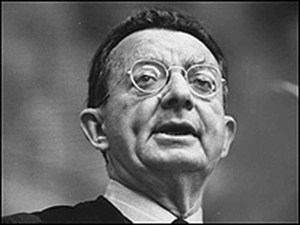
I F Stone

It was a carefully chosen analogy: Stone was also a classical scholar and author of The Death of Socrates. The Athens he contemplated would have been a warts-and-all one, constructed on the injustice of slavery and the subjugation of women, and party, on much too frequent occasion, to war crimes and mob-rule.

And yet in the midst of all this there were new ideas emerging in philosophy, science and the arts, and new politics, in one of the first human stirrings of democracy.

The United States’s bears similar scars to ancient Athens, it’s history marked by slavery and appalling racial prejudice, and by illegal war from Mexico and Nicaragua, to Vietnam and Iraq. But it is also the nation of Abraham Lincoln and Bobby Kennedy, of Harriet Tubman, Martin King and Dorothy Day. It was the country which in the 19th Century showed that democracy was a robust and viable system even in the face of dreadful civil war, and which has produced, like Athens, some of the greatest achievements of the age in science and art.

If it has a rival in the 21st century then I would argue it is the much younger European Union. Like the United States and Athens before it, and every human institution or undertaking before or since, Europe is a flawed, human project. In recent years we have seen one of its most abject failings in its fragmented and often craven efforts to establish a coherent and effective humanitarian policy in response to the refugee crisis in the Mediterranean.

And yet: the European Union represents as vital a political project as the United States. It too represents one of the great flowerings of human civilisation. It has brought enduring peace to a continent that has hitherto been scarred over the centuries by fratricidal war. It is an effort by democratic nations to work together on matters of common interest underpinned by the the principles of human rights, democracy and rule of law. That is a project that is rare in human history and rare in the contemporary world. It is also something that is essential to face the political, environmental, humanitarian and human rights challenges of this fragile and interconnected world. So, for all its flaws, this is a project that is worth fighting for, not running away from in search of some mythic past.

image

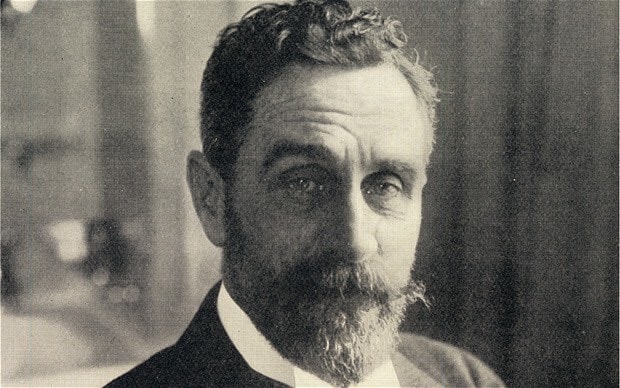
Jo Cox

As Jo Cox noted in her maiden speech to Parliament, migration, including the free movement of EU citizens amongst our member states, has immeasurably enhanced the communities and societies that have benefited from it, through a vibrant diversity in food, music and arts as well as business and commerce.

But this cosmopolitan vision of Europe is anathema to some who instead cling to the same nasty rhetoric that was once used to justify colonialism, but which now is put in the service of a poisonous xenophobic populism. This seeks to convince the electorate that the EU and migrants are to blame for social ills that have been the result of domestic policies and failures in government, sometimes perpetrated by the very people scapegoating others

History shows us that such rhetoric can open an abyss, which the UK descended into on the streets of Birstall on 16th June 2016. The assertions which followed rapidly from those pedalling intolerance, that the brutal assassination of Jo Cox had nothing to do with them, still ring hollow.

Jo Cox understood that the European Union, with all its human flaws and imperfections as well as its enormous potential and aspiration, was worth fighting for. And in the months and years following the awful, bloody UK referendum campaign the fate of the UK and the EU itself still seems to hang in the balance as incompetents and charlatans such as Boris Johnson and Jacob Rees-Mogg are treated like perspicacious philosopher-princes by the BBC and other pusillanimous media.

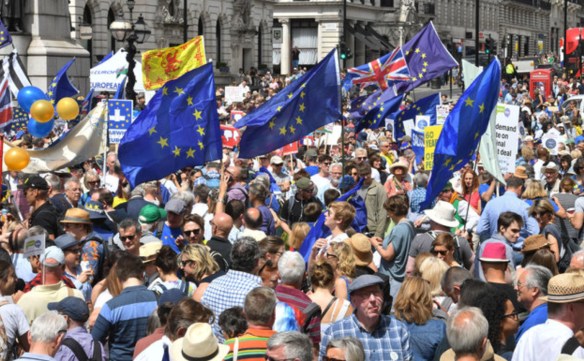
The decency that Jo Cox embodied has not been crushed by the narrow victory in the Brexit referendum of a coalition of racists, delusional imperial nostalgists, disaster capitalists, useful idiots of the Left, and a misled section of the populace. It continues to reassert itself, notably on the streets of London and Belfast on 20th Oct 2018.

Both the UK government, and their tame opposition under Jeremy Corbyn, seem intent on ignoring this demonstration of disgust for their policies by so many people. Instead they seem committed to their process that will eliminate the human and citizens’ rights of tens of millions of people and reek economic devastation in the name of their delusional dreams of Brexit. But they should be careful.

The people of India under Gandhi and Nehru, the African American community of the United States under Martin King, the nationalists of the North of Ireland under Hume and Mallon, showed that ultimately a determined people will, through non-violence, shape the political agenda. And when pan-European progressives achieve that in the UK, as they will, May, Corbyn, their acolytes and their clowns, will all be consigned to the dustbin of history.

178D02E0-0E07-4796-B85E-A0741D10C8B2.jpeg

People’s Vote March, London, 20th Oct 2018


Splendid Isolation? North Korean slavery – not as distant as you might think

There is much international human rights law in the world, and in its midst there is a significant body of law on slavery.

But in spite of all this slavery is still widespread across the world. This is so for a number of reasons. First slavery is still in many places legal.

It is effectively legal in Saudi Arabia. In Qatar and United Arab Emirates the Kafalah system provides a legal underpinning for the enslavement by migrant workers by private individuals. In Uzbekistan and Tajikistan state-sponsored forced labour, particular in the cotton harvest, is used for the enrichment of the elites. In the United Kingdom trafficking of overseas domestic workers has de facto been legalised.

Slavery is also deeply institutionalised in North Korea, and as with Uzbekistan and img_0794Tajikistan, it is used to sustain the privilege and power of that country’s elite.
But, while the world often sees North Korea as an isolated place, consideration of the issue of North Korean slavery shows that it is not nearly so much an isolated thing.

The 2015 United States Trafficking in Persons report notes that, “Chinese authorities continued to forcibly repatriate some North Korean refugees by treating them as illegal economic migrants, despite reports some North Korean female refugees in China were trafficking victims. The government detained and deported such refugees to North Korea, where they may face severe punishment, even death, including in North Korean forced labor camps. The Chinese government did not provide North Korean trafficking victims with legal alternatives to repatriation. The government continued to bar [United Nations High Commissioner for Refugees] access to North Koreans in northeast China; the lack of access to UNHCR assistance and forced repatriation by Chinese authorities left North Koreans vulnerable to traffickers. Chinese authorities sometimes detained and prosecuted citizens who assisted North Korean refugees and trafficking victims, as well as those who facilitated illegal border crossings”.

All of this is contrary to China’s obligations to protect victims of trafficking under the Palermo Protocol of which they are a signatory. China’s failure provides means for Chinese traffickers to coerce their victims with the threat of denunciation to the Chinese authorities. It further sustains the institutional practices of slavery in which North Korea indulges, by effectively enforcing North Korea’s policies beyond its borders.

I would caution the rest of the world from getting too judgemental about this too quickly though. Here we see China indulging in something that the rest of the world also does: erasing an inconvenient slavery problem by the simple assertion, made with great conviction, that it is not actually a problem of slavery. Suggest to any Home Office minister or official that the UK’s overseas domestic worker visa is a license to traffick, and you will see this process in action here.

And of course the complicity with North Korean slavery is not restricted to China. In November 2014 the journalist Pete Pattisson exposed in the Guardian how North Korea trafficked construction workers to Qatar for work on the diverse building projects there.

As I noted at the outset Qatar has legal mechanisms in place to facilitate the enslavement of vulnerable workers by private individuals. One of the consequences of this is that the 2022 World Cup is likely to be the bloodiest sporting event since Julius Caesar’s funeral games. That fact has not caused the repudiation of Qatar in any international forums.

What Pete’s journalism exposed however is one of the sources of hard currency that props up the North Korean dictatorship is from North Korea’s sale of its people internationally. And that again has not caused any sort of repudiation of Qatar or those countries which also avail of the cheap labour of trafficked North Koreans. In October 2015 the UN Special Rapportuer on Human Rights in North Korea estimates that 50,000 North Korean workers are employed in foreign countries, mainly in the mining, logging, textile and construction industries and that the number is rising.

The UN Special Rapporteur estimated that the vast majority are working in China and Russia but others are reportedly employed in countries including Algeria, Angola, Cambodia, Equatorial Guinea, Ethiopia, Kuwait, Libya, Malaysia, Mongolia, Myanmar, Nigeria, Oman, Poland, United Arab Emirates and, of course, Qatar. If North Korea obtains only $10,000 per worker per annum this traffick in human beings would be worth half a billion annually to the dictatorship.

A fundamental issue that we see in many slavery cases, and exemplified in relation to North Korea, is that it is an international issue and needs therefore to be tackled internationally. The importance of international law, and international rule of law is exemplified in relation to North Korea. I suspect that like the UK China’s equivalent of the ministerial code has no mention of international law and so ministers considering their policy in relation to North Korean refugees and victims of trafficking are able to lightly dismiss their human rights obligations and those under the Palermo protocol.

The case of North Korea also shows that slavery must become a central issue of diplomacy. The easy acquiescence that the international community has in the slavery practices of other countries, aside from its moral bankruptcy, is also now a security risk. If the North Korean elite were not obtaining hard currency from the international trafficking of its citizens it would be that much more difficult for the dictatorship to cling to power.

I wonder do many consumers consider the risk of North Korean forced labour in garments that they purchase from China. Whether they do or not again the issue of the enslavement of North Korean exposes the need for new international law. Franklin Roosevelt effectively ended child labour in the United States by banning its use in inter-state commerce. President Obama has taken a leaf from Roosevelt’s book in introducing powers to exclude slavery tainted sea-food from the US.

The European Union should follow suite and establish similar general powers that could be used against the import or any goods manufactured with the use of forced labour, including that for trafficked North Koreans. Such a measure would have repercussions through the entire global political economy by causing real economic threat to those countries that have come to routinely use forced labour of vulnerable workers.

We see much that is horrible and distressing when we look at the institutions of slavery in North Korea, including our own reflection: that of the rest of the world at best standing idly by, at worst benefiting.

That needs to come to an end, not merely with fine words, but with robust and clear sighted international action. I hope the UK, for as long as it is part of Europe, will begin to provide proper leadership on this and bring the authority of the world’s largest single market to bear on this vital human rights issue.

The problem with inequality

Previously published in Business Fights Poverty:

http://community.businessfightspoverty.org/profiles/blogs/dr-aidan-mcquade-inequality

top-1-percentThis week, Oxfam reported that the wealthiest 1% of the world’s population own more than the rest of us combined. Or, put another way that “… runaway inequality has created a world where 62 people own as much as the poorest half of the world’s population.

In his book, How to Speak Money, John Lanchester argues that such inequality emerges from a general consensus amongst policy makers, borne out by significant progress in the real world,  that permitting such inequality is the best way to reduce poverty due to the economic activity which it stimulates.

Which would be fine if inequality itself were not a considerable problem. A number of business theorists and economists have argued that to obtain sustainability, it is essential to seek growth “at the base of the pyramid”, ensuring that the most abjectly poor have a stake in the global economy. But there may be even more worrying threats emerging from inequality.

In 2014, a study funded by NASA found that the competition for resources and the stratification of society into “elites” and “masses” were key factors in the collapse of civilisations. Essentially, by the time the existential threat to a civilisation began to encroach upon the day-to-day lives of the “elites” to such an extent that they were inclined to do something about it, it was already too late.

Such is the existential threat that today’s mind-boggling level of inequality poses to the world. And the challenge for ending this is not merely a rational political or economic one. The realities of contemporary slavery show us that those privileged by unequal power relationships in society become profoundly attached to them in ways that are often quite irrational. For example, a considerable constraint on obtaining growth at the “base of the pyramid” is that of prejudice; many Indian shop keepers would benefit if abjectly poor Dalits and Adavasi had more disposable income to spend. However, many of the same shop keepers would be aghast at such ritually “unclean” people coming into their premises, no matter how much money they possessed.

Similarly, the prejudice against South Asian migrants to the Gulf States makes it next to impossible for the prejudiced to contemplate how such migrants might contribute to society if they were given decent work instead of being part of the Kafala system which enables their enslavement with impunity.

There are solutions to such prejudices: extension of the rule of law, outlawing discrimination, and educating children for mutual understanding and respect. Such steps will require considerable moral courage by our political leaders. And given that many of the global elite are probably in thrall to such prejudices and utterly unaffected by their consequences, it is rather unlikely that too many proposals to tackle inequality and prejudice will emerge from Davos this week. We can only hope that the voices of citizens from civil society and business alike protesting the threats that inequality poses for us all, will eventually pressure the political and economic elites of the world to finally, perhaps at some future Davos, take concerted action to create a fairer world.

Journalism and Slavery: Some issues in reporting forced and child labour today

Thomson Reuters Foundation, 16 Nov 2015

imageIt is rare these days to come across anybody who explicitly supports slavery. Certainly there are those perpetrators who would like you to believe that they are doing their victims a favour. But by and large the political and business elites of the world are united in their condemnation of slavery, and will uniformly express anguish at the thought of children and vulnerable workers being subject to the cruelties of traffickers.  However that apparent consensus masks a more complex reality.

Slavery is a profoundly political issue, both in that it is about power and exclusion from power, and in that it is a hugely contentious subject touching upon some of the most disputed areas of international law and policy.

Indeed some even contend that slavery is not a political issue at all, that it is merely a technical one, and principally one of law enforcement at that. This perspective seems to be a favoured one of the current British Government, the Catholic Hierarchy of England and Wales, and a few naive philanthropists. They seem to regard the ending of slavery as a relatively straightforward matter that requires evil people to be locked up by decent cops.

There are however some profound problems with that view. For a start it presumes that slavery is everywhere illegal. But this is a tenuous presumption.

For example many of you will be familiar with the reports of systematic use of forced labour in Qatar to build the infrastructure for the World Cup. Or some of you may have seen the BBC Newsnight report from 12 Nov in which an Indian domestic worker in Saudi Arabia described have her arm chopped off by her employer as a punishment. It should be noted that the Saudi authorities dispute her account, saying she lost her arm “trying to escape”, and in denying complicity in mutilation they confirm complicity in slavery.

At the root of both these systems of enslavement is what is called the Kafala system, which is a “sponsorship” system that ties workers to their employers to such an extent that even in the most abusive employment relationships, up to and including forced labour, the workers cannot change jobs or even leave the country to go home.

It is a cynical system to legally facilitate medieval levels of exploitation up to and including slavery across the entire Arabian peninsula.

It is also essentially the same system that the UK government has in place for migrant domestic workers to this country. The UK system of overseas domestic workers visas ties workers to employers to such an extent that it de facto legalises the trafficking for forced domestic servitude. Migrant domestic workers know that if they try to leave the employer to whom their visa is tied, irrespective of their treatment, they will minimally be risking impoverishment and unemployment, and are likely to be deported. And that places in the hands of unscrupulous employers an enormously powerful threat to hold over the head of any vulnerable worker hoping to improve their own life and that of their family through hard work.

In other words the cases of UK overseas domestic workers, and Arabian kafala show how too frequently the law, intentionally or otherwise, can be a means to facilitate enslavement.

Furthermore for law enforcement to be the only approach necessary to end slavery also presumes that genuine rule of law exists in a jurisdiction, rather than laws being regarded as merely suggestions to the elite. For example in India there is much decent anti-slavery law. And yet, corrupt police forces and overburdened court systems mean that such law is meaningless for those, such as Dalits and Adavasi, most vulnerable to slavery.

We saw this in the course of a piece of research that we did into forced and child labour in Indian garment manufacture. In this we spoke to children who worked in some of the garment workshops of Delhi. They told us that the only encounters they had with the police were when they were arrested and held as hostages to stop work because their employers had not paid the appropriate bribes.

In India there is also such limited labour inspection that it will never trouble those factory owners who enslave young women and girls to produce the cotton thread that doubtless forms a sizeable percentage of the garments we are each wearing this morning.

A few years ago I met a young woman journalist who was trying to write a positive story on the efforts to end the various forms of slavery in Indian textiles. She was threatened with arrest by the Indian police as an economic terrorist. I fear what sort of threats journalists or civil society in India would now face if they were to try to expose such abuses, given the increasing intolerance and clamp-downs on freedom of speech that Prime Minister Modi is enacting.

So: when you consider the contemporary manifestations of slavery and child labour across the world we see that an alternative perspective is necessary to the simplistic law enforcement one, one that recognises that slavery emerges in the opportunities for exploitation that are presented to unscrupulous individuals in national and international law and policy as it relates in particular to education and human development, employment, trade, migration and rule of law itself.

This perspective illuminates that there is much greater responsibility for slavery than evil criminal godfathers or unscrupulous business executives. Because slavery can only really thrive where governments fail to in their duties of promoting human development and protecting human rights.

A few weeks ago I was visiting cocoa-growing communities in Ghana. There the risk of child labour is exacerbated by the fact that too few of those communities have schools, and even if the kids get to school there is so little provision of vocational and entrepreneurial education for adolescents and young adults that many of them become vulnerable to trafficking for forced labour once they leave school, as they follow risky paths in search of scarce decent work.

And in India Prime Minister Modi intends to reduce factory inspections, and permit child labour as a means of reinforcing the caste system, amongst other so-called labour market reforms. Whatever Modi’s intention the consequence will be to make forced and child labour abuses much more likely across India and hence increase the likelihood that any goods or commodities produced there are tainted by slavery like practices.

In short: if, as journalists, you want to judge whether a government, or anyone for that matter, is actually against slavery it will require a deeper consideration of their policies and practices.

The UK government claims that it wishes to be a world leader in the struggle against slavery. And yet just this month Sir Simon McDonald, Permanent Secretary at the Foreign Office, said that human rights is no longer a priority in the Foreign Office, and instead was supplanted by the”prosperity” agenda.

We see that reflected in the warm embrace the British government has given to Prime Minister Modi and the prospect of trade deals with an India whose supply chains are rife with forced and child labour, and, even more bizarrely, with Saudi Arabia, who remain valued partners in spite of their systematic and entrenched practices of slavery, their intent to crucify a child for protesting for democracy, and their creation and sponsorship of DAESH, Islamic State.

Billy Connolly once said, ”Hypocrisy is the Vaseline of political intercourse”.

We see that clearly in relation to much of the contemporary political discourse on slavery, were many politicians and a few philanthropist crave the title “the new Wilberforce” after the British parliamentarian who obtained the abolition of the trans-Atlantic slave trade in the 19th Century. However, unlike Wilberforce, most of these lack the moral courage or clarity of thought to challenge the vested interests and the political-economic structures that enable so much contemporary slavery.

We see this hypocrisy also in relation to the poisonous immigration debate across Europe. We have seen how establishing safe migration for vulnerable workers is a key issue in ending trafficking. Both the Arabian kafala system and the UK’s systems of tied visas offer opportunities of legal migration to poor working people that are little more than supply channels for the provision of forced labour to traffickers.

But the discussions on safe international migration remain mired in xenophobic cant, which both confuses and is confused by the political discourse on trafficking.

At the height of the refugee crisis in the Mediterranean this summer, we heard the insistent descriptions by European politicians of those who were facilitating transport of refugees across the Mediterranean as “traffickers”. Trafficking, by definition, is the movement of people for the purposes of forced labour or sexual exploitation. It was very clear, very quickly from diligent reporters on the ground in the Mediterranean that what was going on was not trafficking but the facilitation of smuggling. It is true that once these refugees get to Europe that they will be highly vulnerable to traffickers. But this is at least as much because of the failure of Europe’s leaderships to establish safe and legal migration routes, as it is anything to do with the smugglers.

To this day journalists lazily pick up this language from government press releases and repeat it as if it were objective and neutral fact. I heard on the BBC Today programme just last week smugglers being referred to as traffickers. In doing so journalists play into the hands of those politicians who wish to disguise their inaction in the face of the moral imperative of this refugee crisis by the conflation of smuggling and trafficking. By obfuscating the issues they seek to buy political breathing space in the face of the mounting carnage. When faced with the horrors of the Mediterranean this summer, it was easier for politicians to make grand statements blaming migrant deaths on evil traffickers rather than doing their jobs by seeking the causes of the crisis and identifying more effective responses.

The idea of journalism as a Fourth Estate to hold the powerful to account is a foundational one in modern democratic society. But the powerful who benefit from slavery are not used to being held to account. Often they are used to wealth and respect within their own societies, and to warm receptions in international capitals as “partners in prosperity”. They have been protected in recent years first by the comforting myth that slavery was a thing of the past, and latterly by a new set of fairytales: such as the idea that all that is needed is better policing, or that a few cosy words between the rich and powerful are all that is necessary to uproot the entrenched systems of violence and prejudice that underpin contemporary slavery

imageThe ending of slavery needs many things. But it certainly needs courageous journalism to confront this nonsense and to expose to the scrutiny of citizens the realities of slavery in our contemporary world, and the power structures that underpin it.

Doing that may never be a popular job. But it is a vital one.

Good luck.

Torture, mass surveillance, and Dr Sheila Cassidy


Audacity to Believe, is Sheila Cassidy’s fine and moving memoir of her time as a young doctor working in Chile. During that time the US organised a bloody coup against the democratically elected president, Salvador Allende, which brought to power the despotism of Margaret Thatcher’s close friend, General Augusto Pinochet.

Cassidy was herself caught up in the terror that Pinochet unleashed upon his own country. After having treated a wounded rebel she was betrayed, arrested and tortured.

Cassidy is forensic in detailing what happened next, and her descriptions are chilling. She describes two sessions of electric shock torture to the most sensitive areas of her body. In the first session she made up a story about who put her in contact with the rebel she treated. Having wrung this story from her she was dressed and put in a car with the secret police who took her to check out her story. Having found it a farrago of lies they brought her back, stripped her naked again and resumed the torture. This time she broke and told her torturers everything they wanted to know.

There is a common practical, as opposed to moral, objection to torture, which is that, as Cassidy attested, a person being tortured will tell their torturer anything to get the torture to stop. So it is difficult to know what is true, and what is false. However as Pinochet was under no existential threat after he seized power the cowards and rapists of his secret police had plenty of time to check the stories of their thousands of victims and bring them back to the torture chambers if the original stories proved false.

In war, or under the proverbial ticking bomb situation where time is of the essence, it is considerably less likely that torturers would have the luxury to test the accounts of each of their victims. At least until now.

In his book The Finish, about the assassination of Osama Bin Laden, Mark Bowden provides some detail of how the information technology of US defence and intelligence services has advanced in the years since the slaughter of the 11th September attacks on the Twin Towers. The result of this is increased capacity for rapid analysis of data from mass surveillance and cross-checking of interrogations, including those obtained under torture. In other words we are moving into a world in which the intelligence and defence communities of the US, and much of NATO presumably, can render obsolete the practical objections to mass surveillance and torture.

 This is a distressing prospect for a number of reasons. As Mark Bowden has shown elsewhere, in his book Roadwork, the permitting of even limited provision for torture can lead to much wider acquiescence in it as a routine practice. This inevitably comes to ensnare the manifold innocent along with the fewer guilty, and can become a deep source of alienation from and resentment of the perpetrators. As the lessons of Abu Ghraib prison showed the violence of torture will inevitably give rise to the violence of insurrection, as torture not only corrodes the souls of the perpetrators and erodes any of their claims to moral superiority, but instills in its victims a burning desire for revenge.

We seem to be moving into a time when Orwell’s prediction of a permanent state of war is becoming true. In part this has arisen from a glib attitude amongst Western leaders towards war, an ignorance of the political contexts in which they have meddled and an abject failure to understand the political implications of the violence they have unleashed, which has included the incarceration, mistreatment and torture of thousands who have been swept up in these wars.

The erosion of practical constraints on torture increases the risk that in some future conflagration military and political leaders will be enticed by the promise of it delivering some easy tactical advantage. It is vital that they remember that one of the political implications of this form of violence is that it will sow dragon’s teeth that may blossom as armed men in years to come.

Jack Kennedy: Elusive Hero, by Chris Matthews

 Jack Kennedy said the reason that people read biography is to answer the question, “What was he like?” With this fine biography Chris Matthews tries to answer this basic question about JFK himself.

The result is an affectionate, though clear-sighted, biography of Kennedy charting his path from sickly second son of Joseph Kennedy Senior, to President of the United States. It is a short book, only 400 pages or so with equal weight to each chapter of his life, from his childhood to his presidency.

There are many bad things one can say about JFK, from his almost pathological womanising and frequently callous treatment of his wife, Jackie, to his stupid decision to support an invasion of Cuba at the Bay of Pigs, to his escalation of the US involvement in Vietnam and his acquiescence in the coup against, and assassination of, South Vietnamese President Diem.

 And yet… even when all this is considered there is a greatness about Kennedy which even the most damning assessments of him cannot deny. From his earliest days he displayed an extraordinary indomitability of spirit:  when his life was threatened by ill-health; when his PT boat was sunk by a Japanese ship and he displayed enormous fortitude in saving his crew; in his post war efforts in politics; and finally to his election to the Presidency. As President he showed himself on the right side of history and progress more often than not, introducing an economic stimulus to reduce unemployment, bringing the weight of the Presidency to bear in support of civil rights, and in a sustained focus on a nuclear test ban treaty as a first step in de-escalation of the arms race.

But Jack Kennedy’s historical greatness would be guaranteed by one thing: his comportment during the Cuban Missiles Crisis. As Bobby Kennedy noted, “if any one of half a dozen [others] were President the world would have been very likely plunged into catastrophic war,” a war that would have ended humanity.

 During this crisis, Kennedy faced down the hawks amongst his own advisers, rejecting their advice to immediately attack Cuba in favour of a more cautious naval blockade of the island. It has subsequently emerged that had he followed that advice it would have precipitated a nuclear war. As a result Jack Kennedy, the junior naval officer from the Pacific theatre of the Second World War, proved Clemenceau’s dictum, “War is too important to be left to the generals.”

Jack Kennedy saved the world. Shortly after the forces of reaction had him killed and then conspired to assassinate his character and historical achievements. But still there is this, as Chris Matthews puts it, “In the time of our greatest peril, at the moment of ultimate judgement, an American president kept us from the brink, saved us really, kept the smile from being stricken from the planet. He did that. He, Jack Kennedy.”

How to Speak Money: what the money people say – and what they really mean, by John Lanchester


 Sun Tzu, in the Art of War, argued that war was the most important issue in statecraft, because upon it rested the life and death of nations. But, John Lanchester suggests, economics, and economic policy, which affects the lives of every human being alive and those to come, must be a close second. In spite of this, economics is a remarkably inaccessible subject to most of the people who it so profoundly affects, its language so rarified as to be next to impossible for them to intellectually engage with.

Lanchester blames this on “reversification”, the complex and counter-intuitive nature of financial language. For example a “bailout” of the banks is pumping money into them; “credit” is actually debt; and so forth. So, Lanchester sets about reversing this reversification by providing a lexicon of some of the key economic and financial terms that are current in the contemporary political discourse.

Lanchester is an elegant and witty writer and this must rate amongst the most entertaining books on finance ever written.  Here, for example, is part of his explanation of “Nationalisation”: “[it] had entirely gone out of favour in most of the developed world until governments found they had to nationalise banks in order to save the financial system in 2008.” Or on “Student loans”: “A leading candidate for the next big thing to blow up the US, and perhaps the global, economy.” 

The importance of understanding the language of money is stressed in the book’s afterword. Here Lanchester outlines some of the challenges and dilemmas posed to social cohesion by the neo-liberal economics of much of the English speaking world. For example a neo-liberal approach appears to be the fastest way to create wealth at the expense of increasingly vast inequality. 

Amongst those who speak money and set financial policy in much of the world there is a consensus that this Thatcherite approach is the best model to follow and the growing inequality is the price that must be paid. That a recent study argued that inequality is a principle cause of the collapse of civilisations means that this should be a matter of considerably greater public and political discourse. It is not in significant part because the language of money excludes so many for entering the conversation. 

Lanchester himself expresses profound concern about the potential effects of inequality at the conclusion of the book. “When people say: ‘It can’t go on like this”, what usually happens is that it does go on like that, more extendedly and more painfully than anyone could possibly imagine; it happens in relationships, in jobs, in entire countries. It goes way past the point of bearability. And then things suddenly and abruptly change. I think that is where we are today.”

In providing a guide by which ordinary citizens can more readily engage in the politics of economics Lanchester has written an important book. Let’s hope enough people read it before the life and death of our current civilisation is decided by an elite who are too drunk on champagne and coked up to ever feel the effects of injustice or see the signs of crisis.