Abducting a General: The Kreipe Operation and SOE in Crete, by Patrick Leigh Fermor

 Patrick Leigh Fermor, legendary travel writer and Special Operations Executive officer, never published during his own lifetime this, his full account of the kidnap of General Kreipe in Crete in 1944. His junior SOE colleague Billy Moss did, with Leigh Fermor’s help. Ill Met by Moonlight was published in 1950 and made into a famous movie with Dirk Bogarde as Leigh Fermor.

However as Roderick Bailey points out in his foreword to this book, Billy Moss did not speak Greek and the Kriepe kidnapping was his first clandestine operation. So his account lacked understanding and appreciation of the Greek partisans with whom he fought.

Leigh Fermor’s account is therefore something of an apologia to pay proper tribute to the people upon whom he depended for his life during his years undercover in Crete. He notes towards the end of his account that, “There has been more than a hint in these pages of [the kindness and generosity of the Cretan people] and of that aspect of Cretan life which suddenly gives the phrase ‘Brotherhood in arms’ such meaning”.

It is this, rather than a desire to convey a “boy’s-own” adventure, which seems at the heart of this account. It is an account that is marked by a remarkable joie de vivre in spite of the harsh circumstances he describes, and the constant threat of death under which he lived. As such it contrasts interestingly with Eric Newby’s similarly themed, but altogether more melancholic, account of his time being sheltered by an impoverished Italian rural population while on the run from the Germans: Love and War in the Appenines.

Leigh-Fermor conceived of the kidnapping of the German commander in Crete as a bloodless operation, to prevent German reprisals against Cretan civilians. Originally he aimed to kidnap the brutal General Muller, but this plan was thwarted with Muller’s transfer and replacement with General Kreipe.

Leigh-Fermor went ahead with the plan anyway as a morale boosting exercise for the Cretan resistance, and to keep them distracted from shedding German blood and hence provoking fierce reprisals.

He almost achieved his bloodless coup, though his Cretan comrades were at one point compelled to leave the poor driver who had been captured with the General in an unmarked grave. And some months after the operation the Germans conducted a series of brutal reprisals anyway, which may, or may not have been linked to the kidnapping.

Given this, and the undertaking of the operation late in the war when Germany’s fate was all but decided the strategic value of the operation is open to question. But the courage and fortitude that it entailed is not, as Leigh Fermor’s account amply demonstrates. Abducting a General gives a fine insight into a little-known corner of the Second World War, prosecuted, in the main, by ordinary people at terrible cost.

The Grand Slave Emporium: Cape Coast Castle and the British Slave Trade, by William St Clair

Summary: an elegant and distressing exploration of a storehouse for a genocide 

A few months ago I visited Elmina Castle, a centre of Dutch slave trade on Ghana’s Atlantic coast. The tour of the castle started in the women slaves’ dungeons, overlooked by a balcony of the castle governor’s apartment, from which he would periodically select women to rape as they were paraded below.

From the stifling heat of the dungeons the tour eventually proceeds up to the wonderfully airy governor’s apartment and the officers’s quarters at the top of the castle, with spectacular views of the sea and the surrounding coast. The thought of such horrors in the midst of such beauty is profoundly unsettling.

The narrative journey that William St Clair follows in his book The Grand Slave Emporium goes in the opposite direction to the path tourists, pilgrims and penitents tread touring such castles. Starting with a consideration of the establishment of Cape Coast Castle, the centre of the British slave trade on the Ghana coast a few miles from Elmina, he proceeds to describe the lives of the various denizens of the slave castles, from the governors, through the officers to the soldiers and the women – wives, “wenches” and the Castle’s sexual slaves – to the human beings – the slaves for export – who provided the entire rationale for the existence of the hundreds of such castles along the African coast.

The picture he describes is one of banal evil as the pretentious functionaries of the Castle, dreaming of lives like that of that idealised slave trader, Robinson Crusoe, dehumanise and process their human livestock through the Door of No Return and onto the waiting slave ships.

The Door of No Return, Elmina Castle, Ghana

Over hundreds of years slavery devastated the African interior as wars and raids encouraged by the European powers kidnapped millions of people, many of them children, to feed the demand from the Americas for human beings who could and would be worked to death to produce cash crops, mostly for European markets.

It is one of the bleakest episodes in human history, echoing the holocausts of the 20th Century in the level of industialized organisation that was brought to bear on such an atrocity.

In spite of this compassionless bureaucracy of enslavement, moments of humanity and heroism do shine through: one person who had been enslaved through Cape Coast Castle, Quobna Ottobah Cogoano, eventually escaped and became a major anti-slavery campaigner at the end of the 18th Century. And David Richardson, an economic historian, estimated that the extra costs that slave ship owners incurred in order to discourage or defeat insurrections on the slave ships saved many hundreds of thousands of other Africans from having been enslaved.

The Grand Slave Emporium is an elegantly written, but profoundly bleak book. Nevertheless it is a necessary one. It shows humanity in its squalid complexity, and reminds us of how easily societies can, wholesale, descend into savagery while believing themselves to be the epitomes of refinement.

Fighting Slavery in the Midst of War

Remarks to Expert Group Meeting on the impact of armed conflict on people’s vulnerability to trafficking in persons, including sexual and labour exploitation
Amman, Jordan

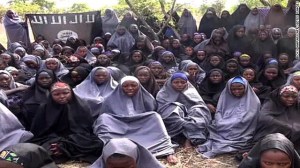
IMG_0669The repeated reports of Islamic State’s (DAESH) use of sexual slavery to entice foreign fighters and terrorise women and girls, and of Boko Haram’s kidnap of young girls in Nigeria and enslavement through forced marriage, has raised public awareness, and horror, regarding the issue of slavery and war.

Historically war has frequently been about slavery. Caesar made his wealth from the trafficking  of millions of Gauls. The trans-Atlantic slave trade was fed by the prisoners captured during wars provoked in Africa by the European powers. In Darfur and South Sudan slavery was used as a weapon to terrorise. Such violence remains a disgraceful aspect of war.

Over 2000 years ago Cicero noted that, “In times of war, the laws are silent,” because of the damage that war does to the institutions of state, and because it breaks the bonds of human restraint, as Shakespeare recognised, letting slip the dogs.

But it is useful to add a degree of gradation to Cicero’s observation, because not all times of war, or times of peace, are equal in their lawlessness.

First there is almost the absolute lawlessness that we see in the realm of active battlefronts and the rule of warlords.

Second there are those areas where war has severely damaged the capacity of the state and rule of law itself.

Third there are the armies of the democracies, which, even in war, should be bound by basic principles of law, even when in battle.

Then there is a further case, when the philosophy of law itself is intrinsically violent, misogynistic and anti-pathetic to human rights.

Under each of these circumstances there are differently constrained possibilities of action against trafficking and sexual violence. Certainly for there to be the greatest possibility for the elimination of such abuses there needs to be peace. But as we see surveying the world from Qatar to Western Europe peace alone is not enough, particularly if that peace is underpinned by brutal jurisprudence.

Sexual violence, like slavery, has always been an aspect of war. Sometimes rape has been raised to a level of policy, as was the case with, for example, the Russian conquest of eastern Germany in 1945, and is also the case in the realms of Islamic State (Daesh) today. This latter case should not be surprising given so much of the authoritarian culture and philosophy of violence of Daesh emanate from Saudi Arabia, a state in which rape victims are prosecuted and, in which, forced child marriage is widely tolerated. Such law and culture asserts that some sorts of violence, enslavement and trafficking, particularly of women and girls, are virtuous. It is from this jurisprudence that the slave markets of Boko Haram and Islamic State spring.

To put it bluntly, reducing violence against women and girls, particularly in the current wars waged by the proxies of Saudi Arabia, requires that their jurisprudence is explicitly and loudly repudiated, particularly as a priority for international diplomacy.

Until now neither the humanitarian nor development communities have in any significant way grasped the issues of slavery, trafficking or child labour. So they fail consistently to address them. There is a need for these sectors to recognise this, and to develop and implement training on slavery and trafficking for policy makers, including donors, and practitioners in these sectors.

Humanitarian assessments and peace-keeping planning should include components relating to trafficking analysis. And that should in turn lead to the enacting of measures to reduce the risks of trafficking for all, in particular women and girls. Furthermore all peace-keeping and humanitarian operations should have significant police or military police presence, with a mandate to investigate human trafficking and sexual violence, and with gender parity amongst such officers.

It should then be a requirement of every humanitarian response that it considers if it can contribute in any way towards the reduction of trafficking and violence in general and against women and girls in particular. This may not always be possible. But considering carefully the question could lead to the empowerment of some who would otherwise be overlooked.

The UK and California now require that companies report on what they are doing to end slavery in their supply chains. Development and humanitarian organisations should be required to follow suite, reporting on how they are seeking to combat this issue through their operations and supply chains. It should not be acceptable that, for example, the use of slavery-produced bricks should pass unconsidered and.unquestioned in humanitarian operations, when awareness of the issues and minor changes in humanitarian programming could establish much more ethical supply chains.

Elimination of slavery, trafficking and child labour is an explicit target in the Sustainable Development Goals. A long term solution to this is universal education, composed not only of reading, writing and arithmetic, but also human rights education, in particular in relation to  girls’ rights. Good vocational and entrepreneurial education is also needed so that greater options for decent work emerge from education. This would consequently reduce the level of attraction to nihilistic and misogynistic death cults, and will be an important path to recovery for children emerging from conflict.

But the immediate imperatives of trafficking and violence against women and girls in war demand urgent action. Humanitarian and development donors, policy-makers and practitioners must engage with these challenges.  Addressing the issue of trafficking in conflict, one of the most complex issues in the realm of anti-slavery, would help advance the overall struggle to end these human rights abuses. With that it would also help to reduce the poverty of people hitherto overlooked in the midst of war.

Journalism and Slavery: Some issues in reporting forced and child labour today

Thomson Reuters Foundation, 16 Nov 2015
imageIt is rare these days to come across anybody who explicitly supports slavery. Certainly there are those perpetrators who would like you to believe that they are doing their victims a favour. But by and large the political and business elites of the world are united in their condemnation of slavery, and will uniformly express anguish at the thought of children and vulnerable workers being subject to the cruelties of traffickers.  However that apparent consensus masks a more complex reality.

Slavery is a profoundly political issue, both in that it is about power and exclusion from power, and in that it is a hugely contentious subject touching upon some of the most disputed areas of international law and policy.

Indeed some even contend that slavery is not a political issue at all, that it is merely a technical one, and principally one of law enforcement at that. This perspective seems to be a favoured one of the current British Government, the Catholic Hierarchy of England and Wales, and a few naive philanthropists. They seem to regard the ending of slavery as a relatively straightforward matter that requires evil people to be locked up by decent cops.

There are however some profound problems with that view. For a start it presumes that slavery is everywhere illegal. But this is a tenuous presumption.

For example many of you will be familiar with the reports of systematic use of forced labour in Qatar to build the infrastructure for the World Cup. Or some of you may have seen the BBC Newsnight report from 12 Nov in which an Indian domestic worker in Saudi Arabia described have her arm chopped off by her employer as a punishment. It should be noted that the Saudi authorities dispute her account, saying she lost her arm “trying to escape”, and in denying complicity in mutilation they confirm complicity in slavery.

At the root of both these systems of enslavement is what is called the Kafala system, which is a “sponsorship” system that ties workers to their employers to such an extent that even in the most abusive employment relationships, up to and including forced labour, the workers cannot change jobs or even leave the country to go home.

It is a cynical system to legally facilitate medieval levels of exploitation up to and including slavery across the entire Arabian peninsula.

It is also essentially the same system that the UK government has in place for migrant domestic workers to this country. The UK system of overseas domestic workers visas ties workers to employers to such an extent that it de facto legalises the trafficking for forced domestic servitude. Migrant domestic workers know that if they try to leave the employer to whom their visa is tied, irrespective of their treatment, they will minimally be risking impoverishment and unemployment, and are likely to be deported. And that places in the hands of unscrupulous employers an enormously powerful threat to hold over the head of any vulnerable worker hoping to improve their own life and that of their family through hard work.

In other words the cases of UK overseas domestic workers, and Arabian kafala show how too frequently the law, intentionally or otherwise, can be a means to facilitate enslavement.

Furthermore for law enforcement to be the only approach necessary to end slavery also presumes that genuine rule of law exists in a jurisdiction, rather than laws being regarded as merely suggestions to the elite. For example in India there is much decent anti-slavery law. And yet, corrupt police forces and overburdened court systems mean that such law is meaningless for those, such as Dalits and Adavasi, most vulnerable to slavery.

We saw this in the course of a piece of research that we did into forced and child labour in Indian garment manufacture. In this we spoke to children who worked in some of the garment workshops of Delhi. They told us that the only encounters they had with the police were when they were arrested and held as hostages to stop work because their employers had not paid the appropriate bribes.

In India there is also such limited labour inspection that it will never trouble those factory owners who enslave young women and girls to produce the cotton thread that doubtless forms a sizeable percentage of the garments we are each wearing this morning.

A few years ago I met a young woman journalist who was trying to write a positive story on the efforts to end the various forms of slavery in Indian textiles. She was threatened with arrest by the Indian police as an economic terrorist. I fear what sort of threats journalists or civil society in India would now face if they were to try to expose such abuses, given the increasing intolerance and clamp-downs on freedom of speech that Prime Minister Modi is enacting.

So: when you consider the contemporary manifestations of slavery and child labour across the world we see that an alternative perspective is necessary to the simplistic law enforcement one, one that recognises that slavery emerges in the opportunities for exploitation that are presented to unscrupulous individuals in national and international law and policy as it relates in particular to education and human development, employment, trade, migration and rule of law itself.

This perspective illuminates that there is much greater responsibility for slavery than evil criminal godfathers or unscrupulous business executives. Because slavery can only really thrive where governments fail to in their duties of promoting human development and protecting human rights.

A few weeks ago I was visiting cocoa-growing communities in Ghana. There the risk of child labour is exacerbated by the fact that too few of those communities have schools, and even if the kids get to school there is so little provision of vocational and entrepreneurial education for adolescents and young adults that many of them become vulnerable to trafficking for forced labour once they leave school, as they follow risky paths in search of scarce decent work.

And in India Prime Minister Modi intends to reduce factory inspections, and permit child labour as a means of reinforcing the caste system, amongst other so-called labour market reforms. Whatever Modi’s intention the consequence will be to make forced and child labour abuses much more likely across India and hence increase the likelihood that any goods or commodities produced there are tainted by slavery like practices.

In short: if, as journalists, you want to judge whether a government, or anyone for that matter, is actually against slavery it will require a deeper consideration of their policies and practices.

The UK government claims that it wishes to be a world leader in the struggle against slavery. And yet just this month Sir Simon McDonald, Permanent Secretary at the Foreign Office, said that human rights is no longer a priority in the Foreign Office, and instead was supplanted by the”prosperity” agenda.

We see that reflected in the warm embrace the British government has given to Prime Minister Modi and the prospect of trade deals with an India whose supply chains are rife with forced and child labour, and, even more bizarrely, with Saudi Arabia, who remain valued partners in spite of their systematic and entrenched practices of slavery, their intent to crucify a child for protesting for democracy, and their creation and sponsorship of DAESH, Islamic State.

Billy Connolly once said, ”Hypocrisy is the Vaseline of political intercourse”.

We see that clearly in relation to much of the contemporary political discourse on slavery, were many politicians and a few philanthropist crave the title “the new Wilberforce” after the British parliamentarian who obtained the abolition of the trans-Atlantic slave trade in the 19th Century. However, unlike Wilberforce, most of these lack the moral courage or clarity of thought to challenge the vested interests and the political-economic structures that enable so much contemporary slavery.

We see this hypocrisy also in relation to the poisonous immigration debate across Europe. We have seen how establishing safe migration for vulnerable workers is a key issue in ending trafficking. Both the Arabian kafala system and the UK’s systems of tied visas offer opportunities of legal migration to poor working people that are little more than supply channels for the provision of forced labour to traffickers.

But the discussions on safe international migration remain mired in xenophobic cant, which both confuses and is confused by the political discourse on trafficking.

At the height of the refugee crisis in the Mediterranean this summer, we heard the insistent descriptions by European politicians of those who were facilitating transport of refugees across the Mediterranean as “traffickers”. Trafficking, by definition, is the movement of people for the purposes of forced labour or sexual exploitation. It was very clear, very quickly from diligent reporters on the ground in the Mediterranean that what was going on was not trafficking but the facilitation of smuggling. It is true that once these refugees get to Europe that they will be highly vulnerable to traffickers. But this is at least as much because of the failure of Europe’s leaderships to establish safe and legal migration routes, as it is anything to do with the smugglers.

To this day journalists lazily pick up this language from government press releases and repeat it as if it were objective and neutral fact. I heard on the BBC Today programme just last week smugglers being referred to as traffickers. In doing so journalists play into the hands of those politicians who wish to disguise their inaction in the face of the moral imperative of this refugee crisis by the conflation of smuggling and trafficking. By obfuscating the issues they seek to buy political breathing space in the face of the mounting carnage. When faced with the horrors of the Mediterranean this summer, it was easier for politicians to make grand statements blaming migrant deaths on evil traffickers rather than doing their jobs by seeking the causes of the crisis and identifying more effective responses.

The idea of journalism as a Fourth Estate to hold the powerful to account is a foundational one in modern democratic society. But the powerful who benefit from slavery are not used to being held to account. Often they are used to wealth and respect within their own societies, and to warm receptions in international capitals as “partners in prosperity”. They have been protected in recent years first by the comforting myth that slavery was a thing of the past, and latterly by a new set of fairytales: such as the idea that all that is needed is better policing, or that a few cosy words between the rich and powerful are all that is necessary to uproot the entrenched systems of violence and prejudice that underpin contemporary slavery
imageThe ending of slavery needs many things. But it certainly needs courageous journalism to confront this nonsense and to expose to the scrutiny of citizens the realities of slavery in our contemporary world, and the power structures that underpin it.

Doing that may never be a popular job. But it is a vital one.

Good luck.

The Greatest Game Ever Played – A movie even for those who, quite rightly, hate golf

imageAs I write Shia LaBoeuf is, as a work of performance art, watching all his movies, back-to-back, in reverse chronological order. Which means that towards the end of this marathon feat of endurance through his sometimes terrible ouvere, he is rewarded with at least one good movie – The Greatest Game Ever Played.

Directed by the actor Bill Paxton, The Greatest Game Ever Played, is based on the true story of the of the 1913 US golf open. But it is a film that is about much more than an extra-ordinary game of golf. The film also deals directly with the class tensions of the early twentieth century and touches upon the profound anti-Catholic prejudices of both the British and American establishments. But at heart the film is about that perennial favourite of triumph against the odds.

imageThe acting is exemplary throughout. Stephen Dillane is excellent as usual as the great British golfer Harry Vardane. Josh Flitter, as a ten year old caddy, steals every scene in which he appears. But the revelation of the movie is Shia LaBoeuf: After a career which to that point had been principally marked by his slap-stick performances in the children’s programme “Even Stevens”, and which subsequently has been marked with poor movie choices and increased eccentricity, LaBoeuf delivers a disciplined, dignified and highly sympathetic performance as a working class Franco-Irish kid fighting his way through the prejudices of the New England WASP establishment.

An old fashioned movie in the best sense of the word: fine acting, clear directing and a great story that grips to the end – the final scene an affectionate nod to Casablanca is just one of the many pleasures that fill a great movie.

Perhaps, as he watches this, Shia LaBoeuf may reflect on the considerable promise he showed as a younger actor, and reflect that it is never too late to be what you might have been.

Anti-Slavery International remains a voice of moral courage in the world

Speech to Annual General Meeting of Anti-Slavery International, 2015

It is an honour and a pleasure to be here once again at Anti-Slavery’s Annual General Meeting, which I think must be our 176th.

imageThis past year in the UK much of the focus of our work has been on on the Modern Slavery Act, and the repercussions of that still occupy us. But it is worth remembering that when the government first published its draft bill it was straightforward criminal justice measure, and an underwhelming one at that. There was no mention of forced labour in business supply chains and nothing on victim protection, both ideas which the government was vocally contemptuous of at the outset. As a result of diligent work by Anti-Slavery staff with our allies in civil society and in parliament this was changed. But the positive measures that we and our allies pressed the government into including in that Act were but a portion of our achievements last year.

For example:

• we helped establish a new organisation exposing slavery and forced labour in Thailand, something for which Anti-Slavery has been very warmly recognised in the region;

• we were instrumental in the development of a law in Senegal providing the basis for State regulation of Qur’anic schools and prohibition of forced child begging;

• we expanded our Migrant Domestic Work Programme both to Bangladesh and India; and

• we published guidance for practitioners on trafficking for forced criminality.

This is a considerable breadth of achievement and the breadth of our work and ambition continues,

• ranging from our transparency in supply chains work emerging not only from our work on the Modern Slavery Act, but also from our continuing work to end child labour in cocoa supply chains in West Africa and from the light we helped shine on the slavery abuses in the Thai fishing industry; to

• our continuing work to help end bonded labour in India’s brick kilns, to

• our ongoing demonstrations in West Africa and Nepal of the importance of education as a means of breaking the transmission of slavery across generations.

These add to a body of achievements over the past five years that have included decisive contributions to changing national and international law, exposure of slavery across the world and empowerment of slavery affected communities.

I think it is worth reflecting upon this body of achievements, taken together, for a moment. First of all none of this would have been possible without the steadfast backing of the organisation by members and supporters over these years, and I would like to take the opportunity to convey my heartfelt thanks for this.

Second, as you will all be aware, these past five years have not been the easiest in Anti-Slavery’s history. Among other things this is because of the difficulties in the external environment, and because we have looked at a world in which millions of children, women and men are enslaved, we have found that unacceptable. So, rather than rest on our laurels, we have chosen to strive to do more to end it, something that brings with it more work, and increased struggle.

As our strategy makes plain, Anti-Slavery was founded to end slavery and we remain the vital organisation that is instrumental in doing that.

I recall when I was being interviewed for this job I mentioned how important I thought it was for poverty reduction that slavery should be eradicated. And this is an issue on which Anti-Slavery has been publicly campaigning since 2007. That it is now recognised as such in the Sustainable Development Goals is, I believe, a singular achievement and not one that would have been obtained without Anti-Slavery’s pressure through long years when we were a lone voice on the issue. As late as November 2013 I was being told by senior figures in some of the newer anti-slavery organisations that such a thing was unachievable.

And yet we achieved it.

Earlier this year I had the honour of being invited to speak at the annual gathering at Westminster Abbey in commemoration of Thomas Clarkson. It was a memorable occasion for me in that it brought together not just Clarkson’s relatives but also Buxtons and descendants of Wilberforce, with myself, and Reggie Norton and Klara Skrivankova representing Anti-Slavery.

It led me to reflect on the reasons we remember with warmth and admiration Clarkson, and Wilberforce, and Buxton, and Equiano, and Lincoln, and Morell, and Casement.

For example in the film The Ladykillers the filmmakers called the little old lady “Mrs Wilberforce” because they wanted the audience to understand that she represented the very best of British society.

But this belovedness was not always the case. The leaders in the struggle against slavery were hated by many in their day because of the choices they made to try to obtain a more just society: Clarkson’s life was threatened, Lincoln was assassinated; Morrell’s health was broken doing hard labour in prison; Casement was the last knight of the realm to be executed for high treason.

But the reason why we remember them still, the reason they were on the right side of history, is that they displayed that very rare quality of moral courage: they were prepared to stand alone in the face of the received political and economic wisdom and the prevailing social attitudes and pressures and put their names to the assertion that, “The world is unjust because humans have made it so. And if we make different moral and political choices, as we must do, that we can change that.”

Anti-Slavery continues to be that voice of moral courage in the contemporary world. That doesn’t always make us popular. It often demands hard choices and difficult decisions. But it is that moral courage that has led to the achievements that we have spoken of this evening and the ones that we will speak of in years to come.

Many of the vested interests who benefit from slavery across the world would love us to go away, or to acquiesce in the comforting myth that the only thing that is now needed to end slavery is for decent cops to lock up evil criminals.

But we cannot go away, we will not go away so long as slavery remains a blight on our human society because of the way humans with power have structured law and policy, nationally and internationally. We will continue to add our voice to those of our comrades across the world struggling to end slavery in their own countries and communities.

At the close of 2015 we can say we have forced the issue of slavery back onto the international development agenda. Now comes the hard part: turning that line in a UN document into a programme of international action.

So long as we endure our supporters and members can be confident that this is what we will be working for, no matter what obstacles are thrown in our path.

Torture, mass surveillance, and Dr Sheila Cassidy


Audacity to Believe, is Sheila Cassidy’s fine and moving memoir of her time as a young doctor working in Chile. During that time the US organised a bloody coup against the democratically elected president, Salvador Allende, which brought to power the despotism of Margaret Thatcher’s close friend, General Augusto Pinochet.

Cassidy was herself caught up in the terror that Pinochet unleashed upon his own country. After having treated a wounded rebel she was betrayed, arrested and tortured.

Cassidy is forensic in detailing what happened next, and her descriptions are chilling. She describes two sessions of electric shock torture to the most sensitive areas of her body. In the first session she made up a story about who put her in contact with the rebel she treated. Having wrung this story from her she was dressed and put in a car with the secret police who took her to check out her story. Having found it a farrago of lies they brought her back, stripped her naked again and resumed the torture. This time she broke and told her torturers everything they wanted to know.

There is a common practical, as opposed to moral, objection to torture, which is that, as Cassidy attested, a person being tortured will tell their torturer anything to get the torture to stop. So it is difficult to know what is true, and what is false. However as Pinochet was under no existential threat after he seized power the cowards and rapists of his secret police had plenty of time to check the stories of their thousands of victims and bring them back to the torture chambers if the original stories proved false.

In war, or under the proverbial ticking bomb situation where time is of the essence, it is considerably less likely that torturers would have the luxury to test the accounts of each of their victims. At least until now.

In his book The Finish, about the assassination of Osama Bin Laden, Mark Bowden provides some detail of how the information technology of US defence and intelligence services has advanced in the years since the slaughter of the 11th September attacks on the Twin Towers. The result of this is increased capacity for rapid analysis of data from mass surveillance and cross-checking of interrogations, including those obtained under torture. In other words we are moving into a world in which the intelligence and defence communities of the US, and much of NATO presumably, can render obsolete the practical objections to mass surveillance and torture.

 This is a distressing prospect for a number of reasons. As Mark Bowden has shown elsewhere, in his book Roadwork, the permitting of even limited provision for torture can lead to much wider acquiescence in it as a routine practice. This inevitably comes to ensnare the manifold innocent along with the fewer guilty, and can become a deep source of alienation from and resentment of the perpetrators. As the lessons of Abu Ghraib prison showed the violence of torture will inevitably give rise to the violence of insurrection, as torture not only corrodes the souls of the perpetrators and erodes any of their claims to moral superiority, but instills in its victims a burning desire for revenge.

We seem to be moving into a time when Orwell’s prediction of a permanent state of war is becoming true. In part this has arisen from a glib attitude amongst Western leaders towards war, an ignorance of the political contexts in which they have meddled and an abject failure to understand the political implications of the violence they have unleashed, which has included the incarceration, mistreatment and torture of thousands who have been swept up in these wars.

The erosion of practical constraints on torture increases the risk that in some future conflagration military and political leaders will be enticed by the promise of it delivering some easy tactical advantage. It is vital that they remember that one of the political implications of this form of violence is that it will sow dragon’s teeth that may blossom as armed men in years to come.

Dictator, by Robert Harris

 Dictator is the final volume in Robert Harris’ fictionalised three-volume biography of Cicero, covering the years up to his death and with it that of the Roman Republic.

Cicero did have a biography written by his secretary Tiro, the inventor of one of the first systems of short-hand which still echoes into contemporary English, for example, e.g. Fortunately for Harris, that biography has been lost to history, so he has constructed his own trilogy as if it were Tiro’s biography of Cicero, with Tiro as narrator.

As with the previous two volumes of the trilogy, Imperium and Lustrum dealing with earlier phases in Cicero’s career, Dictator is a gripping political thriller, covering the period from Cicero’s exile to the downfall of the Republic with the establishment of the second triumvirate of Antony, Lepidus and Octavian.

 Contrary to Goldsworthy’s Caesar, or Massie’s fictionalised accounts of the period, with Harris Cicero is presented as a hero, albeit a flawed one, a proponent of rule of law against arbitrary and tyrannical rule in spite of personal threats and the moral cowardice of his contemporaries.

Unlike Goldsworthy who typically tries to explain his subjects in the contexts of their own time, Harris deliberately seeks parallels with the present. Here he presents a warning for a polity that disdains basic principles of rule of law.

But, Harris does not allow the vital political-philosophical points to interrupt the narrative, which is gripping, as Cicero with only logic and argument in the face of shocking violence seeks to maintain constitutional principles in the face of the vanity of warlords.

The result is a fine political thriller, with much to recommend it for the student of the ancient world.

The UK Modern Slavery Act and the continuing constraints on forced labour eradication

The first thing to say is that the Modern Slavery Act is a decent law with some very important provisions: the measures on victim protection, particularly of children, and the transparency in supply chain clause both represent significant steps forward in government understanding of and action on combating the realities of contemporary slavery.

Of course, as with any law or policy, particularly anti-slavery measures across the world, the challenge is in implementation. And this is where it gets difficult, because, of course, this law does not exist in isolation but in the wider context of national and international law and policy.

Slavery occurs at the conjunction of three factors: individual vulnerability, usually, but not exclusively as a result of poverty; social exclusion; and failure of rule of law. So it is a truism to say that anyone can be enslaved. Generally speaking those who are enslaved are poor people who come from communities that the wider society does not particularly like: Dalits and Adavasi in South Asia, for example, or migrants in Europe.

Understanding that, we see that the cataclysm of war that the West has exported to the Middle East has rendered millions more people, both in the camps and those who have made it to the shores of Europe, vulnerable to slavery. It matters not that the government has spent much of the summer disingenuously describing the phenomenon of refugee flight as trafficking. It is the failure of Europe to establish safe migration routes in the context of a coherent humanitarian and security policy that renders these people vulnerable to slavery, not those in Libya or Turkey who cynically rent or sell those refugees dangerous boats. And let me remind everyone, safe legal migration routes are strategies to prevent trafficking. It is lack of safe migration routes to the gulf states that presents us with the prospect of seeing the 2022 World Cup in Qatar brought to us by the enslavement of tens of thousands of South Asian migrant workers and the manslaughter of thousands more. Qatar front page

The risks are of course exacerbated by the rising tide of xenophobic rhetoric that is being bandied about in this country and in other parts of Europe. I may be idealistic but I still believe it is the duty of politicians to demonstrate moral courage in leadership, not to pander to the prejudices of the ignorant. That path leads only to rising tides of hatred which, in turn, make it easier for traffickers to enslave and exploit vulnerable migrant workers, secure in the knowledge that national political leaders in the countries in which traffickers operate have told their compatriots to resent and fear migrants as sources of all their woes.

And these are not the only obstacles that the effective national anti-slavery strategy in the UK faces.

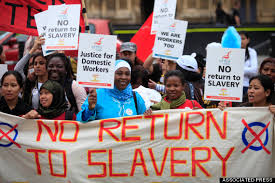
domestic worker protestThere is of course the Overseas Domestic Worker visa which in remains a government-issued license for trafficking for domestic servitude to the UK.

Then there is limited labour inspection in the UK with the remit of the Gangmasters’ Licensing Authority restricted to food and agriculture, with other risky industries such as construction, catering, cleaning, hospitality, care and, of course, and perhaps most seriously, domestic work, uninspected. Even with the guidance of the Modern Slavery Act it is difficult to see how the police can compensate for this lack of inspection, when, apart from a few outstanding specialist units, they lack a culture of slavery awareness.

And, even if they had one, it is difficult to see how they will fulfil all the anti-slavery expectations of the government given the prospect of eye-watering cuts to the police that we are being warned about.

The conflation of labour inspection and immigration patrols that is being mooted around the new UK Immigration bill threatens to worsen the situation even further. Such an arrangement would effectively break trust between potential victims of crime and the inspectors who, if the history of the UK Borders Agency involvement in anti-trafficking work is anything to go by, would prioritise the deportation of trafficking victims, who would also, by the way be witnesses to crime, over their recognition, protection and rehabilitation.

It is in this context that we should also understand the government’s antipathy to the Human Rights Act and the European Court of Human Rights. Nothing upsets the PR bandwagon like a judgement against a country for failure in its human rights obligations. In the past the UK has been held to account in the Court over its failures in anti-slavery law and policy, notably the case of CN versus the United Kingdom in 2012. Given some of the wrong-headedness of UK policy relating to slavery, even with the Modern Slavery Act on the statue books, I would anticipate it will be held to account again if it remains subject to its jurisdiction.

But while it may feel politically expedient to evade this possibility the UK pulling out of the Court will be a signal to other countries, with less robust institutions and shallower human rights traditions, that the UK, one of the moving forces behind the Council of Europe, itself a legacy of Winston Churchill’s vision, now regards key ideals of international rule of law as optional. In such a future mistaken, ill-advised, racist or just plain stupid government behaviour across Europe on the issue of slavery in particular, and human rights in general, could go unchecked if other countries follow the UK’s example.

The government will of course counter that a British Bill of Rights will provide proper protections, at least to people living here. But cuts to legal aid will make into a forlorn hope any recourse to the courts for remedy in the face of bureaucratic incompetence or official indifference.

The UN Guiding Principles on Business and Human Rights argue that businesses have the responsibility to respect human rights and that governments have the responsibility to protect them. It is of course difficult for business to respect the rights of workers if governments are not doing their job of protecting them. This was a matter that compelled UK businesses to seek the transparency in supply chain clause in the Act. I hope that the reports of businesses will not limit themselves to accounts of the management measures they have introduced in order to counter risks of trafficking in their supply chains. I hope the reports will also, as I have attempted to do here, enumerate the law and policy failings in the states in which they are working that increase risks of human trafficking. Because it is a fundamental truth of contemporary politics that the voice of business carries greater weight than that of conscience. With that great power comes a responsibility for business to use its voice to help set out the laws, policies and practices that are necessary to eliminate slavery in their supply chains and, ultimately, in the world.

This goes to the heart of the matter. The elimination of slavery is a political issue. It is not a simple criminal justice challenge or a matter that can be resolved by giving material things, like mosquito nets or vaccines, to people who don’t have things. Those who are enslaved are excluded from power in part so they can be enslaved. So in addition to the national and European issues of government policy and law that I have set out that are essential to effective anti-slavery practice domestically, there are a range of measures in diplomacy and international education, aid and trade policy that are necessary if the UK is to truly provide a leading voice in the struggle against slavery in the world today.

The Modern Slavery Act is an important measure and let me it is a tribute to the good work of Karen Bradley, the minister responsible for bringing this law into existence. I hope people of conscience in the government, in parliament and beyond will recognise this and work to build a more comprehensive anti-slavery system rather than dismantle the foundations that have barely been laid.

Which side are you on? Ending caste-based apartheid in South Asia to end poverty

Manual scavengers in South Asia are Dalits enslaved to clean up other people's shit Manual scavengers in South Asia are Dalits enslaved to clean up other people’s shit

The issue of caste based discrimination is fundamental to the wider question of slavery eradication: it is technically true that anyone can be enslaved, particularly if they are caught up in the cataclysms of war. But that truism masks a more fundamental truth: that the weak who are subject to the prejudices of others are the ones who are vastly more at risk of enslavement: migrants in Western Europe and the Americas; women and children everywhere; Dalits and Adavasi in South Asia.

South Asian apartheid based on caste has provoked surprisingly little international fury over decades in comparison to the more infamous South African version. Both systems confer economic advantage to some based on the human rights abuses of millions of other human beings. But, in comparison to South African apartheid, the South Asian variety is considerably less renowned in significant part because it is less well understood. The ignorance of the rest of the world insulates it from the anger that it should provoke. And we in the North are rewarded for that ignorance with lucrative trade deals many involving forced labour using industries providing cheap goods and commodities to our high streets. For example it is still probable that everyone reading this in the global North is wearing at least one garment that has been tainted with the forced labour of Dalit and Adavasi girls and young women.

So it may be understandable why the bulk of citizens are ignorant of these issues and so have not raised their voices in protest at caste based apartheid in South Asia. But it is not excusable that development and anti-poverty organisations remain so circumspect. There are honourable exceptions of course such as Christian Aid and Action Aid, but the disinterest of the wider community is striking.

Brick kilns across northern India, Pakistan and Nepal enslave Dalit men, women and children to work in them Brick kilns across northern India, Pakistan and Nepal enslave Dalit men, women and children to work in them

I would contend that the blissful ignorance of this issue that many anti-poverty and development organisations affect will prove less tolerable over the coming years. The Sustainable Development Goals, while not explicit on the issue of caste, are explicit in their recognition of the importance of inclusivity to achieve effective development and the need for slavery-eradication in order to obtain poverty reduction and a sustainable economy. National and international NGOs alike must recognise that both these Goals imply that poverty reduction is a political issue requiring fundamental changes in the contemporary status quo. As such they bump up against the prejudices and pretensions of the privileged, most significant the caste based prejudices of the elites of South Asia with the resultant consequences for hundreds of millions of the world’s poorest people.

Unless we recognise these political dynamics at play in our contemporary world we will never grasp the sort of political pressures and processes that will be necessary to change the laws, policies and customs that are still used to subjugate others.

The Kafala system of the Arabian peninsula, which provides employers there the right to unilaterally change terms and conditions of employees, and prevents employees from changing employers or even returning home, is used to provide the legal basis for the enslavement of South Asian migrants. It positively rewards political elites who indulge their prejudices against South Asian migrant workers by enslaving them, including for the World Cup construction in Qatar. In South Asia itself the rule of law does not extend to hundreds of millions of Dalits and Adivasi and hence the powerful are able to enslave them with impunity.

Different political economic models are unappealing to the elites in these situations because they would involve treating those they disdain with decency and recognition of our common humanity.

So changing these political economies requires national and international political pressure. And yet Qatar and Dubai remain valued trading partners with Europe. And the United Kingdom so values its relationship with Saudi Arabia that it doesn’t allow its enthusiasm for the enslavement of migrant workers, its creation and sponsorship of DAESH, the Islamic State, its addiction to the decapitation of human beings, or its intent to crucify a child who protested in favour of democracy, to prevent it from supporting Saudi Arabia’s membership of the UN Human Rights Council. Though to be fair that is perhaps only the second most damaging thing the UK has done to the ideals of human rights and the principles of rule of law in recent years. Its declared intent to repudiate the Human Rights Act and the European Court of Human Rights brings an even more existential threat to the concept of international rule of law.

Furthermore the discussions of India’s permanent membership of the UN Security Council seems untroubled by that country’s high toleration of caste-based violence, its shortcomings in relation to rule of law, and its paltry efforts to end slavery within its own borders or for its citizens overseas.

Dr Ambedkar Dr Ambedkar

Dr Ambedkar noted that “History shows us that where ethics and economics come in conflict, victory is always with economics. Vested interests have never been known to have willingly divested themselves unless there was sufficient force to compel them.
International repudiation was fundamental in bringing political change in South Africa. And yet when the present-day counterparts of Verweod and Voster attend the assemblies of the international institutions that were founded to uphold the principles of human rights and rule of law they are greeted with a warm embrace rather than a cold shoulder.

Since the days of Sparta the privileged have conspired to keep power out of the hands of the helots. That process continues to this day.

But it won’t continue forever. The Irish playwright Brian Friel noted the inevitability of the mounting tide of resistance in his play Freedom of the City. In it a civil rights activist describes the process when ordinary people, the oppressed of a given society, decide enough is enough: “you know your children are caught in the same morass.[But] for the first time in your life you grumbled, and someone else grumbled, and someone else, and you heard each other, and became aware that there were hundreds, thousands, millions of us, all over the world, and in a vague groping way you were outraged.”

That process of outrage has already begun. The development community needs to decide which side it is on. Political leaders need to decide which side they are on. Technocratic responses to poverty, the attempt to transfer things to people who do not have things can never succeed if the reasons that people don’t have things in the first place is because they are prevented from having them by political systems constructed by the elites of their societies.

Instead hard political work is needed to confront the edifices of injustice that are meant to keep those on the bottom where those on top deign the should be. There is a need for a renewed focus on developing partnerships with civil society to empower alienated communities, conducting research and investigation to expose injustice and confront those responsible, begining dialogue and collaborations with trades unions, businesses as well as civil society that are necessary to shift power into the hands of those who have been excluded from power.

The struggle of the helots, the Dalits, the migrants, the outcasts continues. And, unless we properly understand that, irrespective of what we try to do or how we try to do it, we are fated to become part of that most accursed community in human history and society – the well-meaning.