Imagining Gettysburg: The Killer Angels by Michael Shaara

Gettysburg

The Killer Angels is a fine account of the Battle of Gettysburg, the turning point of the American Civil War. Shelby Foote’s magisterial history of that war credits the Union victory at Gettysburg principally to Generals Reynolds and Hancock. However, with the exception of the Confederate General Robert Lee, who is a major protagonist in this novel, for the most part The Killer Angels focuses upon key second and third rank leaders, in particular Longsteet amongst the Confederates and Buford and Chamberlain in the Union army: Buford fought decisively on his own initiative on the first day of the battle to deny the Conferates the high ground, and Chamberlain, along with others such as Paddy O’Rorke and the New York 140th, conducted a brilliant defense of a hill called Little Round Top on the second day to stop the Union forces from being flanked. Both these incidents had been overshadowed in other accounts of the battle, including Foote’s. Here the defence of Little Round Top is the centrepiece of the book, vividly described and for me the novel’s highlight. In emphasising the Little Round Top fight Shaara ensures that Chamberlain, one of the Civil War’s most outstanding figures, is properly remembered (though, perhaps unfairly, to the exclusion of some others who fought on Little Round Top that day).

Joshua Lawrence Chamberlain

Joshua Lawrence Chamberlain

The book advances the thesis that aside from fine Union leadership Confederate disaster at Gettysbury arose from an overwhelming hubris on the part of Lee who seemed incapable of believing, after so many victories up to that point, that defeat could any longer be a possibility for him. However while there is probably considerable truth to this thesis it is sustained in this novel by the sleight of ignoring Lee’s efforts, stopped by the Union cavalry including a young General Custer, to get behind the Union lines with Stuart’s cavalry in support of Pickett’s charge. Pickett’s charge was a desperate gamble, but maybe not quite the sacrificial affair portrayed here. Indeed Custer and the other cavalry who fought that day should perhaps stand alongside Chamberlain and Buford for the importance of their actions on the third day of the battle in ensuring Union victory.

Foote’s Civil War has been called an American Iliad, and it certainly must rank amongst the outstanding American literature, as well as history, of the twentieth century. In the Killer Angels the Homeric echoes are also poignantly present, most notably in the character of Longstreet, doomed like Cassandra to foresee in the minutest detail the coming disaster, but like her unable to make anyone believe him. The image of Longstreet weeping as he passes on the order for what he knows will be a slaughter of his troops on the last day of the battle is a powerful one.

Overall a fine novel that seeks to honour the courage of all, even those who fought for the vile cause of the Confederacy.
Moments of posturing and murder before the fall of Troy: Christopher Logue’s War Music: an account of Books 1-4 and 16-19 of Homer’s Iliad

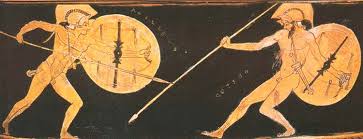
Achiles and Hector

A exquisitely written and consistently gripping new version of parts of the Iliad, starting from Achilles’ quarrel with Agamemnon and ending with Achilles arming for battle against Hector.

In between these two points the book is brimming with arresting images and ideas: Hector compared to a desert burned Rommel; Apollo as “Lord of Light and Mice”, the Sun-god and the bringer of plague; The fate of Troy decided in an ill-tempered negotiation amongst the gods echoes contemporary discussions in corridors of power to visit slaughter on nations and cities half a world away; and, almost as an aside, with the consistent referencing to Zeus as “God” and Apollo “his son” Logue asserts significant Greek influences on the development of Christianity, at the same time making the contemporary resonances of the work all the more stark.

I am not familiar with other adaptations or translations of the Iliad so cannot make any useful comparisons, but I found Christopher Logue’s reworking of the Iliad an exceptional work of poetry – funny, chilling, horrific and thought-provoking by turns. A stunning piece of work.

A path to power paved with war crimes: Philip Dwyer’s Napoleon (1769 – 1799)

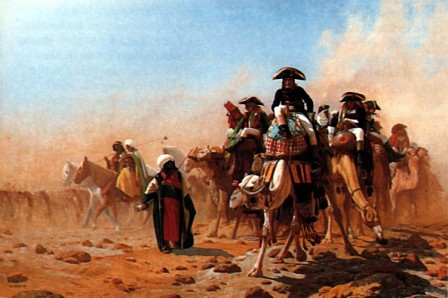
Bonaparte on the march in Egypt and Syria Bonaparte on the march in Egypt and Syria

Summary: An engrossing and chilling piece of work that charts Bonaparte’s path to power paralleled by his precipitous moral decline and the growth of his egotism.

In the course of this fine biography that charts Bonaparte’s rise from Corsica to Consul of France, one particularly distressing anecdote stands out: Following Bonaparte’s capture of Jaffa in 1799 the French troops engaged in a murderous sacking of the town, during which the soldiers kidnapped a large number of women and girls. They were “taken to the French camp and raped. Bonaparte, hearing of this, ordered that all women were to be led into the hospital courtyard by midday on pain of a severe punishment… it was believed that they would be sent back to the ruins of the town where they would find refuge. However a company of chasseurs was assembled to execute them” (p418).

This is very much a political, rather than a military biography of Bonaparte: the reader gets little sense of his tactical genius. The author’s interest is rather focused upon the exercise of power and particularly how Bonaparte parlayed his reputation for military success, often self authored and shamelessly exaggerated, into political power. But while there is little discussion of the battles there is a close consideration of Bonaparte’s role as a general-in-chief, how he organised, or failed to organise his logistics, and his policies towards conquered peoples. The disorganisation of Bonaparte’s march on Cairo pre-figures his failures in his Russian campaign, and the brutality displayed to the Arab populations of Egypt and Syria anticipates the brutality of Europe’s 19th century “scramble for Africa”, and indeed 20th and 21st century Western atrocities in the Middle East.

In considering all of this the author is at pains to emphasise that in terms of ruthlessness Bonaparte was little different from the other commanders of the era, whether British, Austrian or Russian. Yet, while this is undoubtedly true as British policy in Ireland in 1798, for example, confirms, there is something frightening about a man who could make a cold-blooded choice to slaughter those defenceless Palestinian women at Jaffa. Whatever greatness Bonaparte may ultimately have achieved it is dimmed beyond measure when one contemplates it in relation to the terror of those poor women’s last moments.

Bonaparte visits the French plague victims at Jaffa Bonaparte visits the French plague victims at Jaffa

An Irish Butch and Sundance? Robert McLiam Wilson’s Eureka Street: The finest novel ever written about the Troubles in the North of Ireland

All stories are love stories...

All stories are love stories…

I started reading Eureka Street one evening when I was working in Angola. I had no expectations of the book and began reading it really only because a friend had given it to me. I was hooked by the first page. In the end I had to take an afternoon off work to finish it I was so gripped. I think someone has described this book as “the Irish War and Peace… with better jokes than Tolstoy”.

I’ve not read War and Peace yet. Rather Eureka Street reminded me of some of the classic “buddy” movies, like Butch Cassidy and the Sundance Kid, with its shifts between high comedy and brutally realistic violence and its focus at core on the friendship between Chuckie and Jake. One is Protestant and the other Catholic, but this is incidental. There is no heavy handed nonsense about friendship across the barricades in the book. Such friendships are commonplace in Belfast as elsewhere. Rather the book is about ordinary young people trying to live ordinary lives in Belfast in the early 90s. Hence this involves drinking, chasing girls and trying to make a living.

The result is one of the funniest books I’ve ever read as it details Jake’s efforts to recover from a broken heart and Chuckie’s efforts to become rich. Of course this is Belfast during the Troubles so violence intrudes shockingly: modest dreams are no defence against buffoons with guns and bombs intent on putting the world to rights.

The book is a testimony to why Belfast is the greatest city in Ireland – blasted to bits for years by invaders and locals alike and still a home to great love, great humour, great decency and great tea!

A masterpiece!

Recovering a forgotten history and celebrating treason: Fintan O’Toole’s A Traitor’s Kiss

richard-brinsley-sheridan-1-sized

Richard Brinsley Sheridan is remembered today as one of the most brilliant dramatists of the 18th century. What Fintan O’Toole does with this book, while not ignoring Sheridan’s considerable literary achievements is show that there was more to the man than the playwright. In fact Sheridan was one of the most democratic politicians of his day, a political visionary in both Irish and British politics. His reputation as a artist, cemented, almost literally, by his burial in Poets’ Corner in Westminster Abbey, was privileged in order to obscure his much more dangerous treasonous (to Britain) and patriotic (to Ireland) political views lest they encourage others.

The book, beautifully written as is typical of O’Toole, has the pace of a political thriller set against the background of the French Revolution, the United Irish rebellion of 1798 and machinations of Westminster at the time. My one quibble with the book is that it passes over the events of the 1798 rebellion too quickly to give readers unfamiliar with that period a full sense of the trauma that it must have been for Sheridan and those who thought like him.

Nevertheless the book achieves the remarkable feat of showing the modern relevance of someone from 200 years ago who has been ignored for too long in favour of much more imperial figures.

Great stuff!

Peter Bowles and Penelope Keith (as Mrs Malaprop)in a production of Sheridan's The Rivals

Peter Bowles and Penelope Keith (as Mrs Malaprop)in a production of Sheridan’s The Rivals

Redemption, even for spurned lovers: Ben Hur

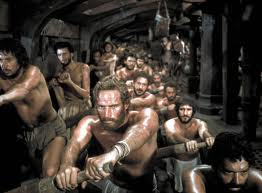
Chuck and Stephen

The terms “epic” and “spectacular” have been cheapened by overuse these past decades, but here is a movie that really deserves them. The story is well known, written by a former US Civil War general, Lew Wallace, while he was governor of New Mexico and otherwise preoccupied with the shennigans of Billy the Kid: Judah Ben Hur (Charlton Heston), a Jewish nobleman, is unjustly sentenced to the galleys by his childhood friend, Messala (Stephen Boyd), now a high Roman official in Palestine. Years later he manages to escape and returns to Palestine to find his mother and sister, condemned to prison with him, and to exact revenge on Messala. In paralell with Judah’s travails a young Jewish rabbi from Nazareth starts to preach a message of peace and justice.

galleysThe movie is rightly celebrated for two of its great set pieces – a sea battle, and even more spectacular, a chariot race. Legends abound around the race; allegedly the director William Wyler, insisted that Heston drive the chariot through the extended, hair-raising sequence: “You just stay in the chariot, Chuck. I’ll make sure you win the race!”

The more intimate scenes between the characters also resonate. Wyler and Boyd agreed that Messala’s motivation for turning on Judah was that on Messala’s return to Jerusalem Judah, his former lover, spurns a contination of their relationship. This is how Boyd plays the scene. Both Boyd and Wyler agreed however that the deeply conservative Heston would not be impressed with this reading and so didn’t deign to tell him. As a result Heston’s performance is solid mahogany in all his scenes with Boyd – accentuating, one can see, Messala’s hurt and frustration.

Its an amazing piece of work, all the more so for being achieved without the sort of computer generated imagery that is now commonplace in cinema. It will always remain a great way to spend an afternoon in front of the telly, but is even better if you get the chance to catch it in all its proper cinematic glory.Image

Times that try men’s souls: David McCullough’s 1776

Washington Crossing the Delaware by Emanuel Gottlieb Leutze

Summary: a gripping account of the beginning of the American war of independence

This is an exceptionally gripping work of narrative history. Written as a companion to McCullough’s John Adams this book focuses on Washington from his appointment as commander of the Continental Army to his crossing of the Delaware at Christmas 1776 to mount a surprise attack on the British forces that had routed him from New York. What makes that story so remarkable is its consideration of the leadership of Washington, most particularly how he turned around his fortunes, and those of the American Revolution, from their nadir following his poor generalship in New York which led many of his closest lieutenants to lose confidence in him.

McCullough conveys in his narrative the extraordinary steeliness of Washington when faced with this crisis and which was core to his historical greatness. President Obama in his inaugural address cited Washington’s crossing of the Delaware in mid-winter as an example of the sort of courage in the face of adversity that was necessary to deal with America’s current travails, and this story can be inspirational to non-Americans (such as myself) or anyone faced with personal or professional reversals.

This is a compelling work, beautifully written, deeply exciting and a great introduction to this period of American history.

What is past is prologue: Warsaw 1920 – Lenin’s Failed Conquest of Europe, by Adam Zamoyski

Summary: a brief but clear and gripping account of one of the pivotal battles of European history

This is a fine, concise account of the war between the Soviet Union and Poland in 1920 and particularly the climatic battle of Warsaw. The book focuses primarily on Józef Pilsudski, the Polish head of state who commanded Polish forces in the war and was architect of the victory, conceiving of a manoeuvre, highly reminiscent of Hannibal’s tactics at Cannae, that led to the Soviet rout. However the author also recognizes the pivotal role played by General Wladyslaw Sikorski, Poland’s Second World War leader until his assassination by the Soviets (probably by the British traitor Guy Burgess using the agency of MI6), in the defeat of the Red Army on the Vistula.

Zamoyski argues that Stalin, who was part of the Soviet Army devastated by the Poles in 1920, developed a pathological hatred of the Poles as a result of this that culminated in his massacre of Polish prisoners of war in Katyn. Interestingly this is the motive that Putin also ascribed to Stalin when he finally publicly acknowledged Soviet responsibility for the Katyn atrocity. Hence the book reads, ultimately, as a prologue to an even greater tragedy, when many of the actors in this drama were cruelly murdered and Poland itself dismembered by the Nazi-Soviet alliance.

In spite of that this is a gripping work on a pivotal and ill remembered aspect of history.

The greatest movie ever made: Casablanca

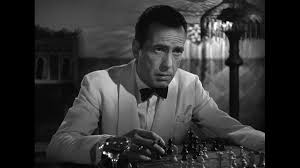
Rick Casablanca

Washed up in Casablanca early in the Second World War, Rick Blaine (Humphrey Bogart), a veteran of the Spanish Civil War, runs a bar and tries to forget his previous political commitment. All this changes when Elsa (Ingrid Bergman), a woman from his past, turns up in town with Victor Laslo (Paul Henreid), a Czech leader of the Resistance, both on the run from the Nazis and in need of help to evade them further.

If you don’t fall in love with the movie Casablanca when you see it there is, in my humble opinion, something wrong with your soul. It is a film that has just about everything: some great humour, some great songs, a poignant love story, political commitment, and it is a cracking wartime thriller to boot. It is one of the most quotable films in movie history (“Round up the usual suspects!”), but the wise cracking does not overshadow some powerful emotion: the La Marseilles scene, when the refugee clientele of Rick’s bar, many of them Jewish in real life, drown out the singing of the German soldiers, I still find one of the most electrifying in cinema history.

Louis and StrasserTo add another level to this, the villian of the movie, Major Strasser, was played by the great Conrad Veight, himself a German and a committed anti-Nazi who fled Germany with his Jewish wife to continue the struggle, raising funds for the war effort by making movies such as Casablanca.

The movie began as just another run of the mill production but somehow, not least through great casting and superb writing, it turned into something magical. It is brilliant at just about every level, and like any classic bears up to repeated viewing. It is a sublime piece of work, possibly the most joyously brilliant film ever made.

Greeneland at its most bleak and exquisite: The Third Man

Joseph Cotton

At the end of the Second World War Holly Martens (Joseph Cotton), a hack Western writer, arrives in Vienna on the promise of a job from his childhood friend Harry Lime. On his arrival in Vienna however he discovers that Harry is dead and being buried that very morning. Dissatisfied by the police explanations of what happened to his friend Holly starts clumsily poking around himself.

The Third Man is based on a Graham Greene story, but Greene was gracious enough to say that the movie is a better version of the story than the subsequent novella. Part of the reason for this was the presence of Orson Welles, adding both his considerable charisma to the film as well as his writing skills, most notably on the famous “cuckoo clock” speech by which his character explains his view of morality to Holly.

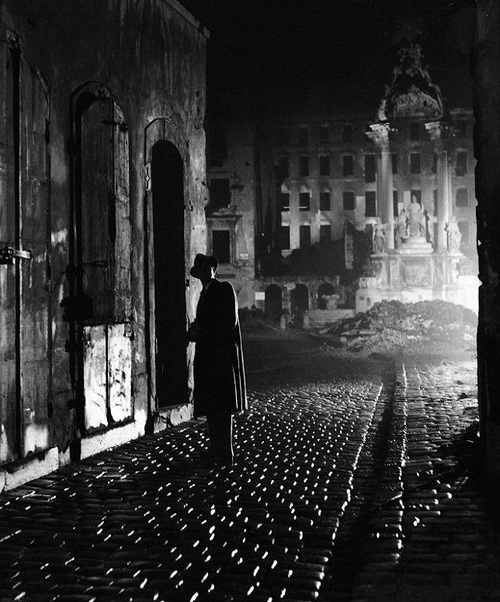
ThirdMan_2_L
The novel is written from the perspective of a military police investigator Calloway (Trevor Howard). The movie, however, takes Holly’s perspective and communicates brilliantly his sense of disorientation in an unfamiliar city – every camera angle is slightly off-kilter – and of isolation – just about everyone speaks (unsubtitled) German.

On top of all of this the cinematography of post war Vienna, reaching a climax in the sewers of the city, is exquisite and the zither soundtrack is a stroke of genius.

This is a funny, beautiful, exciting and bleak work of cinema, replete with Greene’s trademark concerns of morality, Catholicism and betrayal. It is probably the greatest British movie every made and another contender for my list of greatest final scenes of all time.