Mandela

Office wallsHanging on the wall of my very messy office are two portraits, one of Abraham Lincoln, and the other of Nelson Mandela. This is because they both showed that even the most entrenched and hateful systems based on discrimination, violence and racism could be overcome with courage, determination and decency.
Mandela rightly pointed out that “Like slavery and apartheid, poverty is not natural. It is man-made and it can be overcome and eradicated by the actions of human beings.” But, unfortunately poverty cannot be overcome until slavery and apartheid have been eradicated: Mandela dealt with apartheid in South Africa, but it endures against Dalits and minorities in India and other parts of South Asia, and slavery endures across the world.

We need people at the top to draw inspiration from Mandela to take political action to eradicate slavery. Unfortunately, many politicians pay lip service to his achievements but lack the guts to emulate them, preferring bland platitudes to effective action on issues like slavery.

Still, even when things seem bleakest and the brutality of contemporary slavery practices most intractable I sometimes reflect on the odds which Mandela overcame in ending apartheid and re-forging a new nation in South Africa. We also must endure in the struggle and trust that decency and courage will ultimately triumph over the greed and racism that keeps 21 million people enslaved across the world.

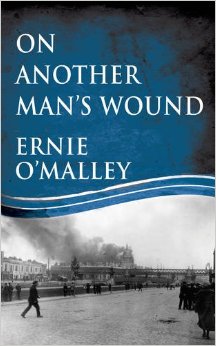
War and its consequences: Ernie O’Malley’s On Another Man’s Wound

on-another-mans-woundSummary: a masterpiece with resonances and relevance beyond its geographic and historical contexts.

“On another man’s wound” is generally regarded as the only personal account by an Irish War of Independence commander that has true literary merit. It is a beautifully written and gripping narrative of O’Malley’s experiences from 1916 to 1921. The book is packed with incident from initial observations on the 1916 rebellion to guerrilla action in the South, to his capture in Kilkenny, subsequent torture, and his participation in the only successful escape from Kilmainham gaol in Dublin. Along the way there are interesting pen portraits of many of the leading figures of the time including Erskine Childers, Liam Lynch, and, not least, Michael Collins.

At its heart the book is a remarkably honest account of the brutalising effects of war: Towards the end O’Malley describes unflinchingly his decision to murder three captured British soldiers just before the Truce. The effect is both chilling and moving: O’Malley’s literary acheivement is to show how his personal experiences are representative of all soldiers in war, which can transform idealistic youth into diminished and bloody men in a pattern that is repeated through history and across the world to this day.

As such the book retains a relevance beyond it geographic and historical contexts: It speaks a truth that should be remembered by all contemplating sending young people to kill and die on behalf of some cherished cause, particularly if the closest the decision-makers have been to war is an Oxford PPE course or a London law chambers.

President Michael D. Higgins on business and human rights

Shane Darcy's avatarBusiness & Human Rights in Ireland

Before he was elected President of Ireland, Michael D. Higgins was an active Labour politician and served as a member of the Oireachtas Sub-Committee on Human Rights. In 2008, the Sub-Committee devoted some attention to the role of the private sector in relation to human rights. Michael D. Higgins was somewhat pessimistic in his views, remarking during the session on the absence of notable progress in this area:

I am at a loss to identify any great achievements of the ethical globalisation movement, to which reference has been made. It reminds me uncomfortably — perhaps I am wrong — of the World Business Council for Sustainable Development, which I encountered for the first time when it was present at the United Nations conference on environment and development in Rio de Janeiro. The council had no difficulty in signing up to the concept of sustainability. The chair was the vice…

View original post 448 more words

A German Odyssey: Field Gray by Philip Kerr (A Bernie Gunther novel)

I had not come across Bernie Gunther before this book, the seventh in a series but one that stands up very well on its own.

The jacket note describes the book as relating to Gunther being press ganged into working for the French intelligence service to identify a war criminal. But this is merely an element in a plot that sprawls across 23 years, taking in the rise of the Nazis, the occupation of France, the invasion of Ukraine, the battle of Konigsberg and the fate of German prisoners in Russian hands after the war. Heydrich and Graham Greene have walk on parts in the novel along with a variety of other real people.

To say the novel is a thriller may be true, but it is not like any other thriller I have read. It is also part war story and a meditation on German history in general and its war and war crimes on the Eastern front in particular. This historical aspect of the story is compelling enough in itself, but a dramatic arc is also established across the book through the relationship relationship between Gunther and another real individual co-opted into the narrative Erich Mielke, a veteran German communist.

In the Russian camps a character alludes to the Odyssey, and this more than Raymond Chandler is the template upon which this story plays out. Gunther here is a wise cracking Odyesseus, brilliantly cunning but, after the war, cursed to wander the world remembering his Penelope as he searches for his home.

Father of US government, grandfather of emancipation: Ron Chernow’s Alexander Hamilton

Alexander HamiltonA truly outstanding, elegantly written, warts and all, biography of a facinating individual. It throws light not only on Hamilton’s life and death at the hands of Aaron Burr, the US Vice President, but also on the Revolutionary war, the drafting of the US constitution, the establishment of US government and finance, and the beginnings of the fault lines that divide US politics to this day: On the one hand the Federalists with their strongly nationalist view of the US and the importance of federal government; on the other hand the Republicans with their promotion of “states rights” and nonsensical fantasies about small government and citizen farmers. Along the way we learn of the first sex scandal in US political history and the strange mores and tragic consequences of the late 18th century duelling culture.

The divisions at this period in US history were described in short-hand by the attitudes to the French Revolution. However it is interesting that while Hamilton and the Federalists were generally Anglophile and deeply distressed by the bloodshed and chaos of the French Revolution, they seem to have been little troubled by the exercise of British power, which between 1796 and 1798 massacred more people in Ireland than died in the entire three years of the French Terror – there is not a single mention of this sanguinary episode of European history in the book.

Towards the end of the book Chernow notes how many of the Republican “slave holding populists were celebrated by posterity as tribunes of the common people. Meanwhile, the self-made Hamilton, a fervent abolitionist and a staunch believer in meritocracy, was villanized in American history textbooks as an apologist of privilege and wealth”.

Countering this tendency in histography Chernow casts Jefferson as villian of the piece, even more so than the murderous Burr, for professing himself an abolitionist but, unlike Washington, never freeing his own slaves and advocating both an economy that was only sustainable through the enslavement of hundreds of thousands of human beings, and a polity that facilitated and rewarded slavery.

In contrast it is clear from Chernow’s work that, in addition to establishing US credit and effective government, a central part of Hamilton’s political project was building in the US an economic system that could not only be sustained without slavery but could also contribute its eradication. While the elimination of slavery ultimately took a civil war Hamilton’s work did provide the North the economic capacity to destroy the slave holding south 60 years after his death. For this, I would argue, that if Lincoln was the “father” of emancipation Hamilton could perhaps be regarded as its “grandfather”.

Chernow makes the argument that, with Washington, Hamilton, for all his faults, was the greatest of the Founding Fathers of the United States. Chernow describes him as the “father of US government”. On the basis of the evidence he presents it is a difficult argument to refute, and, in this time of Tea Party lunacy, his life and achievements are worth celebrating again.

Remembering properly the central event of European history: TImothy Synder’s Bloodlands

Timothy Synder strives with this book to repudiate the anonymity of the mass murders of the twentieth century, reminding the readers that each death represenented an individual human being with all the flaws and hopes of any reader.

Central to his achievement is his taking of a holistic approach to the atrocities, considering not just the policies of Hitler and Stalin separately but in interaction, and considering the Jewish, Polish, Ukranian and Belarusian tragedies in their totality rather than in isolation. This approach is perhaps best exemplified by his consideration of the Warsaw uprisings: here the distinctively Jewish character of the 1943 Ghetto uprising is recognised but not to the exclusion of its Polish character, as demonstrated by the alliance between the Ghetto fighters and the Home Army. Likewise the Jewish contribution to the 1944 Warsaw uprising is discussed: For example after the Home Army liberated the Warsaw concentration camp many of the Jewish slave labourers joined the Home Army, “fighting in their striped camp uniforms and wooden shoes, with ‘complete indifference to life or death'”. (p. 302)

This approach also draws out some uncomfortable ambiguities: Tuvia Bielski, for example, is one of the incontrovertable heroes of the book. His exploits, depicted in the film “Defiance”, saved hundreds of Jewish lives in what is now Belarus. In order to do this he established an alliance with Soviet partisans, which ultimately meant he, a former Polish soldier, was directly involved in the suppression of the Home Army by the invading Soviets in 1944(something not depicted in “Defiance”).

In consciously repudiating more simplistic narratives Snyder make a profoundly important point: horrendous as the history of this time and this place is, it is a central episode of human history. Presuming that this was the work of monsters threatens that we may blunder into perpetrating such atrocities again.

This is a hugely important book: an awesomely impressive research undertaking resulting in an exemplary work of history, beautifully written, horrific and deeply moving by turns. It should be read be everyone with an interest in humanity itself.

Anatomy of a Moment, by Javier Cercas

ub_tejero_coup_etatSummary: The lad battle of the Spanish Civil War?

Following his unconvincing meditation on American atrocities in the Vietnam war in “The speed of light” Javier Cercas returns to his own country’s history for his latest work. “The anatomy of a moment” revisits the theme of the Spanish Civil War and its consequences that Cercas so brilliantly explored in “Soldiers of Salamis”. However in his new book he eschews fiction, even the “post-modern” variety that he practices, which blurs the distinction between the real and the imaginary. Instead he employs a part philosophical, part journalistic meditation on the 1981 attempted coup to overthrow Spanish democracy.

“The anatomy of a moment” focuses on the three parliamentarians who refused to duck when the Civil Guard who invaded the Cortes opened fire. They were Gutteriez Mellado, a former Francoist general now deputy Prime Minister, Santiago Carillo, head of the Spanish Communist party, and Adolfo Suarez, the outgoing Prime Minister. Suarez is above all the hero of the book – in Cercas account a Francoist functionary and “provincial non-entity” who grew into the architect of democracy and a giant of Spanish history. The author returns again and again to the image of Suarez sitting alone on the prime minister’s bench as the bullets fly around him, one of only three people prepared to risk their necks while those with more impecible democratic credentials cower behind their desks, as most of the rest of us would naturally and rationally have done in similar circumstances.

Parts of the book are difficult – the author talks to the reader as if they are already au fait with the history and politics of Spain. This leads, I thought, to a richer experience than books which spoonfeed the reader the historical background: in the end you feel you have earned the understanding you have achieved.

In places the book has the characteristics of a non-fiction thriller as the details of both the coup, led by senior elements in the army, and the countercoup, led by the King, are plotted. The book is also very moving, particularly regarding the travails of Suarez in later life, and a deeply affecting coda when the author reflects upon the life and politics of his own father.

The book is also deeply political, rejecting a current view prevalent in Spain that the rupture between Francoism and democracy was false and that Suarez ensured that those who had power under the dictatorship retained it under the constitutional monarchy. Cercas argues instead that the rupture was real and that Suarez was a “hero of the retreat” from dictatorship. That the author is prepared to set out such forthright opinions on this and other aspects of the coup add to the pleasure of the book: it is widely researched, deeply opinionated history, provocative, but not gratuitously controversialist. It demands the reader thinks while keeping them entertained.

A great book.

Empire of the Summer Moon – Quanah Parker and the Rise and Fall of the Comanches by S.C. Gwynne

PortraiSummary: Brilliant, but not the whole story

This book is a fascinating look at the rise and fall of the Commanche nation. Its intensely exciting and sympathetic to Native Americans in general and the Commanche in particular. However it is also intensely violent, taking a clear sighted, almost forensic, look at the practices of Commanche war-making, particularly their routine use of rape and torture.

(Speaking as a Celt myself) the author draws a not unreasonable comparison of Comanche warfare to Celtic warfare of a bygone era to undermine any racist presumptions about the origins of warriors cruelty. He also notes the intensely political purpose behind Comanche terrorism on settlers and buffalo hunters, and that Texan warfare was itself brutal and racist. However while he spends time describing Comanche violence in some detail, he frequently skates across comparable white violence – explicitly avoiding a deep discussion of the Sand Creek massacre for example.

The author appears to like and admire Quanah, particularly the Quanah of later years who struggled to lead his people in peace after years of violence. Quanah described himself as having been a “bad man” but in later life he appears to have become a warm and generous one with little animosity to whites. However the author’s real hero in this book seems to be the enigmatic Col MacKenzie, Quanah’s nemesis, rather than Quanah himself. One should be grateful to the author for bringing this fascinating man and his role in the violence of the era to greater public attention: for all his crankiness he stands in a much more positive light that the strange, and more infamous, figure of Custer.

For those interested in Hollywood history the author notes how the story of Cynthia Ann Parker, Quanah’s mother, was the inspiration for arguably John Ford’s second greatest Western (after The Man Who Shot Liberty Valance), The Searchers. However he doesn’t mention that MacKenzie seems to have been Ford’s model for Lt Col Kirby Yorke in Rio Grande, another one of John Wayne’s classic roles: the climax of that film – the Colonel leading his troopers into Mexico to attack the Apache on Sheridan’s orders – is something that the author mentions MacKenzie actually did when not fighting the Comanche.

It is a book that can comfortably sit alongside Dee Brown’s classic “Bury my heart at Wounded Knee” and which complements it, providing greater detail to some aspects of that book and a deeper understanding of the politics and attitudes of white America to Native Americans in the course of their conquest.

Domestic servitude: a 21st century system of violence against women and girls

Speech to RMT Union meeting to mark the International Day for the Elimination of Violence against Women and Girls
25 Nov 2013

Thanks very much for having me here. I’ve very honoured to be here and just wanted to say a few words on just one of the issues that sustains violence against women and girls in this country and in the rest of Europe.

A month or so ago the Guardian ran an expose of the use of forced labour in Qatar to build the infrastructure for the World Cup. At the root of the problem there is what is called the Kafala system, which is a sponsorship system that ties workers to their employers to such an extent that even in the most abusive employment relationships, up to and including forced labour, the workers cannot changes jobs or even go home.

It is a cynical system to facilitate medieval levels of exploitation.

It is also essentially the same system that the UK government has in place for migrant domestic workers to this country.

All slavery is violence. It affects more women than men, though not disproportionately so: as I mentioned the thousands of forced labourers bleeding and thirsting to death in Qatar are mostly men. But domestic slavery and servitude is a sector where women are overwhelmingly enslaved and abused.

And it is a sector were the trafficking of women and girls, and by trafficking I mean specifically the movement of women and girls into systems of forced labour and exploitation, is frequently legal. The UK has its system of domestic workers visas tied to employers, and this de facto legalises the trafficking of people for forced domestic work. It does this by explicitly saying to migrant domestic workers that if they leave the employment of the person to whom their visa is tied, no matter how abusive or exploitative that employer may be, they will be deported. And that places in the hands of unscrupulous employers an enormously powerful threat to hold over the head of any vulnerable worker hoping to improve their own life and that of their family through hard work.

The British Prime Minister David Cameron, to his credit employed a domestic worker who had previously escaped from an abusive employer and he sometimes makes reference to how this gives him an insight into contemporary slavery. But if the same domestic worker today was to escape from an abusive employer, following the changes in regulations regarding migrant domestic workers’ visas brought into being by Mr Cameron’s government, she would probably be deported rather than protected.

The system of tying domestic worker visas to employers is common place across the Gulf states as well as in the UK. As with the construction workers of Qatar this system is in place to facilitate the abuse and enslavement of vulnerable domestic workers. A year or so ago an Indonesian domestic worker was executed in Saudi Arabia without having had either legal representation at her trial or consular support. Referring to this case, one colleague asked me “Imagine for a moment that woman was guilty of whatever capital offence she was accused of. Can you imagine the level of abuse that someone like her, from one of the gentlest communities in the world, must have gone through to drive her to some act of violence”.

Consequent of this Indonesia stopped its nationals from travelling to Saudi for work. Saudi now seeks to source its slaves from East Africa, principally Ethiopia and Kenya, though Ethiopia has just recently also introduced a travel ban for its nationals.

Ensuring decent work for domestic workers is an essential challenge in the wider struggle of ending violence against women and girls. Yet the UK, along with the government of Sudan, refused to support a new international convention on decent work for domestic workers when it was formulated at the ILO a year or so ago: and when you are on the same side as the government of Sudan on a human rights issue, you are probably on the wrong side.

The UK’s failure to support decent work for domestic workers runs contrary not just to its proposed anti-slavery and anti-violence agendas. It also runs contrary to its development and anti-poverty agendas. Across the globe women are struggling for better lives for themselves and their families by travelling the world in search of work, frequently domestic work. The remittances they send are vital not only for the future of their families but for the development of their countries. In the months and years to come the remittances of Filipino domestic workers are likely to be more important than the efforts of foreign aid agencies in the reconstruction of their country following the devastation caused by the typhoon there.

David Cameron must see how vital the work of such domestic workers is to all of us in Europe following his employment of a migrant domestic worker to help him care for his family while he carried on the hectic schedule of leading the British Government. For many other people across Europe such workers provide essential support without which they would also find it difficult to cope.

It’s time to start valuing domestic workers not by mere words but by actions, and this country, and all of Europe can start by removing the systems that facilitate the routinized use of violence against them.

End child slavery: my speech to the 3rd Global Conference on Child Labour, Brasilia, 8 Oct 2013

I am sure that in the course of this conference there will, rightly, be recognition of the significant progress in the struggle to end child labour across the world.

The ILO’s recent estimate, that child labour has reduced by 78 million since 2000, representing a one third decline overall which encompasses a 50% reduction in children in hazardous work is, indeed, an enormous achievement.

But in parallel with this there is a much darker statistic. Specifically the ILO 2012 estimate that there are around 5.5 million children in forced labour and that this figure has not varied significantly since 2005.

I do not think that we will do anyone any favours, least of all the children who find themselves in slavery across the globe, by not recognising this figure as anything other than a stark failure. Plainly whatever is being done right to address child labour, including its most hazardous forms, it is not enough to address child slavery.

 26% of all forced labourers are children, the majority found in Asia and the Pacific, and Africa, but every country and region of the world is affected by child slavery, from the cannabis factories of the UK which typically enslave trafficked Vietnamese boys, to the Indian Sumangali system that uses the forced labour of girls to produce the clothes many of us attending this conference today are wearing, to West Africa, where boys and girls are routinely and endemically trafficked into forced labour in agriculture, most well known into cocoa production, domestic work and fisheries.

To consider what must be done to address this most egregious form of child exploitation let us first begin by being clear about what we are talking about. Too often many people  use the terms child labour and child slavery interchangeable.

But here I am not seeking a rhetorical effect. The 1956 Supplementary Convention on Slavery defines child servitude as the handing over of a child with a view to exploitation.

It is important to be clear on this point because it means when we are talking about child labour that however hazardous is that labour it tends to be undertaken when the child is still in the care of their parents, and the parents generally have the best interests of the child at heart, even if they may be profoundly mistaken as to what those best interests are

Nevertheless when engaging in the struggle to end child labour there is that potential commonality of purpose with parents who will often be open to new ideas about how to do better by their children.

No such potential exists when we are discussing the issue of child slavery. For example consider for a moment children who have been handed over from their parents for things such as trafficking for forced labour or sexual exploitation, or forced child labour by a 3rd party, such as the govt of Uzbekistan’s slavery programme for cotton harvesting, or conscription in armed conflicts, or trafficked as child domestic workers.

While these represent diverse practices in a variety of different socio-economic contexts they all have one thing in common: in not one of them, nor any other child slavery situation, do the adults doing the exploiting of the children care one iota for the best interests of the child.

So in addition to the efforts being undertaken by governments, trades unions, businesses and non-governmental organisations on child labour a new set of initiatives are necessary to begin to tackle child slavery properly and systematically.

There are a number of elements to a credible programme against child slavery and I will briefly outline them now.

At the very outset such a programme should acknowledge explicitly the difference between child labour and child slavery and recognise that a new departure is required to address the more egregious abuse of child slavery. Its must be a key lesson of the past 10 years that the approaches of the past to address child labour, even in its most hazardous forms, are woefully insufficient in addressing child slavery.

Second a credible global programme against child slavery must, of course, include education ensuring that school is affordable, accessible and a safe environment particularly for girls.

But it is not enough to presume that the expansion of universal education even on these terms will be enough to protect children who are vulnerable to slavery. Very often those who are most vulnerable do not obtain education because they come from a discriminated against group, such as Dalits and other minorities in South Asia. Hence a credible global response to child slavery must mean the adoption of measures, including relevant anti-slavery and anti-discrimination laws and increased court capacity, that will advance rule of law by preventing bigoted public officials from arbitrarily excluding any section of citizenry from their rights as citizens.

And children must also be directly involved in the struggle against child slavery: In West Africa for example a recurrent reason why children become trafficked into the Ivorian agricultural sector from countries such as Burkina Faso and Mali is their tragically banal dream of owning a bicycle. Given their current circumstances they can’t see how they would ever afford such a thing if they were to stay in school and so fall for the false promises of traffickers. Appropriate vocational and entrepreneurial education that takes accounts of these children’s aspirations could help them imagine a better long term future for themselves that avoids them falling into the abuses of slavery.

It is also important to remember the 2005 research of Lise Rende Taylor in Thailand who found that completion of education was a causal factor of young women and girls being trafficked: because their families had put such efforts into getting these girls and young women educated they expected a return on that investment and hence there was considerable pressure on these girls and young women to leave home to seek work, unintentionally driving them into being trafficked.

There may always be some negative consequences for some to interventions aimed at advancing positive social change for the many. So it is important to move away from the idea of responding to child labour or child slavery as the search for a magic bullet, a simple solution, that will end all problems and instead view any response as a learning process that openly acknowledges any mistakes and seeks to rectify them.

A credible global programme against child slavery must include also elements relating to law enforcement and child protection so that cops in the countries most affected by child slavery can identify children who are in slavery, understand their responsibilities towards them, and know the best methods and partners with whom to work to remove children from slavery. Developing such responses, police force to police force, and child protection specialist to child protection specialist should become a significant component of post 2015 aid programmes.

A credible global programme against child slavery must also include working in and with the very communities where child slavery and slavery-like practices prevail.  Only by fully understanding the complex causes behind harmful social norms and turning them around together with the support of the communities that commonly practice them will child slavery ultimately be eradicated on the large scale required.

This is one area where the business community can play an enormous role by casting a cold eye honestly on its supply chains, recognizing, particularly in agriculture and south Asian garment manufacture, that slavery, and the slavery of children are brutal realities of those supply chains and more robust and open approaches to dealing with them are needed.

I understand that tomorrow the international confectionary company Mondalez is announcing its new policy on child labour which does just this and articulates approaches and expectations of its staff and suppliers in how they will deal with these issues. I believe this radical new approach breaks the old, discredited paradigms of businesses employing dubious “ethical auditors” to assure the world that there are no human rights issues in their supply chains when it is an open secret that there are. Mondalez should be congratulated on adopting such a visionary new approach, which I hope will inspire others to follow suite.

One of the biggest failures in the struggle against child slavery, and indeed all slavery in the world today, is that the development and humanitarian communities are largely absent. It seems that they are hoping, if they ponder the subject of child slavery at all, that the programmes they undertake, blind to non-gender based forms of discrimination, will be sufficient to remove the causes of slavery in general and child slavery in particular.

They won’t be. So it is necessary in order to obtain comparable progress on child slavery that we have seen on child labour, that child slavery eradication must be recognized as a fundamental development goal and included in the post 2015 agenda as such.

Aid policies of governments, international and not-for-profit agencies have to be formulated explicitly stating how they seek to contribute to ending child slavery. For example basic questions should be asked such as “How would UNICEF’s partnering with the Government of Uzbekistan to access funds from the Global Partnership for Education contribute to the ending of that government’s systematic use of forced child labour in cotton harvesting, which, by the way, brings more revenue into Uzbekistan, mostly for private benefit, than would be accessed from the Global Partnership for Education?”

Similarly governments need to consider the roles that trade and diplomatic policy can play: will the community of nations continue to be happy to build commercial links with countries such as Qatar and the Gulf states or Uzbekistan which formulate much of their economic and other policies on being able with impunity to enslave children and other vulnerable workers.

Finally we must have a serious consideration of the relationship between child slavery and child marriage. Work undertaken by Anti-Slavery International, Girls Not Brides and others have shown that child marriage can be slavery of the most distressing kind, as children are in essence traded with the thinnest of veils of respectability for sexual exploitation. That hypocrisy should no longer be tolerated and child forced marriage treated as unacceptable as any other form of child sexual exploitation.

The struggle against child labour should give us hope that we can advance also the struggle against child slavery. But in order to do so we must attack child slavery directly and not merely hope that it might somehow go away. This conference must take up challenge of child slavery if it is to be serious about addressing child labour. If we do not we will return again to some gathering like this in the future with the same figure of 5.5 million children enslaved indicting our failure.