
The Cut Throat Trial, by the Secret Barrister

Summary: One of these suspects is not like the others …

As aficionados of Rumpole will know, a “cut-throat” trial is one in which co-defendants turn on each other. That is the heart of this novel about three boys accused of murder — a case that also involves a victim nearly decapitated, so there is that sort of throat-cutting too.

This is the first foray into fiction by the Secret Barrister. It is told from multiple perspectives: a defense and the prosecution barrister, the judge, and two of the defendants. Each voice feels distinct, a technical feat that lends the narrative both texture and credibility.

As in their non-fiction, the Secret Barrister’s abiding concerns with the state of the law, society, and the criminal justice system in England and Wales permeate every chapter. Like Wendy Joseph’s Unlawful Killings, it exposes the squalid tragedies of murder committed by children.

Yet for all its artistic achievement and political undercurrent, this is first and foremost a courtroom thriller — and it is a cracking one. It takes a staple of English literature, the red-herring-strewn cosy murder mystery, and serves it up American-hard-boiled. Gone are the familiar comforts of Agatha Christie and the nostalgia-fests of Richard Osman. Instead, we are in a world where the streets are mean, knives wound horrifically, killing is messy, dying is sore, cops and lawyers are flawed, defendants are pathetic, and justice is too often elusive.

By refusing to flinch from the grotesque realities of murder, the Secret Barrister has produced a novel several cuts above much contemporary English crime fiction, and one that, like the best of literature, illuminates the human condition while laying bare some of the failings of our world.

The Adventures of Huckleberry Finn, by Mark Twain

Summary: Huck and Jim try to flee their woes, stalked by the malevolent figure of Tom Sawyer.

Dith Pran, the Cambodian journalist made famous by the movie, The Killing Fields, wrote that the most terrifying of the Khmer Rouge were the child soldiers. They had no sense of either mortality or conscience and would kill with no compunction and little excuse.

In his writings on Vietnam, Tim O’Brien also describes this phenomenon amongst American troops, themselves little more than children. O’Brien describes the results when they are unleashed, as the dogs of war inevitably are, on a substantially defenceless civilian population whose pleas for mercy the Americans never understand.

The literary archetype for this monstrousness is perhaps Tom Sawyer. While not the main focus of this book, his presence when he appears inevitably causes mayhem, anguish and a threat to life for any with the misfortune to cross this dangerous clown’s path.

Huckleberry Finn is one of the great novels of America. In it Huck, a free-spirited kid who has grown up in the woods, and Jim, an escaped slave, both flee to the Mississippi River to seek the freedom to pursue their different ideals of happiness.

Along the way they have comic and comic-dreadful encounters with con men, blood feuds, and slave catchers who threaten to undermine their plans. But perhaps the most sinister threat comes from Tom Sawyer, Huck’s supposed friend.

In the book Tom seems to embody not the ideal of personal freedom cherished by Huck and Jim, but another American ideal still very much at large: that of the virtue of overweening self interest. Nothing matters to Tom but his own amusement and he has no concern if the modest hopes of people he regards as lesser, particularly Jim, are torn apart in the service of his gratification.

The spirit of Tom Sawyer still pervades American politics. There is a lineal link from Tom’s ludicrous plans of piracy to Trump’s grotesque fantasies of the benefits of genocide in Gaza. Those Americans who gave repeated standing ovations to Benjamin Netanyahu when that war criminal and genocidist addressed a joint session of Congress embody the spirit of Tom Sawyer. For them too, the lives of large swathes of humanity simply do not matter.

Huckleberry Finn is a charming and very funny reflection on the American Dream. But it knows there is an American nightmare too, and it stares deep into that void left by the absence of American conscience.

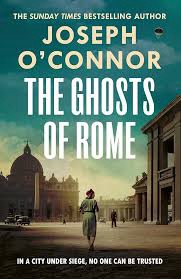
The Ghosts of Rome, by Joseph O’Connor

Summary: more Paddington 2 than Jaws 2

Sequels are a tricky thing. Some, like Margaret Atwood’s The Testaments add something to an earlier classic. More ill-judged ones, like Pat Barker’s The Women of Troy, can dent the lustre of their more accomplished predecessor, seeming to aim to cash in on a successful formula rather than say anything compelling or new.

So it was with some trepidation that I picked up the Ghosts of Rome, Joseph O’Connor’s follow up to his superb novel of European Resistance to Nazism, My Father’s House.

Time has moved on a few months from the first novel, the German occupation has become more brutal, and the pressure on the Choir – the escape line for Allied prisoners of war and Jews established by Monsignor Hugh O’Flaherty – more extreme.

The pattern that O’Connor uses for this book is similar to its prequel: It focuses on one operation, and one individual in the midst of the otherwise present and correct ensemble of the Choir, in this instance Contessa Giovanna Landini – Jo.

O’Connor admits that all of the novel, including the purported transcripts of BBC interviews, is his own invention. But many of the people involved including Jo and her Irish pals, Delia and her daughter Blon, were real. This accentuates the sense of awe regarding what these ordinary people endured and achieved in such extraordinary circumstances. And, even if we know they survived the war this does not diminish the tension.

The Ghosts of Rome is a gripping thriller. But like the best thrillers it is more than that. It explores and asserts the importance of morality and friendship in the face of monstrousness. These remain important ideals in a world in which the genocide of vulnerable people is again high on the agendas of many of the supposed liberal democracies of the West.

The Voyage Home, by Pat Barker

Summary: a fine novel of Cassandra that suffers in comparison with Barker’s initial foray into the stories of Troy

The Voyage Home continues Pat Barker’s feminist retelling of the tales of Troy, following the return of Agamemnon to Mycenae with the enslaved Cassandra in tow. This guarantees that the reunion with his wife Clytemnestra is going to be awkward. Just how awkward Agamemnon, even if he was a cleverer man, could not imagine.

But Cassandra, gifted with prophesy, but cursed that no one ever believes her, knows. In the bloodshed that she foresees she also discerns some measure of justice for the genocide that the Greeks have inflicted on her homeland. 

For this story, Barker replaces Briseis, the narrator of her previous Trojan books, with Ritsa, Cassandra’s maid: slave to a slave, or, as she describes her lowest of the low status, a “catch-fart.” 

The Voyage Home dealing with the beginning of the Oresteia, is, I think, a considerably better book than its predecessor, The Women of Troy. But neither of these books say much additional thematically to the stunning originator of this series, The Silence of the Girls.

Still, it is elegantly written, and Barker’s continuing focus on how war affects civilians and the sexual violence endured by women is important. In addition, Cassandra is always a compelling figure, and Ritsa is a fine creation.