Israel’s Offensive: A Case Study in Racism and Human Rights

Summary: Netanyhu’s war is racism and should be condemned as such

Perhaps I have missed it, but I have not seen many anti-slavery organisations condemning the mounting slaughter of civilians in Gaza, and now Lebanon, over the past year.

I wonder about anti-slavery organizations more than other specialist NGOs or human rights issues because, for the past 20 years this has been my principal area of professional practice and so is a sector with which I have some familiarity.

Perhaps some anti-slavery organization feel that something like Gaza is not part of their mandate and so would be inappropriate for them to raise their voices. Perhaps others are afraid of upsetting donors by raising question about another specialist area – human rights in war – and losing funding for other important work. Maybe others are afraid of annoying the governments of the US, UK and Germany, or certain parts of the EU Commission, who may be complicit with the policies of Netanyahu’s cabal and so losing precious access and the occasional invitation to convivial cocktail parties. 

The thing is this: if we survey the realities of slavery through history right up to the present day we see very clearly that it is rooted in racism and the dehumanisation of others. Hence, anti-slavery organisations must be anti-racist if they are at all serious about tackling the causes and consequences of enslavement. If they fail in that fundamental then they are not truly anti-slavery. They are merely performative distractions. 

Consider now Benjamin Netanyahu’s reference at the start of the assault on Gaza to the Amalek, a nation that, according to the Bible, King Saul was commanded by God to kill every member of. Consider the Israeli blockades of aid to Gaza to deploy famine as a weapon of war, and Israel’s vote on 28 October 2024 to, in effect, ban the largest provider of humanitarian assistance to Palestinians, the UN relief and works agency (UNRWA). Consider how IDF soldiers can  cheerfully make videos for TikTok of their demolition of homes, schools, universities, hospitals and every other vestige of civilian infrastructure that makes Gaza habitable. Consider now Israeli Defence Minister Yoav Gallant’s description of Palestinians as “human animals” as he called for a “complete siege” on Gaza, an imposition of collective punishment that is illegal in international law. 

Gaza, after Israel has “defended itself”

Each of these examples, and there are many more, is a naked expression of racism against a whole people. Racism is at the root of every atrocity that is committed by Netanyahu and his cronies.

The continued acquiescence of US, UK and Germany in this, up to and including the provision of money, material and intelligence to sustain the Israeli offensives, in spite of overwhelming concerns regarding both their morality and legality, has dealt a grievous blow to international rule of law. It has also done something that would have seemed unbelievable a mere 18 months ago. It has established a credible case that there is no moral difference between the foreign policies of Biden’s America, and Putin’s Russia. Both appear ready to shred law and the most basic principles of human rights when it is convenient for them.

It is upon meaningful rule of law and a common adherence to the fundamental principles of human rights that the cause of anti-racism, and anti-slavery, have been advanced. Now, however, if campaigners challenge transgressing governments that their policies are in breach of human rights many will laugh and point to Gaza and Ukraine and say that the US and the UK, Germany, Israel, and Russia have demonstrated that the only right is might.

So, every anti-racist organisation on this planet, and that includes all anti-slavery organisations that are worthy of the name, and every organisation that derives its mandate from the Universal Declaration of Human Rights, must add their voices to the international condemnation of the Netanyahu government’s racist wars. If they do not then they will seem as hypocritical as the western governments who facilitate these wars in spite of the mounting evidence that the bloodshed that Israel perpetrates is foul murder.

As the Irish anti-slavery campaigner Roger Casement put it, “we all on earth have a commission and a right to defend the weak against the strong and to protest brutality in every shape and form.” 

That commission was never more urgent than it is today as we daily bear witness to Netanyhu’s unfolding policy of genocide.

Not ethical leadership: a rocky start to Starmer’s first days in government

Summary: things can sometimes only get worse.

Keir Starmer’s government prides itself in not being idealistic. “We are not a party of protest!” they declare.

The smug, self-satisfaction that this statement implies might be better sustained if the party were conducting itself with unimpeachable professionalism now that it is in government. But its first 100 days in office have been notably rocky. A survey of this period by the Guardian was headlined, “We all hope it’s teething troubles – but worry it’s something worse.”

Well, I suspect it is something worse.

This thought will likely have occurred to many students of organisations. It will be a particular worry to those concerned, as I have been, with what is required to lead ethically: that is, the struggle to make organisational decisions that optimise life-affirming choices by seeking to protect human rights and advance environmental restoration. 

For me, there seems to be three inter-related structural problems with Starmer’s Labour party that are the root of the Labour government’s shaky start and shady future. The first of these is that Starmer’s Labour party is strikingly authoritarian. 

Everyone who has ever effectively led people in organisations will be aware that sometimes a directive approach is needed. For example, if it is necessary to evacuate a building due to an emergency, it is not appropriate to ask everyone how they feel about that first. It is necessary to point folk to the fire exits and tell them to get out. 

However, Starmer seems to privilege such an approach over more collaborative ones even when there is no compelling need. Indeed, his leadership seems to have a problem with any independence of thought and voice.

The run up to the 2024 general election was marked by accusations of a purge of left wing and pro-human rights candidates, and the parachuting into various constituencies of Starmer loyalists, some of them morally repugnant.

Starmer and his acolytes present this as “discipline” and “strong leadership”. It is a peculiar notion of strong leadership when a leader is afraid to countenance a bit of criticism or consider different perspectives on issues. 

From the longer-term view of organisational health this approach is even more problematic. Because if organisations exclude dissent, they reduce their capacity to think critically, to test ideas and winnow out the stupid or counter-productive ones. 

All leadership teams, no matter how smart, will come up with poor ideas from time to time. But truly smart leaders understand that they need processes in place to guard against such things. The restriction of dissension in Labour undermines the necessary processes.

This leads to a second structural problem which will increasingly emerge for Labour as this government proceeds. The purging of intellectual and philosophical diversity, and the fear of being seen as disloyal that is bred by leadership authoritarianism, will reduce Labour’s capacity to generate new ideas as time and events evolve. This will make it more difficult for the government, and the party as a whole, to right recent wrongs and to respond to the new challenges that will inevitably emerge. 

Both these problems, of authoritarianism and lack of intellectual diversity, are dwarfed by the most fundamental of Labour’s current structural problems: that is its moral bankruptcy. 

This was most starkly on display in the infamous interview that Starmer gave to LBC in which he endorsed collective punishment on the people of Gaza for the attacks on Israeli civilians on 7 October 2023, something that he should know as a lawyer, is a war crime under international law. Later assertions that Starmer misspoke or was taken out of context are undermined by the fact that in the weeks following this Labour front-benchers, including the crassly cynical Emily Thornberry and the craven Peter Kyle also publicly endorsed their Dear Leader’s position.

There was a softening of Labour’s Gaza position in the run up to the 2024 election, when it looked as if such an inhumane policy might cost it seats as Israel’s apparent genocidal intent became ever more explicit. However, on attaining power, it has, with a few cosmetic changes, returned to its substantially uncritical support of Netanyahu’s far-Right government. Hence Starmer is notably more reticent on the carnage inflicted on Palestinian civilians in comparison with his public anguish over Israeli casualties.

It is in the context of these three structural failures that we should consider the votes in the first 100 days of this government on maintaining the two-child limit on child benefits and cutting winter fuel payments for pensioners

Not to put too fine a point on it, these votes look more like a process for the breaking of the human spirit of backbench members of parliament rather than any cool consideration of regrettable financial necessity. 

In bringing these matters to a vote when they did, the Labour leadership sought to purge any residual dissent by demanding that, in the name of loyalty, backbenchers should betray their constituents and their consciences on the issue of the poverty of English people, until now a residual Labour moral value.

Having done this, the thoroughly compromised backbenchers have been truly initiated into the moral bankruptcy that is at the core of the British Labour party. So, all will have diminished credibility if they are ever tempted to mount a future principled challenge to the leadership’s proposals, no matter how stupid or morally repellent those proposals might be. 

Starmer’s Labour may be better than the Tories that they replaced. But there seems to me to be a rot at their heart, the stench of which may soon become overwhelming. 

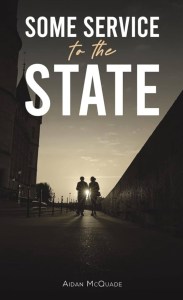
Some Service to the State

Summary: why partition in Ireland has been such an injustice.

“… sometimes it is absence itself which is the hardest thing to hide.”

I grew up in South Armagh, just a mile or so from the British-imposed border in Ireland. That border is a thing that, in many ways, has cast a long shadow over my life. It was, I sincerely believe, at the root cause of many of the problems for both parts of Ireland during the Twentieth Century, not least the squalid little war known as the Troubles during which I grew up.

With partition, the British sought, successfully, to create two sectarian states in Ireland rather than one plural one. My novel, Some Service to the State, is at heart an exploration of some of the human rights abuses that Irish people had to endure as a result of this.

Hence it is an indictment of the injustice of partition’s continuation. As the impetus takes hold for an end to partition and the establishment of a new Ireland, I hope that this book will resonate with an audience that wants to understand better why the status quo has been such a poisonous thing for ordinary people living on the island of Ireland.

But Some Service to the State is also a gripping detective story, about the repercussions of an enquiry into the fate of a girl who seems to have gone missing in that politically divided island.

Here is what other authors said about it: 
Ronan McGreevy, author of Great Hatred: the assassination of Field Marshal Sir Henry Wilson, has said of Some Service to the State that it is “a superb book with dialogue that would not be out of place on the stage of the Abbey Theatre. … [in Mick McAlinden} McQuade has created a character whose travails highlight the thwarted dreams and the tragedy of partition for so many people in post-revolutionary Ireland.” 

Rosemary Jenkinson a multi-award winning playwright and author of Marching Season, has said that the book shows a “prodigious skill in shining a spotlight on the scandal of the mother-and-baby homes and in brilliantly imbuing the past with … [a] potent blend of heart, soul and wit”

If you would like to get a copy, the book is available in the UK from Bookshop.org and in the US from Barnes and Noble. It is also available on Amazon.

I hope you will read it, and if you do, I would love to hear what you think in the comments below.

Keep safe and many thanks.