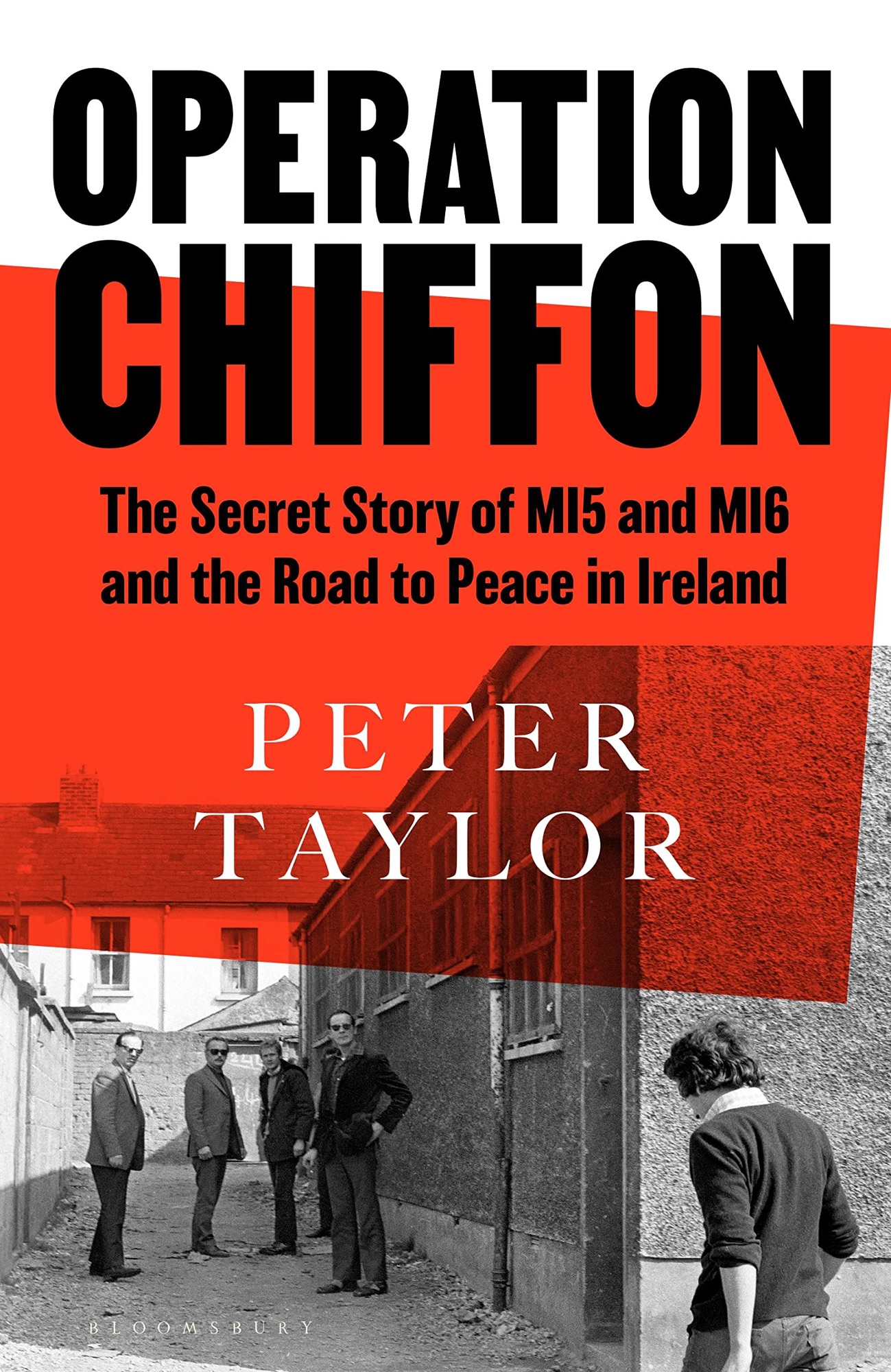
Operation Chiffon, by Peter Taylor

Summary: An indispensable channel, but not the Peace Process

Operation Chiffon is Peter Taylor’s account of the “Back Channel”: the secret line of communication maintained intermittently between the British government and the IRA from the 1970s into the Peace Process. 

Taylor focuses particularly on the MI6 officer Michael Oatley, his MI5 successor, known only as Robert, and their principal intermediary, Brendan Duddy, a Derry businessman.

It is an engaging story, worth telling not least to honour the courage and persistence of those who kept open the possibility of dialogue while the conflict continued. Uncovering its details has been a journalistic project of several decades for Taylor, and he tells the clandestine story extremely well.

Perhaps because he has invested so much in uncovering it, however, Taylor also invests too much historical importance in it. In his telling, the Back Channel becomes not merely one important element of the Peace Process but its decisive mechanism. Indeed, he endorses the contention that without it there would have been no Peace Process.

The wider political architecture receives remarkably little attention. Hume’s three-stranded approach to a settlement, the New Ireland Forum, the Anglo-Irish Agreement, Hume–Adams and the Downing Street Declaration are either treated briefly or relegated to the margins. The constitutional significance of the Anglo-Irish Agreement—giving the Irish government an institutional role in the affairs of a territory claimed as an integral part of the United Kingdom—is scarcely explored. Hume–Adams is also downplayed, on the highly dubious grounds that Martin McGuinness was more central than Gerry Adams to the republican movement’s strategic leadership: McGuinness was the Back Channel’s principal IRA interlocutor.

This mistakes access for authorship. The fact that McGuinness managed a crucial line of communication does not establish that the line itself generated the republican strategy or the political settlement. The Back Channel could communicate intentions, test propositions and build confidence. It could not, by itself, create the political circumstances in which an IRA ceasefire became possible.

Taylor gives particular weight to Robert’s assurance to McGuinness that the eventual outcome of the conflict would be Irish unity. Robert confirms that he expressed this view, apparently going beyond his instructions. Taylor presents the exchange as a decisive moment.

It may certainly have mattered. Coming from someone understood to represent the British government, it could reassure the republican leadership that Britain would not permanently obstruct constitutional change if consent for unity could eventually be secured. But that is different from supposing that Robert’s personal prediction transformed republican strategy. It is more plausible that his words corroborated conclusions already emerging from electoral experience, Hume–Adams, contacts with Dublin and the developing relationship between the British and Irish governments.

Seen within the totality of relationships that produced the Peace Process, corroboration appears to have been the Back Channel’s principal function. The British wanted to establish whether Irish government and SDLP assurances—that an inclusive political process could draw republicans away from violence—were credible. The IRA, in turn, wanted to know whether the political inclusion and constitutional openness promised by Hume and others would actually be delivered once it ended its campaign.

Republican caution was understandable. The movement had emerged from the 1975 ceasefire convinced that it had been induced to suspend its campaign, weakened in the process and offered no corresponding political advance. Whether or not that had been the British government’s deliberate intention, it became a powerful lesson within republican strategy: a ceasefire without reliable political guarantees could become a trap.

As a mechanism of mutual assurance, therefore, the Back Channel was extremely important. It allowed each side to test the seriousness of the other without public commitment and gave messages an authority that informal political contacts might have lacked. 

But a channel is not the same thing as the process whose messages it carries. Without the political framework developed through the work of Hume and many others, there would have been little for Oatley, Robert or Duddy to communicate. Taylor has written a compelling account of one indispensable strand of the Peace Process. His mistake is to treat that strand as the fabric itself.

Four Shots in the Night, by Henry Hemming; and Stakeknife’s Dirty War, by Richard O’Rawe

Summary: two books plumbing the depths of the intelligence war during the Troubles

The morally vile, but tactically brilliant, American Confederate general, Nathan Bedford Forrest had a philosophy when giving battle: Get there first with the most.

This philosophy seems to have been taken up with some degree of alacrity by a raft of English politicians and writers who want to capture the history books to rewrite the Irish peace process as a benevolent English achievement. 

Central amongst these has been Peter Taylor whose focus for some years has been on the role of British intelligence in the peace process, particularly the “Back Channel” between MI6 and the IRA. This, as far as he seems to be concerned, was the only strand of the peace process that mattered. Forget the Hume-Adams talks; forget Irish diplomacy and the Downing Street Declaration; forget George Mitchell; forget the European Union; forget Mo Mowlem. Instead, the peace process was something gifted to the quarrelsome Irish by perspicacious spooks, selflessly concerned with Paddy well-being. 

Hemmings’ book gives a nod to diplomacy with mention of the Anglo-Irish Agreement of 1985 – also portrayed as a British initiative. But, like Taylor he is also principally interested in intelligence operations, albeit with a broader perspective. At its core his book explores three parallel but occasionally overlapping British intelligence operations: In addition to MI6 and the Back Channel, Hemmings describes MI5’s efforts to boost Sinn Fein’s electoral fortunes with a view to weaning them away from violence, and the army’s efforts to disrupt the IRA’s military operations through the activities of, in particular, Freddie Scappaticci – Stakeknife. 

Scappaticci was the army’s most important agent in the IRA. A senior figure he was the head of the IRA’s internal security – the Nutting Squad. He was personally involved in the interrogation, torture and murder of dozens of suspected IRA informers. Many of these were, of course, also British agents, like Scappaticci himself. 

The term “British agent” can be a misleading one. It can lead one to think of James Bond, who was an intelligence officer NOT an agent. The agents are the vulnerable people who through blackmail and bribery are recruited by officers to turn traitor on former friends and neighbours. 

The pathetic plight of these desperate people is a central concern of Richard O’Rawe.  O’Rawe, a former IRA man himself, knew Scappaticci. But given the sociopathology that he documents, he records that he is thankful that he did not know him well. 

Scappaticci was an army intelligence operation. But O’Rawe shows, there was an essential unity between the IRA’s Nutting Squad and the “Tasking and Co-ordinating Group”, the senior officials from all British intelligence agencies who oversaw their diverse operations. So much so that it was they, ultimately, who decided who would live and who would die, and gave orders accordingly for favoured British agents like Scappaticci to kill other less valued ones. 

O’Rawe’s past IRA involvement gives him access to other IRA volunteers and his interviews with them provides a broader perspective on the Troubles to Hemmings whose book is more dominated by British sources. O’Rawe also has an altogether more morally clear-sighted view of that squalid war than Hemmings. He is not afraid to use the term “war crime” in his assessment of the savagery of both IRA and British actions. 

Aside from the desperately sad human stories that these books recount, and the important ethical questions relating to the conduct of insurgency and counter-insurgency that they raise, these books also offer valuable insights into some broader historical questions. 

First, the whispered accusation that Martin McGuinness was a tout is effectively discounted. Given the efforts that MI5 was putting in over decades to coaxing the republican movement onto a more constitutional path, compromising McGuinness like that would have risked wholly undermining their efforts. But while he may never have been a tout, the callousness which McGuinness showed towards human life, particularly in diverse killings of suspected informers, means that while he may be an important figure in Ireland’s history, he should never be thought of as a hero. 

Second, the idea that the IRA was beaten is disabused. Even though British intelligence had compromised major parts of the IRA, its rural organization in South Armagh, Tyrone and Fermanagh were still capable of sustaining the killing, even if there was never any hope of military victory. 

This leads us to the third point, that of the importance of the political processes that were running parallel to these intelligence ones. Without those, offering a constitutional framework that, if not giving the IRA all that they wanted, at least gave them some, there would have been nowhere for the Back Channel to go. The British might like to now remember the peace process as a British led affair, one of the great achievements of New Labour as that morally bankrupt party likes to chauvinistically put it. However, without the thread of Irish leadership showing the way, they would still be entangled in the labyrinth of killing typified by their Stakeknife operation.

Both O’Rawe and Hemmings describe with some admiration the efforts of Jon Boutcher’s Kenova enquiry to get to the bottom of the moral morass of the Troubles intelligence operations. Boutcher, who was involved in the police killing of Jean Charles de Menezes may have been expected to do the decent thing by the British Establishment and cover up embarrassing information. Instead, he recommended prosecutions in 28 cases involving both former IRA and senior British personnel. 

The Public Prosecution Service declined to undertake these prosecutions, which seems a travesty. But in that it is hardly surprising. The Stakeknife operation is but one among many war crimes that the British state was involved in: Aside from Ballymurphy and Bloody Sunday there was also extensive collusion with Loyalist death squads across the North. So, this makes it more understandable why past British governments have scrambled to introduce blanket amnesties for all Troubles era killings. It also gives insight into why the current British government of “human rights lawyer” Keir Starmer still strives to prevent a public inquiry into the killing of Sean Brown

Both Hemmings’ and O’Rawe’s books may require some revision – in the details but most probably not in the substance – in the light of Boutcher’s final Kenova report. But they are still fine work, grappling with difficult subjects. O’Rawe’s in particular, while more narrowly focussed than Hemmings, is an elegantly written work, marked by a burning sense of indignation at the scale of the depravity that he describes

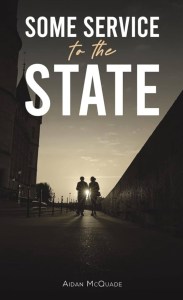
Some Service to the State

Summary: why partition in Ireland has been such an injustice.

“… sometimes it is absence itself which is the hardest thing to hide.”

I grew up in South Armagh, just a mile or so from the British-imposed border in Ireland. That border is a thing that, in many ways, has cast a long shadow over my life. It was, I sincerely believe, at the root cause of many of the problems for both parts of Ireland during the Twentieth Century, not least the squalid little war known as the Troubles during which I grew up.

With partition, the British sought, successfully, to create two sectarian states in Ireland rather than one plural one. My novel, Some Service to the State, is at heart an exploration of some of the human rights abuses that Irish people had to endure as a result of this.

Hence it is an indictment of the injustice of partition’s continuation. As the impetus takes hold for an end to partition and the establishment of a new Ireland, I hope that this book will resonate with an audience that wants to understand better why the status quo has been such a poisonous thing for ordinary people living on the island of Ireland.

But Some Service to the State is also a gripping detective story, about the repercussions of an enquiry into the fate of a girl who seems to have gone missing in that politically divided island.

Here is what other authors said about it: 
Ronan McGreevy, author of Great Hatred: the assassination of Field Marshal Sir Henry Wilson, has said of Some Service to the State that it is “a superb book with dialogue that would not be out of place on the stage of the Abbey Theatre. … [in Mick McAlinden} McQuade has created a character whose travails highlight the thwarted dreams and the tragedy of partition for so many people in post-revolutionary Ireland.” 

Rosemary Jenkinson a multi-award winning playwright and author of Marching Season, has said that the book shows a “prodigious skill in shining a spotlight on the scandal of the mother-and-baby homes and in brilliantly imbuing the past with … [a] potent blend of heart, soul and wit”

If you would like to get a copy, the book is available in the UK from Bookshop.org and in the US from Barnes and Noble. It is also available on Amazon.

I hope you will read it, and if you do, I would love to hear what you think in the comments below.

Keep safe and many thanks.