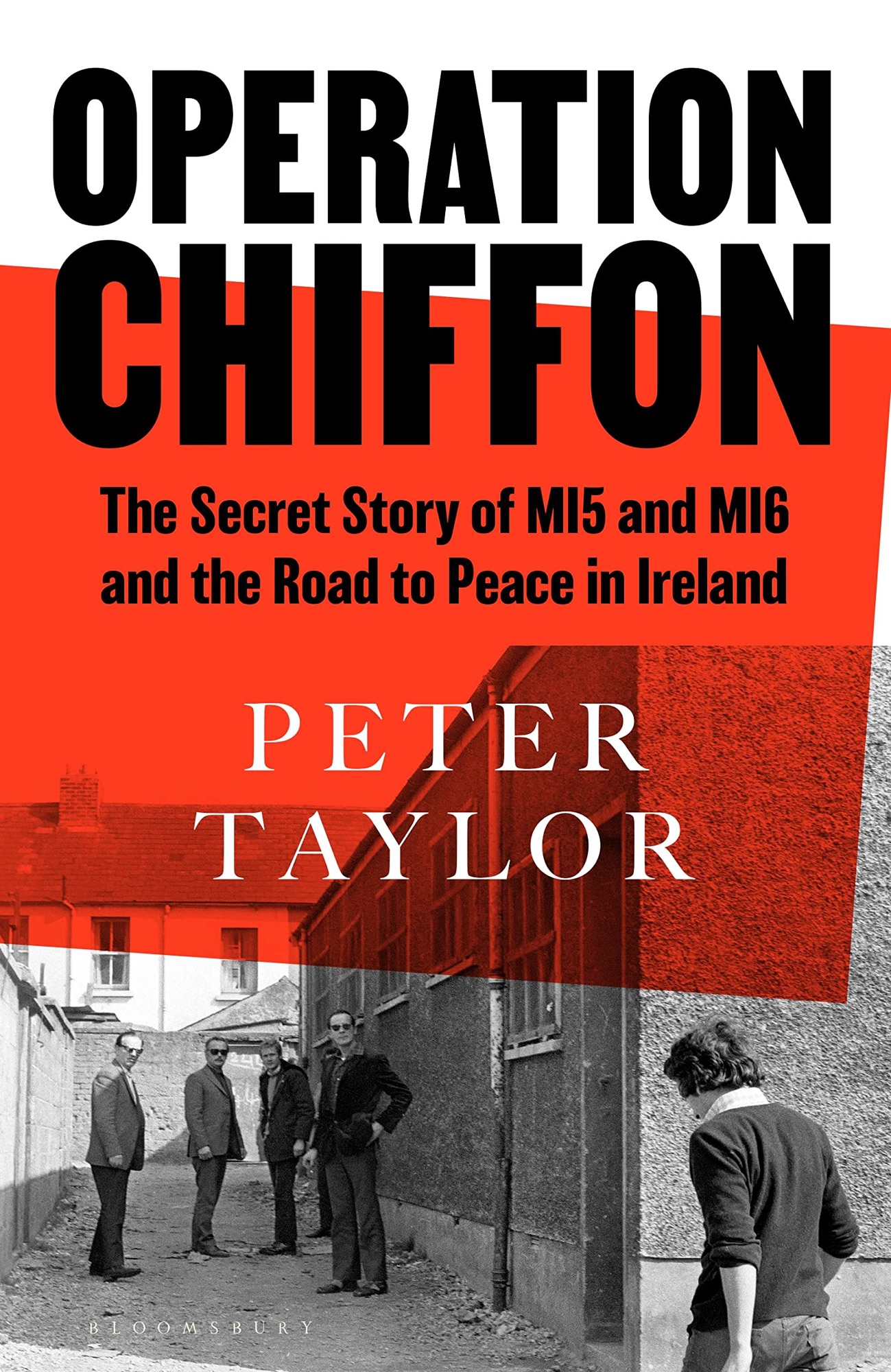
Operation Chiffon, by Peter Taylor

Summary: An indispensable channel, but not the Peace Process

Operation Chiffon is Peter Taylor’s account of the “Back Channel”: the secret line of communication maintained intermittently between the British government and the IRA from the 1970s into the Peace Process. 

Taylor focuses particularly on the MI6 officer Michael Oatley, his MI5 successor, known only as Robert, and their principal intermediary, Brendan Duddy, a Derry businessman.
It is an engaging story, worth telling not least to honour the courage and persistence of those who kept open the possibility of dialogue while the conflict continued. Uncovering its details has been a journalistic project of several decades for Taylor, and he tells the clandestine story extremely well.

Perhaps because he has invested so much in uncovering it, however, Taylor also invests too much historical importance in it. In his telling, the Back Channel becomes not merely one important element of the Peace Process but its decisive mechanism. Indeed, he endorses the contention that without it there would have been no Peace Process.

The wider political architecture receives remarkably little attention. Hume’s three-stranded approach to a settlement, the New Ireland Forum, the Anglo-Irish Agreement, Hume–Adams and the Downing Street Declaration are either treated briefly or relegated to the margins. The constitutional significance of the Anglo-Irish Agreement—giving the Irish government an institutional role in the affairs of a territory claimed as an integral part of the United Kingdom—is scarcely explored. Hume–Adams is also downplayed, on the highly dubious grounds that Martin McGuinness was more central than Gerry Adams to the republican movement’s strategic leadership: McGuinness was the Back Channel’s principal IRA interlocutor.

This mistakes access for authorship. The fact that McGuinness managed a crucial line of communication does not establish that the line itself generated the republican strategy or the political settlement. The Back Channel could communicate intentions, test propositions and build confidence. It could not, by itself, create the political circumstances in which an IRA ceasefire became possible.

Taylor gives particular weight to Robert’s assurance to McGuinness that the eventual outcome of the conflict would be Irish unity. Robert confirms that he expressed this view, apparently going beyond his instructions. Taylor presents the exchange as a decisive moment.

It may certainly have mattered. Coming from someone understood to represent the British government, it could reassure the republican leadership that Britain would not permanently obstruct constitutional change if consent for unity could eventually be secured. But that is different from supposing that Robert’s personal prediction transformed republican strategy. It is more plausible that his words corroborated conclusions already emerging from electoral experience, Hume–Adams, contacts with Dublin and the developing relationship between the British and Irish governments.

Seen within the totality of relationships that produced the Peace Process, corroboration appears to have been the Back Channel’s principal function. The British wanted to establish whether Irish government and SDLP assurances—that an inclusive political process could draw republicans away from violence—were credible. The IRA, in turn, wanted to know whether the political inclusion and constitutional openness promised by Hume and others would actually be delivered once it ended its campaign.

Republican caution was understandable. The movement had emerged from the 1975 ceasefire convinced that it had been induced to suspend its campaign, weakened in the process and offered no corresponding political advance. Whether or not that had been the British government’s deliberate intention, it became a powerful lesson within republican strategy: a ceasefire without reliable political guarantees could become a trap.

As a mechanism of mutual assurance, therefore, the Back Channel was extremely important. It allowed each side to test the seriousness of the other without public commitment and gave messages an authority that informal political contacts might have lacked. 

But a channel is not the same thing as the process whose messages it carries. Without the political framework developed through the work of Hume and many others, there would have been little for Oatley, Robert or Duddy to communicate. Taylor has written a compelling account of one indispensable strand of the Peace Process. His mistake is to treat that strand as the fabric itself.

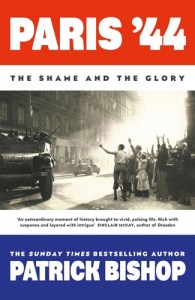
Paris ’44, by Patrick Bishop

Summary: a gripping narrative of the liberation of Paris

Paris ’44 covers similar ground to the bestselling book, Is Paris Burning? by Larry Collins and Dominique Lapierre, focusing on the liberation of Paris from the Germans in 1944.

Bishop finds some novel perspectives on the story through recounting the experiences of JD Salinger and Ernest Hemmingway in the fighting in France. Bishop is also much less generous to the German commander of the Paris garrison, von Choltitz, than were Collins and Lapierre:  That von Cholititz did not set Paris ablaze had little to do with his moral qualms and much more to do with the logistical difficulties of such an act of terrorism. Bishop is also rightly caustic about how the grossly collaborationist French police switched sides when they discerned how the tide of the war was turning.

The Paris uprising in 1944 was possibly the luckiest such insurrection in occupied Europe. Elsewhere resisters were encouraged with considerable cynicism by the Allied high command to give battle to the Germans to draw off forces from the main allied armies. But Paris was one of the few places where the allied armies moved to support the uprisings before the Germans had time to massacre them. The relief of Paris by a Free French armored division was something of which the Home Army in Warsaw, or the Maquis on the French Vercors massif could only dream.

It is a compelling story no matter how it is served up, and Bishop does this with quite some style. 

Palatine, by Peter Stothard; Emperor of Rome, by Mary Beard; Pax: War and Peace in Rome’s Golden Age, by Tom Holland

Summary: not just fun and games

Perhaps we – well … men at least – are fascinated by ancient Rome because it seems so different to today’s world, a place where cruelty was often regarded as a virtue and so many human vices were given free rein, not least as entertainment: In answer to Maximus’ question to the circus audience, we are indeed entertained

But perhaps we are fascinated by it because, paradoxically, the Romans also remind us so much of ourselves in our contemporary world: we see echoes of Nero in buffoons like Boris Johnson and Donald Trump; the genocidal campaigns of the legions in Gaul and Germany echo with the depredations of the Israeli Defence Force in Gaza, and the Russians in Ukraine; the fanaticism of Hamas has resonance with that of the Sicarii defenders of Masada. 

For whatever reasons, historians of other eras must envy those who have stuck to Rome and the seemingly insatiable appetite of readers for new takes on these old stories.

Palatine, by Peter Stothard, Emperor of Rome, by Mary Beard, and Pax, by Tom Holland are amongst the most recent offerings of publishers to meet this ravening demand. 

Of these three highly enjoyable books, Holland’s is perhaps the most straightforward: a narrative chronicle from the downfall of Nero in 69 AD, “the Year of the Four Emperors”, through the Flavian dynasty to Trajan. This may be subtitled “Rome’s Golden Age,” but these things are relative. For example, the campaigns by Vespasian and his son Titus against the Jewish revolt in Palestine, which led to the destruction of the Temple and the mass crucifixion of much of the civilian population of Jerusalem, are a particularly chilling example of performative cruelty in the service of mass murder. 

Nevertheless, Vespasian and Titus are still remembered as “good” emperors. Which is to say they were good for Romans… in the same way as – that contemporary echo again – the British Conservative Party is “good” for rich people, and the British Labour Party wants to be “good” for some English ones. 

Palatine is something of a prequel to Holland’s book. It deals with the first Roman emperors from the perspective of the courtiers of the Palatine – the hill in Rome on which the emperor dwelt and which gives its name to the word “palace”.

The Pantheon

In particular Stothard focuses on the Vitellius family. Heard of them? Well one of them was one of the emperors whose brief reigns in 69 AD, and comic-dreadful ends, were prologue to Vespasian’s more enduring tenure. 

Stothard affects a highly entertaining gossipy style for this. In doing so he gives a sense of the court’s preoccupations through the reigns of Tiberius, Caligula, Claudius and Nero. These ranged from the apparently trivial – seating, décor, banqueting, rumoured love affairs – to the sinister – the growth of Sejanus’ power, the casual cruelties of Caligula. 

What all these subjects had in common were, like an ancient world Kremlinology, they indicated where power lay, who was in favour and who was out. These were questions of life and death on the Palatine. So, the creatures of court paid attention – much as today’s political correspondents claim to do to the gossip and self-serving off-the-record briefings of power-insiders.

Mary Beard covers similar ground to Stothard, but slightly differently. As with her book SPQR her subject is perhaps histography rather than history. That is, rather than delivering a simple narrative, she presents us with the evidence, discusses what it might mean, and hence what conclusions we may be able to draw.

In doing this Beard gives us intriguing factoids, such as that the first representation of the crucifixion of Jesus was in a piece of anti-Christian graffiti found in the slaves’ quarters on the Palatine. But, drawing on diverse sources, including grave inscriptions,  she also gives us some more insight on the way those denizens of the Palatine once thought when contemplating their place in the pecking order and what it might mean for their life prospects. 

In other words, Emperor of Rome is a fine work for anyone who wishes to develop their critical thinking skills, not just in relation to history, but in relation to life. 

Rome may still offer us circuses to distract from the awfulness of the present. But we can also learn from it how to recognise the ways that power corrupts fools and the cruelty that arrogance breeds. Those will remain important skills and responsibilities for citizens for as long as human society continues to exist.