
Summary: speech to the Cambridge Union, 22 October 2026
First of all, thanks for having me. It is really nice to be here and I appreciate the opportunity to learn from my fellow speakers, and from all of you.
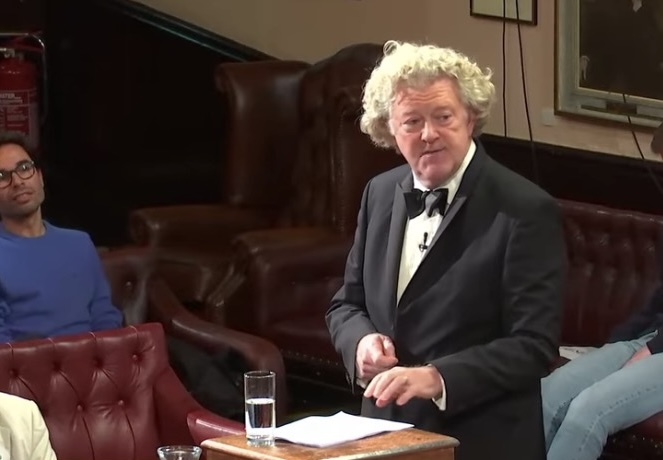
I appreciate it may be a bit ironic speaking for this motion dressed as a James Bond tribute act, but this is the situation that I find myself.
At the outset I want to acknowledge that there are various ways of fighting. Some of us pick up the pen rather than the sword. Some may fight by refusing their labour or by disrupting traffic on a street. But no matter what your weapon of choice, I would suggest that the only useful reason for ever fighting is for justice, and by justice I mean for systems and societies that preserve life rather than destroy it, and promote human happiness rather than create division: human rights are a cause worth fighting for. So too is environmental restoration.
Of course, there are times when taking up arms is justified. If your country is invaded, if your neighbours face extermination, then fighting may be the morally necessary thing to do. But that is not because your country commands it. It is because justice demands it. And if your country commands you to perpetrate injustice, then your moral obligation is to refuse.
So, if justice is our justification for fighting, we must also acknowledge that there have been occasions when British military intervention has made the world a more just place.
The Royal Navy led a protracted campaign against the trans-Atlantic slave trade in the first half of the 19th Century. After the fall of France, the continued resistance of Commonwealth nations, including Britain, to Nazi Germany helped secure the restoration of democracy in Western Europe. And the UK’s intervention in Sierra Leone at the beginning of this century helped bring an end to that country’s bloody civil war.
But as the old saying goes, even a stopped clock is right twice a day. So given the long martial history of Britain it is inevitable that it was going to be on the right side of history every so often.
These positive examples sit alongside a myriad of much more shameful military interventions including Britain’s conquest and exploitation of its colonies, the Opium Wars, the Suez crisis, the invasion of Iraq.
I am just about old enough to remember the Ballymurphy massacre in 1971 when the British Army killed nine unarmed civilians on the streets of Belfast. I am old enough to remember Bloody Sunday in Derry, when the British army murdered 14 civilians for having the temerity to go on to the streets of their own city to demand their civil rights. I am old enough to remember the Miami Showband massacre when loyalist paramilitaries including serving British soldiers murdered three defenceless musicians and tried to kill two more.
I remember the period documented in John Ware’s recent book, Neither Confirm Nor Deny, which explores some of the collusion between British intelligence and paramilitary organisations during the Troubles. I remember walking the streets of Belfast in those days, with the constant fear that those paramilitaries might visit one of their random attacks upon me or my family.
I am sure some of you have read the works of Stanley Milgram, or Christopher Browning. What their work suggests, notwithstanding important differences and criticisms, is that you do not need an army of psychopaths to perpetrate atrocities. You need a relatively small number of people willing to initiate brutality and a much larger number prepared to obey orders, conform to expectations or simply look the other way.
That is how perfectly ordinary people become accomplices to extraordinary evil. Versions of those dynamics were at work in the SS murder squads of eastern Poland during the Second World War, at My Lai during the Vietnam War, in the IRA’s Birmingham and Guildford pub bombings, and in the Hamas attack on festival-goers on 7 October 2023.
In each case, collective allegiance helped justify acts that should have been condemned by individual conscience.
So please understand the danger in treating fighting for King and Country as a virtue in itself. It asks young people in particular to surrender their consciences to the will of others whose interests and morality may never align with those of the people being asked to fight.
Now many of you may be fine with that. Many of you, as Cambridge students, may expect to soon be welcomed into the bosom of the ruling class of this country and anticipate that you will be the ones giving the orders rather than receiving them. If that is the case then vote accordingly.
But growing up during the Troubles in the North of Ireland, and through the course of my professional career in Afghanistan, Ethiopia and Angola, where I led humanitarian operations for civilians trapped in war, I’ve learned a few things: I’ve learned that war is not glorious or exciting, as Chris and Tobias might agree. Even just wars are evil things and victory in a just war can leave societies devastated for generations. I’ve learned that those who endure violence remember it longer than those who inflict it. Whatever action movies promise, violence rarely delivers the clean resolution that its advocates anticipate. War may defeat an army, but it seldom extinguishes the grievances, memories and hatreds that gave rise to the conflict. Indeed, war may only sharpen them and break the restraints on the most brutal of human instincts.
History has shown us again and again that this ideal of fighting for your country has been abused, sometimes by cynical people intent on gain, sometimes by silly ones whose only experience of war is watching The Great Escape on a Bank Holiday. Neither of those groups are ever likely to pay any price themselves for the violence that they unleash.
Perhaps Ed Miliband is finally in the process of crafting an independent foreign policy for the UK, one that is not based on the UK’s vassalage towards the United States, and by extension to the excesses of the Israeli state.
But consider the young RAF crews who were ordered to conduct surveillance flights over Gaza. The British government maintains that those missions were undertaken solely to assist in finding Israeli hostages.
Bloody Sunday. Hillsborough. Windrush. The Post Office scandal. I am sorry if this is news to you, but British public institutions have a long history of concealing wrongdoing and resisting accountability. So why should we blindly accept that everything that those young servicemen and women were ordered to do is lawful and morally defensible? Particularly when they were operating in the midst of a military campaign that has raised profound questions of international law and British complicity, and when those flights continued long after the International Criminal Court issued arrest warrants for Netanyahu and his former defence minister for alleged war crimes and crimes against humanity.
As the writer Omar El Akkad has put it, the day is coming when everyone will always have been against Netanyahu’s campaigns in Gaza, the West Bank, Lebanon and wherever takes his fancy next. When that day comes I fear that the complicity of the Sunak and Starmer governments in that violence will be seen to be another historical stain on the reputation of the UK.
So, you may one day find yourselves called upon to fight for your country. And perhaps the cause will be just. If so, you may decide that fighting is your moral obligation. But remember that even a just war must be fought justly. Do not allow the justice of any cause to become an excuse to cry havoc and let slip the dogs of war.
Do not confuse your country with its government. Do not confuse patriotism with obedience. And never mistake an order from your superiors for moral absolution.
As citizens, you have a responsibility to hold the powerful to account. Do not surrender that responsibility to the very people you are supposed to hold accountable.
Fight for justice if justice demands it. But never fight simply because King and Country tell you to.

