The Shortest History of Ireland, by James Hawes

Summary: “… in this great future we can’t forget our past, so dry your tears I say…”

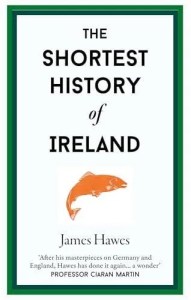
Perhaps not quite as arresting as his Shortest History of Germany, but James Hawes Shortest History of Ireland is an exquisite thing. 

Rather than allow himself to lose narrative momentum, Hawes does, perhaps, skip over a few historical controversies – notably the impact of the Invincibles’ atrocity on the Kilmainham “Treaty”, and Collins role in the assassination of Henry Wilson. But the overall coherence of that narrative, his rigorous attention to evidence, the entertainment of his storytelling and the elegance of the prose are exceptional.
It is refreshing to see proper attention given to the role of Hume in the peace process. This has become something of a rarity in recent accounts which tend to emphasise the parallel squalid spooky shenanigans that some English writers (yes I do mean Peter Taylor!) like to dubiously  assert were central. 

This is immediately the best concise history of Ireland available anywhere. So, it is nice that it concludes on a hopeful note albeit one that must be underpinned by caution: Irish reunification is now inevitable. 

To grasp the full potential of this demands careful planning, perhaps aiming for a new federal constitution based on the four provinces. The current Dublin-centric model of government hordes power in the very way the English did during their colonial exploitation of the island to the continuing detriment of those living “beyond the Pale.”

So, if this book has a moral it’s that if today’s Irish politicians don’t rapidly reconvene the New Ireland Forum to gather evidence and plan for the future, then they will deserve every iota of historical ignominy that will inevitably be heaped upon them. 

Life so far

On turning 60, I thought I should take stock to ponder if have spent my years usefully.

So what have I actually achieved?

Tick tock
  1. I started my professional career working for a couple of years organising hand dug wells for water, and check dams for soil conservation, in rural Ethiopia and Eritrea.
  2. Then I designed a piped water system for a quarter of a million war-displaced people outside Jalalabad in Afghanistan.
  3. After pushing papers in Oxford for a year or so I led a water, sanitation and public health programme for a quarter of a million war-displaced people in the besieged cities of the Angolan interior for the best part of five years.
  4. During that time I caught a sailfish off the coast of Angola. Tagged and released it.
  5. After Angola I learned to dive.
  6. Then I earned a PhD.
  7. I was appointed director of Anti-Slavery in 2006 and immediately had to organise its financial turnaround.
  8. I successfully advocated for making slavery eradication a post-2015 development goal.
  9. I found a woman who’d put up with me.
  10. I contributed to the introduction of a new statute in British law proscribing forced labour.
  11. I ran a marathon, very slowly.
  12. I helped expose slavery in the manufacture of garments for Western high street brands.
  13. I won Mastermind with the specialist subjects Michael Collins, the novels of Dennis Lehane, and Abraham Lincoln.
  14. I helped develop the jurisprudence around “abuse of a position of vulnerability” as a means of trafficking in the case of Chowdury et al v Greece at the European Court of Human Rights.
  15. I helped obtain inclusion of victim protection and supply chain transparency measures in the UK Modern Slavery Act (2015).
  16. I achieved recognition of forced marriage as slavery in the International Labour Organization’s 2017 estimates of global slavery.
  17. I published my 1st novel – The Undiscovered Country about the investigation of a murder during the Irish war of independence.
  18. I learned how to take a better photograph.
  19. I played a key role in mainstreaming anti-slavery in a major UN migration and livelihoods programme in Myanmar.
  20. I published Ethical Leadership: moral decision-making under pressure
  21. I published my 2nd novel – Some Service to the State about the damage caused by partition on modern Ireland.
  22. I worked out how to end slavery. Wrote it down in a book chapter called “Justice against Power: Marshalling a credible response to slavery eradication.”
  23. I’ve been an expert witness in over 200 trafficking cases.
  24. I began writing a play on the life of Frederick Douglass.
  25. I’ve started writing my fourth book on the Irish peace process… which has given me the idea for another play.

I think, on reflection, I have not led a life of quiet desperation. But that doesn’t mean it’s been without crushing disappointments.

Still, once more onto the breach, once more.