Summary: An indispensable channel, but not the Peace Process
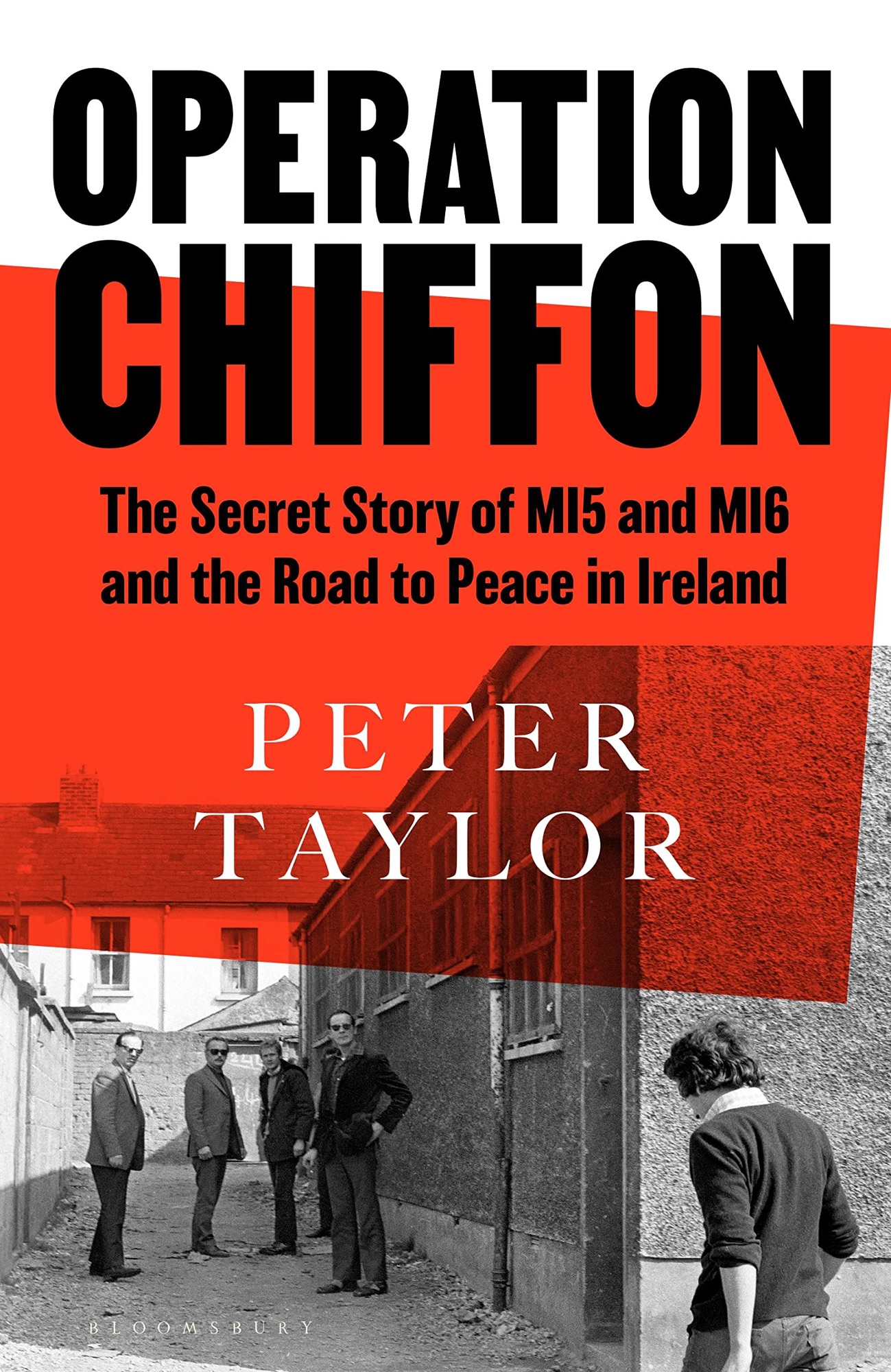
Operation Chiffon is Peter Taylor’s account of the “Back Channel”: the secret line of communication maintained intermittently between the British government and the IRA from the 1970s into the Peace Process.
Taylor focuses particularly on the MI6 officer Michael Oatley, his MI5 successor, known only as Robert, and their principal intermediary, Brendan Duddy, a Derry businessman.
It is an engaging story, worth telling not least to honour the courage and persistence of those who kept open the possibility of dialogue while the conflict continued. Uncovering its details has been a journalistic project of several decades for Taylor, and he tells the clandestine story extremely well.
Perhaps because he has invested so much in uncovering it, however, Taylor also invests too much historical importance in it. In his telling, the Back Channel becomes not merely one important element of the Peace Process but its decisive mechanism. Indeed, he endorses the contention that without it there would have been no Peace Process.
The wider political architecture receives remarkably little attention. Hume’s three-stranded approach to a settlement, the New Ireland Forum, the Anglo-Irish Agreement, Hume–Adams and the Downing Street Declaration are either treated briefly or relegated to the margins. The constitutional significance of the Anglo-Irish Agreement—giving the Irish government an institutional role in the affairs of a territory claimed as an integral part of the United Kingdom—is scarcely explored. Hume–Adams is also downplayed, on the highly dubious grounds that Martin McGuinness was more central than Gerry Adams to the republican movement’s strategic leadership: McGuinness was the Back Channel’s principal IRA interlocutor.
This mistakes access for authorship. The fact that McGuinness managed a crucial line of communication does not establish that the line itself generated the republican strategy or the political settlement. The Back Channel could communicate intentions, test propositions and build confidence. It could not, by itself, create the political circumstances in which an IRA ceasefire became possible.
Taylor gives particular weight to Robert’s assurance to McGuinness that the eventual outcome of the conflict would be Irish unity. Robert confirms that he expressed this view, apparently going beyond his instructions. Taylor presents the exchange as a decisive moment.
It may certainly have mattered. Coming from someone understood to represent the British government, it could reassure the republican leadership that Britain would not permanently obstruct constitutional change if consent for unity could eventually be secured. But that is different from supposing that Robert’s personal prediction transformed republican strategy. It is more plausible that his words corroborated conclusions already emerging from electoral experience, Hume–Adams, contacts with Dublin and the developing relationship between the British and Irish governments.
Seen within the totality of relationships that produced the Peace Process, corroboration appears to have been the Back Channel’s principal function. The British wanted to establish whether Irish government and SDLP assurances—that an inclusive political process could draw republicans away from violence—were credible. The IRA, in turn, wanted to know whether the political inclusion and constitutional openness promised by Hume and others would actually be delivered once it ended its campaign.
Republican caution was understandable. The movement had emerged from the 1975 ceasefire convinced that it had been induced to suspend its campaign, weakened in the process and offered no corresponding political advance. Whether or not that had been the British government’s deliberate intention, it became a powerful lesson within republican strategy: a ceasefire without reliable political guarantees could become a trap.
As a mechanism of mutual assurance, therefore, the Back Channel was extremely important. It allowed each side to test the seriousness of the other without public commitment and gave messages an authority that informal political contacts might have lacked.
But a channel is not the same thing as the process whose messages it carries. Without the political framework developed through the work of Hume and many others, there would have been little for Oatley, Robert or Duddy to communicate. Taylor has written a compelling account of one indispensable strand of the Peace Process. His mistake is to treat that strand as the fabric itself.