Summary: Alvor, Portugal




Summary: Alvor, Portugal
Summary: “… in this great future we can’t forget our past, so dry your tears I say…”
Perhaps not quite as arresting as his Shortest History of Germany, but James Hawes Shortest History of Ireland is an exquisite thing.
Rather than allow himself to lose narrative momentum, Hawes does, perhaps, skip over a few historical controversies – notably the impact of the Invincibles’ atrocity on the Kilmainham “Treaty”, and Collins role in the assassination of Henry Wilson. But the overall coherence of that narrative, his rigorous attention to evidence, the entertainment of his storytelling and the elegance of the prose are exceptional.

It is refreshing to see proper attention given to the role of Hume in the peace process. This has become something of a rarity in recent accounts which tend to emphasise the parallel squalid spooky shenanigans that some English writers (yes I do mean Peter Taylor!) like to dubiously assert were central.
This is immediately the best concise history of Ireland available anywhere. So, it is nice that it concludes on a hopeful note albeit one that must be underpinned by caution: Irish reunification is now inevitable.
To grasp the full potential of this demands careful planning, perhaps aiming for a new federal constitution based on the four provinces. The current Dublin-centric model of government hordes power in the very way the English did during their colonial exploitation of the island to the continuing detriment of those living “beyond the Pale.”
So, if this book has a moral it’s that if today’s Irish politicians don’t rapidly reconvene the New Ireland Forum to gather evidence and plan for the future, then they will deserve every iota of historical ignominy that will inevitably be heaped upon them.
On turning 60, I thought I should take stock to ponder if have spent my years usefully.
So what have I actually achieved?

I think, on reflection, I have not led a life of quiet desperation. But that doesn’t mean it’s been without crushing disappointments.
Still, once more onto the breach, once more.
Summary: images of Bologna, Modena and Florence





Summary: photographs inspired by the art of Mark Rothko




Bologna pavement, Emilia-Romagna







Summary: an evolving list
Ambrose Bierce defined politics in his Devil’s Dictionary as “The conduct of public affairs for private advantage”.
As Trump, Netanyahu and Putin continue to use this as their platonic ideal, here are a few more commonly used terms to better understand this brand of politics in the 21st Century.
Accountability — A principle once thought central to democracy, now regarded as the bad manners of social inferiors.
Betrayal — The dispatch of Caesar by his own signature methods.
Consolation — The knowledge that nits become lice.
Context — The reason a “tragic mistake” was all the enemy’s fault.
Decency — An elusive quality discovered in Caesar only after the knives have safely done their work.
Empathy — An existential threat arising from the dastardly impulses of fellow feeling and compassion.
Gullibility — A touching belief in the stories told by plutocrats.
Hypocrisy — The art of applying opposite principles with identical conviction.
Human moment — A politician’s self-pity.
Human rights — Rights universally acknowledged until someone inconvenient claims them.
Investigation — A process for discovering that a “tragic mistake” was unavoidable.
Realpolitik — A posh name for complicity in atrocities
Responsibility — An elusive quality, once thought central to professionalism, now applied only to those without sufficient privilege.
Rule of Law — An antiquated idea, dating back to Aristotle and Sophocles’ play about that loser Oedipus, that even important people should be accountable.
Self-defence — Violence committed by ourselves.
Special relationship — How vassals describe their vassalage.
Terrorism — Violence committed by the enemy.
Tragic mistake — Violence committed by ourselves against civilians after we got caught.
Wealth — The safest substitute for wisdom and expertise in policy discussions.
Wisdom — The consolation losers derive from losing. Of obsolete utility because of wealth.

Summary: on a theme of blue







Summary: The myth that violence solves problems persists despite history often proving the opposite.
At the end of John Steinbeck’s Of Mice and Men, George shoots his friend Lennie. Lennie, a well-meaning but simple-minded man, does not understand his own strength or the fragility of others. So, he has accidentally killed a young woman, and George knows that if the mob reaches him first Lennie will be tortured before he dies.
Steinbeck understood something that popular culture often forgets: violence rarely solves anything cleanly. Yet in cinema it frequently does. From Westerns to modern action films, societies’ problems are tidily resolved by lethal force.
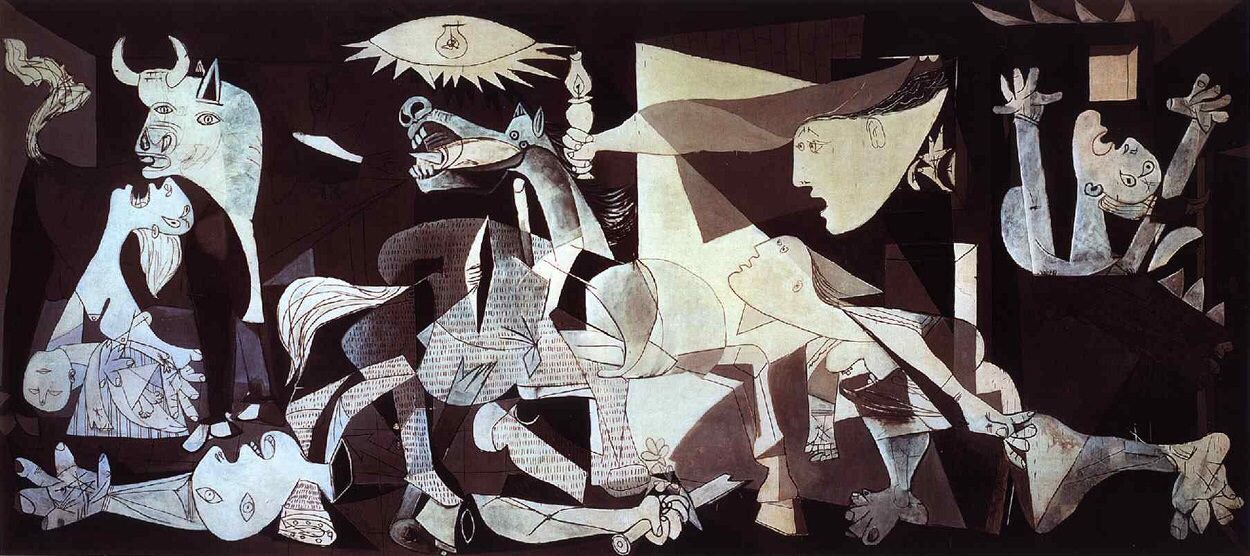
Wyatt Earp invariably sorts out his society’s ills by use of his six-guns. James Bond’s liquidation of supervillains always makes the world a better place.
The satisfactory resolution of daunting problems through the use of violence is so commonplace a trope in cinema that it is perhaps now as deeply embedded a cultural idea in the West as that of Santa, and the Easter Bunny. However, unlike these last two myths, some adults seem to continue to believe it.
Put another way, in spite of the vast historical evidence to the contrary, they believe that the most complex of geo-political problems can be solved, as Eddie Izzard’s character says in the movie Valkyrie, “with the careful application of high explosives.”
Anyone who has any experience of actual war will attest that the matter is much less clear-cut. Violence tends to be the bluntest instrument in problem solving, often ineffective and opening as many new problems as it was meant to resolve.
As Shakespeare warned, in war the dogs are let slip. The ensuing carnage leads to the ties that bind society being sundered, civilians being slaughtered in even the most “surgical” of military strikes, and the infrastructure of daily life being decimated.
There may be diverse reasons that people celebrate the unlawful 2026 US-Israeli assaults on Iran and studiously ignore the piles of children’s corpses that have resulted. What those celebrating have in common is a lack of empathy with the innocent falling under the weight of metal, and a lack of imagination about what will transpire. In particular, they fail to conceive of the legacy of bitterness that will result.
Violence rarely ends a conflict. More often it plants the seeds of the next one. As James Baldwin noted, “The perpetrator always forgets; the victim never does.” Societies that know little history never learn this truth. That has long been true of much of England. It is also true now of the United States.
Anyone who watched the Tucker Carlson interview with US Senator Ted Cruz will have been struck that US foreign policy is being made now by the spectacularly ignorant. Cruz did not even know the population of a country he thought the US should invade.
Such people are malicious contemporary equivalents of Steinbeck’s Lenny – simple-mindedly disdainful of complexity, absent of empathy, and contemptuous of those who are fragile before their military strength.
The world is currently in the hands of such dangerous buffoons, people who treat violence as a solution and assume they will never face consequences for the murderous destruction they unleash.
Even Steinbeck would be at a loss to find a neat narrative resolution to deliver us from their evil.
Summary: Theatre in a theatre of brutal war.
Glorious Exploits is something of a literary first cousin to Michael Hughes’ superb Country, a retelling of the Iliad transposed to the mountains of South Armagh during the Troubles.
Like Hughes, Lennon tells his story of the ancient world in an Irish vernacular – Dublish, in this instance – and the result is a comparable dark magic that brings to unsettling life a barbarous moment from humanity’s bleak history.
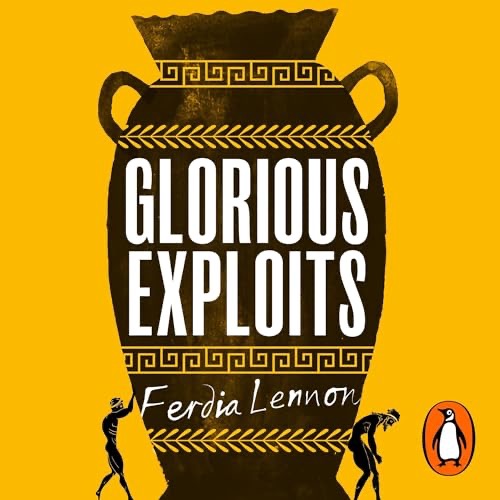
In the aftermath of the collapse of the Athenian invasion of Sicily two literature loving Syracuse potters, Lampo, the narrator, and his childhood pal, Gelon, take to visiting the prisoners, exchanging food for snatches of Euripides. After a while Gelon has the idea of staging a full production of Euripides’ masterpieces Medea, and his new play, The Trojan Women, with the doomed Athenian prisoners in the quarry where they are quartered.
Though his motives are never fully explained, one gets the sense that Gelon hopes to provoke an empathy for the prisoners similar to that Euripides encourages his audiences to feel for his tragic protagonists. This, perhaps, might save both some prisoners and a threatened portion of Syracuse’s soul as it hovers on the edge of a monumental war crime.
The story is based on a true episode in the ghastly Peloponnesian War, and Lennon’s imaginative exploration of it in turn seeks to provoke in the reader an empathy for the long-dead, and help understanding that war’s pities are a constant in human history.
Glorious Exploits is a wonderful book.
Summary: “In a country where they turn back time/ You go strolling through the crowd like Peter Lorre/ Contemplating a crime“





















 aidanjmcquade