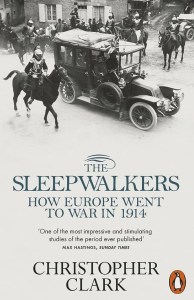
The Sleepwalkers: how Europe went to war in 1914, by Christopher Clark

Summary: So… it was everyone’s fault… but mostly Serbia.

The historian AJP Taylor in his celebrated BBC lectures, How Wars Begin, stated that everyone knows why the Second World War began, but not when, and everyone knows when the First World War began, but not why.

The Sleepwalkers, Christopher Clark’s detailed examination of the origins of the First World War clears up some of that “why” question, but not in any simple way. He describes an interconnected system of “great” European powers – and Serbia – who all took for granted their right to interfere in the affairs of other nations and which developed enormously complex systems of alliances and interests to allow them to do so.

Bizarre imperial attitudes to other countries were not the only strange notions to infest the chancelleries of Europe pre-1914. Many of the denizens of these corridors of power talked seriously of the idea of “preventative war”, which remains, to put it crudely, as much a contradiction in terms as the idea of fucking for virginity.

Hence at the outset of the 20th Century, Europe represented not so much a house of cards destined to collapse sooner rather than later, but a tangle of explosive devices being randomly hit with hammers by supercilious poshos with Napoleonic delusions.

The spark that finally triggered to conflagration was, of course, the assassination of Archduke Franz Ferdinand and his wife, Sophie, in Sarajevo, by the young Serbian nationalist Gavrilo Principe. This was done at the behest of elements in the Serbian government which feared Franz Ferdinand’s intent to increase Slavic representation in the Austro-Hungarian empire. This, Belgrade felt, threatened their dream of a greater Serbia. Franz Ferdinand’s assassination also removed one of the most pacific members of the Austro-Hungarian government and made their impetus towards a war of vengeance all the more assured. From the rubble, of course, Yugoslavia was fashioned, so maybe some Serbs felt the price was worth paying. And didn’t that turn out well.

Some of the dangerously fanciful notions that sparked the cataclysm may have dissipated from Europe, particularly since the rise of the European Union, which was fashioned to make war “not only unthinkable but materially impossible.” However, Clark notes that other dangerous impulses are still at play. Referencing the Euro crisis of 2009/10, Clark describes how, just as in 1914, some countries were prepared in negotiations to use the risk of catastrophic failure for all to advance local interests for some. Similar short-term, selfish interests threaten progress on the climate crisis, which may yet dwarf the carnage of the First World War.

So, a bleak book, but an engaging and thought provoking one, snappily written and frequently gripping.

In search of the Dark Ages, by Michael Wood

Summary: a fine introduction to pre-Norman English history

Over the past 40 years Michael Wood has become known for his highly engaging television documentaries. Some of the books that this has prompted, such as The Story of India, are essentially travel books. Others, such as In Search of Shakespeare, are much more substantial affairs.

Fortunately, In Search of the Dark Ages falls into the latter category. It is a fine history of England from the departure of the Roman Legions to the Norman conquest. Along the way Wood throws out a range of interesting observations and asides, including a judgement that, based on what he wrote in his Confessions, St Patrick was probably from Carlisle.

In the latest edition of this book, Wood has added material on hitherto neglected figures and issues, including Aethelflaed (Millie Brady’s character in the Last Kingdom), who Wood judges to be comparable to her father Alfred in the making of a country called England, and Theodore of Tarsus and Hadrian the African who together established a school teaching the classics in Canterbury during the 7th Century. Just as is the case today, women and immigrants have contributed more to English society than many would like to acknowledge.

Overall then, a fine and entertaining work of English history before William the Bastard showed up in 1066 and helped make stealing other people’s countries the defining trait of the country he stole himself.

Five Decembers, by James Kestrel

Summary: a surprising and compelling crime story to the backdrop of WW2 in the Pacific.

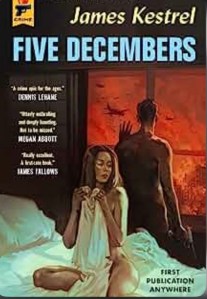
The gloriously lurid, pulp-fiction style cover of Five Decembers suggests it’s going to be one thing: American hard-boiled crime a la Mickey Spillane. There is an element of this: Detective Joe McGrady of the Honolulu Police gets a call to investigate a particularly sadistic double murder in November 1941.

McGrady, however, is something a bit different from your typical Shamus. An ex-Army officer, with a romantic streak, and a history of personal tragedy, who remains intellectually curious having taken the time to learn a bit of Mandarin and appreciate Asian culture in the course of his career. So, by the time we meet him sipping whiskey in a late night bar, it turns out he is markedly nicer than one might have expected on picking up this book. Indeed, most of the characters are a lot nicer than you might expect, generally treating each other with at least professional courtesy, if not genuine affection.

This is important as McGrady is among a small group of characters in the book whose fate the reader can actually care about as his protracted investigation, and personal travails, stretch across the wretched years of war.

The book takes more than one unexpected turn. Not the least of these is its echo of Slaughterhouse Five with a description of the murderous firebombing of Tokyo – something that one of its planners, future Defence Secretary Robert McNamara, even acknowledged was a war crime – and its chilling aftermath.

So, Five Decembers is a surprising novel: not only a fine procedural, but also a thoughtful rumination on the pity of war. It is all the more remarkable and satisfying as a result.

The Secret Hours, by Mick Herron

Summary: 1990s Spook Straße, Berlin: Moscow Rules very much apply

While not quite a Slough House book as readers have come to know them, The Secret Hours is something of a prequel. It tells the story of a questionable British operation in 90s Berlin undertaken by an experienced British intelligence officer known as “Myles”. Readers of the Slough House series will understand the importance of the detail that this particular officer is known to fart a lot.

The story of this operation is told in flashback to an enquiry into malpractices by the intelligence services. Naturally, of course, the ancient history related to this operation has its repercussions in the present. Just because some people are dead, does not mean the past is. As the story evolves, it becomes plain, as Faulkner well understood, that it is not even past.

To say too much more risks exposing some of the deeply satisfying plot twists and narrative sleights of hands that Herron employs in this book. Suffice to say, it is a glorious addition to the Slough House universe and one of the best, to date, in the series.

Empireland, by Sathnam Sanghera

Summary: a gripping and elegantly written survey of the bloody British empire and its echoes in the present day

Between 1845 and 1854 the population of Ireland was halved through starvation – over a million people died – and forced emigration. The English like to refer to this horrendous period as the “Irish Potato Famine”. This suggests the blame for the cataclysm lies with Irish people’s bizarre and somewhat comical taste for spuds, rather than upon callous government policy that thought the death of hundreds of thousands of Irish people a price worth paying for British profits in the agricultural free market.

Paradoxically Sathnam Sanghera sticks with this nomenclature in his exceptional book Empireland. This book both elucidates many of the other atrocities upon which the British Empire was built, and explores the imprint that sustained bloody exercise in pillage still leaves upon contemporary British society. The term “potato famine” is part of that imprint.

There is an echo in this book of Tom Holland’s Dominion, which explores how Christian thought – such as the ideas of human rights and secularism – has so fundamentally shaped European civilisation that the origins are now generally unknown and almost unnoticed.

The British empire brought nothing so positive as human rights to the UK let alone the rest of the world. Rather it became, for much of the world a byword for bloodshed and impoverishment. But the British – in marked contrast to those societies that were on the receiving end of their colonial project – are startlingly ignorant of what Empire entailed or of its repercussions through time. Few British people now have heard of the murderous British suppression of the Sepoy rebellion of 1857, let alone of the sacking of Tibet in 1903 – even though some of the extremely valuable loot once showed up the BBC’s Flog It while Sanghera was writing this book.

And yet the consequences of all that bloodshed is with us at every turn. The British Museum is stuffed with art treasures, such as the Benin bronzes, stolen in the name of Empire. London’s position as a major financial centre is a consequence of the preferential trade terms and punitive tax regimes that the Empire imposed on subject peoples. British xenophobia towards migrants is a contemporary manifestation of the racism of Empire. The presumption of the British ruling class that the rules – whether relating to human rights, trade or public health lockdowns – that apply to others should not apply to them are also echoes of the political economy of the Empire.

Indeed, Brexit may be regarded as the inevitable consequence of the racist logic that underpinned the British Empire: having no more colonies to pillage, the British Establishment instead decided to loot the UK.

Sanghera’s book is a superb and important introduction to this inglorious period of British history and its reverberations into the present. It is elegantly written, accessible, and vital for anyone who wants to understand better why Britain finds itself in its current morass.

I just which he would quit it with his talk of “potato famines”.

Sword of Honour, by Evelyn Waugh (Men at Arms; Officers and Gentlemen; Unconditional Surrender)

Summary: Waugh’s war, through a glass slightly smudged

In 1939 Guy Crouchback returns to Britain from Italy, where he has been nursing a broken heart since his wife, Virginia, left him. His intention is to play some part in the looming war against the totalitarian alliance of Nazi Germany and the Soviet Union. As he prepares to depart Italy he prays at the grave of a fallen knight, known locally as the “English Saint”, who on his way to Palestine to fight in the Crusades, was killed in a local squabble between Italian warlords.

Guy hopes that his war will not be as abject a failure as that. As it transpires his career substantially replicates that of Evelyn Waugh himself: involvement in a dangerous and confused raid on Vichy France at Dakar in Senegal; experience of retreat and defeat in Crete; years of desk jobs in Britain before posting as a liaison officer to the partisans in Yugoslavia.

Along the way he encounters an array of colourful comic characters including Richie Hook, a psychopathic old officer; Trimmer, a charlatan and chancer who the army decide would make a useful national hero; and, almost inevitably, Virginia, his ex-wife, still beautiful but falling on increasingly hard times.

Waugh’s account of all of this is frequently extremely funny, but always shot through with a profound melancholy, as the compromises of war and realpolitik lead to a growing realisation that this is not the glorious crusade that Guy had hoped for. But then neither were the Crusades.

Throughout it all though, Guy remains a sympathetic, almost tragic, protagonist. His courage is rarely acknowledged and never rewarded with responsibility. Nevertheless, his Catholic faith, as his father reminds him, is about something eternal. This he tries to stay true to it by being a decent man even though, as he discovers, he lives in a world in which decency, as easily as callousness, is something that can get people killed.

Waugh’s Sword of Honour trilogy is not so much about the horror of war as of the disillusionment of politics. It is an exquisite work: a classic for a reason.

Finding the Telling Detail: Understanding a Photograph, by John Berger; On Photography, and Regarding the Pain of Others, by Susan Sontag.

Summary: on trying to learn how to take a photograph

In 2004, the Finnish-American photographer, Arno Minkkinen, presented to the world his Helsinki Bus Station Theory of Photography. In summary, he argued that just as all the buses from the Helsinki bus terminal stop at the same first three stops before going to wildly different places, that the work of any photographer, over the first three years of their career, is going to be derivative of the work of somebody else. This is irrespective of what genre the photographer chooses to specialise in, from nudes to landscape to war photography: somebody will have been there before. Originality only emerges after persistence and practice over years. Or, as Minkkinen put it, if you “stay on the fucking bus,” rather than give up as soon as you recognise who your work is aping.

That is all well and good if you know which bus you want to get on in the first place. That is why people read Susan Sontag and John Berger: to work out what sort of photographer they want to be.

For me, John Berger provided an initial inspiration with his observation that some photographers work with “emancipatory” intent. After half of my professional career in humanitarian response and development, and the other half in human rights and anti-slavery work, this idea struck a chord with me, but still left me short of ideas of how to proceed.

Sontag’s photography books, paradoxically lacking any photographs, are not short of ideas. She writes of the philosophy of photography and photographers. Both of her books are enormously rich and challenging affairs. In particular, I found that On Photography required more than one reading to come anywhere close to fully appreciating the depth of her thought on the subject. Regarding the Pain of Others, perhaps because I have some experience of living and working in war zones, perhaps because I had read On Photography first, I found much more accessible.

Photography, Sontag observes, like sex, cooking and dancing, is a democratic art form that anyone can participate in. But just because anyone can press a button does not mean that anyone can take a good photograph. So, Sontag explores why some photographers not only take good photographs but take photos that are sometimes deemed worthy of putting in a museum.

And, there appear to be as many answers to this question as there are such photographers. Nadar reckoned the best portraits he took were of people he knew. Avedon reckoned his best portraits were of people he did not know. Cartier-Bresson reckoned you should think before and after taking a photograph, but definitely not during.

That successful photographers work to such diverse, sometimes mutually exclusive, ideas is one of the paradoxes of good photography. Perhaps I found an explanation from Berger’s own reflections on Sontag, “The camera saves a set of appearances from the otherwise supersession of further appearances…before the invention of the camera nothing could do this, except in the mind’s eye, the faculty of memory.”

So, perhaps what makes a photographer good is when they learn to capture with the camera that which they would wish to remember, or perhaps wish others to remember.

That gave me an idea.

One of my first experiences working in Africa was a visit to a poor neighbourhood in Addis Ababa, Kebele 37. Amidst the open sewers and crumbling mud houses densely packed together amidst a warren of streets I saw that someone had planted a geranium outside their door, in a salvaged cooking oil tin from a food distribution. There was something about that telling detail which seemed to me to encapsulate the indomitability of humanity, even in the midst of such dire poverty.

As a student of photography, that is the sort of image – the telling detail – that I want to capture, to emancipatory purpose when I can.

The Oyster Shucker

With that thought in mind I went for a walk in Borough Market and took the first photo that I think begins to express the sort of photographer I want to be.

Of course, after looking at it a while I thought, “That’s rather derivative of Salgado.” But that’s okay. I think that is the bus I want to be on. Let’s see where it takes me now.

How shall we fail thee, comrades? Part 2

Summary: Basic innumeracy is at the heart of Labour’s intolerance of independent thought in its ranks

The UK’s electoral system is a gerrymander. The population of England is broadly centre-left when one amalgamates the 2019 votes of Labour, the Lib-Dems and the Greens. In spite of this the Conservatives have a massive majority in parliament. This sort of systemic anti-democracy sparked a civil rights movement in the North of Ireland in 1968. However the English continue with their bovine acceptance that this is the best electoral system in the world, because it’s English, just as many still believe that the British response to Covid was “world-beating” irrespective of how many corpses pile up.

Currently so egregious has been Tory government over the past decade, Labour looks set to go into the next gerrymandered UK general election with a poll lead sufficient to overcome the bias in the electoral system. Their confidence is heightened by a dubious belief that their message is cutting through to Scottish voters, that they should know their place in the UK rather than having the audacity to seek their rightful place as an independent nation in the European Union.

The prospect of victory makes the Labour leadership sanguine about the need for electoral reform or electoral alliances. It also seems to be a factor in the party’s increasing intolerance of independent thought, of the voices that suggest that the party’s policy on Brexit is as believable as unicorns, and the party’s attitude to electoral reform and electoral alliances smack of hubris.

This seems to be what is behind the the heave to expel Neal Lawson – and others – from the Labour party for having the temerity to support the ideal of electoral alliances and, by implication, recognising the futility of voting Labour in a constituency when there is negligible prospect of a Labour victory in a first-past-the-post election.

UK Labour has never properly backed the introduction of proportional representation in Westminster elections. Even when the PR-lite “alternative vote” system was offered to the UK electorate a decade ago, many Labour leaders grumbled that it was “too complicated.” It is difficult to conclude that basic innumeracy is not a major factor in this.

Every other country in Europe has PR. Scotland and Northern Ireland have it for elections for their devolved government structures. Mayoral elections in England have previously used the alternate voting system. Why do so many in the UK’s political elite think such a system is too complicated for the English electorate?

Truth is, you do need a basic understanding of fractions and decimal numbers to be able to fully understand most systems of proportional representation. You know: the stuff you were taught in primary school, shortly after “one plus one equals two.”

But more fundamentally, the two major British political parties continue to support FPTP because it suits them. It guarantees the Tories the lion’s share and Labour, who know their place, get the occasional sniff of the leavings.

Given the utter incompetency and cynicism of the current Tory government, Labour can perhaps be reasonably confident of winning the next UK general election. But, given that Labour has swallowed whole the poisoned pill of Boris Johnson’s Brexit, the Tories can also be confident this may well be a one-term Labour government as Labour’s promise to “Make Brexit Work” is shown up for the ludicrous fantasy that the Tories already know it to be.

The Restless Republic, by Anna Keay

Summary: a fine and elegantly written, though overwhelmingly Anglo-centric, account of Cromwell’s dictatorship

In the 2001 film, Rat Race, one family participating in the race stumble upon a “Barbie Museum”. It turns out this does not house a collection of the beloved children’s toy, but rather is a homage to the Nazi war criminal, Klaus Barbie. As one of the deranged guides tell them, “People don’t remember just what a wonderful ballroom dancer he was.”

I thought of that movie while reading Anna Keay’s rather affectionate portrait of Oliver Cromwell in the Restless Republic. He may have overseen the massacres of thousands of people, soldiers and civilians alike, children, women and men, in his racist campaigning in Ireland – something that is mentioned rather than described in any detail in this book. But “Oliver” loved music and could be moved to tears at the accomplishments of his beloved children.

The planned wholesale theft of Irish land by the Cromwellian government and the planned complete ethnic cleansing of Catholics from eastern Ireland required remarkable technical organisation and unprecedented accomplishments in land surveying. This Keay does describe in admiring detail. But eventually, before it could reach its genocidal climax, this “ugly episode in Irish history” was brought to an end. Obviously, as Irish history, it is not something that the English need feel too much responsibility for.

Keay choses to tell the story of the short-lived English republic through the eyes of a range of characters, almost exclusively English, but including both Royalist and Parliamentarian perspectives. It is an imaginative approach and engagingly done, with a strong narrative drive. For example, towards the end, her account of Monck and Fairfax’s machinations to bring about the restoration of the monarchy is quite gripping.

Overall, the Restless Republic is an illuminating and elegantly written work of history. But, appropriate to the theocratic monstrosity of which Keay writes, and to the spirit of Brexit Britain too, I suppose, it is written with negligible empathy for the aspirations and experiences of those non-English people who bore, and continue to bear, the brunt of the English Parliament’s ignorance and crass prejudices.

Artificial Intelligence and Ethical Leadership

The warning on 30 May 2023 by industry experts that Artificial Intelligence (AI) might lead to human extinction was a sobering moment. Given this, I wondered again what are the ethical leadership challenges – relating to the protection of human rights and restoration of the environment – this new technology poses?

I started by asking a “Large Language Model” (LLM) AI system ChatGPT:

“1. Ensuring data privacy: …; 2. Promoting responsible use of AI: Leaders should ensure that AI systems are being used in a responsible way, free from bias and discrimination. 3. Developing AI systems ethically: Leaders should ensure that AI systems are developed with ethical considerations in mind, including avoiding the use of algorithms that have the potential to cause harm. 4. Addressing job displacement: ….; 5. Ensuring accountability: Leaders should ensure that AI systems are held accountable for their actions, and that any mistakes made by AI systems are addressed. 6. Encouraging responsible innovation: Leaders should encourage the responsible use of AI and the development of ethical AI systems.”

It’s okay in so far as it goes, and a bit more candid about risks associated with AI than, for example, Microsoft’s happy-clappy advertising for “Co-pilot”, the AI that it is embedding into its Office suite. This focuses on the undeniable promise of productivity that AI brings, for some
professionals at least.

But the ethical choice-making that ChatGPT asserts is so important in AI is dependent on
morality, and it is not at all clear what is the moral basis upon which AI algorithms are being
constructed.

In the April 2023 edition of the Economist, the paper noted that some AI systems “produced
strange results. Bing Chat suggested to a journalist that he should leave his wife. ChatGPT
has been accused of defamation by a law professor. LLMs produce answers that have the
patina of truth, but often contain factual errors or outright fabrications.
” I found that when I
asked ChatGPT about myself: some biographical details were correct, such as that I have
written two books, but it could not find anything close to their correct names and so just
made stuff up. I think that may be the sort of thing that Microsoft, euphemistically, calls
“usefully wrong.”

But these are trivial enough errors: they are not going to cause an existential crisis for
humanity. But, as leading experts have already warned, AI itself might yet. In April 2023 the Economist reported that, “The degree of existential risk posed by AI has been hotly debated. Experts are divided. In a survey of AI researchers carried out in 2022, 48% thought there was at least a 10% chance that AI’s impact would be “extremely bad (eg, human extinction)”. But 25% said the risk was 0%; the median researcher put the risk at 5%. … researchers worry that future AIs may have goals that do not align with those of their human creators.”

A 5% risk is not a trivial one. This sort of risk was a matter that Isaac Asimov famously pondered when he developed his laws of robotics in the 1940s. Having formulated three laws, including his first, that, “A robot may not injure a human being or, through inaction, allow a human being to come to harm.” Asimov realised, as any viewer of the movie, I Robot, will remember, that something was missing. So, he formulated his “Zeroth Law”: “A robot may not harm humanity, or, by inaction, allow humanity to come to harm.”

There is an argument that you cannot, and some would say should not, build morality into
machines.
For example, Asimov’s first law would incapacitate some of the lethal hardware
so beloved of armchair militarists. But it seems incontestable, indeed inconceivable, that
any AI should be permitted without some robust moral systems to constrain its most dangerous excesses.

There may be better moral systems to guide AI than Asimov’s laws. But if AI is trying to
break up marriages on a whim or defaming a law professor, or anyone else for that matter,
it appears that it does not yet have any moral guidance at all.

So, here’s the rub. If programmed from the outset with some key moral principles, computers will not forget to remember them, as they write increasingly advanced programs for future AI generations. However, it seems that many of the human beings initiating these AI processes have sometimes eschewed moral principles in the rush to technological advance.

This should not, perhaps, be surprising. In recent years we have seen a number of controversies in relation to the use of information technology: In the UK, for example, a group of wealthy ideologues convinced a plurality of British voters, in part through the manipulation of information systems, to vote for Brexit unconcerned with the damage it would do to the economy, to Irish peace, and to the fragile bonds that hold their own country together. Similar information manipulation was at play in the election of Donald Trump in 2016. Yet more seriously still, the manipulation of information systems was also a major factor in instigating the genocide against the Rohingya people in Myanmar that same year.

When confronted with the issues arising from these events, some of the leading industry
figures involved have proven themselves moral vacuums. And these are the people who will
be leading much of the industrial development of AI. Will they be as concerned as Asimov
was about any potential threats to humanity arising from their work?

In spite of the information industry’s warning about the risk of human extinction, I would not want to bet my life on this. The leaders of so many other industries are already overseeing an environmental collapse with no discernible concern for a future that will threaten the lives and livelihoods of their children and grandchildren. The 30 May 2023 warning of the perils of AI aside, tech leaders have so far proven themselves no more concerned with the consequences of the moral choices that they are making for their businesses. For some, the scientific innovation associated with it will be just too fascinating to eschew. Others will not be concerned with the future if they can make lots of money now.

The Economist reports that the EU is considering robust regulation on the development of
AI, and the Biden administration has started a consultation on the same thing. These are
positive moves, but no one should rest easy yet. Unsurprisingly, for a government (and
opposition) that lacks the moral courage to tell the truth about the realities of Brexit, the UK
has until now been proposing a “light touch” approach to AI regulation. This is in the hope of attracting some unregulated tech businesses to compensate somewhat for the industries that their Brexit has already devastated.

In the face of such a pusillanimous abrogation of responsibilities, ethical leaders in business
and the citizenry alike need to respond: to make different professional choices that ensure
that the preservation of life and the restoration of the environment are at the heart of their
organisational strategies, and, through protest and political engagement, to demand that
politicians do the right thing not the easy one.

Protest is, and always has been leadership. But, given the crises facing humanity currently, it
has never been so urgent. And, given the rapidity of AI’s development, the moment at which
it can be constrained by law, regulation and morality may be receding as quickly as the opportunity to stave off ecological collapse.