Small Vices, by Robert B Parker

Summary: Spenser on sparkling form
Spenser’s pal, the high-flying lawyer Rita Fiore, hires him to look into the conviction of a black man, Ellis Alves. Alves, a petty criminal with a history of sexual violence, has been sent to prison for the apparent sexual murder of a young student. The thing is, Alves, unpleasant a human being as ever there was, might not have actually done it.

Spenser starts poking about in the case with his usual mixture of insight and irreverence and finds the cases against Alves to be a bit on the fishy side. All the more so when folk start showing up threatening to do him violence for asking questions in the wrong places. In this instance, however, the violence that they are threatening may, for once, be more than Spenser can handle, even with the capable assistance of his buddy, Hawk.

Parker’s Spenser is a great creation – smart, kind and tough in equal measures, in the mould of the classic knight errant of American gumshoe literature, dwelling amidst a great community of characters, cops and crooks alike. This is a particularly satisfying episode in his literary career, when he finds himself faced with an opponent who may be his martial superior. All in all, a  great episode in the Spenser canon.

The Pale Criminal, by Philip Kerr

Summary: A bleak tale of serial murder as the Nazis prepare to liquidate Berlin’s reputation for toleration

It’s 1938 and Bernie Gunther is enjoying a decent living in Berlin as a private detective, blackmail and missing persons a speciality. Unfortunately Reinhard Heydrich has not forgotten him. He press-gangs Bernie back into the police to oversee the investigation into an apparent serial killer, one who is butchering Aryan schoolgirls in a manner that bears striking resemblance to what anti-Semitic propaganda portrays as Jewish ritual blood sacrifice.

I didn’t enjoy this particular outing of Bernie Gunther as much as others in the series. Perhaps it was the bleakness of the subject matter. Perhaps it was the violence of the plot. Perhaps it was that the portrayal of life in the tolerant capital of a state that has set itself on a path to self-destruction through its surrender to atavistic racism felt a bit close to the bone in post-Brexit London. Perhaps it was the way the recurrent invocation of “the will of the people” by the Nazi characters as justification for their every squalid deed that bothered me: it was like spending my leisure time with a bunch of moronic Brexiteers invading my reading. Perhaps it was a combination of all these things.

Aside from this there is still much to recommend the novel, its labyrinthine plot reflecting the tortuous descent into evil of the nation in which it is set; its detailed historical research and well drawn characters, even the monster Heydrich is recognisably human. And of course it has at its centre Bernie Gunther as our guide: morally compromised, lonely, and striving to be decent. In spite of all he remains likeable and with a firm grip on his flawed humanity. Still one of the greatest literary detectives.

The Great Crash 1929, by JK Galbraith

img_1233

JK Galbraith

Summary: A witty, but challenging, take on how human greed and folly devastated the lives of millions

Some years, like some poets and politicians and some lovely women, are singled out for fame far beyond the common lot, and 1929 was clearly such a year.” 

John Kenneth Galbraith, the legendary economist and public servant, wrote this book in the midst of difficulties he was having in completing another, The Affluent Society. The result is generally regarded as the definitive work on the Crash. But in spite of the seriousness of the subject Galbraith writes with a lightness and humour that leavens the complexity, and which pokes fun at the folly of human beings.

img_1232-1Because what Galbraith depicts is a sort of collective madness that gripped a nation, or more specifically the wealthy of the nation: it was only really they who had the cash to speculate. The rising market of the 1920s convinced many that they could become rich without much effort. It was this delusion combined with extraordinary social inequality, other structural defects in the economy, and inadequate mechanisms and political will to regulate the craziness that led to a Crash of enormous proportions, which acted as a prelude to the Depression and the devastation of millions of lives across the globe.

Galbraith notes that, “I have never adhered to the view that Wall Street is uniquely evil, just as I have never found it possible to accept with complete confidence the alternative view… that it is uniquely wise.” But, as John Lanchester demonstrates in his book,”How to speak money”, the opacity of financial and economic language makes these sectors relatively immune from the sort of democratic scrutiny that other critical sectors, such as defence or the public services, are routinely subject. In such circumstances those who have mastered the language can appear sagacious to the uninitiated.

Galbraith describes in colourful terms just how dangerous this is and the risks that pertain when this happens. As the 2008 crash showed the economy has not yet been inoculated to human deceit and folly, and citizens must remain vigilant lest some future charlatans seek to sell financial snake oil to the rest of us.

Lamentation, by CJ Sansom

img_1225Summary: Henry VIII really wasn’t a nice man. What could possibly go wrong if you upset him?

Matthew Shardlake, the lawyer protagonist of Sansom’s series of Tudor detective novels, is asked by the queen, Catherine Parr, to help with a most delicate matter. A book she has written, Lamentation of a Sinner, has disappeared from her private apartments. The book contains some ideas that the king, Henry VIII, might find heretical and hence could lead to her death, possibly by fire as a heretic.

Shardlake, smart, a bit grumpy, and tolerant is a compelling guide through the insanity of Tudor London. Here the idea of freedom of conscience is little known and life and death depend on being seen to be slavishly devoted to the whims of the king’s religious pronouncements. In this book Shardlake guides us through a labyrinthine plot involving multiple cases, complicated by suspicions of religious orthodoxy and multiple murderers with opaque motives and loyalties.

There is a pervasive sense of dread to this book. It is clear from the outset, a horrific multiple execution by burning, that even well-liked characters from earlier books are not safe, and skill, intelligence and decency are faint protections from the capricious cruelties of tyranny.

One bonus to this book is a detailed historical note at the end in which Sansom speculates on a range of historical issues – from the cause of Henry VIII bloating and death (untreated type 2 diabetes, Sansom reckons) to the fate of Catherine Parr. In this Sansom notes that Elizabeth I, as a child, was sexually abused by Thomas Seymour, Parr’s last husband. Disturbingly this sordid tale was turned into a romantic drama, Young Bess, in the 1950s. This led me to wonder what sort of sick mind would ever wish to turn the story of a child abuser into that of a romantic hero played by Stewart Granger?

The Shardlake novels are a fine portrayal of life in a theocratic police state, inviting us to imagine what life in such places may be like in the contemporary world, and reminding those of us lucky enough to live in the secular and more tolerant West, that we are not so far removed from the less tolerant societies that still disfigure our planet.

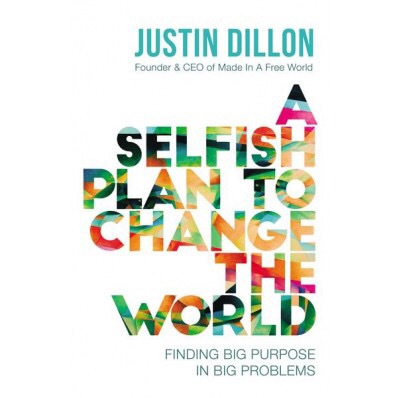
A Selfish Plan to Change the World: Finding Big Purpose in Big Problems, by Justin Dillon

img_1203Summary: a self-help book like no other I have read, concerned with identification of personal purpose, and giving some important insight into contemporary slavery

I must begin with a declaration of interest: Justin Dillon is a pal, someone I got to know and like over beers and years in the margins of conferences and meetings in different parts of the world.

Justin’s warmth, enthusiasms and likeablity come through strongly in this book, which is part memoir, part reportage, part philosophical treatise.

The book begins, rather disconcertingly, with an account of a performance by the Clash in Dublin. This inspired U2 to become who they are, who in turn inspired Justin, an accomplished musician, to change direction to become the filmmaker and anti-slavery activist that he is today. I think Joe Strummer would be pleased by that.

It is an important book in a number of respects. First of all at a time when much of the global discourse on slavery focuses simplistically on the minority of cases that relate to organised crime, Justin shows with illustrative cases from Haiti to Ghana to India that slavery is a complex issue of power, poverty, human rights and international development, not simply one of law enforcement.

Given this, a further theme of the book is even more apposite. This is the importance of purpose. Even before I got to the section in which Justin discusses Victor Frankl I was reflecting that the book could be considered as an application in the field of activism of Frankl’s remarkable work on humans’ search for meaning. Justin discusses how the lack of resources and power that impoverish so many across the world, their “poverty of means”, is echoed in the “poverty of meaning” in the lives of so many who in other respects seem wealthy. His “selfish plan to change the world” then relates to addressing this poverty of meaning by engaging those who lack purpose with the challenge of empowering those who lack means. In honour of Joe Strummer he exhorts his readers to find their “riot,” the struggle for justice that they they wish to be part of.

Justin describes the book as a “self-help manual”, but I doubt there are many other self help manuals like this, because it is one with a profoundly social purpose. Justin recognises that in order to change the world we may first have to change ourselves, and he shows the desperate needs that still exist across the world that demand we all look beyond ourselves.

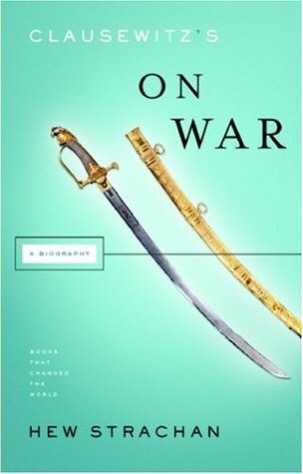
Clausewitz On War, by Hew Strachan

Summary: A difficult introduction to a complex work

I was not very impressed by Hew Strachan’s book, The First World War: Strachan seemed to me much too enamoured with the grand strategy of that war to the exclusion of the human cost for either civilian populations, or for the ordinary soldiers who fought on the diverse battlefields of that war.

This, nevertheless, is an interesting introduction to Clausewitz’s tome, a famously difficult and unfinished work, beloved by professional soldiers and armchair militarists alike.

Some of Clausewitz’s more famous dictums are now well known, such as the idea that, “War is the continuation of politics by other means”. But this can belie the complexity of his thought which was still evolving as he wrote, based on his study and his experience of fighting in the Napoleonic wars,. His experiences with the Russian forces during Bonaparte’s 1812 invasion was particularly influential as he realised that he had participated in one of the most novel campaigns in history.

The complexity of Clausewitz’s thought means that, aside from a interesting biographical chapter, Strachan’s book is itself complex. I think I would need to read it at least twice to begin to grasp some of the ideas properly. So perhaps this is not a book meant for the casual reader but for one preparing to tackle Clausewitz’s On War itself as part of a serious programme of study.

However there is still something to be gleaned from this for the average citizen. Clausewitz remains enormously influential on policy makers and war planners, and as war continues to deface the contemporary world these are ideas which are important to understand. As Clemenceau said, and as Jack Kennedy proved during the Cuban Missiles Crisis, war is much too important to be left to the generals.

The Red Moth, by Sam Eastland

Summary: So, apart from the genocide, tyranny, and the purges, Stalin really wasn’t such a bad old stick

As the German Army is approaching the gates of Leningrad, a light aircraft is brought down by Russian troops. The couriers on board are carrying a painting of a red moth.

When news of this peculiar cargo reaches Stalin, his suspicion is aroused. So he summons his best investigator, Inspector Pekkala, to enquire into the meaning.

Inspector Pekkala is something of a literary cousin of Philip Kerr’s inspired creation Bernie Gunther, another honest detective in the midst of a monstrous system. However unlike Gunther, who is believably worn down over the years by violence and compromise, Pekkala seems almost superhumanly incorruptible: undiminished and undaunted, even in the face of Stalin’s rage.

The interplay between Pekkala and Stalin is very entertaining, but it did bother the history student in me. In these books Stalin comes across more as a stern police captain rather than the genocidist whose paranoid purges of his own military and bureaucracy brought his country to the brink of ruin. Yet both Pekkala, and his side kick Kirov, manage their intimate service to this psychotic in a way that keeps their hands clean, the consciences clear, and their integrity as human beings undimmed. This aspect of the story does demand that whatever structure the reader is suspending their disbelief from has to be stretched a bit further to cross this historical chasm.

This quibble aside, The Red Moth is a hugely entertaining excursion to the battlefields of the Eastern Front, and Eastland’s familiarity with the milieu of Stalinist Russia does paint an engaging portrait of life in those bloody times.

The First World War, by Hew Strachan

Summary: Forget about those working class oiks in the trenches

This is a history of the First World War from the perspective of the High Commands. There is little consideration of the experiences of the ordinary soldiers, or of the civilian populations, though the appalling depredations that they experienced in many places are noted.

Instead Strachan endeavours to show the war for the world struggle across multiple fronts that it was, rather than confine his consideration to the trenches of the Western Front. As far as these are concerned, he notes, the “horror of the trenches” was much less horrible than the horror of mobile warfare and open battle when the majority of the casualties occurred.

Amongst the themes that the book explores is the idea that this was a purposeful war in which the liberalism of the Entente – Britain, France, Russia, and latterly the USA – confronted the conservative militarism of the Central Powers – Germany, Austria-Hungary, and the Ottoman Empire. From this emerged the geo-politics of the Twentieth and now Twenty-First centuries.

He also argues that the legend of “lions led by donkeys” regarding the armies, particularly of the British, is unfair. Instead he argues that the generals when confronted with the new challenges of industrialised warfare learned to develop new and effective tactics and operational approaches.

And yet – when all is said and done even with Strachan’s cogent survey of the strategy and conduct of the war lords – the First World War continues to leave an impression of a war blundered into by a group of imperial leaders with little concern for the their people. Strachan notes that this perspective grew in popularity in the years after the war. But it was certainly present in some form during the war when the combatant poet Wilfred Owen noted how these “old men” were, content, individually and collectively, to watch “half the seed of Europe” slaughtered “one by one”.

Strachan’s erudition means that this book is not one that can be set aside lightly. But it’s sympathy for the high commanders and lack of attention to the plights of the ordinary soldiers and civilians does leave me with a niggling feeling that perhaps, as Dorothy Parker once suggested of another book, it should be flung aside with great force.

The Wonga Coup, by Adam Roberts

img_1101Summary: A book about an unpleasant bunch of mercenaries, and the even more obnoxious Mark Thatcher coming a-cropper at the insolent hands of Johnny Foreigner

In March 2004 a group of mercenaries led by a former British officer, Simon Mann, attempted to undertake a coup in Equatorial Guinea, one of the nastiest dictatorships in Africa. Of course the motivation of Mann and his cronies was not in the least humanitarian, but rather a hope of getting their greedy hands on the country’s considerable oil wealth.

They had form as “soldiers of fortune”. Mann and co were behind Executive Outcomes, a mercenary operation that stiffened the Angolan army’s campaign against the UNITA rebels during that country’s civil war. Those escapades helped Mann become a millionaire.

However while Mann may have had some considerable tactical skills that could contribute to the winning of battles, his talents as an organiser of coups were much less impressive. The plan was bedevilled from the outset by difficulties with logistics and supply, not least of weapons. In the end the amateurishness of their efforts, particularly in the organisers’ inability to keep their plans secret, meant that the coup was easily rolled up by Zimbabwean, South African and Equatorial Guinean intelligence services before a shot was fired. Many of the plotters spent years in dreadful prisons in Zimbabwe and Equatorial Guinea.

In addition to a forensic detailing of the twists and turns of the plot The Wonga Coup has a number of interesting revelations. For a start Mann’s plot wasn’t the first to threaten the Equatorial Guinea dictatorship. The novelist Fredrick Forsyth, it seems, had tried to organise the same thing in the 1970s to install as president his friend, Odumegwu Emeka Ojukwu, the former head of Nigeria’s Katanga secessionists. He failed, but the experience provided him with the detailed research for a novel, The Dogs of War.

The Wonga Coup also details the involvement in the coup of Mark Thatcher, repellant son of the vile former British Prime Minister. Thatcher comes across as just as unpleasant as you might imagine and the account of his downfall at the hands of the South African justice system and its anti-mercenary laws is probably the most deeply satisfying part of the book.

Overall The Wonga Coup is a carefully researched and elegantly written account of a bunch of wealthy, grasping thieves’ efforts to enrich themselves further, and brought down by the extent of their own overweening arrogance that rendered them capable of overlooking even their own incompetence.

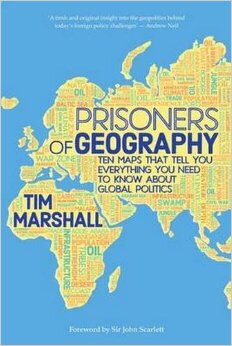
Prisoners of Geography: Ten maps that tell you everything you need to know about global politics, by Tim Marshall

Summary: We’re all trapped, and since Trump inveigled his way into the Oval Office, probably going to die

Recently I was at a meeting with a pro-Brexit member of the British parliament who, six months after the referendum on Britain’s future in Europe, still did not understand the difference between the European Court of Justice and the European Court of Human Rights. Not everyone has to know that of course. But when the person in question is taking decisions that they promise will lead to a better tomorrow, one does expect them to have a firm grasp of the basic facts of today.

Prisoners of Geography is about some of those key and immutable facts. It is about the imperatives that are imposed upon political leaders by the geography within which they find their countries and how they feel compelled to respond.

For example Russia needs a warm water port for its navy. This allows it to project its military power across the oceans and be recognised as a world power. So, when Ukraine displayed a desire to move towards the European Union and Nato it did what it felt was necessary and reclaimed the Crimea and with that Sevastopol, the only warm water port available to it.

Similarly the historical Russian habit of extending its empire into Eastern Europe as far as the borders of Germany is explained by the vulnerability of Moscow to attack from the West across the Northern European Plain. Occupying Poland where the plain is at its narrowest, as it has frequently done, therefore increases Russia’s security from attack.

Another area of potential risk is the artic where Russia’s wish to control the energy sources there could put it on course for a clash with Nato.

Reading this book in the aftermath of 2016 US presidential election was a sobering experience. Marshall reminds us that the United States has a treaty with Taiwan which requires it to go to war if Taiwan is invaded. Something that would spark an invasion by China would be formal recognition by the US of Taiwan as an independent country. Fortunately “there is no sign of that”. Or at least there wasn’t until the US’s gerrymandered electoral system put a narcissist with a disinterest in facts and a xenophobia about China into the Oval Office.

Prisoners of Geography is illuminating not just on these contemporary geopolitical issues, but also on a range of developmental issues: why have Africa and South America developed, or failed to develop, as they have; how geography shaped European history and why the peace the continent has experienced over the past 70 years is not inevitable but the result of conscious political choice in the shape of the European Union. It also throws light on contemporary conflicts in the Middle East, between India and Pakistan, and in the Korean Peninsula.

I was mildly disappointed that there was no chapter on the geopolitics of Britain and Ireland, particularly as Brexit threatens to dangerously reshape the relations between the two islands once again. But, as Brexit also shows, as so much of the UK population and political class is utterly disinterested in reality at this moment in history perhaps there is no point.

Prisoners of Geography is a lucidly written and compelling book. It reminds us why the world is still a dangerous place. It is more dangerous still when power is put into the hands of the intellectually lazy, utterly disinterested in the facts.