The Cut Throat Trial, by the Secret Barrister

Summary: One of these suspects is not like the others …

As aficionados of Rumpole will know, a “cut-throat” trial is one in which co-defendants turn on each other. That is the heart of this novel about three boys accused of murder — a case that also involves a victim nearly decapitated, so there is that sort of throat-cutting too.

This is the first foray into fiction by the Secret Barrister. It is told from multiple perspectives: a defense and the prosecution barrister, the judge, and two of the defendants. Each voice feels distinct, a technical feat that lends the narrative both texture and credibility.

As in their non-fiction, the Secret Barrister’s abiding concerns with the state of the law, society, and the criminal justice system in England and Wales permeate every chapter. Like Wendy Joseph’s Unlawful Killings, it exposes the squalid tragedies of murder committed by children.

Yet for all its artistic achievement and political undercurrent, this is first and foremost a courtroom thriller — and it is a cracking one. It takes a staple of English literature, the red-herring-strewn cosy murder mystery, and serves it up American-hard-boiled. Gone are the familiar comforts of Agatha Christie and the nostalgia-fests of Richard Osman. Instead, we are in a world where the streets are mean, knives wound horrifically, killing is messy, dying is sore, cops and lawyers are flawed, defendants are pathetic, and justice is too often elusive.

By refusing to flinch from the grotesque realities of murder, the Secret Barrister has produced a novel several cuts above much contemporary English crime fiction, and one that, like the best of literature, illuminates the human condition while laying bare some of the failings of our world.

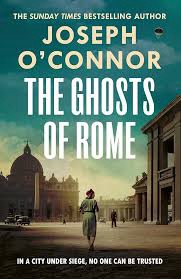
The Ghosts of Rome, by Joseph O’Connor

Summary: more Paddington 2 than Jaws 2

Sequels are a tricky thing. Some, like Margaret Atwood’s The Testaments add something to an earlier classic. More ill-judged ones, like Pat Barker’s The Women of Troy, can dent the lustre of their more accomplished predecessor, seeming to aim to cash in on a successful formula rather than say anything compelling or new.

So it was with some trepidation that I picked up the Ghosts of Rome, Joseph O’Connor’s follow up to his superb novel of European Resistance to Nazism, My Father’s House.

Time has moved on a few months from the first novel, the German occupation has become more brutal, and the pressure on the Choir – the escape line for Allied prisoners of war and Jews established by Monsignor Hugh O’Flaherty – more extreme.

The pattern that O’Connor uses for this book is similar to its prequel: It focuses on one operation, and one individual in the midst of the otherwise present and correct ensemble of the Choir, in this instance Contessa Giovanna Landini – Jo.

O’Connor admits that all of the novel, including the purported transcripts of BBC interviews, is his own invention. But many of the people involved including Jo and her Irish pals, Delia and her daughter Blon, were real. This accentuates the sense of awe regarding what these ordinary people endured and achieved in such extraordinary circumstances. And, even if we know they survived the war this does not diminish the tension.

The Ghosts of Rome is a gripping thriller. But like the best thrillers it is more than that. It explores and asserts the importance of morality and friendship in the face of monstrousness. These remain important ideals in a world in which the genocide of vulnerable people is again high on the agendas of many of the supposed liberal democracies of the West.

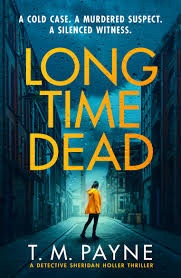
A roundup of Unusual Suspects: Isolation Island, by Louise Minchin; The Trials of Lila Dalton, by L J Shepherd; Long Time Dead, by T M Payne; A Limited Justice, by Catriona King.

Summary: books that it would be criminal to overlook!

I once met a woman who had given her newborn daughter the second name of “Danger” just so when she was older she would be able to say, like the heroine of a 1930s movie, “Danger is my middle name!”,

There is a strong hint of such movie heroines in Lauren, the investigative journalist protagonist of Louise Minchin’s Isolation Island

Minchin uses her experience of journalism and having been a contestant on the storm ravaged set of “I’m a Celebrity, get me out of here!” to craft a fun, Agatha Christie inspired, tale of murder amongst game show contestants. 

Minchin brings a lovely devilment to her tale, fattening up the despicable before despatching them while Lauren desperately tries to unearth the evil genius behind the mayhem.  

Minchin has described her heroine as being braver than herself. That may or may not be true – Minchin is also a triathlete and having done one myself I can attest that those are daunting things. But, perhaps as importantly Lauren is driven by a sense of journalistic ethics and a conviction of the importance of truth, which must be Minchin’s own. 

In a time of in which even genocide is being made undiscussable, it is important to be reminded that some truths, no matter how inconvenient, must be spoken. 

On the opening page of The Trials of Lila Dalton, the titular Lila, a barrister it seems, stands up in court with no knowledge of how she got there, but with a client to defend. LJ Shepherd, the author, a barrister herself, describes her book as an “ontological mystery”. That is, not only does her protagonist have to get to the bottom of the facts of her case – the defence of a man accused of a bombing atrocity – but also work out who the hell she is and what she is doing there. 

Shepherd’s is an entertaining and intriguing story. I am not sure that it really required the reality questioning elements as the issues she deals with – the importance of the right to a defence in a criminal trial no matter how seemingly heinous the accused, and the question of how democratic societies protect themselves from violent assaults by those who do not share their values – are important enough.

These quibbles aside, the quality of Shepherd’s writing is exceptional, particularly when describing the treating of casualties in the aftermath of an explosion: these recalled for me some of the accounts of the survivors of the Rana Plaza collapse in Bangladesh. In this Shepherd does that most difficult of things: she forces the reader to empathise with victims that they may prefer not to think of.

In Long Time Dead, an extra body shows up in a grave and it is identified as a man suspected of murdering a cop and grievously injuring a bystander seven years earlier. The investigation eventually falls to Detective Inspector Sheridan Holler. 

It was Chandler, I think, who conceived of his tales of gumshoes as updated versions of the stories of Knights Errant from Arthurian legend. So, whatever else was unclear in his mysteries, no matter how corrupt the world in which they ventured, one thing you could count on was that his shamus would endeavour to do the right thing, protecting the innocent and unmasking the guilty. 

TM Payne’s peeler protagonist in Long Time Dead is an inheritor of that tradition. While she may find the sort of defence barrister of which LJ Shepherd writes somewhat distasteful, she is still fundamentally decent and committed to the finding the truth. 

There is an echo of Payne’s book in Catriona King’s A Limited Justice. Like it, it is a police procedural – a type of crime novel for which I have a particular affection. 

Both have the bonus of being written by writers who know what they are talking about: Payne is a former cop; King has worked as a police forensic medical examiner. Both eschew the brooding detective for sympathetic professionals – the sort of people who you might actually like to work with. 

A Limited Justice begins with King’s investigator, Marco Craig, opening a probe into a particularly grisly killing on a Belfast garage forecourt. As with many of the Sherlock Holmes stories, as the investigation unfolds the story of the perpetrator and their motivation becomes as important as that of the investigators. Consequently, King is able to use her story to explore not just the crime itself, but contemporary Northern Ireland. As is typical of Northern Ireland the story is replete with black humour. 

Both King and Payne have founded book series based on their protagonists. It is easy to see why: both are appealing companions on the mean streets of the imagination, and King and Payne, like Minchin and Shepherd, are both very gifted writers. 

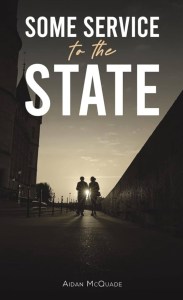
Some Service to the State

Summary: why partition in Ireland has been such an injustice.

“… sometimes it is absence itself which is the hardest thing to hide.”

I grew up in South Armagh, just a mile or so from the British-imposed border in Ireland. That border is a thing that, in many ways, has cast a long shadow over my life. It was, I sincerely believe, at the root cause of many of the problems for both parts of Ireland during the Twentieth Century, not least the squalid little war known as the Troubles during which I grew up.

With partition, the British sought, successfully, to create two sectarian states in Ireland rather than one plural one. My novel, Some Service to the State, is at heart an exploration of some of the human rights abuses that Irish people had to endure as a result of this.

Hence it is an indictment of the injustice of partition’s continuation. As the impetus takes hold for an end to partition and the establishment of a new Ireland, I hope that this book will resonate with an audience that wants to understand better why the status quo has been such a poisonous thing for ordinary people living on the island of Ireland.

But Some Service to the State is also a gripping detective story, about the repercussions of an enquiry into the fate of a girl who seems to have gone missing in that politically divided island.

Here is what other authors said about it: 
Ronan McGreevy, author of Great Hatred: the assassination of Field Marshal Sir Henry Wilson, has said of Some Service to the State that it is “a superb book with dialogue that would not be out of place on the stage of the Abbey Theatre. … [in Mick McAlinden} McQuade has created a character whose travails highlight the thwarted dreams and the tragedy of partition for so many people in post-revolutionary Ireland.” 

Rosemary Jenkinson a multi-award winning playwright and author of Marching Season, has said that the book shows a “prodigious skill in shining a spotlight on the scandal of the mother-and-baby homes and in brilliantly imbuing the past with … [a] potent blend of heart, soul and wit”

If you would like to get a copy, the book is available in the UK from Bookshop.org and in the US from Barnes and Noble. It is also available on Amazon.

I hope you will read it, and if you do, I would love to hear what you think in the comments below.

Keep safe and many thanks.

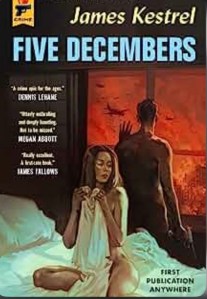
Five Decembers, by James Kestrel

Summary: a surprising and compelling crime story to the backdrop of WW2 in the Pacific.

The gloriously lurid, pulp-fiction style cover of Five Decembers suggests it’s going to be one thing: American hard-boiled crime a la Mickey Spillane. There is an element of this: Detective Joe McGrady of the Honolulu Police gets a call to investigate a particularly sadistic double murder in November 1941.

McGrady, however, is something a bit different from your typical Shamus. An ex-Army officer, with a romantic streak, and a history of personal tragedy, who remains intellectually curious having taken the time to learn a bit of Mandarin and appreciate Asian culture in the course of his career. So, by the time we meet him sipping whiskey in a late night bar, it turns out he is markedly nicer than one might have expected on picking up this book. Indeed, most of the characters are a lot nicer than you might expect, generally treating each other with at least professional courtesy, if not genuine affection.

This is important as McGrady is among a small group of characters in the book whose fate the reader can actually care about as his protracted investigation, and personal travails, stretch across the wretched years of war.

The book takes more than one unexpected turn. Not the least of these is its echo of Slaughterhouse Five with a description of the murderous firebombing of Tokyo – something that one of its planners, future Defence Secretary Robert McNamara, even acknowledged was a war crime – and its chilling aftermath.

So, Five Decembers is a surprising novel: not only a fine procedural, but also a thoughtful rumination on the pity of war. It is all the more remarkable and satisfying as a result.

The Man Who Died Twice, by Richard Osman

Summary: Highly entertaining soft-core Brexity fantasy

The second book in Richard Osman’s Thursday Murder Club series, The Man Who Died Twice returns to the genteel environs of its predecessor.

Like many second books in series, from Denis Lehane to JK Rowling, one can feel Osman getting into his stride, having established his universe and now able to concentrate more on the evolving story rather than scene-setting.

The Man Who Died Twice is a more overtly right-wing work than its predecessor. In it roughish-diamond coppers think nothing of fitting up suspects they just know are guilty, and the book’s pensioner heroes take the law into their own hands with the casual disdain for due process of the most knuckle headed of authoritarians.

Doubtless this will play well with the Daily Mail readers who are a core demographic in this book’s audience. But even so, it would have been nice if Osman showed the slightest knowledge of the brutal realities of child slavery in “county lines” and the operation of the British drugs economy if he is going to include such things in his books.

But that would probably upset the soft-core fantasy for Brexity readers. Instead this is a world with few complexities and no bad language, in which foreigns know their place, and plucky have-a-go British heroes with bulldog spirit always triumph over the baddies and are home in time for cocoa.

In spite of its politics, The Man Who Died Twice is a highly entertaining affair, with plenty of good jokes and a twisty plot. Even without the unicorns, it’s a vision of sunlit uplands that is as close as the English are ever going to get to the Brexit they thought they voted for. So it’s hard to grudge them their fairytales, particularly when they are as elegantly written as this.

Northern Heist, by Richard O’Rawe

Summary: nasty men doing nasty things, nastily

At Christmas 2004 the IRA robbed the Northern Bank, putting the Peace Process, not for the first time, in jeopardy.

Taking that incident as his inspiration, with Northern Heist Richard O’Rawe has imaginatively reconstructed how a bunch of professional criminals would go about robbing the “National Bank”. This fictional institution occupies much of the same physical space as the Northern Bank that was actually robbed in Belfast. And, this being Belfast, of course, their shenanigans do not go unnoticed by the Provisionals who want a cut of any action the criminals manage to obtain.

With its focus on deeply unsympathetic criminals, particularly its anti-hero James “Ructions” O’Hare, Northern Heist reminded me of Richard Stark’s Parker novels. Its depictions of the Belfast underworld also echo with Maurice Leitch’s classic novel, Silver’s City. 

Overall, Northern Heist is very fine work from O’Rawe.

Act of Oblivion, by Robert Harris

Summary: a fine historical thriller based on the manhunt for the regicides of Charles I

The Act of Oblivion was a key law in British history. It paved the way for restoration of the monarchy by promising to forget the offences of most, but not all, of those who had waged war on Charles I.

Exempted from the act were the regicides, those who signed the death warrant of Charles. For them the fate of hanging, drawing and quartering awaited.

Many foolishly surendered to the crown and were tortured to death in this way in spite of their pleas for mercy. Others had to be hunted down.

Robert Harris’ book focuses on the manhunt for two of the regicides: William Goffe and his father-in-law Edward Whalley. Goffe and Whalley have had the good sense to make for North America as Charles II approached English shores. But, they wonder, as the search for them reaches across the Atlantic, is this far enough?

Act of Oblivion is a fine thriller. It is also a fine historical novel. It would be a superb introduction to the English Civil War for anyone ignorant of the subject. It is, appropriately enough, a warts and all portrayal of the period, charting the descent of the parliamentary cause into a horrendously bigoted, brutal military dictatorship. It also details the bloody revenge of the royalists following the collapse of the Commonwealth

Other reviewers have described Goffe and Whalley’s principle pursuer, a fictional character called Richard Naylor, as a “monster.” But I think this misses the point of the book.

While the principle sympathy of the book is with Whalley and Goffe, Nayler has become what Goffe and Whalley once were and would have continued to be had they not fallen from power: a merciless zealot.

Early in the book Harris quotes the biblical verse “an eye for an eye.” Because Martin King was not born until the 20th Century he cannot go further. But this book is an illustration of King’s point that, if pursued, this maxim of vengeance leaves the whole world blind.

Ashenden, by W Somerset Maugham; The Mask of Dimitrious, by Eric Ambler; and Bad Actors, by Mick Herron

Summary: a glimmer of a new day on Spook Street?

As the increasing brutality and lawlessness of Boris Johnson’s British government becomes manifest, the forlorn cry of “We are better than this” emerges from time to time from the ineffectual British Left. To which, many South Asians, Africans and Irish respond with the question, “When exactly?”

England has certainly been different to this, as the attitudes on display in these three spy novels written over the course of the past century demonstrate. But it is not clear that it was much better when they were written.

Somerset Maugham’s Ashenden concerns the adventures of the eponymous writer who is recruited into British intelligence during the First World War, as Maugham himself was. The book is mostly set in and around Geneva, Maugham’s own principal intelligence haunt during his spooky days.

Starting in Istanbul, the superb Mask of Dimitrious traces a route through central Europe to Paris in the interwar years. It concerns another writer, Charles Latimer, as he tries to piece together the career of a man who has taken advantage of the bloody chaos following the collapse of the Central Powers to reinvent himself as a master criminal.

Bad Actors, is Mick Herron’s eighth novel in his glorious Slough House series. It follows the hilariously grotesque Jackson Lamb and his Joes as they collide with on-going Russian machinations to take advantage of Brexity Britain.

Each book echoes its antecedents. All three have a fine sense of place. But aside from this they are tonally quite different: Maugham a master of supercilious Englishness; Ambler more hard-boiled but with a keen awareness of the pity of post-First World War European history; and Herron is carefully attuned to how the farce of Brexit nourishes a similar authoritarianism to that which haunted the central Europe of Ambler’s book.

Taken together with Greene and Le Carre these novels suggest a society that has fundamentally changed over the century, shedding at least some of its ignorant self-satisfaction. Instead there appears to be a growing awareness of how Britain has often been an amoral or malign influence in the world. Now, reflected in Herron’s black comedic works, Britain’s silliness is increasing in proportion to its diminishing economic prospects and political influence.

Perhaps then there is a faint glimmer of hope that Britain can become “better than this.” Until then, different generations of spy writers offer interesting insights on how well it has understood what it has actually been.

The Slough House series, by Mick Herron (Slow Horses; Dead Lions; Real Tigers; London Rules; Spook Street; Joe Country; Slough House)

Summary: extraordinarily bingeable, spooky epic

I started reading Mick Herron’s Slough House series a month or so ago thinking this will be a series to keep me entertained over a year or two, a palette cleanser between volumes such as Caro’s biography of Lyndon Johnson or other more “worthy” reading material.

Thing is, once I’d finished volume one, Slow Horses, I had to check out volume two… and once that was done, there was an urgent need to find out what was going on in volume 3…

So, in the end, I’ve read all seven books in the series in about a month, and it’s one of the most pleasurable reading experiences I’ve had in many a year.

The Slough House series recounts the misadventures of the denizens of Slough House, a bunch of failed MI5 officers, stuck into a run down office in the Barbican area of London under the supervision of the vile Jackson Lamb. (“You broke the arm of a 23 year old woman.” “I’d have broken the arm of a 40 year old man too. This is what a feminist looks like.”)

Tina Fey once discussing her comic creation Jack Donaghy, for her sublime TV series 30 Rock, described him as an archetypal nightmare boss: not just one who was repulsive, but worse still one who was right an awful lot of the time.

Mick Herron’s creation, Jackson Lamb, turns this all the way up to eleven: a misanthropic, rude, bullying, flatulent, unsanitary nightmare who is, nevertheless, very funny, ferociously smart, protective of his subordinates from anyone apart from him bullying them, and just the sort of violent talent you want at your side when the chips are down.

Mick Herron has been compared with John Le Carre, and the Slough House series shares a similar milieu, and political concerns, charting the rise of authoritarianism in Brexity England. But this is Le Carre on acid. The books are very funny, often violent, and pervaded with a deep sense of dread that arises from the knowledge that your favourite characters dwell in these pages under mortal threat.

Having finished the latest novel in the series, Slough House, I am bereft. Treat yourself and jump in.