A Man Without Breath, by Phillip Kerr

Bernie Gunther reckons that his life should be marginally easier now that Czech and Slovak patriots have done him, and humanity, the great favour of assassinating his erstwhile boss, Reinhard Heydrich, a recurrent source of his prior misadventures.

However in the forests of Katyn on the Eastern Front the German Army has stumbled upon a set of mass graves. Remarkably these don’t appear to be the work of the Nazis, but rather might answer the vexing question of what has become of all the Polish officers captured by the Nazi’s former Soviet allies when they dismembered Poland between them in 1939.

So Goebbels, intent on pinning these murders on Stalin and showing the world that it is not just Germany that has the programme of war crimes and genocide, needs a detective to help sort out the evidence and make sure that the bodies they are digging up are indeed the right ones. Hence Bernie is shipped out to the German army halted for winter in Belarus while it awaits an oncoming Soviet offensive in springtime.

Things are complicated further by Bernie stumbling into the machination of some anti-Nazi officers in the German Army trying to put an end to Hitler, and person or persons unknown trying to put an end to Bernie.

Gunther would be a compelling character in any novel but the effect is considerably enhanced in the context of the German State and Army in the midst of the Second World War: much as Bernie would like to be a decent man it becomes increasingly difficult in the bloody lunacy of war and the evil bureaucracy of the state. The series reinforces the point, chillingly detailed by Timothy Synder in his history of the Bloodlands where this story occurs, that atrocities, then as now, are committed by ordinary human beings abandoning their consciences, the constraints of law, and ordinary human decency, to supposed higher ideals. This philosophical seriousness combined with the nightmarish setting, a twisty plot and the wry observations of Bernie make the book a delight from start to finish.

A henchman’s eye view: Prague Fatale, by Philip Kerr

pragueAfter the sprawling odyssey of Field Gray, the previous novel in this series, this book takes on the more intimate template of an Agatha Christie “country house murder” – except this country house is owned by a mass murderer, filled with mass murderers and the victim himself is a mass murderer.

The country house is Heydrich’s and he is hosting a weekend party for a group of senior SS officers. Into this mix he draws the narrator, Bernie Gunther, a Berlin detective of Social Democratic and anti-Nazi sympathies, who has managed to keep (relatively) clean hands despite his time in the killing fields of the East. Heydrich wants Gunther to join his bodyguard when the murder occurs, and, as Gunther acknowledges, he is not really a man you can refuse. Hence, as well as investigating a murder amongst murderers, Gunther becomes witness to the beginnings of Heydrich’s reign of terror in the Czech lands (before his just dispatch by the Czechoslovak patriots Kubis and Gabcik, as detailed so brilliantly in Laurent Binet’s stunning novel HHhH). prague night

Gunther is an attractive narrator – wryly witty and historically knowledgeable, though morally questionable, as he himself painfully recognises. Hence as well as being a compelling thriller this book (as does Field Grey) offers some detailed insights into the Nazi regime and Germany’s prosecution of the Second World War. Its a fine, exciting and, at times, poignant novel that, importantly, tries to show the human face and nature of some history’s monsters.

Hard boiled all the way through: Where The Dead Lay (Frank Behr series No. 2), by David Levien

indy-downtownFrank Behr, Indianapolis private investigator and protagonist of David Levien’s previous novel “City of the Sun”, investigates the murder of one of his few friends, Aurelio, a jiu jitsu trainer and former mixed martial arts champion. The investigation leads him into contact with a local family of criminals with ambitions to establish themselves, through ferocious violence, in the big leagues.

Behr has many attractive features as a character – courage, loyalty and intelligence to start with, but he is also morose, humourless, angry, emotionally distant and rather inarticulate on any subject other than armed or unarmed combat. These are believable and understandable characteristics for a person with his life history, but they do not make him the most enjoyable protagonist to spend a novel with.

The plot is some consolation, and there is a significant compulsion for the reader to see how all the pieces fit together. However there isn’t that much else: one learns little of the city (Indianapolis) in which the novel is set, or contemplate few moral dilemmas that may be associated with the investigation of violent crime perpetrated by professional criminals. Still its an entertaining, though violent, crime novel, good for a bleak holiday. But it leaves me with no desire to ever cross paths with Frank Behr again.

Homicide in the Navajo Nation – Skinwalkers, by Tony Hillerman

Navajo 2In the middle of the night someone tries unsuccessfully to kill Navajo police officer Jim Chee by putting three shotgun blasts through the wall of his trailer. Meanwhile Lt Joe Leaphorn is investigating three apparently unrelated homicides in different parts of the reservation. As Leaphorn’s enquiries proceed he senses a link with the attack on Chee and so recruits his help to the investigation.

The contrasting personalities of traditional Jim Chee and more sceptical Joe Leaphorn are finely drawn – both deeply attractive characters, not perfect but complementary to each other in their professional skills and with imperfect but believable private lives as well. The detail and care of the characterisation enriches an absorbing plot and a beautifully plain style of writing.Navajo 1

Much of what I have written above could be said about many fine thrillers. But it is the rooting of this story in Navajo history and culture that makes it something truly out of the ordinary. This provides not just absorbing background to the plot but a context that is fundamental to understanding the motivations of the characters.

Having finished it, it is great to know there is more in this series, but sad to find out that Tony Hillerman died a few years ago – its like meeting a new friend only for them to disappear immediately.

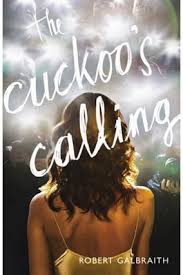
The Cuckoo Calling – JK Rowling (writing as Robert Galbraith)

cuckoocallingA supermodel, Lula, falls to her death from her balcony in London. The police rule the death as suicide. However the model’s brother is unconvinced. So, he hires a private detective to reinvestigate the case.

Enter JK Rowling’s new serial hero: Cormoran Strike, a gumshoe in the classic mould. Comoran is a war injured ex-military police investigator, haunted by the demons of his youth, his past cases, his war and his shattered love-life. Cormoran, and his side kick Robin – you gotta love an author who calls the side-kick Robin, (though here Robin is a bright young female PA rather than a boy-wonder) – begin an investigation into the tangled web of Lula’s life and death.

The result is a great crime novel, closer to the American hard-boiled tradition rather than the genteel English country house mystery, but with a strong sense of contemporary London.

Despite the shift in genres from children’s literature to crime, JK Rowling displays the traits that made her Harry Potter series such a joy: intricate plotting, great pacing, elegant writing and a lovely sense of humour – Cormoran’s drunken, broken hearted discourses being a particular pleasure: I’ve got to admit I identified with this aspect of the chap’s life more than might be healthy.

All in all it’s a delight from start to finish and I very much look forward to Cormoran’s next outing.

Follicly challenged Paddy as knight errant: Plugged by Eoin Colfer

This book marks Eoin Colfer’s move from children’s to adult fiction with the introduction of another serial character: Daniel McEvoy – ex Irish army sergeant, now working as a doorman in a sleasy New Jersey nightclub, worrying about losing his hair and trying to stay out of trouble.

McEvoy is an attractive character and his reflections on life and death, as he tries to extricate himself from increasingly complex and life-treatening situations, are very entertaining and often insightful. However in spite of the violence the book is more of a comedy than a thriller: except for a few scenes there is little sense of menace, and the wise-cracking, though generally entertaining, on a number of occasions simply does not ring true, disrupting any tension that had begun to accumulate. Hugh Laurie managed the combining of comedy and thriller better in his novel “The Gun Seller” in no small part by cutting the wise-cracks from the action scenes. (Paradoxically real life can produce unbelievable dialogue: George McDonald Fraser notes in his memoir of the war in Burma, “Quartered Safe Out Here”, that he once heard a comrade shout, after having been shot, “They got me the dirty rats!”, something, he says, that despite being true was so unbelieveable he would never have used it in a work of fiction.)

These points aside, the plot is compelling and satisfyingly twisty, drawing upon the roots of modern crime fiction: Dan carries with him an echo of Chandler’s Marlowe as a fundamentally honourable man, a contemporary knight errant, in a corrupt metropolis. The jokes are generally very good indeed. And many of the characters, particularly, I thought, Zeb and Simon, well drawn. It also highlights the courage and experiences of UN peace-keeping forces (Dan is a veteran of the operation in Lebanon), something rarely touched upon in popular culture, and something that deserves greater attention.

And the book kept me up at night so I could finish it and find out how the various strands resolve: one should never quibble too much about a book that can do that.

20 years on: Innocent by Scott Turow

After 20 years its good to catch up again with some of the key characters of Presumed Innocent who have, since that book’s publication, been hovering at the edges of Turow’s novels – almost all based in the fictional metropolis of Kindle County – a stand-in, one presumes, for contemporary Chicago.

Rusty Sabich, the protagonist of Presumed Innocent, is now a senior judge. Tommy Molto, his former prosecutor, is in Rusty’s old job, in charge of the County’s Prosecuting Attorney’s office. The plot of this book revolves around the mysterious death of Rusty’s wife, Barbara, as Tommy is reluctantly drawn into investigating him again.

While the plot and mystery are compelling the true joy of the book arises from the exploration of the messy lives and loves of the characters. Turow uses the device of first person, present tense narrative for three of his principal protagonists. Hence we come to know them intimitately while they remain in crucial ways mysteries to each other and to Tommy. There is an echo in this book of vintage Graham Greene in the compassion and understanding with which Turow treats the characters and their mistakes. However, unlike much of Greene’s work, in this book it is the Catholic character, Tommy, who’s moral compass is steadiest in the midst of all, his prosecutorial zeal mellowed with love and age to a more humane commitment to justice and rule of law.

This book may lack the twists and surprises of Presumed Innocent, but it makes up for it in many other ways, not least the beauty of its writing, and is pretty much an unalloyed joy from start to finish.