The Tainted, by Cauvery Madhavan

Summary: an elegant exploration of Hiberno-Indian relations over the decades

While anti-colonialism is now deeply culturally embedded in contemporary Ireland, our history on the matter, as Cauvery Madhavan gently reminds us with this book, is rather more complicated. 

The Tainted takes as its starting point a fictionalized story of a 1920 mutiny by Irish troops in India. (In the book the “Kildare” rather than the Connaught Rangers are the mutineers).

Because, superficially, the British and Irish are white, the British expect the Irish to collaborate with them in treating the Indians in the way that the British treat the Irish at home.

By and large the Irish are happy to comply. But when news of the depredations of the Black and Tans percolates through to the Irish barracks the centre cannot hold, and the colonial authorities are murderously provoked when Irish soldiers down arms in protest.

The second two-thirds of the book explore the repercussions from this incident down the years, not least for Rose, a young “Anglo-Indian” woman – daughter of an Irish father and an Indian mother. 

Cleverly Madhavan does not allow her narrative to rest with any single character for too long.  Instead she shifts the psychological perspective of the novel across a range of characters into the first decades of Indian independence. By doing this she gives insight into the attitudes and prejudices of different communities, and shows how these pose needless challenges to the appreciation of each other’s common humanity. 

Madhavan’s novel is an engaging and illuminating exploration of identity, cultures and history, elegantly written and ultimately hopeful. After all, whatever our skin, our blood is the same colour. 

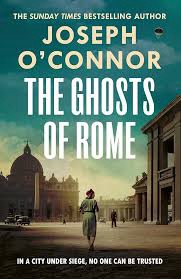
The Ghosts of Rome, by Joseph O’Connor

Summary: more Paddington 2 than Jaws 2

Sequels are a tricky thing. Some, like Margaret Atwood’s The Testaments add something to an earlier classic. More ill-judged ones, like Pat Barker’s The Women of Troy, can dent the lustre of their more accomplished predecessor, seeming to aim to cash in on a successful formula rather than say anything compelling or new.

So it was with some trepidation that I picked up the Ghosts of Rome, Joseph O’Connor’s follow up to his superb novel of European Resistance to Nazism, My Father’s House.

Time has moved on a few months from the first novel, the German occupation has become more brutal, and the pressure on the Choir – the escape line for Allied prisoners of war and Jews established by Monsignor Hugh O’Flaherty – more extreme.

The pattern that O’Connor uses for this book is similar to its prequel: It focuses on one operation, and one individual in the midst of the otherwise present and correct ensemble of the Choir, in this instance Contessa Giovanna Landini – Jo.

O’Connor admits that all of the novel, including the purported transcripts of BBC interviews, is his own invention. But many of the people involved including Jo and her Irish pals, Delia and her daughter Blon, were real. This accentuates the sense of awe regarding what these ordinary people endured and achieved in such extraordinary circumstances. And, even if we know they survived the war this does not diminish the tension.

The Ghosts of Rome is a gripping thriller. But like the best thrillers it is more than that. It explores and asserts the importance of morality and friendship in the face of monstrousness. These remain important ideals in a world in which the genocide of vulnerable people is again high on the agendas of many of the supposed liberal democracies of the West.

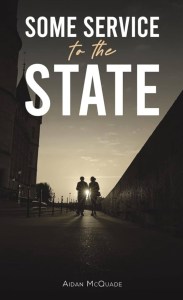
Some Service to the State

Summary: why partition in Ireland has been such an injustice.

“… sometimes it is absence itself which is the hardest thing to hide.”

I grew up in South Armagh, just a mile or so from the British-imposed border in Ireland. That border is a thing that, in many ways, has cast a long shadow over my life. It was, I sincerely believe, at the root cause of many of the problems for both parts of Ireland during the Twentieth Century, not least the squalid little war known as the Troubles during which I grew up.

With partition, the British sought, successfully, to create two sectarian states in Ireland rather than one plural one. My novel, Some Service to the State, is at heart an exploration of some of the human rights abuses that Irish people had to endure as a result of this.

Hence it is an indictment of the injustice of partition’s continuation. As the impetus takes hold for an end to partition and the establishment of a new Ireland, I hope that this book will resonate with an audience that wants to understand better why the status quo has been such a poisonous thing for ordinary people living on the island of Ireland.

But Some Service to the State is also a gripping detective story, about the repercussions of an enquiry into the fate of a girl who seems to have gone missing in that politically divided island.

Here is what other authors said about it: 
Ronan McGreevy, author of Great Hatred: the assassination of Field Marshal Sir Henry Wilson, has said of Some Service to the State that it is “a superb book with dialogue that would not be out of place on the stage of the Abbey Theatre. … [in Mick McAlinden} McQuade has created a character whose travails highlight the thwarted dreams and the tragedy of partition for so many people in post-revolutionary Ireland.” 

Rosemary Jenkinson a multi-award winning playwright and author of Marching Season, has said that the book shows a “prodigious skill in shining a spotlight on the scandal of the mother-and-baby homes and in brilliantly imbuing the past with … [a] potent blend of heart, soul and wit”

If you would like to get a copy, the book is available in the UK from Bookshop.org and in the US from Barnes and Noble. It is also available on Amazon.

I hope you will read it, and if you do, I would love to hear what you think in the comments below.

Keep safe and many thanks.

The Voyage Home, by Pat Barker

Summary: a fine novel of Cassandra that suffers in comparison with Barker’s initial foray into the stories of Troy

The Voyage Home continues Pat Barker’s feminist retelling of the tales of Troy, following the return of Agamemnon to Mycenae with the enslaved Cassandra in tow. This guarantees that the reunion with his wife Clytemnestra is going to be awkward. Just how awkward Agamemnon, even if he was a cleverer man, could not imagine.

But Cassandra, gifted with prophesy, but cursed that no one ever believes her, knows. In the bloodshed that she foresees she also discerns some measure of justice for the genocide that the Greeks have inflicted on her homeland. 

For this story, Barker replaces Briseis, the narrator of her previous Trojan books, with Ritsa, Cassandra’s maid: slave to a slave, or, as she describes her lowest of the low status, a “catch-fart.” 

The Voyage Home dealing with the beginning of the Oresteia, is, I think, a considerably better book than its predecessor, The Women of Troy. But neither of these books say much additional thematically to the stunning originator of this series, The Silence of the Girls.

Still, it is elegantly written, and Barker’s continuing focus on how war affects civilians and the sexual violence endured by women is important. In addition, Cassandra is always a compelling figure, and Ritsa is a fine creation. 

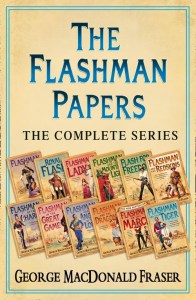
The Flashman Papers, by George McDonald Fraser (Flashman; Royal Flash; Flash for Freedom!; Flashman at the Charge; Flashman in the Great Game; Flashman’s Lady; Flashman and the Redskins; Flashman and the Dragon; Flashman and the Mountain of Light; Flashman and the Angel of the Lord; Flashman and the Tiger; Flashman on the March)

Summary: A thoughtful rumination on Empire masquerading as a scurrilous romp… or is it the other way round?

I read my first Flashman book in the 1990s when I was working in Afghanistan. That book, George McDonald Fraser’s first dealing with the character, described his experiences in the retreat from Kabul. In the market of the town in which I was living, Jalalabad, it was still possible to buy buttons cut from the uniforms of the British dead of that retreat.

The Flashman books are rigorously researched historical novels, and so a great introduction to aspects of British imperial history which are little remembered in Britain, but which still reverberate in the global South. 

They are also exceptionally filthy and extremely funny, though much of the humour, drawing on the racist attitudes of Victorian England – and indeed of McDonald Fraser’s own day – can sometimes be hard to stomach. It is as if the boorish bores of Foster’s Passage to India are given centre stage to opine on the imperial order and revel in the privilege of being top dog in it, albeit with much more interesting lives to narrate.  

By the end of his life, Flashman has attained the rank of Brigadier General, been awarded the Victoria Cross and a knighthood, and is regarded as one of the heroes of Victorian Britian. He has met some of the greatest luminaries of his age, including Lincoln and Bismarck, and been witness to some of the epoch-making events of his days, including the Charge of the Light Brigade, the burning of the Summer Palace in Beijing, and the Battle of Little Bighorn. 

Throughout all of this Flashman remains what he was when expelled from Rugby in Tom Brown’s Schooldays: an utter and selfish coward. And so, his reputation as a Victorian hero is built upon a reality of luck, murder, rape, deceit and pillage. In other words, Flashman is probably the most honest exemplar of British Empire in all of literature. 

Indeed, it is honesty – at least as a memoirist – that is one of Flashman’s few redeeming qualities, though he is also proud of his gifts with languages, women and horses. It is an impressive achievement that McDonald Fraser never softens the character across the decades of the books. 

However, readers continue to be seduced by Flashman. He is undeniably charming when he wants to be. His humour can be enough to make the reader forget on occasion that these are the memoirs of a monster, someone prepared to sacrifice the lives and liberty of everyone who has ever trusted or helped him, with the possible exception of his canny and perpetually under-estimated wife, Elspeth, if it can advantage him. 

Because of the painstaking historical research, Flashman can be highly opinionated on the events and individuals involved. Flashy is never reticent about what he thinks of the good sense or otherwise of the unfolding events and those involved in them. Some of the opinions are uncontentious: he is in justifiable awe of Lincoln, for example. But some of his conclusions are much more questionable: for example, he is mightily impressed by the venial betrayer of the Navajo, Kit Carson. But then as an inveterate Judas himself, Flashman may have sensed a kindred spirit in Carson.

McDonald Fraser states in an introduction to these books that all he was interested in was writing adventure stories. But, he writes, readers insist on finding in them works of satire, moral tales, indictments of Empire, handbooks for leadership. He was once even dumbfounded to find the books compared to Proust in a German review. 

I’ve not read Proust, but tend to agree with the critics who have found all those things that McDonald Fraser said he never put there. I have also read some Tolstoy and, for my tuppence worth, would suggest that taken together these books are literature worthy of serious comparison with the great Russian writer’s ruminations on the Napoleonic wars: a sort of 18-certificate Carry On British Colonialisim, if you will. 

They are a remarkable achievement, and gloriously entertaining. Try them.

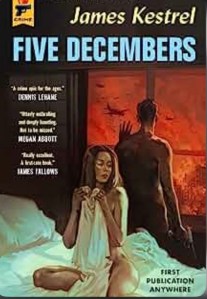
Five Decembers, by James Kestrel

Summary: a surprising and compelling crime story to the backdrop of WW2 in the Pacific.

The gloriously lurid, pulp-fiction style cover of Five Decembers suggests it’s going to be one thing: American hard-boiled crime a la Mickey Spillane. There is an element of this: Detective Joe McGrady of the Honolulu Police gets a call to investigate a particularly sadistic double murder in November 1941.

McGrady, however, is something a bit different from your typical Shamus. An ex-Army officer, with a romantic streak, and a history of personal tragedy, who remains intellectually curious having taken the time to learn a bit of Mandarin and appreciate Asian culture in the course of his career. So, by the time we meet him sipping whiskey in a late night bar, it turns out he is markedly nicer than one might have expected on picking up this book. Indeed, most of the characters are a lot nicer than you might expect, generally treating each other with at least professional courtesy, if not genuine affection.

This is important as McGrady is among a small group of characters in the book whose fate the reader can actually care about as his protracted investigation, and personal travails, stretch across the wretched years of war.

The book takes more than one unexpected turn. Not the least of these is its echo of Slaughterhouse Five with a description of the murderous firebombing of Tokyo – something that one of its planners, future Defence Secretary Robert McNamara, even acknowledged was a war crime – and its chilling aftermath.

So, Five Decembers is a surprising novel: not only a fine procedural, but also a thoughtful rumination on the pity of war. It is all the more remarkable and satisfying as a result.

Sword of Honour, by Evelyn Waugh (Men at Arms; Officers and Gentlemen; Unconditional Surrender)

Summary: Waugh’s war, through a glass slightly smudged

In 1939 Guy Crouchback returns to Britain from Italy, where he has been nursing a broken heart since his wife, Virginia, left him. His intention is to play some part in the looming war against the totalitarian alliance of Nazi Germany and the Soviet Union. As he prepares to depart Italy he prays at the grave of a fallen knight, known locally as the “English Saint”, who on his way to Palestine to fight in the Crusades, was killed in a local squabble between Italian warlords.

Guy hopes that his war will not be as abject a failure as that. As it transpires his career substantially replicates that of Evelyn Waugh himself: involvement in a dangerous and confused raid on Vichy France at Dakar in Senegal; experience of retreat and defeat in Crete; years of desk jobs in Britain before posting as a liaison officer to the partisans in Yugoslavia.

Along the way he encounters an array of colourful comic characters including Richie Hook, a psychopathic old officer; Trimmer, a charlatan and chancer who the army decide would make a useful national hero; and, almost inevitably, Virginia, his ex-wife, still beautiful but falling on increasingly hard times.

Waugh’s account of all of this is frequently extremely funny, but always shot through with a profound melancholy, as the compromises of war and realpolitik lead to a growing realisation that this is not the glorious crusade that Guy had hoped for. But then neither were the Crusades.

Throughout it all though, Guy remains a sympathetic, almost tragic, protagonist. His courage is rarely acknowledged and never rewarded with responsibility. Nevertheless, his Catholic faith, as his father reminds him, is about something eternal. This he tries to stay true to it by being a decent man even though, as he discovers, he lives in a world in which decency, as easily as callousness, is something that can get people killed.

Waugh’s Sword of Honour trilogy is not so much about the horror of war as of the disillusionment of politics. It is an exquisite work: a classic for a reason.

My Father’s House, by Joseph O’Connor

Summary: an outstanding historical thriller of Europeans united against the Nazis

Philippe Sands once wrote a very fine book on the origins of the international law on crimes against humanity and genocide, East-West Street. This does not in my mind absolve him of writing The Ratline: a pointless, rambling wastrel of a book, undertaken, it seems at the behest of the son of a Nazi, who believed his father was, nevertheless, a good man.

He wasn’t.

The Ratline in question in the book’s title was a bit of a Godot character. It never really shows up. The Nazi in question could not stump up the cash to pay the venal and corrupt Vatican officials who were offering Nazis a way of escape from the allies’ dragnet to South America and Southern Africa.

Despite his high profile role in the Vatican Hugh O’Flaherty doesn’t show up in Sands’ Ratline either. Not that this committed anti-Nazi Irishman would have had anything to do with it. But he is an altogether more interesting character, with a much more interesting story to tell of a single night than Sands found to tell in the years he covers before, during and after the war in The Ratline.

O’Flaherty was the head of one of the key Italian resistance networks of the Second World War, run vastly more effectively and altruistically out of the Vatican than the later Ratline. With his pan-European group of Irish, Italian, Dutch and British friends he kept thousands of Jews and escaped prisoners safe as the Gestapo grip on the city tightened.

My Father’s House is a wonderful historical thriller that, by focussing on a single mission by the group introduces us to its various personalities. These take turns narrating the events of the mission. This is an elegant and compelling way to explain to the readers their previous lives before the horrors of the Nazi occupation forced heroism upon them. One scene, in which the British ambassador to Rome, a member of O’Flaherty’s group, encounters O’Flaherty and his deputy, British officer Sam Derry, in the Vatican gardens is particularly chilling. Derry is rehearsing the false names and addresses he will give up under torture if captured.

It is a wholly gripping and deeply moving story of love and friendship in the face of adversity, and asserts a position for O’Flaherty’s alongside Casement as one of the great Irish humanitarians of the Twentieth Century.

Small Things Like These, by Claire Keegan

Summary: already a modern classic

In the middle 1980s, Bill Furlong is a fuel merchant in the town of New Ross in the South-East of Ireland. He is doing alright in difficult financial times. But on the verge of middle age, this father of five daughters is beset with the usual worries, about money, about the future of this daughters, about getting them into the good school in town. Perhaps, he feels these worries more keenly than others because, this is the only family he has, his mother having died when he was a child and never knowing his father.

In the run up to Christmas, Furlong’s work brings him all sorts of places, including to the laundry that the nuns run, where they take care of girls who have become pregnant out of wedlock. This was a fate Bill’s mother avoided because of the kindness of her employer, a Protestant woman farmer who made sure this didn’t happen.

Small Things Like These is a very small book about an enormous thing. It is a beautifully written and intensely moving story of an ordinary man in an ordinary place, finding the courage to do something properly heroic. There are books fifty times the length of this one that have less to say, less memorably.

This book is sure to achieve the status of a modern classic and justly so. It is an outstanding piece of work, utterly exquisite.

Act of Oblivion, by Robert Harris

Summary: a fine historical thriller based on the manhunt for the regicides of Charles I

The Act of Oblivion was a key law in British history. It paved the way for restoration of the monarchy by promising to forget the offences of most, but not all, of those who had waged war on Charles I.

Exempted from the act were the regicides, those who signed the death warrant of Charles. For them the fate of hanging, drawing and quartering awaited.

Many foolishly surendered to the crown and were tortured to death in this way in spite of their pleas for mercy. Others had to be hunted down.

Robert Harris’ book focuses on the manhunt for two of the regicides: William Goffe and his father-in-law Edward Whalley. Goffe and Whalley have had the good sense to make for North America as Charles II approached English shores. But, they wonder, as the search for them reaches across the Atlantic, is this far enough?

Act of Oblivion is a fine thriller. It is also a fine historical novel. It would be a superb introduction to the English Civil War for anyone ignorant of the subject. It is, appropriately enough, a warts and all portrayal of the period, charting the descent of the parliamentary cause into a horrendously bigoted, brutal military dictatorship. It also details the bloody revenge of the royalists following the collapse of the Commonwealth

Other reviewers have described Goffe and Whalley’s principle pursuer, a fictional character called Richard Naylor, as a “monster.” But I think this misses the point of the book.

While the principle sympathy of the book is with Whalley and Goffe, Nayler has become what Goffe and Whalley once were and would have continued to be had they not fallen from power: a merciless zealot.

Early in the book Harris quotes the biblical verse “an eye for an eye.” Because Martin King was not born until the 20th Century he cannot go further. But this book is an illustration of King’s point that, if pursued, this maxim of vengeance leaves the whole world blind.