The Pale Criminal, by Philip Kerr

Summary: A bleak tale of serial murder as the Nazis prepare to liquidate Berlin’s reputation for toleration

It’s 1938 and Bernie Gunther is enjoying a decent living in Berlin as a private detective, blackmail and missing persons a speciality. Unfortunately Reinhard Heydrich has not forgotten him. He press-gangs Bernie back into the police to oversee the investigation into an apparent serial killer, one who is butchering Aryan schoolgirls in a manner that bears striking resemblance to what anti-Semitic propaganda portrays as Jewish ritual blood sacrifice.

I didn’t enjoy this particular outing of Bernie Gunther as much as others in the series. Perhaps it was the bleakness of the subject matter. Perhaps it was the violence of the plot. Perhaps it was that the portrayal of life in the tolerant capital of a state that has set itself on a path to self-destruction through its surrender to atavistic racism felt a bit close to the bone in post-Brexit London. Perhaps it was the way the recurrent invocation of “the will of the people” by the Nazi characters as justification for their every squalid deed that bothered me: it was like spending my leisure time with a bunch of moronic Brexiteers invading my reading. Perhaps it was a combination of all these things.

Aside from this there is still much to recommend the novel, its labyrinthine plot reflecting the tortuous descent into evil of the nation in which it is set; its detailed historical research and well drawn characters, even the monster Heydrich is recognisably human. And of course it has at its centre Bernie Gunther as our guide: morally compromised, lonely, and striving to be decent. In spite of all he remains likeable and with a firm grip on his flawed humanity. Still one of the greatest literary detectives.

Lamentation, by CJ Sansom

img_1225Summary: Henry VIII really wasn’t a nice man. What could possibly go wrong if you upset him?

Matthew Shardlake, the lawyer protagonist of Sansom’s series of Tudor detective novels, is asked by the queen, Catherine Parr, to help with a most delicate matter. A book she has written, Lamentation of a Sinner, has disappeared from her private apartments. The book contains some ideas that the king, Henry VIII, might find heretical and hence could lead to her death, possibly by fire as a heretic.

Shardlake, smart, a bit grumpy, and tolerant is a compelling guide through the insanity of Tudor London. Here the idea of freedom of conscience is little known and life and death depend on being seen to be slavishly devoted to the whims of the king’s religious pronouncements. In this book Shardlake guides us through a labyrinthine plot involving multiple cases, complicated by suspicions of religious orthodoxy and multiple murderers with opaque motives and loyalties.

There is a pervasive sense of dread to this book. It is clear from the outset, a horrific multiple execution by burning, that even well-liked characters from earlier books are not safe, and skill, intelligence and decency are faint protections from the capricious cruelties of tyranny.

One bonus to this book is a detailed historical note at the end in which Sansom speculates on a range of historical issues – from the cause of Henry VIII bloating and death (untreated type 2 diabetes, Sansom reckons) to the fate of Catherine Parr. In this Sansom notes that Elizabeth I, as a child, was sexually abused by Thomas Seymour, Parr’s last husband. Disturbingly this sordid tale was turned into a romantic drama, Young Bess, in the 1950s. This led me to wonder what sort of sick mind would ever wish to turn the story of a child abuser into that of a romantic hero played by Stewart Granger?

The Shardlake novels are a fine portrayal of life in a theocratic police state, inviting us to imagine what life in such places may be like in the contemporary world, and reminding those of us lucky enough to live in the secular and more tolerant West, that we are not so far removed from the less tolerant societies that still disfigure our planet.

The Red Moth, by Sam Eastland

Summary: So, apart from the genocide, tyranny, and the purges, Stalin really wasn’t such a bad old stick

As the German Army is approaching the gates of Leningrad, a light aircraft is brought down by Russian troops. The couriers on board are carrying a painting of a red moth.

When news of this peculiar cargo reaches Stalin, his suspicion is aroused. So he summons his best investigator, Inspector Pekkala, to enquire into the meaning.

Inspector Pekkala is something of a literary cousin of Philip Kerr’s inspired creation Bernie Gunther, another honest detective in the midst of a monstrous system. However unlike Gunther, who is believably worn down over the years by violence and compromise, Pekkala seems almost superhumanly incorruptible: undiminished and undaunted, even in the face of Stalin’s rage.

The interplay between Pekkala and Stalin is very entertaining, but it did bother the history student in me. In these books Stalin comes across more as a stern police captain rather than the genocidist whose paranoid purges of his own military and bureaucracy brought his country to the brink of ruin. Yet both Pekkala, and his side kick Kirov, manage their intimate service to this psychotic in a way that keeps their hands clean, the consciences clear, and their integrity as human beings undimmed. This aspect of the story does demand that whatever structure the reader is suspending their disbelief from has to be stretched a bit further to cross this historical chasm.

This quibble aside, The Red Moth is a hugely entertaining excursion to the battlefields of the Eastern Front, and Eastland’s familiarity with the milieu of Stalinist Russia does paint an engaging portrait of life in those bloody times.

The Other Side of Silence, by Philip Kerr

It’s 1956 and Bernie Gunther, social democratic Berlin detective, and former whipping boy of Heydrich and Goebels, is living incognito on the French Rivera, working as a hotel consierge with only a regular bridge game by way of diversion. However, as usual, trouble, in the form of a former Gestapo acquaintance intent on blackmailing the English novelist, Somerset Maugham, finds Bernie.

While the main action in this novel relates to the Cold War, significant parts of what happens find their origin much deeper, in Nazi era Germany, and in particular the 1945 Battle of Königsberg that has featured in other novels of the series, in which Bernie was captured by the Soviets. For Bernie “the past is not dead, it is not even past,” as William Faulkner put it elsewhere.

The same can also be said for the character of Somerset Maugham in this novel, whose clandestine life as a British agent and as a homosexual comes back to haunt him.

The Bernie Gunther series is a particularly rich and wry meditation on history. This instalment is no exception, and as always Bernie remains an engaging guide though Europe’s shameful past. True he has become morally diminished by years of war and bloodshed, but he still struggles to hold on to a sense of humour and some modicum of basic human decency in the midst of it all. And that, sometimes, may be the best any of us can hope for.

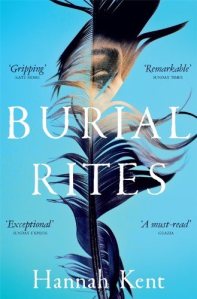
Burial Rites, by Hannah Kent

imageAgnes Magnusdottir has been condemned to death for her involvement in the murder of two men, one of them her lover. As she awaits confirmation of her sentence she recounts the events leading up to these deaths to a young priest, appointed as her spiritual advisor, and the members of the family she has been billeted with.

Burial Rites is a sort of a Nordic “Crime and Punishment”. It is beautifully written and desperately sad, a story of both the physical violence that destroys lives, and the violence of poverty that destroys hope as well.

It is a very rich book – a portrait of a poor rural community on the edge of the world in northern Iceland at the beginning of the 19th Century; a whodunnit; a book about the redemptive power of decency.

At the heart of the story is Agnes – a fiercely intelligent woman cursed by the bad luck of her birth – finally finding a place in a family and a community as a sword of Damocles, in this case an executioner’s axe, hangs over her.

It is a fine work, extraordinary also that it is Hannah Kent’s first novel.

An Evil Eye, by Jason Goodwin

 An Evil Eye is the fourth book in Jason Goodwin’s series about Yashim, an official in the Ottoman Court of the 19th Century with a particular penchant for investigation. A eunuch, butchered as a teenager by the enemies of his father, his status means he is privileged access to the harem as well as the city and so is frequently entrusted with some of the Court’s more sensitive enquiries.

In this book a body is found in the water tank of an Orthodox monastery outside of Istanbul bringing with it the suspicion that perfidious Christians have murdered a Muslim. Yashim is sent to investigate and hopefully stave off an ugly incident. Of course the body is merely the tip of a much more dangerous and labyrinthine plot that threatens the entire stability of the Ottoman State.

Jason Goodwin is an historian. He has written an earlier history of the Ottoman Empire, and so knows his stuff. This is one of the greatest pleasures of his books – he transports the reader to bustle of 19th Century Istanbul and Yashim is an elegant and erudite guide through its diversity. Yashim is not only a man of action but also a polyglot and cook – I was inspired, with modest success, to attempt three of his culinary efforts over the course of reading this book.

 In his investigations Yashim is assisted by his close friend Palewski, the Polish Ambassador to the Ottoman Empire. Of course at the time in which the book is set Poland doesn’t exist, subsumed by the empires of the “Great Powers”. But the Ottoman Empire insists on maintaining the embassy of its old enemy. At the very least it annoys the Russians. Palewski also has one of the best lines I’ve come across in while: “If you go on saying and believing the same things for long enough, the world will eventually come around.” That should be a motto for anyone who has ever strived for a more humane world.

I must confess that for the fourth time reading one of Yashim’s adventures I am still not very clear on what happened. I think this, to an extent, is a result of quite complex plots with a myriad of characters and various strands running from the harems to the Court, to the international embassies and their spies and diplomats, to the back streets and waterfronts of Istanbul. Perhaps I should simply be paying closer attention to the final pages of the book.

In spite of these reservations I will be picking up the next instalment of the adventures of Yashim and Palewski. They are tales of escapism like few others.

Dictator, by Robert Harris

 Dictator is the final volume in Robert Harris’ fictionalised three-volume biography of Cicero, covering the years up to his death and with it that of the Roman Republic.

Cicero did have a biography written by his secretary Tiro, the inventor of one of the first systems of short-hand which still echoes into contemporary English, for example, e.g. Fortunately for Harris, that biography has been lost to history, so he has constructed his own trilogy as if it were Tiro’s biography of Cicero, with Tiro as narrator.

As with the previous two volumes of the trilogy, Imperium and Lustrum dealing with earlier phases in Cicero’s career, Dictator is a gripping political thriller, covering the period from Cicero’s exile to the downfall of the Republic with the establishment of the second triumvirate of Antony, Lepidus and Octavian.

 Contrary to Goldsworthy’s Caesar, or Massie’s fictionalised accounts of the period, with Harris Cicero is presented as a hero, albeit a flawed one, a proponent of rule of law against arbitrary and tyrannical rule in spite of personal threats and the moral cowardice of his contemporaries.

Unlike Goldsworthy who typically tries to explain his subjects in the contexts of their own time, Harris deliberately seeks parallels with the present. Here he presents a warning for a polity that disdains basic principles of rule of law.

But, Harris does not allow the vital political-philosophical points to interrupt the narrative, which is gripping, as Cicero with only logic and argument in the face of shocking violence seeks to maintain constitutional principles in the face of the vanity of warlords.

The result is a fine political thriller, with much to recommend it for the student of the ancient world.

Dark Fire, by C J Sansom

In the course of an apparently hopeless effort to defend a young woman on a charge of murdering her cousin, the lawyer Matthew Shardlake receives some unexpected help from Thomas Cromwell, King Henry VIII’s chief minister: a 12 day postponement on the case to allow him time to marshal a proper defence. In return Cromwell, requires Shardlake to undertake an investigation on his behalf: to locate the formula and means of making Greek Fire, the legendary incendiary weapon of the Byzantine empire. This is rumoured to have been discovered in the library of a monastery that Cromwell’s philistine policies have had vandalised in the course of the Dissolutions.

C J Sansom, the author, is both a historian and a lawyer, as well as a novelist. So this book, the second in his series about Shardlake, is rich in detail both of the political and religious controversies and the legal practices of the time. Shardlake, and so presumably Sansom himself, considers Cromwell as the lesser of evils that could befall the English state, but doesn’t skip over the atrocities the man was capable of: Shardlake’s memory of how Cromwell had a Catholic priest slow-roasted to death is a particularly chilling passage in the book.

In spite of the careful attention to historical detail Shardlake is the very model of a modern Londoner: humane and rational, his best friend, Guy, a Catholic physician and apothecary of Moorish origin, his side kick, Barak, a secular Jew. As such he is a companionable guide to the mad slaughterhouse that was Henry VIII’s London, a place more like a European Saudi Arabia, or Islamic State (DAESH), than the place we are familiar with in the 21st Century.

The result is a gripping and unusual crime novel, as Shardlake and Barak grapple with the parallel mysteries of a child murder and Greek Fire. I look forward to the rest of the series.

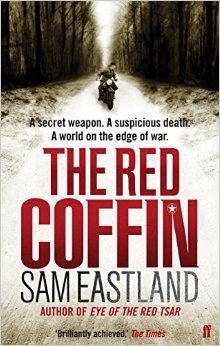
The Red Coffin, by Sam Eastland

imageInspector Pekkala is an honest cop in Stalin’s secret police, the NKVD. So Stalin gives him the job of finding the truth behind the grisly death of the head of the Soviet programme to develop a new tank, the T34, or, as the test drivers have begun to call it, the Red Coffin.

The idea of the honest investigator in a corrupt world is not a new one: Raymond Chandler’s Phillip Marlowe was conceived of as a knight errant updated to his contemporary Los Angeles. More recently Phillip Kerr’s Bernie Gunther, JK Rowling’s Commoran Strike, and Martin Cruz Smith’s great creation Arkady Renko walk similar paths.

What makes Pekkala different is his milieu, that of Stalinist Russia, and Eastland clearly knows this subject well: One comic-dreadful moment is when Stalin sends for an officer he desperately needs only to discover he has already forgotten that he has had the man liquidated.

The resulting book is highly entertaining, but I am not sure wholly convincing. The notion that Stalin would keep a few honest men about is not completely beyond the bounds of credibility: Stalin tolerated Zhukov, for example, because he knew he needed his genius to fight the Nazis.

So the idea underpinning this book is that in the increasing paranoia and terror of Stalin’s purges Pekkala, formerly a special investigator for the Tsar, is kept about for the moments when Stalin needs the truth, not just scapegoats. I am not sure that the relationship between the two would develop to such an extent that anyone would ever feel comfortable about carrying out a practical joke on the psychotic tyrant though.

The resolution of the mystery is also a bit disappointing, arriving in an series of unforced confessions. However a confrontation with a tank on the Polish border at the climax does redeem the book somewhat.

Overall it’s an entertaining book, and the characters of Pekkala and his sidekick Kirov are engaging enough to want to return to the series.

The Narrow Road to the Deep North, by Richard Flanagan

Summary: “Because courage, survival, love – all these things didn’t live in one man. They lived in them all or they died and every man with them; they had come to believe that to abandon one man was to abandon themselves.”

Dorrigo Evans doesn’t have a particularly high opinion of himself. He is an inveterate womaniser, a distant father, a disloyal husband, an excessive drinker, and a sometimes reckless surgeon. Yet, because of his time as a commanding officer of enslaved Australian prisoners of war on the Burma death railway, he is regarded as a national hero. This he regards as somewhat fraudulent, echoing the pretenses of leadership that he displayed in the camps. Dorrigo knows what he is: an officer who failed his men by allowing himself to become complicit in the war crimes of their Japanese captors.

The Narrow Road to the Deep North won the Booker prize in 2014 and trails behind it a mountain-load of praise. It deserves every accolade: it is an extraordinary meditation on war, death, heroism, trauma, love and loss. It is also one of the most difficult books I have ever read.

The centrepiece of the book is an extended account of a single day in the POW camp, echoing Solzhenitsyn’s novel of the gulag, One Day in the Life of Ivan Denisovich. I found this particularly gruelling, the pages suffused with dread for the atrocities that the author has already informed us will occur. Through this section we meet the doomed, struggling to maintain their dignity and decency in the face of the implacable brutality of Japanese militarism. Perhaps not all readers will find this such a difficult section but it took me weeks to read, unable to handle more than a few pages a day.image

I am particularly relieved that I stuck with this. The discomfort of reading about the death railway is as nothing to what those, including the author’s father, suffered on it.

And the novel is ultimately one of profound insight and devastating power: it made me cry more than once. It affirms a theme of Ian McEwan’s Atonement, that war obliterates not only life but love itself, and is unflinching in showing the reader that atrocities are committed by people as human as we are: Dorrigo’s captors go to their graves believing themselves good and patriotic people, more concerned with how they felt about killing than for the actual murders they inflicted on helpless prisoners.

But there are also more redemptive and hopeful notes. In contrast to his captors Dorrigo survives the war thinking himself a bad man, a failure and accomplice to war crimes, thinking that is a product, no doubt, of post-traumatic stress. But Flanagan shows us how, even at our most flawed, human beings may be better than we ever dare to imagine ourselves. Indeed, it may even be our flaws, sometimes, that compel us to heroism.

The Narrow Road to the Deep North is a masterpiece.