Summary: second in a series of guest blogs from “Elphaba” on the ongoing war in Sudan
There was some great excitement in Singa this week as it was announced that many vehicles had been found and owners could bring proof of ownership and reclaim theirs. Ours was a battered, old, much-loved and very unreliable crate. She appeared to have some kind of sentience: working on a whim for some and not others. Opening and closing the windows was an act of will power (no winders that worked). But she had given great service carrying sheep, produce, people and everything in between for several years before she was taken at gun point last summer
A family member, Ax, went to see if she was there. He said the site was depressing. It was full of lines of metal shells, most with no wheels, broken windows and some with little or no innards.
At the back of his mind in going to look for the vehicle, apart from the fact that it is “something to do” when daily routines are still restricted, was a potential to get her back “in case we need to run”. But then you are an easier target in car than on foot. Behind this is the reality that although our family are for the most part fine, there is a thin ice feeling.
On the 4th October a friend in El Obeid rang and we were delighted to hear all was well. The next day he rang to say that they had been bombarded with drones. Omderman has also been hit. Nothing is resolved. And South Sudan is still unravelling.
One of the fall-outs of the war coupled with climate change (I think) has been a steep increase in Dengue fever. We also hear disputed reports of cholera outbreaks. Now at the tail-end of the rains is the malaria season
In the end we could not locate our vehicle. We laughed that she was never exactly a get away car, except in the sense that we seemed to get away with paying very little road tax over the years. In this seemingly endless war, the citizens who have lost most of what we think of as essentials are expected to pay significant amounts to reclaim their cars at a time that inflation in the costs of everyday needs, and the continuing devaluation of currency, bites.
Summary: The UK government’s shenanigans around Palestine Action undermines fundamental principles of rule of law
In 2010, Tom Bingham — former Master of the Rolls, Lord Chief Justice, and Law Lord — demonstrated in his book The Rule of Law that the concept is fundamental to any tolerably functioning democracy. He set out eight principles, including that: • legal rights and liabilities must be determined by law, not the arbitrary discretion of, for example, ministers; • the law must provide effective protection for fundamental human rights; and • the rule of law requires states to comply with their obligations under international law as seriously as domestic ones.
The British government appears to violate all three of these particular principles in its decision to ban Palestine Action and criminalise anti-genocide demonstrators.
To begin at the beginning: there is no agreed definition of terrorism in international law and little academic consensus. The terrorism scholar Alex Schmid once suggested that terrorism might be considered “peacetime equivalents of war crimes.” That deliberately omits atrocities such as Hiroshima, Dresden or Gaza, but it is easy to see why governments responsible for mass civilian killings might resist such a definition that makes them seem at least terrorism adjacent.
In the absence of international agreement, terrorism becomes whatever individual governments decide it is. In the UK, the government has defined it broadly as violence against people and damage to property in pursuit of a political cause. Yet even by that standard, its application is arbitrary. The killing of close to 100,000 civilians by a UK ally is treated as legally too complex for ministers to judge, but the throwing of paint on a weapons system is not. To brand the latter vandalism as “terrorism” is to reduce the definition to a tool of political convenience — a textbook example of arbitrary discretion, and thus a breach of the rule of law.
This arbitrariness also undermines basic human rights protections, most clearly in the assault on the right to peaceful protest. On 6 September 2025, Steve Masters, a British military veteran, was arrested while sitting in his wheelchair in Parliament Square holding a poster. He was one of 890 people detained that day. Their “crime” was not violence, but conscience: holding placards in solidarity with Palestine Action. Farcically, many will be charged with terrorism offences.
Protesters hold up a mirror to the British government, and the government recoils from its reflection. Yet it is only the protesters who offer any hope that the UK might one day be able to face itself with any self-respect, once the atrocities with which it has been complicit have passed.
Summary: First in a series of guest blogs on the war in Sudan, by “Elphaba”
I have been writing family bulletins for myself and anyone ready to read them since the start of the war in Sudan in April 2023. Kind readers have followed events that have driven my family from their homes at gun point from areas around Umderman to Gedarif and Singa. Then again from Singa as they went under siege there.
Before the war, meeting of the Blue and White Niles at Khartoum: many of the buildings in this photo have now been burnt down
In an attempt to spread the burden of too many mouths to feed under one roof and much heart searching they scattered further. Some made the treacherous route to the north only later to face long electricity blackouts in April and May in the hottest time of the year. Others fled Singa on foot eastwards to Gedarif. From there one or two made it to Saudi Arabia where they have safety but at the cost of visa renewals and a deep sense of loss.
Now since the start of this year with relative peace in the Eastern areas of Sudan. For our family, at last, the kids are mostly back at school, the offices working and the economy working on some level. The banks work intermittently and cash is in very short supply. Some can use online banking with an app but for all everyday trading for basic goods, it is only cash. Adding to this, at some point in the year someone thought it a good idea to introduce a new currency and a new layer of potential confusion and corruption. In most of the East only the new currency works, while in the West only the old. In Khartoum and Wad Medani both get used.
With no immediate drama, I worry that we run the risk of joining the world in forgetting that the war and instability is far from over and accepting a new normal that is anything but. Now with the rains falling heavily there is very little seed to plant to benefit because infrastructure is decimated and only very few have any spare funds. And there is drama. For our friends in El Obeid and our once-home Dilling, siege, counter siege and fear have outlasted anything seen in the East and Darfur continues to be another story again. We last heard from close family friends there about a year ago.
As in Israel/Palestine there are huge profits and plans for still greater ones being made by those who would seize power and (ab)use weakness. In Port Sudan there are huge agricultural schemes under discussion not to mention rebuilding contracts and deals with the Gulf. It is mind-numbingly depressing in its logic of winner – eventually- takes all at whatever cost.
Meanwhile, for our family there is the on-going need to claw back dignity and rebuild with the resources we have. The young men – nephews and sons – working for low wages as labourers, drivers and other sorts of fixers send back what they can. They are themselves stranded in nearby countries away from their families and they know that whatever they send it is never enough. We are aware we have more than many and less than others.
I challenge anyone to fault the determination. My elderly sisters-in-law (elderly = 10 years older than me and in their 70s) have returned to their suburb in Umderman. There is no power. They returned to homes totally stripped bare “not even a teaspoon”. The first job for Nxxx was to buy a front gate as that too had been taken. Bottled gas costs 5 times what it did a year ago and anyway the cooker is gone. The widespread gossip that her neighbour’s son – now gone – whom Nxxx had known since childhood orchestrated the theft of her property and many others. And yet after a few days Nxxx at least is back in her house. As Rxxx explained to me from Saudi Arabia, her homesickness palpable: “of course all the family have been amazing. We are lucky. So much luckier than many. But you ache for what is yours, where you are you and where you’re not thought of a ‘a displaced’”
The violence has gone from these neighbourhoods for now and the young men returning have great plans to fix the power. Knowing the place well, I have no idea how they are getting by. I know it will be a profoundly communal endeavour. My 24year old nephew, his own life plans long since on hold returned from Port Sudan to help his father. He says they live on ful and ta’amia because that is made at a local shop where they have fuel. I imagine them all together much of the day to support, chat about possibilities, find workarounds to issues, talk prices and a future. I hope this will help them recover for now from the trauma of recent months/years.
The profound divide emerging in Sudan and the discrimination and racism that underlies the political stories is a worrying strategic trend that most Sudanese don’t have the luxury of considering. Maybe in that there are some universal trends.
Summary: calls for humanitarian aid are being used by pusillanimous politicians to distract from their failures to directly address the causes of humanitarian crisis in Gaza, most specifically Israel’s genocidal assault.
For over five years in the late 1990s I worked, mostly for Oxfam GB, organizing assistance, including water supply and sanitation, for the civilian victims of the civil war in Angola.
So, humanitarian response is a subject area I know a little about. As students of management and leadership will be aware, a problem with a bit of expertise is that you can presume that everyone understands the fundamentals as well as you do. This is called taken-for-grantedness in the literature.
I have been taking-for-granted that David Lammy and Keir Starmer – human rights lawyers after all, as they like to tell us, and therefore smarter than everyone else, as they like to imply – would understand the fundamentals of humanitarianism. After all, they have been pontificating on it since the start of Israel’s murderous assault on Gaza in 2023.
But maybe they don’t. Maybe it is possible that they are not the craven accomplices to war crimes that their ongoing military and diplomatic support of Israel suggests. Perhaps they are just pig ignorant of the vitally important stuff that successful humanitarian response requires.
So, here are a couple of the most basic lessons of humanitarianism for their edification.
The technical term for this position in relation to humanitarian response is “Oxford Union debating horseshite”. It is part of an approach to politics that values a plausible sounding point to win an immediate argument over the concrete measures necessary to resolve the actual causes of the crisis that the argument is about. Food assistance, vital as it is, does not protect from the other forms of collective punishment, such as the cutting of power and water that Keir Starmer advocated Israel doing, let alone the mass burning alive of children that Israel has routinised in Gaza since the outset of its violence.
2. If a belligerent nation is using famine as a weapon of war, then they are not going to permit humanitarian assistance unless put under robust pressure to do so. Robust pressure, not expressions of sadness or concern: Boycotts. Divestments. Sanctions. Criminal accounting.
The British government used to like to depict itself as a world leader against slavery. But there has been a deafening silence from that government, and indeed much of the anti-slavery community, on this matter.
6. If you have soldiers in place to machine gun aid recipients, then the purpose of an aid distribution is not humanitarian. It is war crimes.
7. If you are materially supporting a political regime that has publicly stated its war aims are ethnic cleansing, then no amount of humanitarian assistance will mitigate that. You too are practicing genocide, even if you are also offering the doomed their meagre last meals.
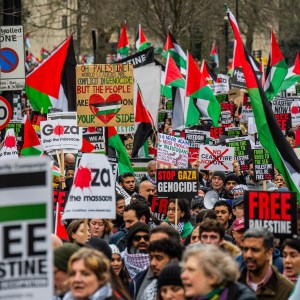
Maybe these ideas are new to Starmer, Lammy and the rest of their government. But they are not hard. Indeed, tens of thousands of ordinary British people demonstrate that they grasp these most fundamental points already as, month in, month out, they gather in protests across the country to indict their own government for its abject moral collapse.
Summary: Netanyhu’s war is racism and should be condemned as such
Perhaps I have missed it, but I have not seen many anti-slavery organisations condemning the mounting slaughter of civilians in Gaza, and now Lebanon, over the past year.
I wonder about anti-slavery organizations more than other specialist NGOs or human rights issues because, for the past 20 years this has been my principal area of professional practice and so is a sector with which I have some familiarity.
Perhaps some anti-slavery organization feel that something like Gaza is not part of their mandate and so would be inappropriate for them to raise their voices. Perhaps others are afraid of upsetting donors by raising question about another specialist area – human rights in war – and losing funding for other important work. Maybe others are afraid of annoying the governments of the US, UK and Germany, or certain parts of the EU Commission, who may be complicit with the policies of Netanyahu’s cabal and so losing precious access and the occasional invitation to convivial cocktail parties.
The thing is this: if we survey the realities of slavery through history right up to the present day we see very clearly that it is rooted in racism and the dehumanisation of others. Hence, anti-slavery organisations must be anti-racist if they are at all serious about tackling the causes and consequences of enslavement. If they fail in that fundamental then they are not truly anti-slavery. They are merely performative distractions.
Each of these examples, and there are many more, is a naked expression of racism against a whole people. Racism is at the root of every atrocity that is committed by Netanyahu and his cronies.
The continued acquiescence of US, UK and Germany in this, up to and including the provision of money, material and intelligence to sustain the Israeli offensives, in spite of overwhelming concerns regarding both their morality and legality, has dealt a grievous blow to international rule of law. It has also done something that would have seemed unbelievable a mere 18 months ago. It has established a credible case that there is no moral difference between the foreign policies of Biden’s America, and Putin’s Russia. Both appear ready to shred law and the most basic principles of human rights when it is convenient for them.
It is upon meaningful rule of law and a common adherence to the fundamental principles of human rights that the cause of anti-racism, and anti-slavery, have been advanced. Now, however, if campaigners challenge transgressing governments that their policies are in breach of human rights many will laugh and point to Gaza and Ukraine and say that the US and the UK, Germany, Israel, and Russia have demonstrated that the only right is might.
So, every anti-racist organisation on this planet, and that includes all anti-slavery organisations that are worthy of the name, and every organisation that derives its mandate from the Universal Declaration of Human Rights, must add their voices to the international condemnation of the Netanyahu government’s racist wars. If they do not then they will seem as hypocritical as the western governments who facilitate these wars in spite of the mounting evidence that the bloodshed that Israel perpetrates is foul murder.
As the Irish anti-slavery campaigner Roger Casement put it, “we all on earth have a commission and a right to defend the weak against the strong and to protest brutality in every shape and form.”
That commission was never more urgent than it is today as we daily bear witness to Netanyhu’s unfolding policy of genocide.
Summary: those who have lost their moral compass will never understand that protest is leadership
Rule of international double standards
Today, it appears that many Western political leaders apply multiple caveats to the principle of the universality of human rights. The result is that rather than rule of international law we seem increasingly to have rule of international double standards.
The moral black hole at the heart of Western policy towards Israel
British, American and German policy on Gaza appears to be underpinned by a view that Palestinian lives are not equal to Israeli lives and so unworthy of comparable protection. Hence those three governments seem to have decided that it is better to arm and provide diplomatic cover for the far-Right Netanyahu government rather than to uphold the most basic principles of human rights and international humanitarian law.
In the face of the considerable evidence of genocide these governments are deaf to the international protests of conscience, and to the demands of Palestinian and Israeli voices for peace. Instead, they work to maintain the murderous Israeli Defence Forces supply lines at all costs.
I have heard some try to justify this human rights double standard in relation to Israel by responding to protests with patronising reference to the need for realism, for a “realpolitik” approach to the conflict. This is, perhaps, a notion they may imagine that the protesters do not have the sophistication to properly understand. However, many will know that “realpolitik” is a term that has considerable previous, notably in the hands of Henry Kissinger, as a euphemism for moral vacuity and acquiescence in crimes against humanity.
Given this many will remain unconvinced that “realpolitik” really is a sufficient justification for the mounting horrors in Gaza and the West Bank. So, why are the US, the UK and Germany so steadfast in their support of a far-Right Israeli government pursuing such a horrendous campaign of violence?
It is worth remembering that Germany was genocidal in Namibia well before the Nazis ever came to power. While relatively democratic, Britain and the United States were also genocidal in the 19th and 20th centuries in relation to, amongst others, Native Americans, Ireland and South Asia. It was democratically elected governments in the US that launched the invasion of Vietnam and the destruction of Cambodia. It was democratically elected governments in the US and UK that unlawfully invaded Iraq. Today it is democratically elected governments in the US, UK and Germany that have facilitated the far-Right in Israel in their indiscriminate slaughter of Gazan civilians.
So, if we take even a medium-term historical view on these countries, it seems that there is a strain of thinking in those nations’ political cultures stretching from Left to Right that still view war crimes and genocide not as appalling and even unforgivable aberrations, but as legitimate policy options when it is convenient for them or those, however unsavoury, that they deem allies.
But it is the protests of which they are so contemptuous that so often change cultures and countries in the ways in which corrupt politicians can only dream. This is because protest is moral leadership that seeks to make the world a better place by demanding that it become so.
It is because of protesters that women have the vote, that apartheid has been ended in South Africa, that civil rights have been advanced in the US and the North of Ireland. When many governments have sought to merely manage the status quo – the “realpolitik” – protesters have asserted that this is not good enough and demanded better.
Today protesters understand, as the Irish patriot and human rights activist Roger Casement once put it, that “… we all on earth have a commission and a right to defend the weak against the strong, and to protest against brutality in any shape or form”.
So, at the end of the day, as Israel’s allies become ever more deeply mired in the murder of children, it is the protesters they disdain who will perhaps contribute most substantially to an end to apartheid in Israel/Palestine and thereby save the souls of their own countries.
In 2017 I was awarded an honorary OBE in recognition of my services to the eradication of slavery. I am now returning this as it is something which I can no longer, in good conscience, keep.
On 15 April 2024, your government refused to provide protections for the victims of modern slavery from your unconscionable “Rwanda scheme”. Over the past months you, as Prime Minister, have acquiesced in attacks on the European Convention on Human Rights by members of your parliamentary party. These, along with the UK’s bipartisan position on Gaza, have put into sharp focus how British policy now distinguishes between people whose lives it values, and those whose lives it disdains.
These represent a fundamental repudiation by the UK of the principles of the Universal Declaration of Human Rights. They are a rejection also of an enduring British human rights tradition stretching back to Thomas Clarkson, William Wilberforce, and Mary Wollstonecraft, and a longer tradition of rule of law that stretches back to Magna Carta.
As such they send to the whole world a message that the UK rejects the core bases of human rights and rule of law upon which progress in human dignity, including anti-slavery action has been based for hundreds of years. This can only impede the anti-slavery struggle and embolden other governments who seek to systematically abuse the rights of their subjects and citizens, including by the facilitation of their enslavement.
I hope that you will yet find it in your heart to alter course and embrace and defend these British traditions of human rights and rule of law rather than sacrifice them to some ill-judged populist crusade.
Summary: an elegantly written exploration of the contemporary impact of the British Empire on the world.
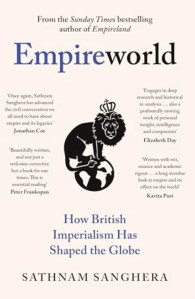
Empireworld, Sathnam Sanghera’s follow up to his brilliant, Empireland, expands on the theme of that earlier work, exploring the impact of the British Empire beyond Britain’s shores.
Sanghera does not cover everything. If he did he would still be writing. But also, as he acknowledges, there are some subjects which have been so comprehensively dealt with that he feels he has little new to add.
The history he does recount here is a mixture of the thematic – for example, the role of botany in Empire, and the imperial and anti-imperial history of British NGOs – and geographic – for example, Nigeria and Mauritius. His discussion of anti-slavery is a mixture of the two, with a principle focus on Barbados and the West Indies.
Across the book Sanghera shows how every idea carries with it the seed of its own opposite: racism and slavery generated anti-slavery and anti-racism; imperialism gave rise to anti-imperialism. This leads to a very complex history, allowing the discernment in some places of many positive legacies of Empire – rule of law, parliamentary democracy, tea – alongside many negatives – partition, civil war, corruption, impoverishment.
This complexity leads Sanghera to be careful in his conclusions, seeking with this book to promote nuance, understanding, and dialogue, rather than judgement.
This is a hugely laudable objective, particularly for a country that needs to recognise, as Sanghera rightly notes, that other peoples’ – foreigners! – perspectives on Empire are vital for a proper understanding.
One such foreign perspective that Empireworld put me in mind of, was the 1916 speech from the dock by the great Irish anti-slavery activist and anti-imperialist, Roger Casement, who observed, “For [the English Establishment], there is only “England”; there is no Ireland; there is only the law of England, no right of Ireland; the liberty of Ireland and of an Irishman is to be judged by the power of England.“
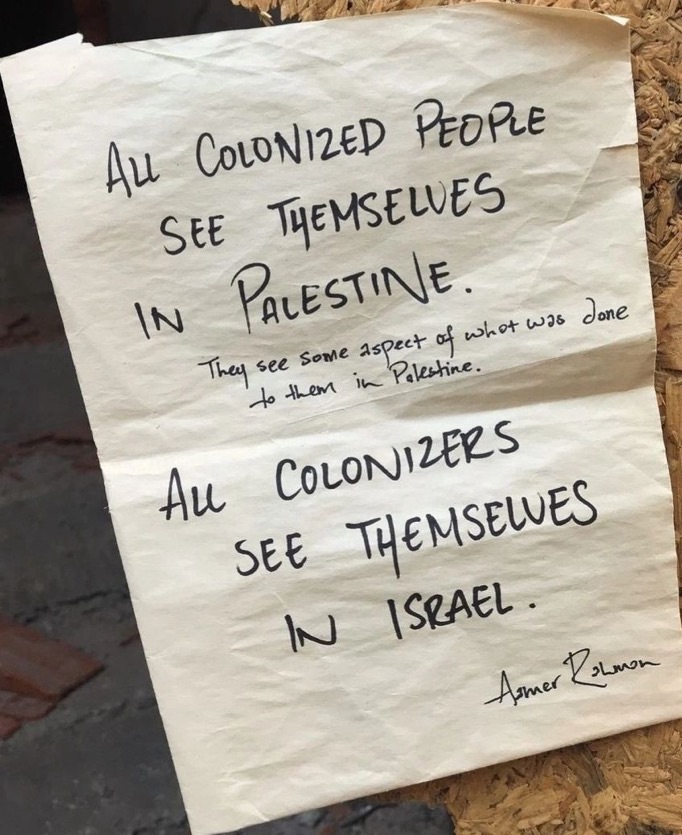
For Ireland, one could substitute the name of any country of Empire. Empire was positive for subject peoples if it was in England’s interest. If it was not, then, as Sanghera describes, they could be starved, enslaved, shot with dum-dum bullets or subject to any other expedient or abuse that the British government chose to mete out.
This principle remains true to this day, it seems to me, for Scotland and the North of Ireland, the last vestiges of Empire.
Sanghera does not discuss Ireland, or Scotland, much in this book. But he does not have to. There are plenty of others who have and continue to do so. Instead, Empireworld is another superb study of frequently unacknowledged and unexplored history. A visit to Kew is never going to be the same again.
The article revealed that only 54% of FTSE 250 have published codes of ethics, according to research by the Institute of Business Ethics. Of these only 57% are considered as “good”.
As Ms McConville, my English teacher at school in Newry, used to regularly ask in her efforts to coax more lucid writing from even her most inarticulate pupils, “What does ‘good’ even mean?”
Milton Friedman would have said that “good” meant making a profit for shareholders within the law. This is a moral perspective that is still widely prevalent in government and business. I have met more than one business executive who has been admiring of such guidance as an amoral underpinning to their strategic approaches. But such amorality is also wholly inadequate for dealing with the existential challenges facing humanity in the 21st Century. Each of those challenges – from climate change to contemporary slavery – is already a product of thousands of business and political leaders thinking that such things are somebody else’s problem.
The People Management article quotes Ian Peters, director of the Institute of Business Ethics, with another perspective on “good”. He says, “A code of ethics should be the cornerstone for any organisation, ensuring it’s doing the right thing for the right reasons.”
This organisational focus on ethics is one that I am strongly in agreement with, though this also begs the question, “What is ‘right’?” It is further striking that others quoted in the article instead emphasise only personal conduct in the workplace and whistle-blowing duties and protections.
These are, of course, important issues. No one should have to endure fear and bullying in any workplace. But in my view ethics is a yet more fundamental thing. It is, at heart, a strategic question and, consequently a leadership one.
In my book, Ethical Leadership: moral decision making under pressure, I define ethical leadership as the effort “to optimize life-affirming choices that seek to protect human rights and advance ecological restoration irrespective of how inhospitable the political, social or professional environment.”
Sometimes this requires dissent or “whistle-blowing”: protest is often, after all, just another name for leadership.
But ethical leadership is also about strategic choice making. For example, a business executive who, decides to source from a textile, electronics or fisheries supply chain in Asia or Africa that they know to be highly destructive of the environment and rife with exploitative labour practices, will often be behaving completely legally. They may also be acting in the spirit of a code of conduct that emphasises legal compliance. But there is, nevertheless, the sulphurous whiff of the banality of evil in such choices.
But, like the rest of us, I may be forced to. The current precariousness of continued human existence on this planet is a result of so many political and business leaders not looking beyond the short-term questions of immediate profit rather than the long-term question of sustainability or, for that matter, human survival.
For humanity to have a chance requires now that business executives and politicians focus on promoting choices that protect human rights and restore the environment, not just those that comply with the law and obtain short-term financial gains.
Summary: a desperately sad but hopeful perspective on Israeli Apartheid and the illegal occupation of Palestine
Rami Ethanan, a graphic designer, and Bassam Aramin, a scholar, are friends. They have a lot in common. Both are smokers. Both are former combatants. Both understand the deep, moral corrosiveness of the Israeli occupation of the Palestinian territories. Both understand that peace requires people to talk to each other and try to understand each other’s point of view. Both are the fathers of murdered children: Rami’s daughter, Smadar, was murdered by Palestinian suicide bombers; Bassam’s daughter, Abir, was murdered by Israeli soldiers.
Apeirogon is the story of how, in particular, these two men have sought to advocate for peace by building mutual understanding. But it ranges even more widely, into the lives of their families, including their murdered daughters, and into the cultural and political history of Israel and Palestine.
(From the Guardian)
I finished this book just before Israel launched its latest series of child-killing attacks on Gaza. As usual, in such situations, American politicians are to be found on social media congratulating themselves for the US military support to Israel that allows its leadership to launch such attacks on Gaza with impunity. Such politicians find the slaughter of children with rockets, and American journalists with bullets, much more palatable than the murder of children by suicide bombers. But that is the logic of the US’s military alliance with what the Israeli human rights organisation, B’Tselem, has called an apartheid state.
The asymmetric nature of the warfare between Israelis and Palestinians is very much on display with the latest Israeli attack on Gaza. In prison, for throwing a dud grenade at an Israeli patrol, Bassam realised that responding to Israeli violence with violence, even if only stones, plays into the hands of those who want to sustain the occupation: it allows them to portray Israeli violence and theft as defensive, and the Palestinians as less than human. As a result of this realisation Bassam became committed to the ideal of non-violence.
Rami, recognising the common humanity of Palestinian and Israeli families who had suffered similar losses to his own, came to his own realisation that the status quo offered no real security for Israelis either. His wife, Nurit, a distinguished academic and peace activist, had understood this much earlier: with enormous courage she explicitly and publicly blamed the racist and militaristic policies of Israeli Prime Minister Benjamin Netanyahu for the death of her daughter.
Apeirogon reminds us that as well as the meat-headed terrorists in the high echelons of government and the military, Israel and Palestine also have thousands of people like Rami and Bassam: people committed to non-violence, human rights and dialogue as a path towards justice.
For success such activists need international support. Yet the US and Europe fail utterly to do this, privileging Israel with arms and trade rather than compelling the dialogue that is essential for any meaningful peace to be forged.
Apeirogon is an extraordinarily important book. It is a tribute to the thousands of (asymmetrically) marginalised Palestinians and Israelis who have sought to build peace and fraternity through dialogue and understanding rather than acquiesce in violence. How many more children will be slaughtered before their path is recognised as the only truly viable one?





 aidanjmcquade