
Judgement at Tokyo, by Gary J. Bass

Summary: A gripping account of the flawed and politically compromised attempt to bring Japan’s wartime leaders to justice.

The title of Gary Bass’s book echoes that of the Spencer Tracy classic Judgment at Nuremberg. Like the film, the book intercuts biographies of key participants—including the judges and defendants—with appalling accounts of the Japanese atrocities under consideration. These include the stories of an Australian serviceman who survived an attempted beheading and a nurse who survived gang rape and the murder of her friends and colleagues.

But, as Bass explores, the Tokyo trial was in several respects more legally and morally problematic than its Nuremberg counterpart. Opening on 3 May 1946 and concluding on 12 November 1948, it indicted 28 Japanese military and political leaders for crimes against peace, conventional war crimes and crimes against humanity. Twenty-five ultimately received judgments.

For a start, the judges were deeply divided over the legal foundations of the tribunal, particularly its authority to punish individuals for waging aggressive war. The majority secured convictions, but never produced an entirely convincing answer to the charge that they were applying criminal law retrospectively.

Second, General Douglas MacArthur, the effective American ruler of occupied Japan, considered it politically expedient to exclude Emperor Hirohito from prosecution. MacArthur’s officials also sought to prevent evidence implicating the Emperor from entering the proceedings. Whatever conclusion a properly constituted court might have reached about Hirohito’s individual guilt, his exclusion prevented the tribunal from fully examining the responsibility of the person at the apex of Japan’s wartime state.

Third, Shiro Ishii and other members of Unit 731, responsible for biological warfare and forced human experimentation, received immunity from the United States in exchange for their research data. The demands of American military science were thus placed above either justice for their victims or the tribunal’s professed commitment to individual accountability.

Fourth, the United States had itself carried out attacks involving the mass killing of Japanese civilians – not only the atomic bombings of Hiroshima and Nagasaki, but also the incendiary destruction of Tokyo and other cities. Whether or not these attacks were legally equivalent to the crimes prosecuted at Tokyo, their omission exposed the tribunal to the powerful charge that it represented the justice of the victors rather than the impartial application of universal law.

In his discussion of the Second World War in the Pacific, Max Hastings describes “technological determinism” as one factor behind the use of the atomic bomb: once an enormously expensive and powerful weapon existed, the impulse to use it became extremely difficult to resist. Hastings argues that Japan’s eventual defeat was already assured by the naval blockade, the destruction of its industries and cities, and impending Soviet intervention, although he also emphasises the ferocity of continuing Japanese resistance and the pressures facing Truman.

Robert McNamara, who served in the statistical machinery supporting the American bombing campaign, later recalled Curtis LeMay’s observation that, had the United States lost the war, they would have been prosecuted as war criminals. McNamara agreed, adding that both LeMay and he had been “behaving as war criminals.” His question – what makes an act immoral if one loses but not if one wins? – goes to the heart of the moral difficulty Bass describes.

Given these contradictions, it is unsurprising that the Tokyo judgments proved considerably more controversial than those at Nuremberg. The most famous dissent came from the Indian judge Radhabinod Pal, who called for the acquittal of all the defendants. His opinion appalled Jawaharlal Nehru but was enthusiastically appropriated by Japanese nationalists, who treated it as vindication of Japan’s war while often ignoring Pal’s own recognition of the atrocities committed by Japanese forces.

Pal’s dissent nevertheless exposed genuine defects in the proceedings: retrospective law, selective prosecution, colonial hypocrisy and the refusal to subject Allied conduct to the same moral principles imposed upon the defeated. Yet those defects did not make Japanese aggression or atrocities imaginary, nor did the Allies’ hypocrisy absolve those responsible for them. That tension – between the necessity of judgment and the partiality of those presuming to judge – is the intellectual centre of Bass’s book.

As in his account of Bangladesh’s war of independence, The Blood Telegram, Bass takes a complex event of major global importance that has become largely neglected in the West and turns it into an enthralling narrative. He explores not only the legal intricacies and geopolitical hypocrisies involved, but also gives voice to their appalling human cost.

The Classical World: An Epic History of Greece and Rome, by Robin Lane Fox

Summary: a survey of Greece and the Roman Empire from Homer to Hadrian

Robin Lane Fox may, for want of space, skim over some important subjects, such as the Peloponnesian War or the Year of the Four Emperors (69 AD BTW). But The Classical World is still a lucid and engaging narrative, and an excellent introduction to the sweep of that whole period of history.

It’s depressing to think that after some 2,500 years of history humanity has little changed: the abject supplication that the UK displays towards the US shows what empires expect of their vassals is little changed in millennia; today privileged poshos still think as little of committing genocide on foreigns as did democratic Athens or autocratic Rome.

But, as Lane Fox notes, some of the ideas from this time notably those of Socrates and particularly Jesus, offer a more hopeful ideal for humanity.

Given the depths to which western civilisation has sunk at this point in time, Jesus’ imperative to love our neighbours as ourselves still has a lot of heavy lifting to do.

Old habits, new protests: on the politics of Israel’s allies

Summary: those who have lost their moral compass will never understand that protest is leadership

Rule of international double standards

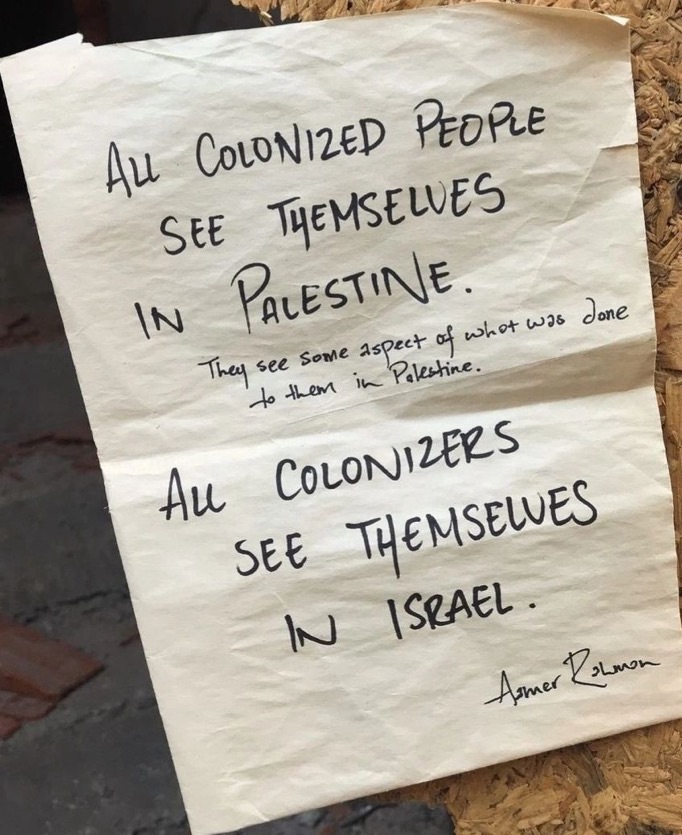
Today, it appears that many Western political leaders apply multiple caveats to the principle of the universality of human rights. The result is that rather than rule of international law we seem increasingly to have rule of international double standards. 

This is particularly plain in relation to British, American and German policy towards Gaza. In comparison with their supportive policy towards Ukraine and their outrage at Putin’s war crimes there, in relation to Gaza there is a lack of condemnation for ceaseless attacks upon civilians. On the contrary, the British, Americans and Germans remain publicly and materially supportive of Israeli policy.

The moral black hole at the heart of Western policy towards Israel

British, American and German policy on Gaza appears to be underpinned by a view that Palestinian lives are not equal to Israeli lives and so unworthy of comparable protection. Hence those three governments seem to have decided that it is better to arm and provide diplomatic cover for the far-Right Netanyahu government rather than to uphold the most basic principles of human rights and international humanitarian law.

In the face of the considerable evidence of genocide these governments are deaf to the international protests of conscience, and to the demands of Palestinian and Israeli voices for peace. Instead, they work to maintain the murderous Israeli Defence Forces supply lines at all costs. 

I have heard some try to justify this human rights double standard in relation to Israel by responding to protests with patronising reference to the need for realism, for a “realpolitik” approach to the conflict. This is, perhaps, a notion they may imagine that the protesters do not have the sophistication to properly understand. However, many will know that “realpolitik” is a term that has considerable previous, notably in the hands of Henry Kissinger, as a euphemism for moral vacuity and acquiescence in crimes against humanity. 

Given this many will remain unconvinced that “realpolitik” really is a sufficient justification for the mounting horrors in Gaza and the West Bank. So, why are the US, the UK and Germany so steadfast in their support of a far-Right Israeli government pursuing such a horrendous campaign of violence?

It is worth remembering that Germany was genocidal in Namibia well before the Nazis ever came to power. While relatively democratic, Britain and the United States were also genocidal in the 19th and 20th centuries in relation to, amongst others, Native Americans, Ireland and South Asia. It was democratically elected governments in the US that launched the invasion of Vietnam and the destruction of Cambodia. It was democratically elected governments in the US and UK that unlawfully invaded Iraq. Today it is democratically elected governments in the US, UK and Germany that have facilitated the far-Right in Israel in their indiscriminate slaughter of Gazan civilians

So, if we take even a medium-term historical view on these countries, it seems that there is a strain of thinking in those nations’ political cultures stretching from Left to Right that still view war crimes and genocide not as appalling and even unforgivable aberrations, but as legitimate policy options when it is convenient for them or those, however unsavoury, that they deem allies. 

Protest as leadership

It is in this context that the leaderships of the US, the UK and Germany display such an extraordinary arrogance toward those protesting their disgust at their policies. In the UK, along with their gleeful grasping at graft, their contempt towards protesters is a measure of government ministers’ extraordinary sense of entitlement.

But it is the protests of which they are so contemptuous that so often change cultures and countries in the ways in which corrupt politicians can only dream. This is because protest is moral leadership that seeks to make the world a better place by demanding that it become so. 

It is because of protesters that women have the vote, that apartheid has been ended in South Africa, that civil rights have been advanced in the US and the North of Ireland. When many governments have sought to merely manage the status quo – the “realpolitik” – protesters have asserted that this is not good enough and demanded better.

Today protesters understand, as the Irish patriot and human rights activist Roger Casement once put it, that “… we all on earth have a commission and a right to defend the weak against the strong, and to protest against brutality in any shape or form”.

So, at the end of the day, as Israel’s allies become ever more deeply mired in the murder of children, it is the protesters they disdain who will perhaps contribute most substantially to an end to apartheid in Israel/Palestine and thereby save the souls of their own countries.