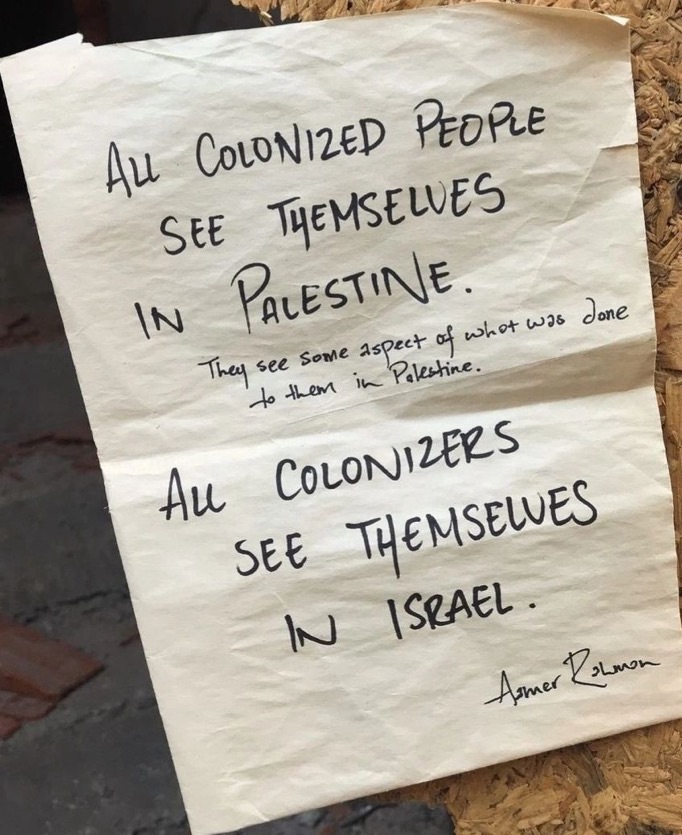
Humanitarian response for slow learners: lessons urgently needed for Gaza

Summary: calls for humanitarian aid are being used by pusillanimous politicians to distract from their failures to directly address the causes of humanitarian crisis in Gaza, most specifically Israel’s genocidal assault.

For over five years in the late 1990s I worked, mostly for Oxfam GB, organizing assistance, including water supply and sanitation, for the civilian victims of the civil war in Angola. 

So, humanitarian response is a subject area I know a little about. As students of management and leadership will be aware, a problem with a bit of expertise is that you can presume that everyone understands the fundamentals as well as you do. This is called taken-for-grantedness in the literature. 

I have been taking-for-granted that David Lammy and Keir Starmer – human rights lawyers after all, as they like to tell us, and therefore smarter than everyone else, as they like to imply – would understand the fundamentals of humanitarianism. After all, they have been pontificating on it since the start of Israel’s murderous assault on Gaza in 2023. 

But maybe they don’t. Maybe it is possible that they are not the craven accomplices to war crimes that their ongoing military and diplomatic support of Israel suggests. Perhaps they are just pig ignorant of the vitally important stuff that successful humanitarian response requires. 

So, here are a couple of the most basic lessons of humanitarianism for their edification.

1. The solution to a humanitarian crisis caused by war is not aid. It is an end to war. At the early stages of Israel’s latest assault on Gaza, Starmer and others attempted to deflect from their monstrous acquiesce in Netanyahu’s war crimes by rejecting the calls for  an immediate ceasefire and instead calling for pauses in the violence to allow for the delivery of more aid

The technical term for this position in relation to humanitarian response is “Oxford Union debating horseshite”. It is part of an approach to politics that values a plausible sounding point to win an immediate argument over the concrete measures necessary to resolve the actual causes of the crisis that the argument is about. Food assistance, vital as it is, does not protect from the other forms of collective punishment, such as the cutting of power and water that Keir Starmer advocated Israel doing, let alone the mass burning alive of children that Israel has routinised in Gaza since the outset of its violence.

2. If a belligerent nation is using famine as a weapon of war, then they are not going to permit humanitarian assistance unless put under robust pressure to do so. Robust pressure, not expressions of sadness or concern: Boycotts. Divestments. Sanctions. Criminal accounting.

3. If an assaulting army deliberately massacres humanitarian workers delivering food aid to hungry people, they are probably using famine as a weapon of war. Humanitarian workers not party to that war crime will therefore be made a target.

4. If an assaulting army on encountering their own nationals, stripped to their underpants and begging for help in their own language, shoots them, then that army is not on a rescue mission. Imagine what fate awaits those who cannot speak the attackers language. But you don’t have to because it has been documented by those the Israelis would seek to make victims. Indeed, the Israelis themselves have even videoed their own war crimes to show the world, so proud are they of what they inflict.

5. If an assaulting army is enslaving the civilian population they are attacking, then they are certainly not interested in any aspect of the humanitarian well-being of those civilians. In March 2025 the Israeli newspaper Haaertz reported that, ‘In Gaza, Almost Every IDF [Israeli Defence Forces] Platoon Keeps a Human Shield, a Sub-army of Palestinian Slaves.

The British government used to like to depict itself as a world leader against slavery. But there has been a deafening silence from that government, and indeed much of the anti-slavery community, on this matter. 

6. If you have soldiers in place to machine gun aid recipients, then the purpose of an aid distribution is not humanitarian. It is war crimes. 

7. If you are materially supporting a political regime that has publicly stated its war aims are ethnic cleansing, then no amount of humanitarian assistance will mitigate that. You too are practicing genocide, even if you are also offering the doomed their meagre last meals. 

Maybe these ideas are new to Starmer, Lammy and the rest of their government. But they are not hard. Indeed, tens of thousands of ordinary British people demonstrate that they grasp these most fundamental points already as, month in, month out, they gather in protests across the country to indict their own government for its abject moral collapse.

Hacks and Leadership

Summary: a not very funny rumination on a very funny tv show

Who wants to read about what the tv series Hacks has to say about leadership? Probably no one. But it has lessons on that subject area as important as those that Buffy and Angel teach on philosophy and morality. So here are a few thoughts.

If you haven’t seen Hacks yet, you are lucky. There are four seasons awaiting your delectation. However, like much writing about humour the following is not all that. Still, this is free to read. So tough.

Hacks is about the borderline unhealthy relationship between a legendary comedian, Deborah Vance (played by the legendary Jean Smart) and her new writer, Ava Daniels (the very funny and genuinely admirable Hannah Einbinder). 

While the setting may be the glamourous world of showbusiness, fundamentally it is a workplace comedy. In the workplace that Deborah and Ava find themselves in by season 4 they represent archetypes of bad leadership: Deborah is imperious and ridiculously demanding, with no sense of workers’ rights and frequently forgetting that she has a duty to teach not just perform. Ava is well-meaning but so young she does not know what she does not know. In particular she has not quite grasped that her brilliance as a writer does not necessarily provide her with the knowledge and experience to be a professional leader. 

If you are in any way like me, this will immediately remind you of Lavina Greacen’s book, Chink, her biography of the Irish Second World War general Eric Dorman-Smith.

Just me?

Well, a central theme of that book was that leadership is a collective task, requiring at least two people to have any chance of working. 

This is something that the writers of Hacks also instinctively seem to understand. Neither Ava nor Deborah are necessarily people you would like to know in real life. But together they make each other better as people and as leaders. Of course, they have difficulty admitting this to each other – too much ego getting in the way. And they have even more difficulty realizing that there are others central to what success they have achieved, not least Jimmy, their self-effacing and under-appreciated manager (perhaps the real hero of the show?)

Maybe if they had read a few of Louise Penny’s Inspector Gamache novels they would know that they need to use more the four sentences that achieve wisdom: “I was wrong,” “I’m sorry,” “I don’t know,” and “I need help”. 

But they haven’t. Indeed, not enough people have. That is one of the reasons why there is so little wisdom and empathy among those responsible for leading in today’s world. It is also one of the reasons that moral leadership increasingly falls to the protests of artists like Hannah Einbinder and Kneecap, while so many more respectable pillars of society are silent as gravestones. 

All that aside, Hacks is one of the best portrayals of workplace politics since The Wire. And it’s bleeding funny.  Try it. 

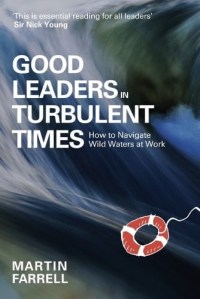
Good Leaders in Turbulent Times: How to Navigate Wild Waters at Work, by Martin Farrell

Summary: “Ever try. Ever fail. No matter. Try again. Fail again. Fail better.”

As a means to educate, stories are as old as humanity. And the best ones endure. That is why, for example, the wisdom of the parables of Jesus still resonates. 

Philip Gourevitch, in his book “A Cold” Case, explored the importance of stories in mentorships, as a way in which leaders share their experience with the next generation of “apprentices”. That is a tradition that Martin Farrell enters with his book, “Good Leaders in Turbulent Times: How to Navigate Wild Waters at Work”. 

As well as having led organisations himself, Farrell has a long background mentoring leaders: he was a particular help to me during one nightmarish phase of my career. So, he has deep understanding that even the best leaders often have to endure reversals and “the slings and arrows” of those who have never experienced the grinding responsibilities of choice-making that leadership entails. 

In other words, he has heard, if not all the stories, a great many of them. He recounts these here in the intertwined stories of a group of fictional not-for-profit CEOs at various stages of their careers each enduring their own professional crises. As resources for learning they are a reminder to other leaders going through their own trials that they are not alone. Others have passed this way and endured… or at least survived. Here are some of the ways they managed to cope.

Farrell understands that beneath the latest fads and fashions, which come and go and come back again, leadership is a human process and it takes a human toll. That is a truth that is often underappreciated by new leaders when they take up their roles. More unforgivably it is too often forgotten by board members who blunder in their organizational stewardship as a result, often in ways that they are never held accountable for. 

Because of this, Farrell’s book is a vital one and should be required reading for CEOs. It should also be required reading for board members, particularly those who have never been CEOs. It is book that the for-profit as well as the not-for-profit sectors can usefully learn from.

Good Leaders in Turbulent Times is an accessible, humane book, imaginatively designed and wonderfully illustrated by Steve Appleby. It is an important contribution to leadership literature.  

Leadership in the “grey-zone” 

Summary: Remarks to the conference “Leadership in Dialogue: Exploring the Spaces between Ideas, Communities, Worldviews”, Birmingham, 8 to 10 December 2024[1]

There are diverse perspectives on leadership. Mine is leadership as a responsibility to choose – particularly in choices that affects the lives of others, in organisations or in wider society.

That has been most the defining feature of my experience of leadership, and something you never really appreciate until you are in that role. Key aspects of leadership involve decisions on resource allocation. Such choices are always fraught because there are always winners and losers, upset and distress, and lingering resentments. 

Of course it can always be worse – I spend a good number of years leading humanitarian operations in, among other places, Angola during the civil war there. This led to some choices that were even more filled with anguish than the difficult but routine budget allocations that all leaders have to deal with. I write in my book, Ethical Leadership, about having to prioritize the lives of one group of people over another and how you have to learn to live with that after. That thought experiment with the runaway tram can get very real in some leadership roles. 

So given that these are leadership realities, ethical leadership is self-evidently important: by ethical leadership I mean the attempt to make the most life affirming choice possible, irrespective of the difficulty of the situation. A life affirming choice is one that optimizes the protection of the environment on one hand and the protection of human rights on the other.

Now, when we are making choices it is important for leaders to remember that those choices are made in, what I call in my book “a cruciform of agency”.

That is, there are aspects of the choice – whether that choice relates to a love affair, or work, or war – that are in the social world: those are the rules and resources associated with the choice:  the laws, polices, practice, finances or people who will be affected.

Then there are the personal aspects of the choice: the ones relating to the choice maker’s aspirations and experiences, and most fundamentally to their moral values.

The dialogue between these personal and social aspects of choice can be conceived of interacting orthogonally, hence the idea of a cruciform of agency emerges.

Now there is a 2002 paper by Craig and Greenbaum on a mining operation in South Africa. In that paper they recount how when they raised concerns with the mine management about issues such as health and safety, or labour terms and conditions, or the environmental damage that the operation caused, the managers they interviewed would express sympathy, but assert there was nothing they could do. The company they worked for caused the problems. Their responsibility was simply to get on with the job. They seemed to believe that they had no moral responsibility for the damage caused by the company despite the fact that it was they themselves who constituted the company. 

This denial of personal responsibility of policy makers and business executives for the consequences of their choices is a central constraint on obtaining progress on many of the world’s contemporary problems including slavery, something that affects an estimated 50 million people in the world today. 

I have rarely met anyone who has been in favour of slavery in principle. However, many in reality are in favour of slavery in practice. And if you doubt that, to take just one example, look at the hostile environments for migrants that many political leaders, from left to right in rich countries, take such pride in. This, despite the well documented fact that such hostile environments lead to the trafficking into forced labour and sexual exploitation of hundreds of thousands of vulnerable people. 

If the personal aspects of leadership, particularly the moral responsibility of the leader for the consequences of their choices is abandoned then ethical leadership becomes impossible, and indeed much worse may emerge. But this is not uncommon.

You all know the history: The Nazi’s used the idea of “just following orders” to try to evade personal moral responsibility for their atrocities.

Henry Kissinger infamously used the notion of “realpolitik” to justify his murderous foreign policy that devastated the lives of millions in Bangladesh, Cambodia and Vietnam.

Today, Joe Biden, Olaf Scholz, Keir Starmer and David Lammy use the formulation “Israel has the right to defend itself” to justify their craven complicity in war crimes and genocide.

While the words used in each of these examples are different, their purpose is the same. They are explicit attempts to disguise moral bankruptcy and evade basic leadership responsibilities for the catastrophic human consequences of their choices. For this they deserve utter condemnation in “history and eternity” as Abraham Lincoln once put it.

The evasion of personal responsibility in a choice is the anathema of ethical leadership, and it brings with it a loss of authority: what follower worth their salt is ever going to respect a moral coward.

And there is always something more moral that leaders can do, even in the most extreme of circumstances. At the very least they can protest.

The current British prime minister likes to boast that his is not a party of protest. Which of course is true. Because protest is leadership. Protest is a way in which a society can open dialogue with itself and change the ways it thinks about itself. 

Protest is sometimes the only way more formal dialogue with power can be obtained. Protest is how women’s rights and gay rights, minority rights and, indeed, all human rights have been advanced in the world. Protest matters nationally and internationally as the struggles to end apartheid in South Africa and bring some measure of justice to the north of Ireland have shown. 

It also matters internationally because the failure of the West to protest Israel’s atrocities in Gaza, Lebanon and now Syria, compared to our volubility on Ukraine exposes an ugly, frankly racist, double standard at the centre of Western policy. 

Much of the progress towards human dignity, including limiting contemporary forms of slavery, has been through advancing international rule of law. This avenue for progress has now been struck a grievous blow, because the profound undermining of the principle of the universality of human rights that Western policy towards Gaza has asserted. This has undermined in a fundamental way the ideal of an impartial system of international rule of law. 

Many European leaders are expressing concern at the threat that Donald Trump poses to international order. But the damage done to that system of rule of international law by Biden, Starmer and Scholz is already catastrophic. 

At the heart of ethical leadership is the ideal once set out by the Irish patriot and anti-slavery campaigner Roger Casement who said, “We all on earth have a commission and a right to defend the weak against the strong and to protest brutality in every shape and form.” 

That is a commission which we must all take up. Because, more than any other time in my life, the challenge for all of us to lead ethically is at its most urgent. We are all leading in the grey zone now. Indeed, it is almost night.


[1] In his essay collection, The Drowned and the Saved, Primo Levi wrote of the “grey zone” a morally ambiguous space where the ideas of right and wrong are no longer absolute and “good” decisions are impossible. 

Not ethical leadership: a rocky start to Starmer’s first days in government

Summary: things can sometimes only get worse.

Keir Starmer’s government prides itself in not being idealistic. “We are not a party of protest!” they declare.

The smug, self-satisfaction that this statement implies might be better sustained if the party were conducting itself with unimpeachable professionalism now that it is in government. But its first 100 days in office have been notably rocky. A survey of this period by the Guardian was headlined, “We all hope it’s teething troubles – but worry it’s something worse.”

Well, I suspect it is something worse.

This thought will likely have occurred to many students of organisations. It will be a particular worry to those concerned, as I have been, with what is required to lead ethically: that is, the struggle to make organisational decisions that optimise life-affirming choices by seeking to protect human rights and advance environmental restoration. 

For me, there seems to be three inter-related structural problems with Starmer’s Labour party that are the root of the Labour government’s shaky start and shady future. The first of these is that Starmer’s Labour party is strikingly authoritarian. 

Everyone who has ever effectively led people in organisations will be aware that sometimes a directive approach is needed. For example, if it is necessary to evacuate a building due to an emergency, it is not appropriate to ask everyone how they feel about that first. It is necessary to point folk to the fire exits and tell them to get out. 

However, Starmer seems to privilege such an approach over more collaborative ones even when there is no compelling need. Indeed, his leadership seems to have a problem with any independence of thought and voice.

The run up to the 2024 general election was marked by accusations of a purge of left wing and pro-human rights candidates, and the parachuting into various constituencies of Starmer loyalists, some of them morally repugnant.

Starmer and his acolytes present this as “discipline” and “strong leadership”. It is a peculiar notion of strong leadership when a leader is afraid to countenance a bit of criticism or consider different perspectives on issues. 

From the longer-term view of organisational health this approach is even more problematic. Because if organisations exclude dissent, they reduce their capacity to think critically, to test ideas and winnow out the stupid or counter-productive ones. 

All leadership teams, no matter how smart, will come up with poor ideas from time to time. But truly smart leaders understand that they need processes in place to guard against such things. The restriction of dissension in Labour undermines the necessary processes.

This leads to a second structural problem which will increasingly emerge for Labour as this government proceeds. The purging of intellectual and philosophical diversity, and the fear of being seen as disloyal that is bred by leadership authoritarianism, will reduce Labour’s capacity to generate new ideas as time and events evolve. This will make it more difficult for the government, and the party as a whole, to right recent wrongs and to respond to the new challenges that will inevitably emerge. 

Both these problems, of authoritarianism and lack of intellectual diversity, are dwarfed by the most fundamental of Labour’s current structural problems: that is its moral bankruptcy. 

This was most starkly on display in the infamous interview that Starmer gave to LBC in which he endorsed collective punishment on the people of Gaza for the attacks on Israeli civilians on 7 October 2023, something that he should know as a lawyer, is a war crime under international law. Later assertions that Starmer misspoke or was taken out of context are undermined by the fact that in the weeks following this Labour front-benchers, including the crassly cynical Emily Thornberry and the craven Peter Kyle also publicly endorsed their Dear Leader’s position.

There was a softening of Labour’s Gaza position in the run up to the 2024 election, when it looked as if such an inhumane policy might cost it seats as Israel’s apparent genocidal intent became ever more explicit. However, on attaining power, it has, with a few cosmetic changes, returned to its substantially uncritical support of Netanyahu’s far-Right government. Hence Starmer is notably more reticent on the carnage inflicted on Palestinian civilians in comparison with his public anguish over Israeli casualties.

It is in the context of these three structural failures that we should consider the votes in the first 100 days of this government on maintaining the two-child limit on child benefits and cutting winter fuel payments for pensioners

Not to put too fine a point on it, these votes look more like a process for the breaking of the human spirit of backbench members of parliament rather than any cool consideration of regrettable financial necessity. 

In bringing these matters to a vote when they did, the Labour leadership sought to purge any residual dissent by demanding that, in the name of loyalty, backbenchers should betray their constituents and their consciences on the issue of the poverty of English people, until now a residual Labour moral value.

Having done this, the thoroughly compromised backbenchers have been truly initiated into the moral bankruptcy that is at the core of the British Labour party. So, all will have diminished credibility if they are ever tempted to mount a future principled challenge to the leadership’s proposals, no matter how stupid or morally repellent those proposals might be. 

Starmer’s Labour may be better than the Tories that they replaced. But there seems to me to be a rot at their heart, the stench of which may soon become overwhelming. 

Old habits, new protests: on the politics of Israel’s allies

Summary: those who have lost their moral compass will never understand that protest is leadership

Rule of international double standards

Today, it appears that many Western political leaders apply multiple caveats to the principle of the universality of human rights. The result is that rather than rule of international law we seem increasingly to have rule of international double standards. 

This is particularly plain in relation to British, American and German policy towards Gaza. In comparison with their supportive policy towards Ukraine and their outrage at Putin’s war crimes there, in relation to Gaza there is a lack of condemnation for ceaseless attacks upon civilians. On the contrary, the British, Americans and Germans remain publicly and materially supportive of Israeli policy.

The moral black hole at the heart of Western policy towards Israel

British, American and German policy on Gaza appears to be underpinned by a view that Palestinian lives are not equal to Israeli lives and so unworthy of comparable protection. Hence those three governments seem to have decided that it is better to arm and provide diplomatic cover for the far-Right Netanyahu government rather than to uphold the most basic principles of human rights and international humanitarian law.

In the face of the considerable evidence of genocide these governments are deaf to the international protests of conscience, and to the demands of Palestinian and Israeli voices for peace. Instead, they work to maintain the murderous Israeli Defence Forces supply lines at all costs. 

I have heard some try to justify this human rights double standard in relation to Israel by responding to protests with patronising reference to the need for realism, for a “realpolitik” approach to the conflict. This is, perhaps, a notion they may imagine that the protesters do not have the sophistication to properly understand. However, many will know that “realpolitik” is a term that has considerable previous, notably in the hands of Henry Kissinger, as a euphemism for moral vacuity and acquiescence in crimes against humanity. 

Given this many will remain unconvinced that “realpolitik” really is a sufficient justification for the mounting horrors in Gaza and the West Bank. So, why are the US, the UK and Germany so steadfast in their support of a far-Right Israeli government pursuing such a horrendous campaign of violence?

It is worth remembering that Germany was genocidal in Namibia well before the Nazis ever came to power. While relatively democratic, Britain and the United States were also genocidal in the 19th and 20th centuries in relation to, amongst others, Native Americans, Ireland and South Asia. It was democratically elected governments in the US that launched the invasion of Vietnam and the destruction of Cambodia. It was democratically elected governments in the US and UK that unlawfully invaded Iraq. Today it is democratically elected governments in the US, UK and Germany that have facilitated the far-Right in Israel in their indiscriminate slaughter of Gazan civilians

So, if we take even a medium-term historical view on these countries, it seems that there is a strain of thinking in those nations’ political cultures stretching from Left to Right that still view war crimes and genocide not as appalling and even unforgivable aberrations, but as legitimate policy options when it is convenient for them or those, however unsavoury, that they deem allies. 

Protest as leadership

It is in this context that the leaderships of the US, the UK and Germany display such an extraordinary arrogance toward those protesting their disgust at their policies. In the UK, along with their gleeful grasping at graft, their contempt towards protesters is a measure of government ministers’ extraordinary sense of entitlement.

But it is the protests of which they are so contemptuous that so often change cultures and countries in the ways in which corrupt politicians can only dream. This is because protest is moral leadership that seeks to make the world a better place by demanding that it become so. 

It is because of protesters that women have the vote, that apartheid has been ended in South Africa, that civil rights have been advanced in the US and the North of Ireland. When many governments have sought to merely manage the status quo – the “realpolitik” – protesters have asserted that this is not good enough and demanded better.

Today protesters understand, as the Irish patriot and human rights activist Roger Casement once put it, that “… we all on earth have a commission and a right to defend the weak against the strong, and to protest against brutality in any shape or form”.

So, at the end of the day, as Israel’s allies become ever more deeply mired in the murder of children, it is the protesters they disdain who will perhaps contribute most substantially to an end to apartheid in Israel/Palestine and thereby save the souls of their own countries.

Fairly Smooth Operator, by Caroline Walsh

Summary: a thoughtful rumination on leadership from the experience of, on occasion, being badly led

Caroline Walsh’s book, Fairly Smooth Operator, is something of a memoir, recounting her experiences, first as a member of the US Coast Guard, and later as an analyst with the CIA.

Her theme is not, however, derring do, military morality or historical scandals. Rather Walsh’s focus tends towards the more mundane aspects of life in these organisations and particularly the “chickenshit” of military life. With humour and considerable generosity of spirit she explores the petty abuses of power meted out on weaker or more junior colleagues, because the abuser is a bully or an idiot. She reflects on the damage this does to both individuals and the organisations of which they are parts, because bad leadership invariably results in the injury and loss of good people.

So, Fairly Smooth Operator is a useful book for anyone concerned with the world of work in general and, in particular, with the challenges of management and leadership in teams and in big, bureaucratic organisations.

Walsh is now studying for a PhD in the area of ethical leadership. Judging on this book, she will doubtless have many more useful and important things to say on this subject in years to come.

Artificial Intelligence and Ethical Leadership

The warning on 30 May 2023 by industry experts that Artificial Intelligence (AI) might lead to human extinction was a sobering moment. Given this, I wondered again what are the ethical leadership challenges – relating to the protection of human rights and restoration of the environment – this new technology poses?

I started by asking a “Large Language Model” (LLM) AI system ChatGPT:

“1. Ensuring data privacy: …; 2. Promoting responsible use of AI: Leaders should ensure that AI systems are being used in a responsible way, free from bias and discrimination. 3. Developing AI systems ethically: Leaders should ensure that AI systems are developed with ethical considerations in mind, including avoiding the use of algorithms that have the potential to cause harm. 4. Addressing job displacement: ….; 5. Ensuring accountability: Leaders should ensure that AI systems are held accountable for their actions, and that any mistakes made by AI systems are addressed. 6. Encouraging responsible innovation: Leaders should encourage the responsible use of AI and the development of ethical AI systems.”

It’s okay in so far as it goes, and a bit more candid about risks associated with AI than, for example, Microsoft’s happy-clappy advertising for “Co-pilot”, the AI that it is embedding into its Office suite. This focuses on the undeniable promise of productivity that AI brings, for some
professionals at least.

But the ethical choice-making that ChatGPT asserts is so important in AI is dependent on
morality, and it is not at all clear what is the moral basis upon which AI algorithms are being
constructed.

In the April 2023 edition of the Economist, the paper noted that some AI systems “produced
strange results. Bing Chat suggested to a journalist that he should leave his wife. ChatGPT
has been accused of defamation by a law professor. LLMs produce answers that have the
patina of truth, but often contain factual errors or outright fabrications.
” I found that when I
asked ChatGPT about myself: some biographical details were correct, such as that I have
written two books, but it could not find anything close to their correct names and so just
made stuff up. I think that may be the sort of thing that Microsoft, euphemistically, calls
“usefully wrong.”

But these are trivial enough errors: they are not going to cause an existential crisis for
humanity. But, as leading experts have already warned, AI itself might yet. In April 2023 the Economist reported that, “The degree of existential risk posed by AI has been hotly debated. Experts are divided. In a survey of AI researchers carried out in 2022, 48% thought there was at least a 10% chance that AI’s impact would be “extremely bad (eg, human extinction)”. But 25% said the risk was 0%; the median researcher put the risk at 5%. … researchers worry that future AIs may have goals that do not align with those of their human creators.”

A 5% risk is not a trivial one. This sort of risk was a matter that Isaac Asimov famously pondered when he developed his laws of robotics in the 1940s. Having formulated three laws, including his first, that, “A robot may not injure a human being or, through inaction, allow a human being to come to harm.” Asimov realised, as any viewer of the movie, I Robot, will remember, that something was missing. So, he formulated his “Zeroth Law”: “A robot may not harm humanity, or, by inaction, allow humanity to come to harm.”

There is an argument that you cannot, and some would say should not, build morality into
machines.
For example, Asimov’s first law would incapacitate some of the lethal hardware
so beloved of armchair militarists. But it seems incontestable, indeed inconceivable, that
any AI should be permitted without some robust moral systems to constrain its most dangerous excesses.

There may be better moral systems to guide AI than Asimov’s laws. But if AI is trying to
break up marriages on a whim or defaming a law professor, or anyone else for that matter,
it appears that it does not yet have any moral guidance at all.

So, here’s the rub. If programmed from the outset with some key moral principles, computers will not forget to remember them, as they write increasingly advanced programs for future AI generations. However, it seems that many of the human beings initiating these AI processes have sometimes eschewed moral principles in the rush to technological advance.

This should not, perhaps, be surprising. In recent years we have seen a number of controversies in relation to the use of information technology: In the UK, for example, a group of wealthy ideologues convinced a plurality of British voters, in part through the manipulation of information systems, to vote for Brexit unconcerned with the damage it would do to the economy, to Irish peace, and to the fragile bonds that hold their own country together. Similar information manipulation was at play in the election of Donald Trump in 2016. Yet more seriously still, the manipulation of information systems was also a major factor in instigating the genocide against the Rohingya people in Myanmar that same year.

When confronted with the issues arising from these events, some of the leading industry
figures involved have proven themselves moral vacuums. And these are the people who will
be leading much of the industrial development of AI. Will they be as concerned as Asimov
was about any potential threats to humanity arising from their work?

In spite of the information industry’s warning about the risk of human extinction, I would not want to bet my life on this. The leaders of so many other industries are already overseeing an environmental collapse with no discernible concern for a future that will threaten the lives and livelihoods of their children and grandchildren. The 30 May 2023 warning of the perils of AI aside, tech leaders have so far proven themselves no more concerned with the consequences of the moral choices that they are making for their businesses. For some, the scientific innovation associated with it will be just too fascinating to eschew. Others will not be concerned with the future if they can make lots of money now.

The Economist reports that the EU is considering robust regulation on the development of
AI, and the Biden administration has started a consultation on the same thing. These are
positive moves, but no one should rest easy yet. Unsurprisingly, for a government (and
opposition) that lacks the moral courage to tell the truth about the realities of Brexit, the UK
has until now been proposing a “light touch” approach to AI regulation. This is in the hope of attracting some unregulated tech businesses to compensate somewhat for the industries that their Brexit has already devastated.

In the face of such a pusillanimous abrogation of responsibilities, ethical leaders in business
and the citizenry alike need to respond: to make different professional choices that ensure
that the preservation of life and the restoration of the environment are at the heart of their
organisational strategies, and, through protest and political engagement, to demand that
politicians do the right thing not the easy one.

Protest is, and always has been leadership. But, given the crises facing humanity currently, it
has never been so urgent. And, given the rapidity of AI’s development, the moment at which
it can be constrained by law, regulation and morality may be receding as quickly as the opportunity to stave off ecological collapse.

“A (hu)man must have a code”: ethical leadership and saving the world.

The recent People Management article, “Codes of ethics: does every company need one?” raised a number of interesting questions.

The article revealed that only 54% of FTSE 250 have published codes of ethics, according to research by the Institute of Business Ethics. Of these only 57% are considered as “good”.

As Ms McConville, my English teacher at school in Newry, used to regularly ask in her efforts to coax more lucid writing from even her most inarticulate pupils, “What does ‘good’ even mean?”

Milton Friedman would have said that “good” meant making a profit for shareholders within the law. This is a moral perspective that is still widely prevalent in government and business. I have met more than one business executive who has been admiring of such guidance as an amoral underpinning to their strategic approaches. But such amorality is also wholly inadequate for dealing with the existential challenges facing humanity in the 21st Century. Each of those challenges – from climate change to contemporary slavery – is already a product of thousands of business and political leaders thinking that such things are somebody else’s problem.

The People Management article quotes Ian Peters, director of the Institute of Business Ethics, with another perspective on “good”. He says, “A code of ethics should be the cornerstone for any organisation, ensuring it’s doing the right thing for the right reasons.”

This organisational focus on ethics is one that I am strongly in agreement with, though this also begs the question, “What is ‘right’?” It is further striking that others quoted in the article instead emphasise only personal conduct in the workplace and whistle-blowing duties and protections.

These are, of course, important issues. No one should have to endure fear and bullying in any workplace. But in my view ethics is a yet more fundamental thing. It is, at heart, a strategic question and, consequently a leadership one.

In my book, Ethical Leadership: moral decision making under pressure, I define ethical leadership as the effort “to optimize life-affirming choices that seek to protect human rights and advance ecological restoration irrespective of how inhospitable the political, social or professional environment.

Sometimes this requires dissent or “whistle-blowing”: protest is often, after all, just another name for leadership.

But ethical leadership is also about strategic choice making. For example, a business executive who, decides to source from a textile, electronics or fisheries supply chain in Asia or Africa that they know to be highly destructive of the environment and rife with exploitative labour practices, will often be behaving completely legally. They may also be acting in the spirit of a code of conduct that emphasises legal compliance. But there is, nevertheless, the sulphurous whiff of the banality of evil in such choices.

A recent leading article in the Economist reported that researchers estimate a 5% risk that the current development of Artificial Intelligence systems may result in something “extremely bad (eg, human extinction).” So, I for one am concerned that the executives leading the development of this technology are thinking about ethical standards beyond mere compliance with law, particularly given that so much of the necessary law to constrain dangerous AI development does not yet exist.

Perhaps they are actively thinking about these risks. But as some of them at least also seem untroubled with the manipulation of information systems that was a major factor in instigating the genocide against the Rohingya people in Myanmar in 2016, I would not want to bet my life on it.

But, like the rest of us, I may be forced to. The current precariousness of continued human existence on this planet is a result of so many political and business leaders not looking beyond the short-term questions of immediate profit rather than the long-term question of sustainability or, for that matter, human survival.

For humanity to have a chance requires now that business executives and politicians focus on promoting choices that protect human rights and restore the environment, not just those that comply with the law and obtain short-term financial gains.

So, all businesses, indeed all leaders, need ethical codes of conduct that will compel them to make life-affirming choices the core of their business and economic strategies.

Covid-19: lessons from war and humanitarian response

Summary: With COVID-19 Boris Johnson has been faced with a once in a lifetime crisis. He has failed the test.

Boris Johnson does love his military metaphors. They are intrinsic to his whole cod-Churchillian shtick. So, this past nine-months, at least after he finally bothered to show up to the COBRA crisis meetings, he’s been “wrestling” Covid-19, “whacking” it, “fighting” and “doing battle” with it.

Covid-19 doesn’t seem that bothered. Because it’s a virus. In these circumstances Johnson cosplaying a war leader is rather like, to borrow from Milan Kundera, attacking a panzer division with a mime troupe.

In truth, unlike other “natural disasters”, such as an earthquake or a tsunami, the effects of Covid-19 do bear some resemblance to a war induced emergency. Like the Troubles in the North of Ireland, or the civil war in Angola, wars ebb and flow like this pandemic. At different times they are more lethal in some places rather than others. Like this pandemic, wars also tend to be protracted crises in which we have to learn how to survive until a solution is in place.

Some research scientists working on treatments and vaccines, and the health professionals working in critical care, are fighting the virus. But the rest of us are effectively bystanders, just trying to survive it until, hopefully, the efforts of these professionals bear fruit. Unfortunately, in my experience, as we await a solution some people will always court risky behaviour as they become bored with the restrictions on life that health or human security concerns impose.

So the role then of a sane prime minister in these circumstances must be more akin to a humanitarian manager, trying to keep as many people alive until a resolution comes, rather than a general confronting an enemy. In such circumstances the language of battles and campaigning becomes redundant. Instead the priorities of humanitarian response are the relevant ones: Avoidance of risk and protection from harm, first for critical workers, then for the rest of us.

Jacinda Arden seems to have understood that. Boris Johnson has not. Arden has led by example. Johnson, with the not inconsiderable assistance of his father and Dominic Cummings, has shown that he expects different rules to apply to his coterie than to the rest of us.

Hence Johnson’s leadership in this crisis has been typified by muddle and confusion. Whenever there has been a hard choice to be made, he has routinely fluffed it. It is ironic that the government that so fetishized control of its borders in their fevered flight from the European Union, did not, unlike just about every other country in the EU, close its borders to prevent reimporting of the virus. Like the last lock down Johnson will show up to the next one three weeks late and, it appears, millions of dollars short.

The Covid-19 pandemic has thrown into sharp focus the fact that Boris Johnson is in possession of the single most dangerous trait in any leader: He wants to be popular. Hence he will tell any lie, fudge any choice if it just buys him another fleeting moment of the illusion of popularity. Every time a lie or an inadequacy is exposed he simply tells another, bigger lie to distract from his last failure. Hence his escalating promises of “world-beating” testing, track and trace. Lying having worked to deliver Brexit, it’s a trait that now seems to pervade the government with lethal consequences for the vulnerable.

When Johnson was just a philandering journalist this sort of behaviour only hurt those unfortunate enough to have loved or trusted him. As prime minister this has directly resulted in the UK having the highest death toll in Europe and the worst economic performance during this crisis.

As we are now poised on the brink of a second surge in Covid-19 infections it is critical that the UK government fundamentally rethink their approach to this crisis, learning from New Zealand, and the countries of South East Asia how they have managed to keep their populations safe from this disease.

Certainly, one critical issue, as Jacinda Arden has shown, is leadership. When human lives are at stake, any credible humanitarian response demands serious leaders for whom this will be the overriding priority. Johnson has failed in that test already. He should resign.