Ambrose Bierce defined politics in his Devil’s Dictionary as “The conduct of public affairs for private advantage”.
As Trump, Netanyahu and Putin continue to use this as their platonic ideal, here are a few more commonly used terms to better understand this brand of politics in the 21st Century.
Terrorism: violence committed by the enemy against civilians.
Self-defence: violence committed by ourselves against civilians.
Tragic mistake: violence committed by ourselves against civilians after we got caught.
Investigation: a process for discovering that the “tragic mistake” was unavoidable.
Context: why the “tragic mistake” was all the enemy’s fault.
Responsibility: we are sorry that the enemy made us kill those civilians.
Summary: The myth that violence solves problems persists despite history often proving the opposite.
At the end of John Steinbeck’s Of Mice and Men, George shoots his friend Lennie. Lennie, a well-meaning but simple-minded man, does not understand his own strength or the fragility of others. So, he has accidentally killed a young woman, and George knows that if the mob reaches him first Lennie will be tortured before he dies.
Steinbeck understood something that popular culture often forgets: violence rarely solves anything cleanly. Yet in cinema it frequently does. From Westerns to modern action films, societies’ problems are tidily resolved by lethal force.
Wyatt Earp invariably sorts out his society’s ills by use of his six-guns. James Bond’s liquidation of supervillains always makes the world a better place.
The satisfactory resolution of daunting problems through the use of violence is so commonplace a trope in cinema that it is perhaps now as deeply embedded a cultural idea in the West as that of Santa, and the Easter Bunny. However, unlike these last two myths, some adults seem to continue to believe it.
Put another way, in spite of the vast historical evidence to the contrary, they believe that the most complex of geo-political problems can be solved, as Eddie Izzard’s character says in the movie Valkyrie, “with the careful application of high explosives.”
Anyone who has any experience of actual war will attest that the matter is much less clear-cut. Violence tends to be the bluntest instrument in problem solving, often ineffective and opening as many new problems as it was meant to resolve.
As Shakespeare warned, in war the dogs are let slip. The ensuing carnage leads to the ties that bind society being sundered, civilians being slaughtered in even the most “surgical” of military strikes, and the infrastructure of daily life being decimated.
There may be diverse reasons that people celebrate the unlawful 2026 US-Israeli assaults on Iran and studiously ignore the piles of children’s corpses that have resulted. What those celebrating have in common is a lack of empathy with the innocent falling under the weight of metal, and a lack of imagination about what will transpire. In particular, they fail to conceive of the legacy of bitterness that will result.
Violence rarely ends a conflict. More often it plants the seeds of the next one. As James Baldwin noted, “The perpetrator always forgets; the victim never does.” Societies that know little history never learn this truth. That has long been true of much of England. It is also true now of the United States.
Anyone who watched the Tucker Carlson interview with US Senator Ted Cruz will have been struck that US foreign policy is being made now by the spectacularly ignorant. Cruz did not even know the population of a country he thought the US should invade.
Such people are malicious contemporary equivalents of Steinbeck’s Lenny – simple-mindedly disdainful of complexity, absent of empathy, and contemptuous of those who are fragile before their military strength.
The world is currently in the hands of such dangerous buffoons, people who treat violence as a solution and assume they will never face consequences for the murderous destruction they unleash.
Even Steinbeck would be at a loss to find a neat narrative resolution to deliver us from their evil.
There are diverse perspectives on leadership. Mine is leadership as a responsibility to choose – particularly in choices that affects the lives of others, in organisations or in wider society.
That has been most the defining feature of my experience of leadership, and something you never really appreciate until you are in that role. Key aspects of leadership involve decisions on resource allocation. Such choices are always fraught because there are always winners and losers, upset and distress, and lingering resentments.
Of course it can always be worse – I spend a good number of years leading humanitarian operations in, among other places, Angola during the civil war there. This led to some choices that were even more filled with anguish than the difficult but routine budget allocations that all leaders have to deal with. I write in my book, Ethical Leadership, about having to prioritize the lives of one group of people over another and how you have to learn to live with that after. That thought experiment with the runaway tram can get very real in some leadership roles.
So given that these are leadership realities, ethical leadership is self-evidently important: by ethical leadership I mean the attempt to make the most life affirming choice possible, irrespective of the difficulty of the situation. A life affirming choice is one that optimizes the protection of the environment on one hand and the protection of human rights on the other.
Now, when we are making choices it is important for leaders to remember that those choices are made in, what I call in my book “a cruciform of agency”.
That is, there are aspects of the choice – whether that choice relates to a love affair, or work, or war – that are in the social world: those are the rules and resources associated with the choice: the laws, polices, practice, finances or people who will be affected.
Then there are the personal aspects of the choice: the ones relating to the choice maker’s aspirations and experiences, and most fundamentally to their moral values.
The dialogue between these personal and social aspects of choice can be conceived of interacting orthogonally, hence the idea of a cruciform of agency emerges.
Now there is a 2002 paper by Craig and Greenbaum on a mining operation in South Africa. In that paper they recount how when they raised concerns with the mine management about issues such as health and safety, or labour terms and conditions, or the environmental damage that the operation caused, the managers they interviewed would express sympathy, but assert there was nothing they could do. The company they worked for caused the problems. Their responsibility was simply to get on with the job. They seemed to believe that they had no moral responsibility for the damage caused by the company despite the fact that it was they themselves who constituted the company.
This denial of personal responsibility of policy makers and business executives for the consequences of their choices is a central constraint on obtaining progress on many of the world’s contemporary problems including slavery, something that affects an estimated 50 million people in the world today.
I have rarely met anyone who has been in favour of slavery in principle. However, many in reality are in favour of slavery in practice. And if you doubt that, to take just one example, look at the hostile environments for migrants that many political leaders, from left to right in rich countries, take such pride in. This, despite the well documented fact that such hostile environments lead to the trafficking into forced labour and sexual exploitation of hundreds of thousands of vulnerable people.
If the personal aspects of leadership, particularly the moral responsibility of the leader for the consequences of their choices is abandoned then ethical leadership becomes impossible, and indeed much worse may emerge. But this is not uncommon.
You all know the history: The Nazi’s used the idea of “just following orders” to try to evade personal moral responsibility for their atrocities.
Henry Kissinger infamously used the notion of “realpolitik” to justify his murderous foreign policy that devastated the lives of millions in Bangladesh, Cambodia and Vietnam.
Today, Joe Biden, Olaf Scholz, Keir Starmer and David Lammy use the formulation “Israel has the right to defend itself” to justify their craven complicity in war crimes and genocide.
While the words used in each of these examples are different, their purpose is the same. They are explicit attempts to disguise moral bankruptcy and evade basic leadership responsibilities for the catastrophic human consequences of their choices. For this they deserve utter condemnation in “history and eternity” as Abraham Lincoln once put it.
The evasion of personal responsibility in a choice is the anathema of ethical leadership, and it brings with it a loss of authority: what follower worth their salt is ever going to respect a moral coward.
And there is always something more moral that leaders can do, even in the most extreme of circumstances. At the very least they can protest.
The current British prime minister likes to boast that his is not a party of protest. Which of course is true. Because protest is leadership. Protest is a way in which a society can open dialogue with itself and change the ways it thinks about itself.
Protest is sometimes the only way more formal dialogue with power can be obtained. Protest is how women’s rights and gay rights, minority rights and, indeed, all human rights have been advanced in the world. Protest matters nationally and internationally as the struggles to end apartheid in South Africa and bring some measure of justice to the north of Ireland have shown.
It also matters internationally because the failure of the West to protest Israel’s atrocities in Gaza, Lebanon and now Syria, compared to our volubility on Ukraine exposes an ugly, frankly racist, double standard at the centre of Western policy.
Much of the progress towards human dignity, including limiting contemporary forms of slavery, has been through advancing international rule of law. This avenue for progress has now been struck a grievous blow, because the profound undermining of the principle of the universality of human rights that Western policy towards Gaza has asserted. This has undermined in a fundamental way the ideal of an impartial system of international rule of law.
Many European leaders are expressing concern at the threat that Donald Trump poses to international order. But the damage done to that system of rule of international law by Biden, Starmer and Scholz is already catastrophic.
At the heart of ethical leadership is the ideal once set out by the Irish patriot and anti-slavery campaigner Roger Casement who said, “We all on earth have a commission and a right to defend the weak against the strong and to protest brutality in every shape and form.”
That is a commission which we must all take up. Because, more than any other time in my life, the challenge for all of us to lead ethically is at its most urgent. We are all leading in the grey zone now. Indeed, it is almost night.
[1] In his essay collection, The Drowned and the Saved, Primo Levi wrote of the “grey zone” a morally ambiguous space where the ideas of right and wrong are no longer absolute and “good” decisions are impossible.
Summary: on trying to learn how to take a photograph
In 2004, the Finnish-American photographer, Arno Minkkinen, presented to the world his Helsinki Bus Station Theory of Photography. In summary, he argued that just as all the buses from the Helsinki bus terminal stop at the same first three stops before going to wildly different places, that the work of any photographer, over the first three years of their career, is going to be derivative of the work of somebody else. This is irrespective of what genre the photographer chooses to specialise in, from nudes to landscape to war photography: somebody will have been there before. Originality only emerges after persistence and practice over years. Or, as Minkkinen put it, if you “stay on the fucking bus,” rather than give up as soon as you recognise who your work is aping.
That is all well and good if you know which bus you want to get on in the first place. That is why people read Susan Sontag and John Berger: to work out what sort of photographer they want to be.
For me, John Berger provided an initial inspiration with his observation that some photographers work with “emancipatory” intent. After half of my professional career in humanitarian response and development, and the other half in human rights and anti-slavery work, this idea struck a chord with me, but still left me short of ideas of how to proceed.
Sontag’s photography books, paradoxically lacking any photographs, are not short of ideas. She writes of the philosophy of photography and photographers. Both of her books are enormously rich and challenging affairs. In particular, I found that On Photography required more than one reading to come anywhere close to fully appreciating the depth of her thought on the subject. Regarding the Pain of Others, perhaps because I have some experience of living and working in war zones, perhaps because I had read On Photography first, I found much more accessible.
Photography, Sontag observes, like sex, cooking and dancing, is a democratic art form that anyone can participate in. But just because anyone can press a button does not mean that anyone can take a good photograph. So, Sontag explores why some photographers not only take good photographs but take photos that are sometimes deemed worthy of putting in a museum.
And, there appear to be as many answers to this question as there are such photographers. Nadar reckoned the best portraits he took were of people he knew. Avedon reckoned his best portraits were of people he did not know. Cartier-Bresson reckoned you should think before and after taking a photograph, but definitely not during.
That successful photographers work to such diverse, sometimes mutually exclusive, ideas is one of the paradoxes of good photography. Perhaps I found an explanation from Berger’s own reflections on Sontag, “The camera saves a set of appearances from the otherwise supersession of further appearances…before the invention of the camera nothing could do this, except in the mind’s eye, the faculty of memory.”
So, perhaps what makes a photographer good is when they learn to capture with the camera that which they would wish to remember, or perhaps wish others to remember.
That gave me an idea.
One of my first experiences working in Africa was a visit to a poor neighbourhood in Addis Ababa, Kebele 37. Amidst the open sewers and crumbling mud houses densely packed together amidst a warren of streets I saw that someone had planted a geranium outside their door, in a salvaged cooking oil tin from a food distribution. There was something about that telling detail which seemed to me to encapsulate the indomitability of humanity, even in the midst of such dire poverty.
As a student of photography, that is the sort of image – the telling detail – that I want to capture, to emancipatory purpose when I can.
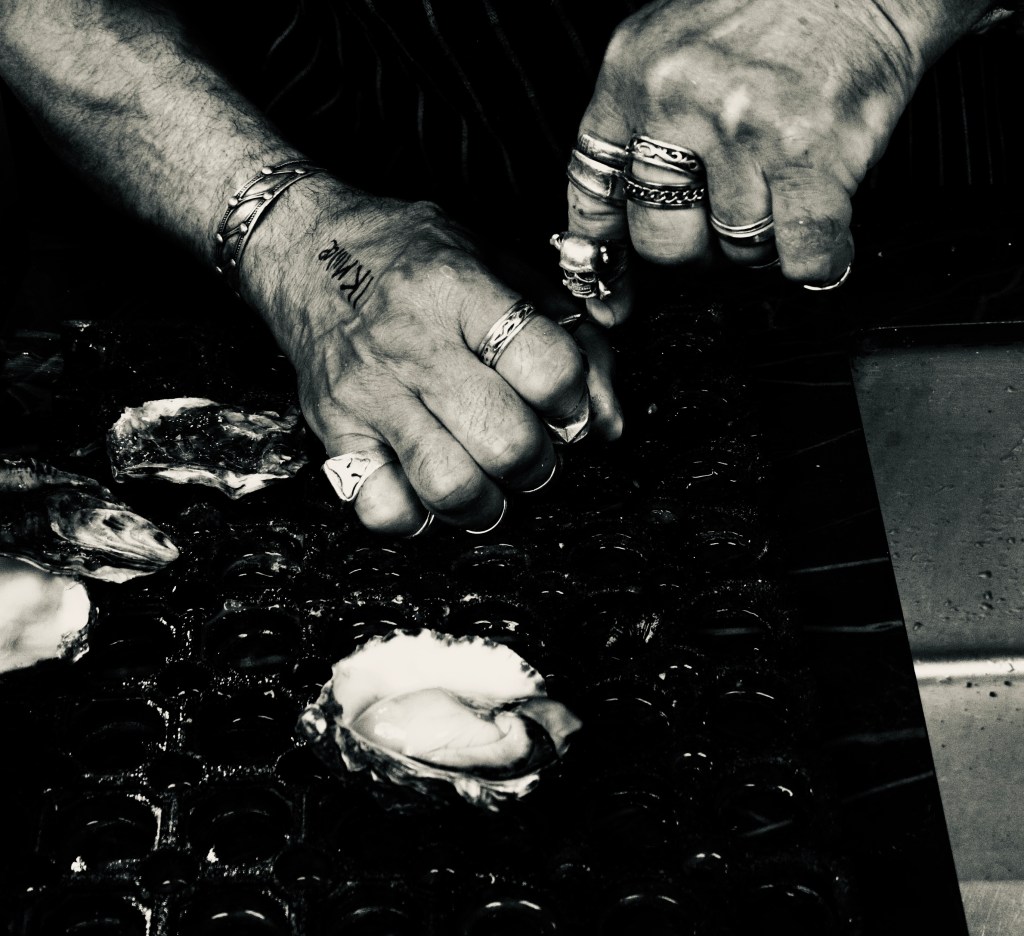
The Oyster Shucker
With that thought in mind I went for a walk in Borough Market and took the first photo that I think begins to express the sort of photographer I want to be.
Of course, after looking at it a while I thought, “That’s rather derivative of Salgado.” But that’s okay. I think that is the bus I want to be on. Let’s see where it takes me now.
I started by asking a “Large Language Model” (LLM) AI system ChatGPT:
“1. Ensuring data privacy: …; 2. Promoting responsible use of AI: Leaders should ensure that AI systems are being used in a responsible way, free from bias and discrimination. 3. Developing AI systems ethically: Leaders should ensure that AI systems are developed with ethical considerations in mind, including avoiding the use of algorithms that have the potential to cause harm. 4. Addressing job displacement: ….; 5. Ensuring accountability: Leaders should ensure that AI systems are held accountable for their actions, and that any mistakes made by AI systems are addressed. 6. Encouraging responsible innovation: Leaders should encourage the responsible use of AI and the development of ethical AI systems.”
But the ethical choice-making that ChatGPT asserts is so important in AI is dependent on morality, and it is not at all clear what is the moral basis upon which AI algorithms are being constructed.
In the April 2023 edition of the Economist, the paper noted that some AI systems “produced strange results. Bing Chat suggested to a journalist that he should leave his wife. ChatGPT has been accused of defamation by a law professor. LLMs produce answers that have the patina of truth, but often contain factual errors or outright fabrications.” I found that when I asked ChatGPT about myself: some biographical details were correct, such as that I have written two books, but it could not find anything close to their correct names and so just made stuff up. I think that may be the sort of thing that Microsoft, euphemistically, calls “usefully wrong.”
But these are trivial enough errors: they are not going to cause an existential crisis for humanity. But, as leading experts have already warned, AI itself might yet. In April 2023 the Economist reported that, “The degree of existential risk posed by AI has been hotly debated. Experts are divided. In a survey of AI researchers carried out in 2022, 48% thought there was at least a 10% chance that AI’s impact would be “extremely bad (eg, human extinction)”. But 25% said the risk was 0%; the median researcher put the risk at 5%. … researchers worry that future AIs may have goals that do not align with those of their human creators.”
A 5% risk is not a trivial one. This sort of risk was a matter that Isaac Asimov famously pondered when he developed his laws of robotics in the 1940s. Having formulated three laws, including his first, that, “A robot may not injure a human being or, through inaction, allow a human being to come to harm.” Asimov realised, as any viewer of the movie, I Robot, will remember, that something was missing. So, he formulated his “Zeroth Law”: “A robot may not harm humanity, or, by inaction, allow humanity to come to harm.”
So, here’s the rub. If programmed from the outset with some key moral principles, computers will not forget to remember them, as they write increasingly advanced programs for future AI generations. However, it seems that many of the human beings initiating these AI processes have sometimes eschewed moral principles in the rush to technological advance.
When confronted with the issues arising from these events, some of the leading industry figures involved have proven themselves moral vacuums. And these are the people who will be leading much of the industrial development of AI. Will they be as concerned as Asimov was about any potential threats to humanity arising from their work?
In spite of the information industry’s warning about the risk of human extinction, I would not want to bet my life on this. The leaders of so many other industries are already overseeing an environmental collapse with no discernible concern for a future that will threaten the lives and livelihoods of their children and grandchildren. The 30 May 2023 warning of the perils of AI aside, tech leaders have so far proven themselves no more concerned with the consequences of the moral choices that they are making for their businesses. For some, the scientific innovation associated with it will be just too fascinating to eschew. Others will not be concerned with the future if they can make lots of money now.
The Economist reports that the EU is considering robust regulation on the development of AI, and the Biden administration has started a consultation on the same thing. These are positive moves, but no one should rest easy yet. Unsurprisingly, for a government (and opposition) that lacks the moral courage to tell the truth about the realities of Brexit, the UK has until now been proposing a “light touch” approach to AI regulation. This is in the hope of attracting some unregulated tech businesses to compensate somewhat for the industries that their Brexit has already devastated.
In the face of such a pusillanimous abrogation of responsibilities, ethical leaders in business and the citizenry alike need to respond: to make different professional choices that ensure that the preservation of life and the restoration of the environment are at the heart of their organisational strategies, and, through protest and political engagement, to demand that politicians do the right thing not the easy one.
Protest is, and always has been leadership. But, given the crises facing humanity currently, it has never been so urgent. And, given the rapidity of AI’s development, the moment at which it can be constrained by law, regulation and morality may be receding as quickly as the opportunity to stave off ecological collapse.
The article revealed that only 54% of FTSE 250 have published codes of ethics, according to research by the Institute of Business Ethics. Of these only 57% are considered as “good”.
As Ms McConville, my English teacher at school in Newry, used to regularly ask in her efforts to coax more lucid writing from even her most inarticulate pupils, “What does ‘good’ even mean?”
Milton Friedman would have said that “good” meant making a profit for shareholders within the law. This is a moral perspective that is still widely prevalent in government and business. I have met more than one business executive who has been admiring of such guidance as an amoral underpinning to their strategic approaches. But such amorality is also wholly inadequate for dealing with the existential challenges facing humanity in the 21st Century. Each of those challenges – from climate change to contemporary slavery – is already a product of thousands of business and political leaders thinking that such things are somebody else’s problem.
The People Management article quotes Ian Peters, director of the Institute of Business Ethics, with another perspective on “good”. He says, “A code of ethics should be the cornerstone for any organisation, ensuring it’s doing the right thing for the right reasons.”
This organisational focus on ethics is one that I am strongly in agreement with, though this also begs the question, “What is ‘right’?” It is further striking that others quoted in the article instead emphasise only personal conduct in the workplace and whistle-blowing duties and protections.
These are, of course, important issues. No one should have to endure fear and bullying in any workplace. But in my view ethics is a yet more fundamental thing. It is, at heart, a strategic question and, consequently a leadership one.
In my book, Ethical Leadership: moral decision making under pressure, I define ethical leadership as the effort “to optimize life-affirming choices that seek to protect human rights and advance ecological restoration irrespective of how inhospitable the political, social or professional environment.”
Sometimes this requires dissent or “whistle-blowing”: protest is often, after all, just another name for leadership.
But ethical leadership is also about strategic choice making. For example, a business executive who, decides to source from a textile, electronics or fisheries supply chain in Asia or Africa that they know to be highly destructive of the environment and rife with exploitative labour practices, will often be behaving completely legally. They may also be acting in the spirit of a code of conduct that emphasises legal compliance. But there is, nevertheless, the sulphurous whiff of the banality of evil in such choices.
But, like the rest of us, I may be forced to. The current precariousness of continued human existence on this planet is a result of so many political and business leaders not looking beyond the short-term questions of immediate profit rather than the long-term question of sustainability or, for that matter, human survival.
For humanity to have a chance requires now that business executives and politicians focus on promoting choices that protect human rights and restore the environment, not just those that comply with the law and obtain short-term financial gains.
Summary: Unity in diversity requires accommodation not triumphalism
Towards the end of Colin Murphy’s gripping play, The Treaty, there is a scene in which Griffith and Collins present to the Irish cabinet the text securing partial independence that they have managed to negotiate. The minister of defence, Cathal Brugha, berates them brutally for the compromises they have been forced to accept and for failing to meet every detail of his impossible ideal of an Irish republic. As far as Brugha is concerned Griffith and Collins are traitors bought off by the British.
As discussions regarding the constitutional arrangements for a new Ireland are developed over the next few years this scene will be played out again and again across Ireland in households and communities, on social media and in elected forums. The heirs of Cathal Brugha, the self-appointed guardians of the sacred flame of Irish republicanism, will denounce all those who propose any sort of accommodation with unionism as a means to secure Irish unity. Indeed, it’s happening already.
I recently commented on social media that, much as I like the Irish tricolour, a new Ireland might need a new flag. And, really, the only folk who should maybe be singing the Soldier’s Song these days are the national Defence Forces.
That was met with not inconsiderable fury from some folk. John Hume may have taught us that you can’t eat a flag, but Twitter teaches us that flag-shaggers are not just Brexity gammons. There are plenty in Ireland too whose communion with the patriot dead allows for no iota of compromise on their ideals of an Irish republic.
The questions of the compromises needed to obtain peace and unity led me to reread Playing the Enemy, John Carlin’s superb account of the end of apartheid. Many will be familiar with part of the story: the book, particularly its final third, provided the basis of the Clint Eastwood movie, Invictus.
Carlin’s outstanding book is much more detailed in its account of how the peaceful transition of power was achieved. It starts well before Nelson Mandela’s release from prison. There, he had decided not just to endure, but to continue to struggle. And part of this struggle involved understanding his captors. Starting first with his jailers, then with the increasingly senior officials and ministers who came to negotiate with him, then with the far Right who he engaged with to stave off the risk of civil war, Mandela sought to build trust and demonstrate to them that they had nothing to fear from a democratic future in South Africa.
Part of this process involved understanding the power of symbols. He learned Afrikaans so that he could show his oppressors respect as human beings by speaking to them in their own language. He came to appreciate the importance of rugby to the Afrikaners and the passion they felt for their anthem and the green and gold Springbok jersey.
As negotiations progressed he made sure that these symbols, which for decades had represented oppression to the black majority of the population, were retained in the new South Africa. In the course of the 1995 rugby world cup he led his whole country to embrace and share them.
Mandela understood that peace in South Africa depended not on victory for one side over another but through accommodation of all. It was his country’s incredible good fortune that they had in Mandela a person with the moral and the intellectual grandeur necessary to lead his people away from more retributive ideals to a place to where they came to share his vision of unity in diversity.
Ireland does not have a Mandela. So, achieving a new Ireland will depend on much more contentious leaders, and other ordinary people making accommodations with each other and with unpalatable symbols of the past to create a new rainbow nation in the Northern hemisphere.
It is an achievable goal. But it is something that will be threatened not just by the Protestant Supremacists of the North. It will also be put in jeopardy by the absolutist heirs of Cathal Brugha, the hard-faced men and women unreconciled to the variety of the Irish nation, and disgusted by any mention of compromises that may be necessary to achieve a unity of this diversity.
In the Milan Kundera novel, The Unbearable Lightness of Being, the character Sabina, an artist, has a particular repugnance for kitsch. This is, she says, art with the shit removed. It’s the sort of thing exemplified by the socialist realist art of the communist era which would show heroic soldiers and shinny happy people basking in the sun of their Dear Leader. Never would these images ever hint at food shortages, Nazi collaboration, gulags, or the torture chambers where political prisoners would get their fingernails pulled out.
There is still, on the far-Left, some childish nostalgia for communism which, in the great tradition of kitsch, asserts that its dreadful absurdities and ghastly atrocities were aberrations from “true” communism, rather than its essence.
But, in a sort of bizarre historical symmetry, the Right in the U.K. seems increasingly dominated by an indulgence in the shit that the far-Left has jettisoned. Ignorance is always the soundest basis for prejudice. So, for some years the British Right has been wallowing in that like pigs as they have stoked the xenophobia and racism that is at the heart of their entire Brexit project.
But bad as things are, and they are dreadful, things are likely to get even worse before they get better. How do I know? Well, it’s there for everyone to see in pounds, shillings and inches.
Even thinking, as Boris Johnson has, of reintroducing the Imperial system of measurement to a nation that has not taught or used this system in the past 50 years is the epitome of a shit idea. But it is apposite that this idea should come from Johnson, a man fixated on bridges but infamous for being incapable of getting any built anywhere, something that today fundamentally depends on usage of the metric system.
If this was ancient Rome, Boris Johnson might try circuses to distract his subjects from their increasing poverty as he extends his brand of blundering authoritarianism. But the British Right has only shit to play with so it throws the masses shit.
It is beyond weird that a country that has produced Shakespeare and the Beatles, Mary Wollstonecraft and Benjamin Zephaniah should think that its culture depends fundamentally on an impractical system of measurement. But if you don’t know one end of a measuring tape from a theodolite, then that is the sort of shit you might believe.
As Sabina knew in The Unbearable Lightness of Being, shit is essential to life. But you shouldn’t play with it, let alone try to turn it into public policy.
Summary: An absorbing and convincing account of the influence of Christianity on contemporary Western society.
Dominion is essentially a history of thought, specifically how Christian thought, and its offshoots, have shaped Western civilisation over two millennia.
Because it has been with us so long it is easy to lose sight of just what a revolutionary philosophy Christianity was when it first arose in Roman Palestine and then swept across the empire.
The central symbol of Christianity, the cross, is a reminder that Christianity was the antithesis of the prevailing religions and sects which dominated the Mediterranean basin at the time which, often literally, deified prestige and power. The cross was a means to humiliate and torture political prisoners to death, and hence terrorise Roman subjects into obedience to the empire. It was the means of execution of Jesus, a young rabbi whose teachings of love and forgiveness had so unsettled the leaderships of both the Jewish and Roman administrations in Palestine.
Having initially been a supporter of the persecutions of Christians, Paul, on the road to Damascus of course, changed his mind and became one of the new religion’s most powerful advocates. As a Roman citizen he was able to travel the empire and so ensure the spread of this new religion that so radically emphasised the importance of loving each other and good works.
The refusal of Christians to participate in the sacrifices to the Roman gods, including the emperor, marked them apart as subversive to the order of the empire and so a handy scapegoat as the occasion demanded,
Things changed when the murderously psychotic Emperor Constantine converted to Christianity and began to transform Christianity into a state religion. This process was briefly interrupted by his successor, Julian, who having grown up watching his family being murdered on the orders of Constantine, a threat that he lived under himself for many years, repudiated Christianity and tried to reinstall the old gods. But even this was irrevocably tainted by Christian thought as Julian insisted that the pagan temples must display charity to the poor, a wholly Christian idea hitherto unknown in paganism.
Holland traces the evolutions in Christian thinking, and the schisms, wars and Reformations that resulted over the subsequent two millennia. Certainly this includes many tales of hypocrisy, intolerance and bloodshed. But alongside these, there are also stories of courage and redemption, such as the ending of Apartheid in South Africa, which show what may be achieved when flawed people endeavour to hold to the ideals that Jesus was assassinated for.
If many in secular Europe with its assertion of universal human rights feel that much of what Christianity had to offer is no longer relevant it is worth bearing in mind that secularism is itself a specifically Christian concept, and human rights, as Holland points out, originally a Catholic idea.
Dominion is a fine, gripping book that helps to understand the origins of Western society and how these origins still reverberate, often unacknowledged, in so much contemporary Western thought.
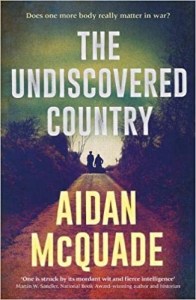
“The tree was in the river and the kid was in the tree… The kid couldn’t have been more than ten or eleven. He looked like a ragdoll caught in the branches.”
So begins my novel, The Undiscovered Country, which, after a long road to publication, is finally out in time for Second Lockdown/ Christmas. The Irish Times has called it, “‘A smart and pacy debut that details a historical period that deserves further exploration.”
For Hamlet, the “undiscovered country” was death. That lurks within these pages alongside reflections on Dutch people’s relationship with beer and cheese, the origins of the idea of the rule of law, and the true meaning of red-headed women in Renaissance paintings. These ruminations are my protagonists’ equivalent of whistling in the dark as they try to get to the truth about a murder that they stumble upon in the midst of a war for another “undiscovered country”, the emergent Irish republic in 1920.





 aidanjmcquade