With Great Power Comes Great Responsibility: business and the struggle to end contemporary slavery

Speech to Westminster event on modern slavery bill and slavery in international supply chains

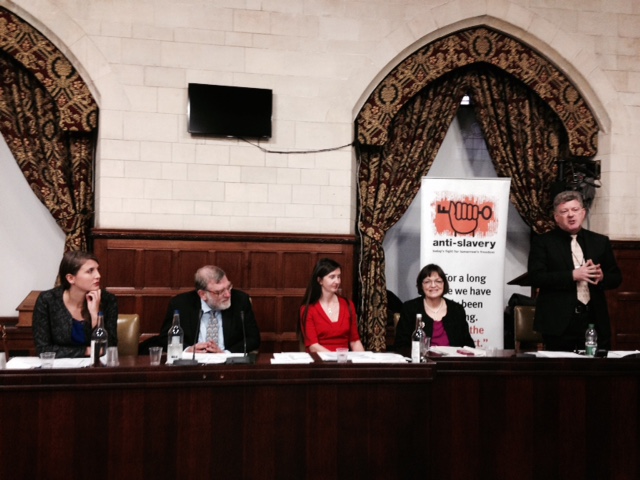
HoC3I would just like to say a few things:

First of all I think it is fair to say that the fact that there is a decent bill is a tribute to the work of all the parliamentarians involved who contributed considerable time and effort into moving this bill from its original and narrow law enforcement focus to something that gives greater recognition to the humanity of the victims of the crime and the need to look at what is happening in the supply chains of goods and labour both abroad and in the UK.

It’s a particular privilege to be beside Sir John Randall and Fiona McTaggart today and to have the opportunity to thank both of you for your efforts and those of many other people of moral courage and conviction in the Lords and the Commons who made this possible.

Anti-Slavery has been working on the challenges of ending forced labour in international supply chains for many years, and we have been working for over a year now with parliamentarians, civil society organisation, businesses and lawyers to improve many aspects of the Bill and I would also like to take the opportunity to recognise those involved in ensuring that there is a transparency in supply chains clause in this bill. That there is such a clause is a result of business, trade unions and NGO members of the Ethical Trading Initiative, putting pressure on the government to introduce such a measure to level the playing field of international trade between those who wish to trade more ethically and those who are not bothered.

In truth had businesses not added their voice to this demand there would still be nothing in the bill. Adam Smith believed that it was the duty of states to regulate businesses. Today I fear that too many politicians regard their responsibility towards business regulation as being to ask businesses how they wish to be regulated. Which is a more progressive position I suppose than that of the Department of Business which seems ideologically opposed to any sort of regulation.

So I think there is a hard truth in today’s world: that the voice of business carries vastly more weight with government than the voice of conscience.

As Spiderman teaches us: With that great power comes great responsibility. Because while slavery is sometimes an issue of organised crime it is more often an issue of the contemporary political economy. By that I mean it is an opportunistic crime practiced by unscrupulous people who see a chance to exploit others to their benefit as a result of constraints and enablements they discern in the law, regulation and custom by which we conduct employment, production and trade in the contemporary world.

One very real consequence of this political economy is that each of us in this room is probably wearing at least one garment tainted, at least in part, by slavery. Whether as a result of the use of state-sponsored forced labour of millions in the cotton harvests of Uzbekistan, or as a result of the enslavement of Dalit girls and young women in the spinning mills of Tamil Nadu in India, or some other aspect of forced labour, including child slavery, in the weaving, cutting, stitching or finishing of the garments that end up on our high streets.

Just to give one illustration of what that means in human terms: in the course of a piece of research into trafficking in garment manufacture in India Anti-Slavery spoke to the mother of one young 20 year old woman who worked in a cotton spinning mill there. She described visiting her daughter:

“I spoke to her in a room provided for visitors”, she said, “because visitors are not allowed to go inside the mill or hostel. My daughter told me that she was suffering with fever and vomiting often. …I met with the manager and requested him to give leave to my daughter because she was unwell. I told him that I would send my daughter back once she was better. But the manager refused saying that there was a shortage of workers therefore they cannot grant leave. He also assured me that they would take care of my daughter and asked me not to worry.”

A week later she received a message to say now she could collect her daughter. She was dead.

Now frequently when businesses are presented with evidence of slavery or other human rights abuses in supply chains their defence is “But we audit our supply chains!” Such ethical auditing has been going on for years now. So it is reasonable to come to some assessment of its effectiveness. And one of the things that is completely clear is that it has been wholly ineffectual in identification and protection of vulnerable workers, and wholly inadequate in bringing about any reform in the systems of production where forced labour and trafficking are so rife.

That should not be news to anyone because generally speaking the purpose of “ethical auditing” is to find nothing. And should some diligent journalist or non-governmental organisation ever expose the sort of exploitation that is routine in, for example, the supply of cheap garments to our high streets, there is no consequence for those businesses or for any business executives who have knowingly made decisions to source from slavery. Their goods are not excluded from European markets. The executives are not held criminally liable. I am not clear if the lack of extraterritoriality in clause 2 of the bill, the slavery offence, is deliberate in order to guard such executives further.

So the transparency in supply chain clause should not be seen as an end but as the beginning of a conversation on how we should seek anti-slavery reform of the contemporary political economy. But for such reform to happen will probably require business people such as yourselves to start the process. And I am encouraged to see a room full of businesses and investors – in fact, this may be the very first time such a large group of NGOs, businesses, investors and parliamentarians has come together to discuss modern slavery.

Investors in particular can begin to change the terms by which we conduct business by engaging on behalf of the ownership on how businesses are responding to the risks of forced labour and slavery in their supply chains. Business leaders can ask this question of themselves and of each other: Are you recognising the risks of slavery throughout supply chains and moving to credibly reduce those risks by ensuring basic protections of workers in those supply chains? Or do you find you are doing business with people who hide behind the comforting myths of ethical audits but in reality care little for the lives that are destroyed in far flung parts of the world because of their decisions?

Businesses must also, I think, begin to engage more systematically with government on these issues. John Ruggie, the author of the UN Guiding Principles on Business and Human Rights, pointed out that businesses have the duty to respect the rights of workers while governments have the duty to protect them. But I am sure that many folk who are in this room today will attest to the fact that it is very difficult to respect the rights of workers if the relevant governments are, either through incompetence or design, failing to protect those workers.

The expansion of globalisation means that the international law governing this new approach to doing business becomes increasingly vital.

The risks of forced labour in international supply chains are compounded because, to use a legal metaphor, there is a prima facie case, I believe, that a number of businesses, countries and regions of the world are basing their competitive advantage on the use of forced labour. Anti-Slavery International investigations in India have shown how the routinized used of the forced labour of girls and young women is now a central feature of garment production for northern hemisphere markets. Further investigations in Thailand have shown how forced labour is a significant feature of production for export markets, most notoriously perhaps in the fisheries that supply prawns to our supermarket shelves.

In both these countries the failure of international rule of law is compounded by a failure of national rule of law. For Dalits in India, for Lao, Burmese and Cambodian migrants in Thailand, the notion of equal protection before the law would be a laughable notion if the consequences of its absence were not so tragic. In India the courts are so overworked that it would take hundreds of years to clear the back log of cases in Delhi alone meaning that factories that use forced labour of vulnerable workers, such as those producing cotton garments in the southern Indian state of Tamil Nadu, can act with virtual impunity. In Thailand, police describe migrant workers as walking ATMs, people to be harassed and extorted from not to be protected.

These are not just national issues. They are issues that should be of concern of British aid and diplomacy if Britain truly wishes to be an international anti-slavery leader. And they should be of concern to all of you if you have the slightest interest in doing business in these parts of the world.

Business must once again take a central role in leadership of the anti-slavery struggle. Businesses can begin with more rigorous investigations of supply chains with the intent to identifying and remedying problems that affect the rights of workers and communities rather than focusing primarily on managing risks to reputation and brand. Where the causes of slavery or other human rights abuses lie beyond the control of businesses, they are very well placed to pressure governments to do their job of protecting human rights.

Many of you will be aware of the challenges of forced labour in Thai fisheries. Anti-Slavery International is currently working with a range of UK retailers, many of whom are in the room today, on a unique pilot project to identify and address the risks of forced labour in supply chains and empower workers to access remedies. This work is very much about partnership between business and civil society, risk assessment and due diligence, rather than the traditional “audit” approach. At the same time, the work in Thailand highlights how governments are failing to protect workers in a range of industries and business can play a vital role in putting pressure on governments to act properly.

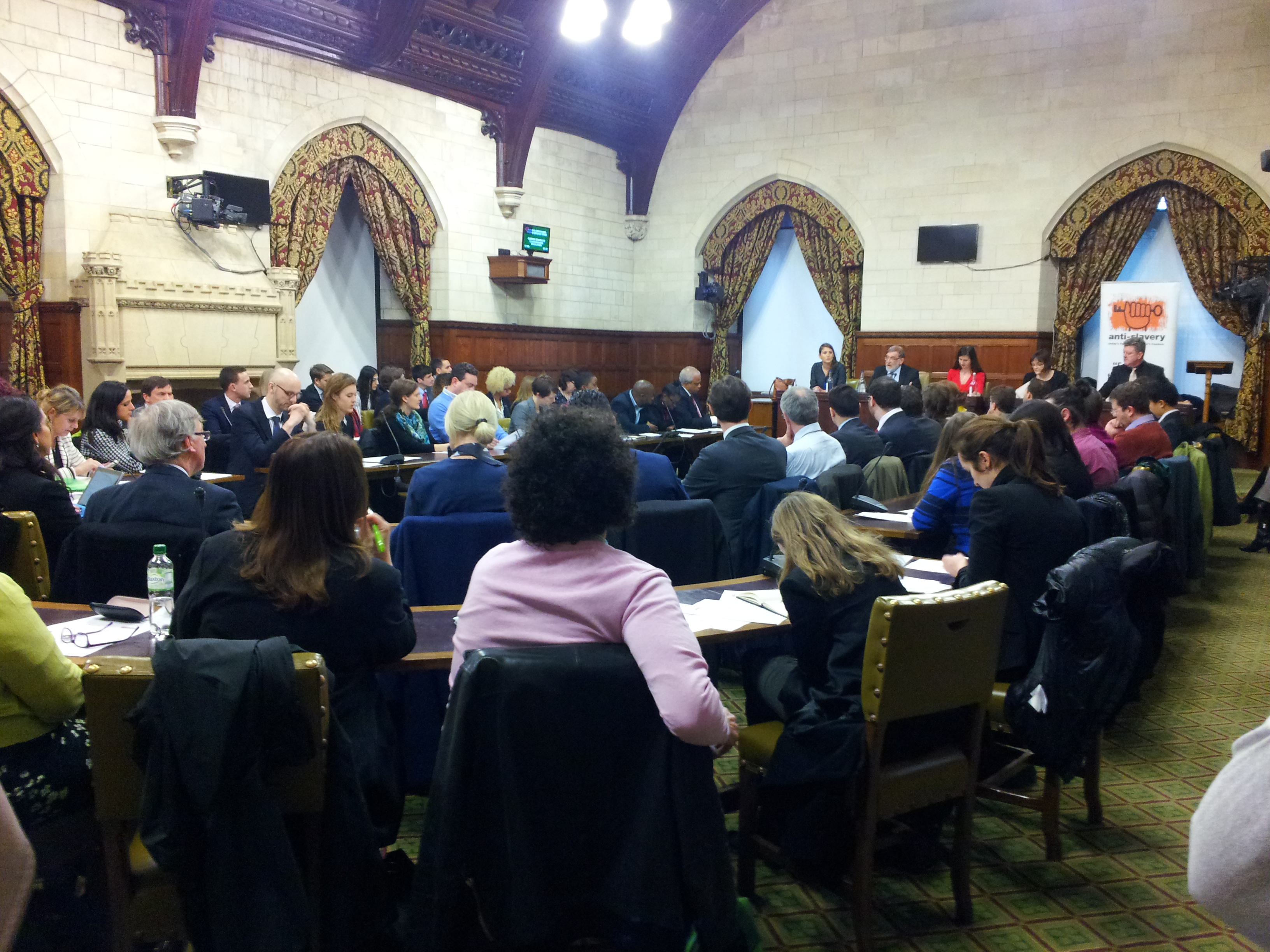
committee meetingI regularly meet business and political leaders who are forthright in their opposition to the very principles of slavery. I am pleased to see that many of them have also recently begun to publicly show the depth of their moral courage by also seeking practical measures to end slavery. Many have added their voice to ours to send a strong message to the UK government on the importance of transparency in supply chains.

But all of us here have some measure of power to do more. As the Modern Slavery Bill reaches its very final stage next week, I would also like to encourage all of you in the room and especially those that represent business and investors to respond to the government consultation on supply chains. Your response will be key in ensuring that there is parity and coherence in reporting, that those businesses that lead the way will not be undermined by those who choose not to report or make minimal efforts to disclose.

I would also like to invite all of you to build on the collaboration across sectors and work further with civil society on addressing modern slavery.

We can turn away and hope somebody else we sort modern slavery out. Or instead we can grasp what opportunities present themselves to us and strive for reform and emancipation, and in the process help change a moment of history for vulnerable people across the world.

The Rise of Islamic State, by Patrick Cockburn

imageThe Rise of Islamic State is a short book but an extremely important one. Cockburn, a veteran Middle East correspondent, lucidly describes how Islamic State has arisen as a concrete legacy of Bush and Blair’s inept and illegal invasion of Iraq. He also unpicks the political and military quagmire currently extant in that region.

Cockburn identifies Saudi Arabia as the primary source of financial support for Islamic State (DAESH) and its predecessor Al Qaeda, and the origin of its barbaric “jurisprudence”. However in the aftermath of 9/11, or indeed at any time subsequently it seems, rather than confront Saudi Arabia, or Pakistan with its murky ties to international terrorism, the Bush administration instead invaded Iraq, a country that, for all the brutality of Saddam had nothing to do with the 9/11 attacks.

George W Bush, with his pal Prince Bandar bin Sultan,

George W Bush, with his pal Prince Bandar bin Sultan, “godfather” of DAESH (Islamic State)

One can only imagine how Prince Bandar bin Sultan, the Saudi ambassador to the US, an instigator of the Iraq invasion and frequent house guest of George Bush, must have giggled to himself at how easily led the US was towards advancing Saudi Arabia’s brutal foreign policy without Saudi ever having to get its hands dirty. As head of Saudi intelligence subsequently, from 2012 to 2014, Bandar was the key individual responsible for backing DAESH against Shia and minorities in the region and so helping them become the potent military force they currently are.

Cockburn points out that while DAESH may not be loved by the Sunni population of Iraq, they are tolerated by them because the alternative, perhaps unbelievably to some, would be much worse for them. The bigoted, pro-Sunni extremism of DAESH Wahhabism is mirrored by the brutality and sectarianism of the Shia militias that the US and UK supported Iraqi government have been sponsoring.

Which brings us to the present: the Obama administration’s efforts seemed to be towards a detente with Iran as an element in not only a nuclear non-proliferation strategy but as one, along with support for the Kurds, against DAESH.

The desire of the US Congressional Republicans in collusion with Netanyahu to undermine a deal with Iran seems peculiar. However this is in keeping with the ineptitude and dysfunctionality of US Middle Eastern policy over the past 15 years, something made altogether more terrifying when the shallow but fevered imaginings of Donald Trump are brought to bear on the situation.

However one should also recognise that US policy towards the region now appears to have much in common with that of the UK. Both seem to value the possibility of profiting from the sales of arms to Saudi Arabia rather than actual regional security. In the end perhaps the US and UK will gain the same comfort as the gun store owner who at least has the satisfaction of knowing he sold the gun to the psychopath who murders him.

All too human: war and terrorism in the contemporary world

Picasso's Guernica

Picasso’s Guernica

In the aftermath of the recent spate of atrocities by Islamic fundamentalists it is probably worth focussing on a couple of points that have been obscured in the rush to condemnation.

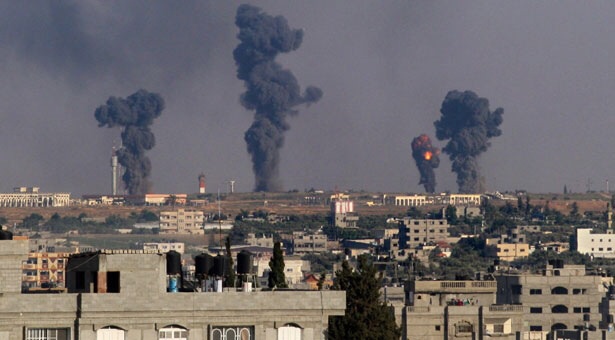
First this sort of atrocity is nothing new in modern history. Ordinary Germans routinely massacred civilians in Eastern Poland during the Second World War. Much of the RAF bombing campaign on Germany during the same war was indiscriminate and killed thousands of old people, women and children. American troops in Vietnam regularly butchered Vietnamese civilians. Irish paramilitaries slaughtered both compatriots and British civilians alike. The last vestiges of the notion of Israeli “purity of arms” died in the slaughterhouse Prime Minister Netanyahu created in Gaza in the summer of 2014. In fact in the sweep of human history the idea of refraining from making war on civilians has been rather unpopular, and the wars emanating from, and waged in the contemporary Middle East are no exception.

The notion that Muslim atrocities are somehow qualitatively different and beyond the moral pale of what the Western world would contemplate is laughable, and must be even more laughable to those who, in recent years, have been on the receiving end of the violence of the West and its allies.

However it does seem plain that at this point in history there is a significant sub-culture within the European Muslim community which is alienated from the democratic ideals of wider European society, and within that, a smaller minority which is prepared to resort to violence and terrorism both in Europe and abroad as an expression of this alienation.

A lot of the focus in the aftermath of the most recent attacks has been on the need for European Muslim community leadership to combat this alienation. Such leadership has and will continue to have considerable potential to lead young people away from violence and towards more constructive roles for their community and wider society. But it is disingenuous to presume that the reason that young people are engaged in violence to the current extent is because of failures in the leadership of the Muslim community.

To presume this may be comforting to non-Muslims, as it implies that we have no responsibility for Muslim alienation. But it is not a response to the violence that will leave a single individual anywhere in the world any safer or more protected from random and brutal terrorism.

Goya's Shootings of the third of May

Goya’s Shootings of the third of May

Because, of course, alienation and terror on this scale never occurs in a vacuum. Just because the wider society is unaware of the narrative that is justifying that terrorism to its perpetrators does not mean that such a narrative does not exist. And just because the narrative may be filled with distortions and logical inconsistencies does not mean that it is any less compelling to its adherents.

What should be apparent to even the most myopic of observers is that the fundamentalist violence that we have witnessed in Europe over the past 10 years comes in the context of a much wider system of violence. And, as Patrick Cockburn has put it, “It is inevitable that sparks from these conflicts land in Western Europe and other parts of the world.”

For many in the West this cycle of violence started with the attacks on the World Trade Centre. However Muslim grievances predate that. For example the West’s acquiesce in an emerging system of Israeli imposed apartheid in Palestine or the horrific brutality of the wars in Algeria are both capable of providing alternative points of origin for a narrative in which 9/11 seems no less and no more justifiable than Dresden or Nagasaki. And the brutal conduct of the bloody fiasco in Iraq has sustained the flow of grievance.

European Muslims are likely to have similar reactions to injustices against Muslims in Gaza or elsewhere as Irish Americans had against British injustice in the North of Ireland. However the danger, from a contemporary point of view, is that the US wasn’t seen as being complicit in British injustice. Today Europe, in particular the UK, may be closely and ignominiously identified as being complicit in the bloody mess of Iraq and Israel’s violence against Palestinians.

In other words, distasteful as it may seem to some, the current spate of Islamic fundamentalist terror is a political problem. It is not an Islamic versus Western ‘clash of civilisations’, though some would like it to be portrayed as such: Netanyahu’s cynical elbowing to the front of a Parisian photocall with international leaders in the aftermath of the Charlie Hebdo attack was a physical assertion of this idea. He intended to convey to Europe and beyond that it has no choice but to stand alongside his militarism. Rather what we see is a set of wars of varying sizes and asymmetries that are born from fundamental human and therefore political issues of injustice, violence, alienation, cruelty and stupidity.

But if we can accept that this fundamentalist violence is the consequence of a more mundane set of political problems then we can recognise that it requires political solutions, or at least a political process, to address the causes of alienation alongside the security response necessary to attempt to fend off future attacks.

Picasso's Rape of the Sabine Women

Picasso’s Rape of the Sabine Women

The full extent of the political agenda that should be followed will be considerable and international in scope. It may necessarily include consideration of the question of reconciliation between French and Algerian peoples. It should probably include confrontation of Pakistan and in particular Saudi Arabia as countries that have been the ideological reservoirs, financiers and facilitators of much of the terror that is currently plaguing the Middle East and the world. Unquestionably one element must be the robust pursuit of a just peace between Israel and Palestine, instead of the international acceptance of the quasi-apartheid that currently pertains. This will require the Jewish community bearing a heavy burden of leadership comparably to that required of non-violent Muslim leaders: the one thing the current Israeli government and its apologists seem afraid of is ordinary Jews publicly repudiating the Israeli government’s extremist policies and racist attitudes. Such sanction carries with it a credibility that non-Jews, lacking links to the appalling tragedy of Jewish history, could never hope to attain.

An international political process that openly seeks to deal justly with grievances would provide political weight and credibility to those leaders and citizens, particularly Muslims, who wish to pursue the path of non-violence. Without it, those same advocates for peace will be rendered much less effective, twisting in the wind as the West blunders on repeating the patterns of the past 10 years with brutal and inept military responses to problems emerging from countries and societies that we barely begin to understand.

Learning from History and the Present: citizens and the struggle to end slavery

Keynote speech to the 15th Annual UNESCO Chair & Institute of Comparative Human Rights International Conference, University of Connecticut

I was asked to speak a little about the broad overview of contemporary slavery and provide some historical background on the struggle So I will try to do that.

I think an important place to start relates to the question of what do we mean by slavery. I am frequently dismayed at meetings of both academics and activists when some pose questions such as “What is modern slavery?” or “Is trafficking slavery?”

The struggle against slavery is one of the oldest human rights struggles in the world, so if someone is new to this field, as some important actors are, it is important to remember that we do not have to reinvent the wheel. This path has been trodden by giants before us and we are building on the work that they have done.

So what is contemporary slavery? When we in Anti-Slavery International talk about “slavery” we use that word as an overarching term for the human rights abuses defined in international law, principally by the 1926 Slavery Convention, by the 1930 Forced Labour Convention, the 1956 Supplementary Convention on Slavery, the 2000 Palermo Protocol on trafficking, and the 2014 Forced Labour Protocol.

A good working definition of contemporary slavery comes from the 1930 Forced Labour Convention, which defines forced labour as all work or service extracted under menace of penalty, for little or no pay, for which the person in question has not offered themselves voluntarily. Trafficking is the technical process of moving people into situations of forced labour – so trafficking is indeed, by definition, slavery.
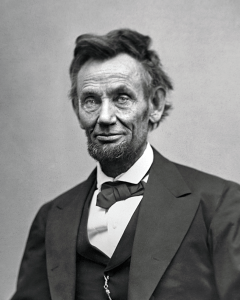
Lincoln sought a legal basis to end slavery in the United States

Lincoln sought a legal basis to end slavery in the United States

There are other important international laws related to this field, in particular on child labour and decent work, and there are important nuances within the slavery conventions I mentioned. But it is vital to note that this question of, “What is slavery?” is not a matter for social scientific contention of the sort so beloved by academics. It is something that has been established in international law as a result of considerable effort over the past 100 years to provide a robust framework for the continuing struggle against slavery. Remember how Lincoln had to struggle for a legal basis to end slavery in the United States. It is important to realise that we do not have to go back to that situation.

An Indian brick kiln

An Indian brick kiln

Part of the reason for this breadth of law in the international conventions is that contemporary slavery reflects a diversity of human experience: a life lived in bonded labour in Indian brick kilns is different in important respects from that of a Nepalese domestic worker in Lebanon, or somebody in chattel slavery in West Africa, or a “restavek” child slave in Haiti, or a forced labourer in American agriculture. Hence the responses to these problems must be nuanced and adjusted to the realities of those particular abuses in the time which they occur. The 2014 Forced Labour Protocol was adopted in recognition that the realities of forced labour have changed since the original Convention was adopted in 1930, and there will doubtless be other areas where there is a need for further extension and development of the international law, for example around the issue of child marriage.

But in spite of the spectrum of experiences of contemporary and historical slavery empirical studies conducted by Anti-Slavery International and others indicate that slavery emerges at the conjunction of three common factors: individual vulnerability, usually, but not exclusively as a result of poverty; social exclusion; and failure of rule of law.

The issue of social exclusion and discrimination is a fundamental one in slavery: when we look at historical slavery in the Americas we see that racism was both a cause and a consequence of that slavery.

Thus has it been, thus will it always be.

In Latin America today many in forced labour are indigenous people. In Western Europe most people in slavery are migrant workers. In South Asia most people in slavery are Dalits or from other scheduled castes or minority groups.

This is important for a variety of reasons, not least that it inhibits the issue from becoming a political one: if slavery is being inflicted upon groups and individuals who the wider society simply does not like, then that wider community is more likely to tolerate the abuses if they see them and not raise their voice to demand that governments do their jobs to stop the problem.

And slavery is very much a failure of governments’ most fundamental responsibility: establishing rule of law. Tom Bingham, one of the outstanding British jurists of the past 50 years argued that human rights, including, of course, an absolute prohibition on slavery, must be at the heart of any credible system of rule of law. But in a recent study we conducted of child labourers enslaved in the garment workshops of Delhi they told us how, despite plenty of good Indian law against slavery and child labour, when the workshop owners fail to pay bribes to the police, the police come, arrest the children and hold them hostage, stopping work, until the bribes are paid. In other parts of India Dalits enslaved in brick kilns or agricultural labour find it next to impossible to obtain legal remedy for the situations in which they find themselves.

In other parts of the world rule of law is much more explicitly undermined. In Qatar there is the “kafalah” system. This is a so-called sponsorship system that ties workers to their employers to such an extent that even in the most abusive employment relationships, up to and including forced labour, the workers cannot change jobs or even go home. It is this system that underpins the trafficking for forced labour of thousands of South Asian labourers for work on the infrastructure and venues for the soccer world cup in Qatar 2022.

Kafalah is a cynical system to facilitate medieval levels of exploitation up to and including slavery across the Gulf states.

It is also essentially the same system that the United Kingdom government has in place for migrant domestic workers. The UK system for domestic workers’ visas de facto legalises trafficking for forced domestic servitude. It does this by explicitly saying to migrant domestic workers that if they leave the employment of the person to whom their visa is tied, no matter how abusive that employer may be, they will be deported. That places in the hands of unscrupulous employers an enormously powerful threat to hold over the head of any vulnerable worker hoping to improve their own life and that of their family through hard work.

The refusal to apply basic protections of rule of law to some within a society is sometimes deliberate in order to obtain some aristocratic privilege over a group of people, such as was the case with the 19th Century US system of slavery, even when free labour and emancipation were more attractive economically. This remains the case with India’s caste-based apartheid today.

Sometimes the failure to provide basic rule of law protections are as a result of a mistake or oversight. Sometimes, as we are presently seeing with the British Government, it is as a result of ineptitude born of ignorance, ideology and xenophobia. In the UK, for example, if a person from the European Union presents themselves to the authorities as a potential survivor of trafficking then there is a greater than 80% chance they will be recognised as such. If they come from outside the European Union then there is less than a 20% chance they will be recognised as such. That sort of imbalance in decision making can only be the result of institutionalised discrimination, something fed by the media and political elites who should instead be sanctioning those who disgrace their offices by privileging their petty bigotries over their responsibilities under the law.

In the 21st century the issue of government response to slavery becomes much more vital as the political economy becomes increasingly globalised. With globalisation the capacity of states to regulate business, as envisioned by classical economics is increasingly limited because too few states recognise that this responsibility now requires extraterritorial legislation to ensure the legal accountability of trans-national corporations, and of individual business executives who are running those corporations. Such legislation is also a central requirement in the struggle against contemporary slavery, particularly as businesses extend their operations into countries with limited rule of law and high levels of corruption.

The history of the struggle against slavery, as with the rest of the struggle for human rights, and the rest of history, is sometimes a messy and fraught affair, filled with petty rivalries, personal jealousies and self-serving accounts. And because, given the nature of slavery, its history is quite a personal story. People are not enslaved by poverty or drugs or some impersonal force: human beings do this to other human beings.

The diversity of personal perspectives means that there is inevitably a diversity of historical narratives. This is accentuated in the history of the struggle against slavery by the fact that there is a plurality of historical slavery experiences just as there are a plurality of contemporary experiences: from the trans-Atlantic slave trade and that of the Americas, to the trafficking from East Africa to Asia, to the indigenous forms of slavery and slavery-like practices, such as serfdom, that were present in Europe and the rest of the world.

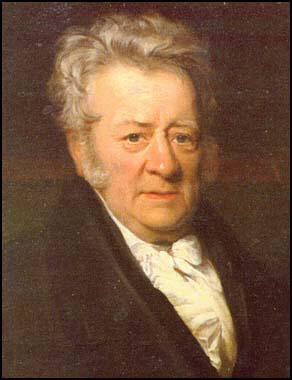
Thomas Clarkson

Thomas Clarkson

Memory can be a self-serving thing as can the official versions of history. So surveying the history of this struggle can be confusing. Alongside the immense, and immensely troubling, accounts of the experiences of people in slavery, there are also propagandistic accounts of the benefits of slavery for enslaved people. And, just considering the anti-slavery struggle, there were also inevitable clashes between the leading anti-slavery figures. This resulted in such unedifying spectacles as the efforts by the sons of William Wilberforce to try to write the monumental figures of Clarkson and Equiano out of history, or the efforts of Salmon Chase to organise a coup d’etat against Lincoln. Some historian’s even discern a dispute between Spartacus and Crixis at the height of the Gladiator War.

But, nevertheless, history and society critically interrogated can be a source of understanding and learning.

The former French Prime Minister Georges Clemenceau was once asked if anything could ever be said with certainty about the First World War given all the vast and bloody confusion that entailed. Yes, he said. “No one can ever say Belgium invaded Germany.”

Such hard facts may be rare enough in history, and indeed in any aspect of life, but it is important to try to find them because from them we can discern what worked, what didn’t work and why.

And, at least as importantly, the process of thinking critically about history, and of refusing to accept unthinkingly the propaganda of the powerful or the official versions of the winners, of considering carefully life and society, can provide a basis for developing our own citizenship and our capacity for action for justice.

I think there are a number of hard truths that than can be discerned from contemplation of the historical and contemporary struggles against slavery.

The first thing that emerges for me from consideration of the diversity of contemporary anti-slavery struggles is that there is not a single anti-slavery movement.

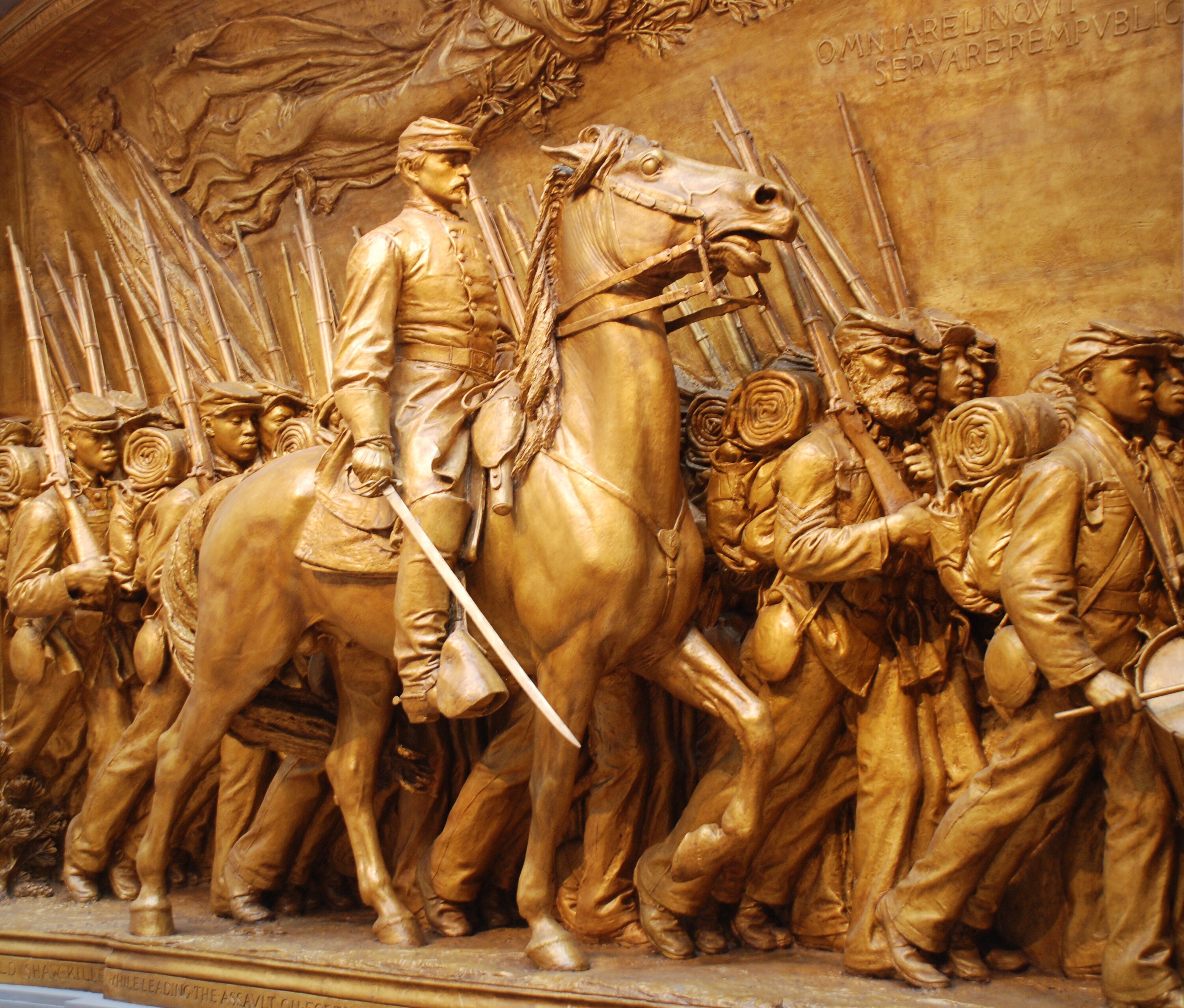
The memorial to Shaw and the 54th

The memorial to Shaw and the 54th

I was at the International Slavery Museum in Liverpool a while ago and I saw a poster there commemorating the struggle against slavery and the transatlantic slave trade: it said “Remember not that we were enslaved, but that we fought“. It’s a truth stunningly emphasised in the memorial to Robert Gould Shaw and the Massachusetts 54th on Boston Common.

And it remains the case today. However the activists who risk life and limb to end contemporary slavery across the globe know that few today beyond their own directly affected communities are remotely interested in trying to end these modern forms of slavery.

Unlike previous struggles against aspects of slavery or more recent struggles to end, for example, apartheid in South Africa, or to advance the peace process in the North of Ireland, the contemporary efforts of indigenous campaigners against slavery are very poorly supported by international efforts.

There is very limited discussion on how policy on migration, international aid, trade, or diplomacy should be shaped to support local anti-slavery activists. There is little discussion on how to reshape the international political economy away from one where unscrupulous political and business leaders are allowed to develop competitive advantage through their facilitation of, or use of, forced labour and slavery. The international silence is deafening on caste discrimination in South Asia, which imposes a system of apartheid on over 300 million people. This system not only undermines the very concepts of rule of law and democracy in South Asia but also provides the social exclusion vital to establish a population who can be enslaved with impunity.

This provides huge benefits to powerful vested interests across South Asia. But we in the Northern hemisphere also benefit. Slavery provides us cheap shrimp for the dinner plates of Europe and North America. So extensive still is the use of the forced labour of girls and young women in garment manufacture in southern India, not to mention the forced labour, including forced child labour, in cotton production in Uzbekistan and other parts of central Asia, that the probability is that every one of us in this room is wearing at least one garment that is tainted with contemporary slavery.

Just to give one illustration of what that means in human terms: In the course of a piece of research Anti-Slavery International, funded by Humanity United, conducted into the forced labour of girls and young women in the garment sector of the state of Tamil Nadu in Southern India we spoke to the mother of one young woman, 20 years old, about the same age as many of you, who worked in a cotton spinning mill there. She described visiting her daughter:

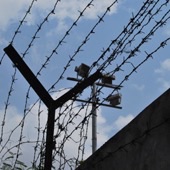
Barbed wire around the compound of a South Indian spinning mill

Barbed wire around the compound of a South Indian spinning mill

“I spoke to her in a room provided for visitors”, she said, “because visitors are not allowed to go inside the mill or hostel. My daughter told me that she was suffering with fever and vomiting often. …I met with the manager and requested him to give leave to my daughter because she was unwell. I told him that I would send my daughter back once she was better. But the manager refused saying that there was a shortage of workers therefore they cannot grant leave. He also assured me that they would take care of my daughter and asked me not to worry.”

A week later she received a call to say now she could collect her daughter. She was dead: a life over before it had barely been allowed to begin.

Just as enslaved people were worked to death on the plantations of the US South in the 19th Century so too are they today worked to death in the garment factories of Southern India, the fishing boats of Thailand, on the World Cup building sites of Qatar and the rest of the Gulf, in agricultural fields from West Africa to North America, and in the servants quarters of every major city of the world.

Thus has it always been.

A further point that emerges from consideration of historical and contemporary slavery is that there is no silver bullet to end slavery.

I think this is one of the key lessons of the history of the anti-slavery movement. When Anti-Slavery International’s antecedents in the Committee for the Abolition of the Trans-Atlantic Slave Trade was established in 1787 they believed that the ending of the slave trade would inevitably lead to the ending of slavery. It was certainly an important milestone but additional effort was necessary until chattel slavery was abolished in the British Empire. But even then slavery transmuted into different forms: bonded labour was still tolerated in British India and now in independent India and Pakistan. Indentured labour became a feature of British colonialism post-1839.

In the United States there was a similar approach to the eradication of slavery. Some believed that confining of slavery to the US South would ultimately lead to it naturally dying out there. But in the end a devastating war was necessary. And again slavery transmuted first into exploitation and then into a variety of new forms affecting vulnerable workers in the unpoliced parts of the economy.

In the present day in spite of slavery being illegal in most countries of the world there are a minimum of 21 million people in slavery and forced labour. Whatever magic bullets have been fired at the problem they have failed to stop it.

Instead we need to conceive of a much broader based approach to dealing with contemporary slavery: complex problems generally require sophisticated solutions. This is the case with slavery. It is a crime, but it needs more than a criminal justice approach to counteract. As I mentioned earlier the anti-slavery struggle, if it is to be successful, must become a centrepiece of diplomacy, and policy and practice related to migration, international aid and trade.

Such an approach must include a comprehensive programme of human, civil and economic rights for those most discriminated against and most vulnerable to slavery. This would offer a chance of peace and prosperity for them, their families and their countries rather than the continued violence of forced labour and poverty that describes their present, not to mention the risks to their futures.

The beginning of such a programme should be marked by a clear declaration by the United Nations that the eradication of slavery and child labour should be made stand-alone post-2015 sustainable development goals. This would help focus the minds of the thousands of anti-poverty and humanitarian professionals on considering how their particular expertise and professional responsibilities may contribute to the elimination of slavery. For those of you who take practical action against slavery perhaps consider writing to your president and to the Secretary General of the United Nations with this demand.

Leading on from this the struggle to end slavery should be a central feature of governmental aid programmes such as those of USAID and the other major multilateral and bilateral agencies across the world. This means establishing specific anti-slavery budget lines for countries and regions with the greatest prevalence of slavery, and mainstreaming consideration of slavery into other anti-poverty and humanitarian work. Without such consideration there is a significant risk that anti-poverty interventions either relatively or absolutely exacerbate the position of the most vulnerable groups in those communities.

For example in 2005 our colleagues in the Niger anti-slavery organisation TImidria identified that slaves were being used in some of the food for work programmes which had been set up in response to the West African famine of the time. The way this worked was that slave masters would send those they had enslaved to toil all day on the programmes and on their return they would confiscate the ration cards they had been given in payment for their work.

Now I don’t want to be glib about this. I worked in humanitarian response for many years and appreciate deeply what a difficult and vital role it is. Without exposure to the institutions of contemporary slavery I am sure I would have made a similar mistake, and indeed probably did in other parts of the world. My point is that a basic question that development and humanitarian professionals should ask is, “How can my work impact upon slavery and non-gender based discrimination in the area in which I am working?” Asking such questions can help mainstream anti-slavery practice to development and humanitarian work and lead to the sort of qualitative improvement in practice that gender mainstreaming brought two decades ago.

An appropriate international struggle against slavery should also include attention to the need for safe migration: we should not tolerate the establishment of rules on migration that facilitate the trafficking of vulnerable people. Countries that establish such rules, like Qatar, like the UK, should be treated as pariahs and the terms with which they trade with the rest of the world should be altered. There is an hypocrisy in how migrant workers are treated internationally. On one hand we, as an international community, tolerate circumstance of injustice and poverty which compel them to migrate. We will then go so far sometimes to recognise the importance of remittances from these workers towards the development of their countries and reducing the poverty of their families. But the world still fails to ensure safe migration. At the moment in Europe we are witnessing carnage off our southern shores because of a wholesale failure of political courage in addressing this issue.

Perhaps it is another hard lesson of history that when the moral courage of political leaders fails in the face of prejudice and vested interests it is the vulnerable who are usually the ones to pay in the bloody routine of violence that ensues.

200 years ago people like Equiano and Clarkson in Europe, and in the Americas, Sam Sharpe, Nat Turner, Touissant, the Maroons decided, for diverse reasons, to try to end slavery, so morally repugnant did they find it. In doing so they took on a system that the writer Adam Hochschild has compared in the equivalence of its power to the oil industry today. In ending the slave trade through force of arms and force of argument in a mere 20 years they showed what could be achieved when there is the collective will and the audacity of ambition to do so.

Olaudah Equiano

Olaudah Equiano

Clarkson, Equiano, Turner and Sharpe, the Maroons, the Quakers, and the nascent trades unions have been substantially written out of the history of that struggle, first by Wilberforce’s sons, and largely forgotten subsequently. That historiographical injustice contributes not just to the misremembering of what happened, but the misunderstanding of why it happened. The achievements of 200 years ago were a classic example, in Bobby Kennedy’s phrase, of numberless diverse acts of courage and belief shaping the history of the time. Thus has it been, thus will it always be.

Whatever our differences one thing that unites us is that we are all citizens in this world. And that brings with it not just rights but responsibilities. We have the responsibility to remember properly. We have the responsibility to think and to understand. We have the responsibility to act. “Do to others what you want them to do to you.” And remember that when we act with common purpose, in spite of all our flaws and diverse motives, that still, together, we can overcome.

Whoops!: Why everyone owes everyone and no one can pay, by John Lanchester

Goldman-Sachs-46830569144Whoops! is a clear, cogent and coherent explication of how the financial crisis came about, emerging from a culture of greed and a ludicrous, supposedly rational, belief that risk could, for all intents and purposes, be eliminated from financial transactions. More frightening is that almost nothing has been done to prevent such a crisis happening again – President Obama’s modest efforts having been eviscerated by the right of his own party and nothing notable in Europe at the time of publication in 2010.i-hate-being-greedy-but

So terrifying are the implications of the situation that even the regular and excellent jokes that pepper the narrative do little to alleviate the feeling of dread that the book evokes. It is a vital book and an indictment of pusillanimous politicians and economists who have defered to greedy bankers and consequently brought devastation to millions.

Boycotts in the history of human rights struggles

The growing calls for boycotts of Israel and Israeli goods led me to reflect over the past couple of days on the role of boycotts in the struggle for human rights. 

I reckon Anti-Slavery International can (just about) claim credit for the idea of the boycott: in the 1790s: our predecessors in the Committee for the Abolition of the Trans-Atlantic Slave Trade advocated boycotting slave-produced sugar as part of the campaign to end slavery.

image

The boycott was later introduced to Ireland by one of the greatest of all Irish leaders, Charles Stewart Parnell, in the midst of the agitation for land reform in the late 19th Century. He was desperate to obtain an effective means of non-violent resistance that would harness the energies of his movement and head off potential for violence as the conflict intensified. Shortly after proposing the idea it was put into impressive effect against the eponymous Captain Boycott in Mayo and his name has stuck to the tactic.


Charles Stewart Parnell

Charles Stewart Parnell

When delivered effectively boycotts can still be potent weapons. But they are also often blunt instruments: They can and do cause hurt to those they are launched in sympathy with as well as their oppressors. During the struggle against apartheid in South Africa activists were clear that boycotts of South African goods would also harm black South Africans alongside the racist clique running the country. However they judged that the level of harm would be marginal compared to what they were already suffering and the damage to white economic interests would be disproportionately higher.

Given the risks of harm to intended beneficiaries the boycott, as a weapon in the struggle for human rights, must be one of last resort. Anti-Slavery, in consultation with colleagues in Uzbekistan, judges that the state-sponsored child slavery practices in the cotton sector there warrant a boycott. There have also been suggestions of a boycott of the Qatar 2022 World Cup because of the routine use of forced labour by that country in the construction of the venues and infrastructure for that event. However the ideal would be that international pressure on the Qatari authorities would lead to increased opportunities for decent work for the tens of thousands of South Asian workers who have sought employment there as a potential route out of poverty.

image

The conflict in Israel/Palestine arguably dwarfs these examples in terms of complexity. But if Israeli policy in the Occupied Territories continues to convince the world that that government has chosen the path of apartheid rather than peace, as former US President Jimmy Carter feared, then many may feel that the conditions necessary to justify a boycott have been met. Perhaps this prospect may eventually open the minds of the Israeli government to alternative policy responses to their illegal occupation of Palestinian lands and their siege of Gaza, imageaway from their current predominantly narrow, military ones. As the Palestinians pose little military threat to Israel there is little chance of a just peace deal being formed to resolve the military conflict. But the moral revulsion that Israel’s disproportionate assault on Gaza has provoked in much of the world, and their continued flouting of international law, may ultimately bring about a comprehensive boycott of the country and with that an increasing economic threat. Ultimately that may demand more just resolution of the conflict with the Palestinian people before international opprobrium becomes intolerable.