The Last Battle, by Stephen Harding

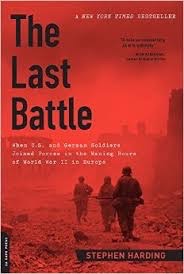
imageOn 5 May 1945 arguably the last ground battle of World War 2 took place. It was a relatively small and very brief affair by the horrendous standards of that war, but it made up for that in terms of strangeness.

In the early hours of the morning of 5 May a force of Waffen SS attacked a castle in Austria, Schloss Itter, intent on massacring the prisoners there. The attack was resisted by a tiny ad hoc force of US tankers, Austrian resistants, anti-Nazi Wehrmacht and the prisoners themselves, who were a veritable who’s who of the French political and military elite, including Gamelin, Daladier, Reynaud, Weygand and the labour leaders Leon Jouhaux and Augusta Bruchelen.

It is the only known time in the war when Wehrmacht and Allied troops fought side by side.

imageimageThe Last Battle is a short but highly entertaining book, and very informative regarding the divisions and dissensions in French politics both before and after the fall of France. It is also a warm tribute to the American and German commanders during the battle, Jack Lee and Josef Gangl, both of whom could have ignored the threat to the prisoners in the castle but who instead risked their lives with the Austrian resistance to stop a blood bath.

The Narrow Road to the Deep North, by Richard Flanagan

Summary: “Because courage, survival, love – all these things didn’t live in one man. They lived in them all or they died and every man with them; they had come to believe that to abandon one man was to abandon themselves.”

Dorrigo Evans doesn’t have a particularly high opinion of himself. He is an inveterate womaniser, a distant father, a disloyal husband, an excessive drinker, and a sometimes reckless surgeon. Yet, because of his time as a commanding officer of enslaved Australian prisoners of war on the Burma death railway, he is regarded as a national hero. This he regards as somewhat fraudulent, echoing the pretenses of leadership that he displayed in the camps. Dorrigo knows what he is: an officer who failed his men by allowing himself to become complicit in the war crimes of their Japanese captors.

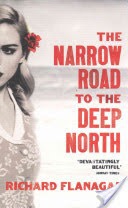
The Narrow Road to the Deep North won the Booker prize in 2014 and trails behind it a mountain-load of praise. It deserves every accolade: it is an extraordinary meditation on war, death, heroism, trauma, love and loss. It is also one of the most difficult books I have ever read.

The centrepiece of the book is an extended account of a single day in the POW camp, echoing Solzhenitsyn’s novel of the gulag, One Day in the Life of Ivan Denisovich. I found this particularly gruelling, the pages suffused with dread for the atrocities that the author has already informed us will occur. Through this section we meet the doomed, struggling to maintain their dignity and decency in the face of the implacable brutality of Japanese militarism. Perhaps not all readers will find this such a difficult section but it took me weeks to read, unable to handle more than a few pages a day.image

I am particularly relieved that I stuck with this. The discomfort of reading about the death railway is as nothing to what those, including the author’s father, suffered on it.

And the novel is ultimately one of profound insight and devastating power: it made me cry more than once. It affirms a theme of Ian McEwan’s Atonement, that war obliterates not only life but love itself, and is unflinching in showing the reader that atrocities are committed by people as human as we are: Dorrigo’s captors go to their graves believing themselves good and patriotic people, more concerned with how they felt about killing than for the actual murders they inflicted on helpless prisoners.

But there are also more redemptive and hopeful notes. In contrast to his captors Dorrigo survives the war thinking himself a bad man, a failure and accomplice to war crimes, thinking that is a product, no doubt, of post-traumatic stress. But Flanagan shows us how, even at our most flawed, human beings may be better than we ever dare to imagine ourselves. Indeed, it may even be our flaws, sometimes, that compel us to heroism.

The Narrow Road to the Deep North is a masterpiece.

The Rise of Islamic State, by Patrick Cockburn

imageThe Rise of Islamic State is a short book but an extremely important one. Cockburn, a veteran Middle East correspondent, lucidly describes how Islamic State has arisen as a concrete legacy of Bush and Blair’s inept and illegal invasion of Iraq. He also unpicks the political and military quagmire currently extant in that region.

Cockburn identifies Saudi Arabia as the primary source of financial support for Islamic State (DAESH) and its predecessor Al Qaeda, and the origin of its barbaric “jurisprudence”. However in the aftermath of 9/11, or indeed at any time subsequently it seems, rather than confront Saudi Arabia, or Pakistan with its murky ties to international terrorism, the Bush administration instead invaded Iraq, a country that, for all the brutality of Saddam had nothing to do with the 9/11 attacks.

George W Bush, with his pal Prince Bandar bin Sultan,

George W Bush, with his pal Prince Bandar bin Sultan, “godfather” of DAESH (Islamic State)

One can only imagine how Prince Bandar bin Sultan, the Saudi ambassador to the US, an instigator of the Iraq invasion and frequent house guest of George Bush, must have giggled to himself at how easily led the US was towards advancing Saudi Arabia’s brutal foreign policy without Saudi ever having to get its hands dirty. As head of Saudi intelligence subsequently, from 2012 to 2014, Bandar was the key individual responsible for backing DAESH against Shia and minorities in the region and so helping them become the potent military force they currently are.

Cockburn points out that while DAESH may not be loved by the Sunni population of Iraq, they are tolerated by them because the alternative, perhaps unbelievably to some, would be much worse for them. The bigoted, pro-Sunni extremism of DAESH Wahhabism is mirrored by the brutality and sectarianism of the Shia militias that the US and UK supported Iraqi government have been sponsoring.

Which brings us to the present: the Obama administration’s efforts seemed to be towards a detente with Iran as an element in not only a nuclear non-proliferation strategy but as one, along with support for the Kurds, against DAESH.

The desire of the US Congressional Republicans in collusion with Netanyahu to undermine a deal with Iran seems peculiar. However this is in keeping with the ineptitude and dysfunctionality of US Middle Eastern policy over the past 15 years, something made altogether more terrifying when the shallow but fevered imaginings of Donald Trump are brought to bear on the situation.

However one should also recognise that US policy towards the region now appears to have much in common with that of the UK. Both seem to value the possibility of profiting from the sales of arms to Saudi Arabia rather than actual regional security. In the end perhaps the US and UK will gain the same comfort as the gun store owner who at least has the satisfaction of knowing he sold the gun to the psychopath who murders him.

All too human: war and terrorism in the contemporary world

Picasso's Guernica

Picasso’s Guernica

In the aftermath of the recent spate of atrocities by Islamic fundamentalists it is probably worth focussing on a couple of points that have been obscured in the rush to condemnation.

First this sort of atrocity is nothing new in modern history. Ordinary Germans routinely massacred civilians in Eastern Poland during the Second World War. Much of the RAF bombing campaign on Germany during the same war was indiscriminate and killed thousands of old people, women and children. American troops in Vietnam regularly butchered Vietnamese civilians. Irish paramilitaries slaughtered both compatriots and British civilians alike. The last vestiges of the notion of Israeli “purity of arms” died in the slaughterhouse Prime Minister Netanyahu created in Gaza in the summer of 2014. In fact in the sweep of human history the idea of refraining from making war on civilians has been rather unpopular, and the wars emanating from, and waged in the contemporary Middle East are no exception.

The notion that Muslim atrocities are somehow qualitatively different and beyond the moral pale of what the Western world would contemplate is laughable, and must be even more laughable to those who, in recent years, have been on the receiving end of the violence of the West and its allies.

However it does seem plain that at this point in history there is a significant sub-culture within the European Muslim community which is alienated from the democratic ideals of wider European society, and within that, a smaller minority which is prepared to resort to violence and terrorism both in Europe and abroad as an expression of this alienation.

A lot of the focus in the aftermath of the most recent attacks has been on the need for European Muslim community leadership to combat this alienation. Such leadership has and will continue to have considerable potential to lead young people away from violence and towards more constructive roles for their community and wider society. But it is disingenuous to presume that the reason that young people are engaged in violence to the current extent is because of failures in the leadership of the Muslim community.

To presume this may be comforting to non-Muslims, as it implies that we have no responsibility for Muslim alienation. But it is not a response to the violence that will leave a single individual anywhere in the world any safer or more protected from random and brutal terrorism.

Goya's Shootings of the third of May

Goya’s Shootings of the third of May

Because, of course, alienation and terror on this scale never occurs in a vacuum. Just because the wider society is unaware of the narrative that is justifying that terrorism to its perpetrators does not mean that such a narrative does not exist. And just because the narrative may be filled with distortions and logical inconsistencies does not mean that it is any less compelling to its adherents.

What should be apparent to even the most myopic of observers is that the fundamentalist violence that we have witnessed in Europe over the past 10 years comes in the context of a much wider system of violence. And, as Patrick Cockburn has put it, “It is inevitable that sparks from these conflicts land in Western Europe and other parts of the world.”

For many in the West this cycle of violence started with the attacks on the World Trade Centre. However Muslim grievances predate that. For example the West’s acquiesce in an emerging system of Israeli imposed apartheid in Palestine or the horrific brutality of the wars in Algeria are both capable of providing alternative points of origin for a narrative in which 9/11 seems no less and no more justifiable than Dresden or Nagasaki. And the brutal conduct of the bloody fiasco in Iraq has sustained the flow of grievance.

European Muslims are likely to have similar reactions to injustices against Muslims in Gaza or elsewhere as Irish Americans had against British injustice in the North of Ireland. However the danger, from a contemporary point of view, is that the US wasn’t seen as being complicit in British injustice. Today Europe, in particular the UK, may be closely and ignominiously identified as being complicit in the bloody mess of Iraq and Israel’s violence against Palestinians.

In other words, distasteful as it may seem to some, the current spate of Islamic fundamentalist terror is a political problem. It is not an Islamic versus Western ‘clash of civilisations’, though some would like it to be portrayed as such: Netanyahu’s cynical elbowing to the front of a Parisian photocall with international leaders in the aftermath of the Charlie Hebdo attack was a physical assertion of this idea. He intended to convey to Europe and beyond that it has no choice but to stand alongside his militarism. Rather what we see is a set of wars of varying sizes and asymmetries that are born from fundamental human and therefore political issues of injustice, violence, alienation, cruelty and stupidity.

But if we can accept that this fundamentalist violence is the consequence of a more mundane set of political problems then we can recognise that it requires political solutions, or at least a political process, to address the causes of alienation alongside the security response necessary to attempt to fend off future attacks.

Picasso's Rape of the Sabine Women

Picasso’s Rape of the Sabine Women

The full extent of the political agenda that should be followed will be considerable and international in scope. It may necessarily include consideration of the question of reconciliation between French and Algerian peoples. It should probably include confrontation of Pakistan and in particular Saudi Arabia as countries that have been the ideological reservoirs, financiers and facilitators of much of the terror that is currently plaguing the Middle East and the world. Unquestionably one element must be the robust pursuit of a just peace between Israel and Palestine, instead of the international acceptance of the quasi-apartheid that currently pertains. This will require the Jewish community bearing a heavy burden of leadership comparably to that required of non-violent Muslim leaders: the one thing the current Israeli government and its apologists seem afraid of is ordinary Jews publicly repudiating the Israeli government’s extremist policies and racist attitudes. Such sanction carries with it a credibility that non-Jews, lacking links to the appalling tragedy of Jewish history, could never hope to attain.

An international political process that openly seeks to deal justly with grievances would provide political weight and credibility to those leaders and citizens, particularly Muslims, who wish to pursue the path of non-violence. Without it, those same advocates for peace will be rendered much less effective, twisting in the wind as the West blunders on repeating the patterns of the past 10 years with brutal and inept military responses to problems emerging from countries and societies that we barely begin to understand.

Manhunt: The 12 day chase for Abraham Lincoln’s killer, by James L. Swanson

Sympathy for the Devil

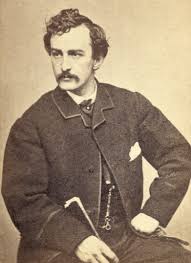
John Wilkes Booth

John Wilkes Booth

Manhunt, as the subtitle indicates, is an account of the hunt for John Wilkes Booth and the cabal of bitter, reactionary racists who murdered the United States’ greatest president, Lincoln, and tried to kill his Vice President, Andrew Johnson, and his Secretary of State, William Seward.

Swanson succeeds well in his apparent objective of writing a non-fiction thriller based on the hunt for these assassins, and appears to have developed some sympathy for his subjects, presenting in detail their considerable bravery and endurance in the aftermath of the murder. Among the conspirators was Dr Samuel Mudd, who treated Booth when he was on the run. Mudd was imprisoned as a conspirator but he and his family subsequently worked for his exoneration, saying he was only doing his duty as a doctor and had no knowledge of Booth or the conspiracy. John Ford, a Lincolnphile, even immortalised this story in one of his films, The Prisoner of Shark Island.

His name is still ...

His name is still …

Swanson argues however that Mudd was indeed part of the conspiracy and Booth’s encounter with him was no accident, but rather a rendezvous with a known sympathiser. The moral of this part of the story is that you can still say “his name is Mudd” with a clear conscience.

The book illuminates this aspect of the Civil War, often passed over or obscured in other texts by the monumental tragedy of Lincoln’s assassination. Amongst the startling details that Swanson reveals is that Booth obtained access to Lincoln’s presence merely by presenting his card: his brother was a friend of Lincoln and strong supporter of the Union so Booth was also welcomed as a friend.

Overall the book is a sobering reminder to the contemporary world that courage is not the highest of virtues but rather often facilitates some of the worst of human behaviour and can lead to some of the greatest pain and loss.

Lincoln and his Generals, by T. Harry Williams

Lincoln and his commandersThis is a fine and concise introduction to Lincoln and the course of the American Civil war. The focus, as the title indicates clearly, is on one of the major themes of the war – Lincoln’s efforts to obtain an effective commander for the Union armies, and Lincoln’s own role as chief Union strategist and Commander in Chief.

In the course of this there is some notable insight into the necessary qualities of good generals, and generalship and war-making in the context of a democratic state. Many of the wider issues of the war including the experience of slaves, emancipation, and the actual experiences of the the fighting for the ordinary soldiers are only lightly touched upon. Nevertheless this remains a fine overview of the war and a good introduction to some of its key controversies.

A Spy Among Friends: Kim Philby and the Great Betrayal, by Ben MacIntyre

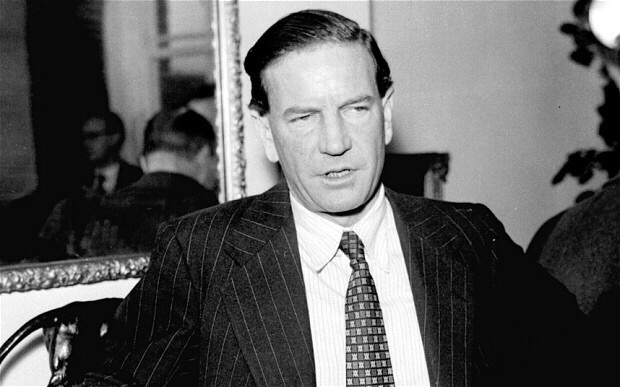
Kim Philby

Kim Philby

A Spy Among Friends is a study of the overlapping careers of three spies from the 1930s to the 60s: the MI6/KGB double agent, Kim Philby; his friend and fellow MI6 officer, Nicholas Elliot, and James Jesus Angelton, the CIA officer who befriended of Philby during the Second World War.

It is an elegantly written narrative, generally compelling, filled with anecdote (not least on some of Pope John XXIII’s resistance activities), and at times chilling, particularly regarding Philby’s betrayals to the KGB, including of German anti-Nazi resistance and of agents that he was personally running. Almost without exception these people were liquidated.

The psychology that could enable a person to commit such casual bloodshed is examined through the frame of Philby’s friendships with, and (less lethal) betrayals of Elliot, Angelton and his wives, all of whom fell for his charm, but never knew the real man.

I found Elliot, Philby’s friend, defender, and ultimately his accuser, though charming, not much more sympathetic than Philby. While loyal to his country and service his complacent class-ridden arrogance was a central feature in his presumption that his close friend Philby must be above suspicion merely because of his class and upbringing. MacIntyre’s research and a brief afterword by John le Carre, who met Elliot on a number of occasions, suggests that, while not treacherous, Elliot’s role in the final unmasking of Philby may not have been quite as honourable as he always maintained.

Overall the book is an entertaining excursion into a slice of Cold War history and a reminder of the perils of unquestioningly accepting the crass arrogance and privilege of the ruling classes.

Into that Darkness: From Mercy Killing to Mass Murder; and Albert Speer: His Battle with Truth, by Gitta Sereny

Summary: Two masterpieces of Second World War history that show the terrifyingly human face of the monstrous

Gitta Sereny’s subjects in these two seminal works are the war crimes and the industrialised genocides of the Nazis. But, as the prisms through which she explores these issues are the biographies of Franz Spangl and Albert Speer, she never loses sight, or lets the reader lose sight, of one of the most troubling truths about these, and all, atrocities: that the war criminals and monsters who perpetrate them are as human as any one of us.

Albert Speer on trial in Nuremberg

Albert Speer on trial in Nuremberg

Speer was, amongst other roles, Hitler’s armaments minister and Sereny’s biography of him is rich in detail regarding the management of Germany’s wartime economy and Speer’s exceptionally effective efforts in keeping it functioning in the face of Allied bombing, Nazi in-fighting and Hitlerian fantasy. Stangl was a provincial police officer, transferred into the Nazis’ early experiments of murder with their “mercy killing” programme, and finally “promoted” to manage the death camp at Treblinka. The two biographies therefore provide chilling insights into both the highest echelons of Nazism and the horrific consequence of the decisions taken there.

Franz Stangl in prison in Dusseldorf

Franz Stangl in prison in Dusseldorf

Sereny’s thorough research into her subjects included extensive interviews with both men. Almost of necessity she came to establish considerable sympathetic understanding with them. But she never lost sight of what they did. Her conversations in Dusseldorf prison with Stangl forced him, with devastating personal effect, to finally acknowledge what he had done. Speer, a much more intelligent man, arguably one with the potential for greatness, was altogether a more slippery character, and so much more sophisticated in evading, even to himself, similar acknowledgement of his measure of responsibility for the crimes of the Nazis. At the end of the war he had all but deluded himself into believing that the Allies would ask him to help lead in the reconstruction of a devastated Germany.

In spite of the bleakness of the books’ subjects they are not devoid of heroism: In Into That Darkness Rudy Masarek, a leader of the Treblinka uprising, stands in telling contrast to Stangl; in the case of Speer Claus von Stauffenberg, the leader of the 20 July plot against Hitler, stands in juxtaposition. Though they appear only fleetingly in the pages of these books the lives of these men, with their exceptional moral and physical courage, powerfully indict the evasions of both Stangl and Speer. These were men who came from similar backgrounds but whose moral choices were diametrically opposed to everything that Stangl and Speer came to stand for.

These are amongst the most extraordinary and important works of non-fiction of the 20th Century. They are compelling studies of the descent into evil of one ordinary man and an extraordinary one. They are powerful, elegantly written, gripping and vital for understanding how close to the abyss human beings and human society still hovers.

Thirteen Days: A memoir of the Cuban Missile Crisis, by Robert Francis Kennedy

JFK lonlinessSummary: A gripping and insightful account of leadership in the days when the world almost came to an end.

Thirteen Days is Bobby Kennedy‘s memoir of the Cuban missiles crisis. It was incomplete at the time of his assassination and yet remains an arrestingly insightful work.

Bobby played a crucial role in the Cuban missiles crisis, being one of a minority of “doves” on the “ExComm” drawn together from the highest echelons of the government and military to advise the President. It was in no small part because of Bobby’s advocacy that the “doves” on ExComm won the crucial arguments to set the US strategy in relation to the crisis.

But, while being straightforward about his role, he sought in no way to present himself as the hero of the book. Rather this role is reserved for his brother Jack, the President.

In an introduction to the book Arthur Schlesinger, Jr notes that Bobby Kennedy once commented “The 10 or 12 people who had participated in all these [ExComm] discussions were bright and energetic people. We had perhaps amongst the most able in the country and if any one of half a dozen of them were President the world would have been very likely plunged into catastrophic war.

That the world did not get plunged into such a catastrophic war is in large part a measure of the extraordinary calmness of Jack in his deliberations and, above all, his startling moral courage in being prepared to face down his military advisers who wanted to bomb Cuba and invade as first response to the discovery of the missile sites. Bobby commented on their attitude in the book, “I thought, as I listened, of the many times I had heard the military take positions which, if wrong, had the advantage that no one would be around at the end to know.” Afterwards Jack told his friend Ben Bradlee, the legendary Washington Post editor, “The first advice I’m going to give my successor is to watch the generals and to avoid the feeling that because they were military men their opinions on military matters were worth a damn”.

It’s good advice not just for a political leader dealing with the military but also for one dealing with any professional group, particularly police and security forces, and indeed for any leader dealing with those claiming “expert” knowledge. A key theme of the book is the importance of debate and disagreement in decision making, as a process of obtaining the best options to even the most horrendous challenge and avoiding the sort of “groupthink” that can lead one unquestioningly towards stupid and undesirable choices.

Reading this book as the carnage of the 2014 war in Gaza seems to have begun again, it is striking how, in spite of being faced with a genuine existential threat to their country and the world, as opposed to the substantially imaginary one posed by Hamas to Israel currently, Jack and Bobby were hugely concerned with the thought of inflicting casualties.Listening to military proposals for a sneak attack on Cuba, Bobby passed a note to his brother, “I now know how Tojo felt when he was planning Pearl Harbour.”  Both knew that bloodshed would lead to the situation spiralling out of control, and Jack and Bobby were both familiar enough with the military, and with the human consequences of war,to take this matter lightly. They knew that the lives of untold millions who had neither voted for them nor even heard of them depended on their decisions. So they weighed carefully the consequences of every choice, both immediate and long term. Jack in particular was always striving to empathise with Khrushchev’s position and to give him ways in which he also could exit the quagmire in which they found themselves. Ultimately Jack, again displaying enormous moral courage, took the considerable political risk of instructing Bobby to make a secret offer of withdrawing Nato missiles in Turkey in exchange for the Soviet withdrawal of their missiles from Cuba.

Aside from the drama of the story the book is teeming with insights on war, politics, decision making, and the moral courage that is fundamental to leadership, and filled with vivid scenes: after the crisis is passed,  Jack remains in his office is sitting at his desk writing a letter to the widow of the American pilot killed in the course of the crisis.

Arthur Schlesinger, Jr called the book a minor classic. He was right. It’s a short but extraordinary work that will bear rereading.

The Final Run, by Tommy Steele

The singer and artist Tommy Steele, who was the author of the Final Run,  told the story that sometime after the second world war he discovered that his grandfather had been one of a group of Churchill lookalikes used to disguise and decoy the movements of the real wartime prime minister – an idea famously used in Jack Higgins’ “The Eagle has landed”. Taking this as a starting point he builds a very efficient thriller to imagine how such ruses could have been used to effect a pause in the German advance on Dunkirk.

Steele displays an impressive cold-heartedness in his imagining of how such a plot might play out. The historical liberties he takes never lose sight of either the ruthless efficiency or sadism of the Nazis.

The book compares favourably to the work of, for example, Higgins – not great literature but fine entertainment: a war thriller that does exactly what it says on the tin.