Dirty Linen: The Troubles in my home place, by Martin Doyle

Summary: An outstanding portrait of the pity of war

Margaret Yeaman has never seen her grandchildren. She lost her sight on 15 March 1982 when a no-warning car bomb exploded close to her workplace in Banbridge, County Down, causing splintering glass to lacerate her face. 

Margaret’s story, of being in the “wrong place at the wrong time” is just one amongst many that Martin Doyle explores in his book, Dirty Linen. The book also takes exception to that “wrong place, wrong time,” line. So many of the people whose stories Doyle recounts were just doing their jobs, providing for family and community, or just trying to have a bit of craic. It was the paramilitaries who were in the wrong place at the wrong time for these ordinary people.

Some will still argue that atrocities such as the ones recounted in this book were necessary to advance justice in the North of Ireland. But as Margaret and people like her tell their stories of how their families were devastated by violence, these should bring shame to that notion: as if the British government was ever going to be moved to change policy by Paddies butchering Paddies on the country roads of Ireland. It’s why they introduced “Ulsterisation” to begin with.

Dirty Linen is, in part a memoir, and Doyle gives an honest accounting of his experiences coming of age amidst such carnage, including the miserable abuse he sometimes suffered as a young Catholic in that religiously mixed part of County Down. 

This book could also act as something of an introduction to the art of the North of Ireland. As literary editor of the Irish Times, Doyle is able to draw upon the work of so many writers and artists, from Seamus Heaney to F E McWilliams and Colin Davidson, to help him give voice to the depth of the human tragedy that the Troubles represented.

But, as a result of Doyle’s sensitive interviews with Margaret and people like her, his book is also an exemplary work of journalism and a deeply important contribution to understanding the history of the Troubles. It offers an unflinching portrait of the pity of war by exploring the trauma and courage of the victims of both loyalist and “republican” paramilitaries. 

Some of those victims whose stories Doyle explores also became perpetrators, or at least sympathetic to the idea of revenge. But so many more refused to become as twisted as those who mutilated them and their families. Instead. they often begged for no retaliation and strove for forgiveness, or at least toleration. Theirs are stories that are so much more heroic than anything that could ever be written about the paramilitaries who pressed the triggers or planted the bombs.  

If this was all that Doyle did, then the book would be a marvel. But his painstaking accumulation of detail across the book also builds a picture of the pervasiveness of collusion between British state forces and the loyalist Glenanne gang. Perhaps other writers and researchers have done similar work. But I have not read such a convincing indictment of the breadth of British collusion anywhere else. So, if you want to understand why the British government is so keen to stop Troubles era criminal investigations, read this book.

At a time when the Troubles seem to be giving rise to some exemplary non-fiction, Doyle’s book could well stand out as a classic. 


Brotherhood: when West Point rugby went to war, by Martin Pengelly

Summary: an important insight into American war-making

Before 9/11, Martin Pengelly, with his amateur English rugby team, played against West Point in a friendly game when they toured the UK. Pengelly’s team won. In subsequent West Point legend Pengelly’s team was described as “semi-professional”. They were not.

Rugby in West Point is something of an outsiders’ sport. So, the West Point rugby team was populated by students who, by and large, were not quite good enough to get on the American football team. Still, some disadvantages turn out to be advantages by introducing these young men to a much finer sport.

Over twenty years since his on-pitch encounter with these young men Pengelly revisits them and explores how they fared in the subsequent “9/11wars” in which they fought.

The book is an interesting study of a subculture – rugby – of a subculture – West Point, and of American officers’ experiences in twenty-first century war and counter insurgency.

It is perhaps churlish to note that there is negligible consideration of the impact of these wars on Iraqi and Afghan civilians. Pengelly was not a combatant and the politics and humanitarian consequences of US policy, whether astute or blundering, does not seem to be at the forefront of the minds of any of those whose story he is telling. So, there is little of the sort of empathy and soul searching that Tim O’Brien, for example, brought to his writings on Vietnam.

Still, it would take a heart of stone not to be moved by the waste of life, in training and in combat, that Pengelly describes his subjects enduring.

Overall, this is an elegantly written book, and an important insight into what goes into the make-up of a revered portion of American society, one that will continue to exert its influence nationally and internationally into the foreseeable future.

The Kidnapping: A hostage, a desperate manhunt and a bloody rescue that shocked Ireland, by Tommy Conlon and Ronan McGreevy

Summary: a lucid and gripping account of an important aspect of the Troubles.

On 24 November 1983, Don Tidey, a supermarket executive, was kidnapped from outside his home by a unit of the Provisional IRA. Twenty-three days later, on 16 December, he was rescued in Derrida Wood, County Leitrim, by a joint operation of the Irish Army and the Garda. In the course of the rescue the IRA unit killed two people: 23 year-old Garda recruit Gary Sheehan, and Private Patrick Kelly of the Irish Army.

The authors trace the origins of this tragedy to the early 1980s when the IRA came up with a new fundraising strategy: kidnapping for ransom. It began with the legendary racehorse, Shergar. Seemingly temperamental stallions do not submit to the same sort of intimidation techniques that the IRA found worked so well on innocent German factory managers and single mothers from Divis Flats. So, unable to keep the horse placid, they killed and disappeared the beast before moving on to vulnerable human targets. Conlon and McGreevy recount the series of kidnapping and extortion operations that followed before the abduction of Tidey.

It is sometimes easy for a Northerner like myself to forget the dreadful impact that the Troubles had upon the South. With this book the authors seek to redress this historical amnesia. Both Leitrim men, they also expose the prejudices that other parts of Ireland, with their crass ignorance of what it means to have a significant paramilitary presence in one’s community, developed against their county.

There is a palpable and justifiable thread of disgust at the paramilitaries’ attitudes and actions running through this book. At one point the authors quote John Hume who observed that many Provos seemed to regard Irish citizens who did not support their bloody campaign as lesser beings.That may well have eased their qualms about pressing triggers on people like Gary Sheehan and Paddy Kelly who were doing nothing more than trying to protect the innocent. Conlon and McGreevy also trace the devastation wreaked by the trauma of those deaths on their surviving families. Meanwhile the probable killers continue to be feted in Sinn Fein circles, and those they killed ignored.

The Kidnapping is a superb book that helps strip away any romantic hue forming around the Troubles and helps all Ireland face up to another vital piece in the totality of our history.

Killing Thatcher: the IRA, the manhunt, and the long war on the Crown, by Rory Carroll

Summary: insight on the Troubles through the prism of a gripping account of one bloody incident

Patrick Magee did not kill Thatcher when the bomb he planted in the Grand Hotel, Brighton exploded. She emerged from the wreckage with her reputation burnished by an extraordinary display of courage and self-possession for one who had just survived an assassination attempt.

Magee did kill Jeanne Shattock, Anthony Berry, Eric Taylor, Muriel Maclean and Roberta Wakeham. Most were sleeping when the bomb exploded but were not killed instantly. Instead they suffocated, terrified and alone, in the rubble that scythed through the hotel, unleashed by the explosion. Others were grievously injured, including former nurse, Margaret Tebbitt, who was left quadriplegic. More would probably have died were it not for the startling courage of the firefighters who attended the scene and broke protocol by insisting on searching for survivors before the building was declared free of explosives.

Killing Thatcher is Rory Carroll’s gripping narrative of the events leading up to this 1984 bombing and the subsequent hunt for the bombers. Its principal focus is on Magee, but it is also an account of the others, from Magee’s victims to the bomb disposal experts and cops who he came into interaction with during the course of his involvement in the IRA’s often vicious campaign in England.

Magee is in many respects a hugely impressive individual. After release from prison, in which he earned a PhD, he showed considerable moral courage in meeting and subsequently working with Anthony Berry’s amazing daughter, Jo. This initial meeting, he admitted, was the first time he realised that he had been responsible for the death of a fine person. But in spite of his apparently genuine regrets, he continues to insist that the Brighton bombing was a legitimate act of war.

Following her callous handling of the 1981 hunger strikes, Thatcher was a hate figure in much of Ireland. So, the Brighton bombing was principally an act of revenge rather than a strategic move coolly calculated to advance war aims. Justice in Ireland was instead advanced by the diplomacy of Taoiseach Garret Fitzgerald, who convinced Thatcher to sign the Anglo-Irish agreement the year after the bombing. This laid the foundations for the Good Friday Agreement of 1998.

Reading this book as thousands of women, children and men are suffocating to death in the bombed out rubble of Gaza, I imagine that, like Magee before he met Jo Berry, Netanyahu, Hamas and their cheerleaders in the British parliament and American Congress do not trouble themselves to think of the dying as fine human beings. But I doubt that any of them would have the integrity of the likes of Patrick Magee to face their victims, or of Thatcher to put in the groundwork for a political solution, in spite of personal feelings.

So, for all that is repellent about British and IRA policy and actions during the Troubles, Magee and Thatcher appear now as moral paragons by comparison with many contemporary political figures with their weasel words in defence of war crimes.

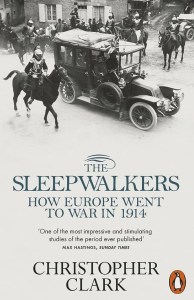
The Sleepwalkers: how Europe went to war in 1914, by Christopher Clark

Summary: So… it was everyone’s fault… but mostly Serbia.

The historian AJP Taylor in his celebrated BBC lectures, How Wars Begin, stated that everyone knows why the Second World War began, but not when, and everyone knows when the First World War began, but not why.

The Sleepwalkers, Christopher Clark’s detailed examination of the origins of the First World War clears up some of that “why” question, but not in any simple way. He describes an interconnected system of “great” European powers – and Serbia – who all took for granted their right to interfere in the affairs of other nations and which developed enormously complex systems of alliances and interests to allow them to do so.

Bizarre imperial attitudes to other countries were not the only strange notions to infest the chancelleries of Europe pre-1914. Many of the denizens of these corridors of power talked seriously of the idea of “preventative war”, which remains, to put it crudely, as much a contradiction in terms as the idea of fucking for virginity.

Hence at the outset of the 20th Century, Europe represented not so much a house of cards destined to collapse sooner rather than later, but a tangle of explosive devices being randomly hit with hammers by supercilious poshos with Napoleonic delusions.

The spark that finally triggered to conflagration was, of course, the assassination of Archduke Franz Ferdinand and his wife, Sophie, in Sarajevo, by the young Serbian nationalist Gavrilo Principe. This was done at the behest of elements in the Serbian government which feared Franz Ferdinand’s intent to increase Slavic representation in the Austro-Hungarian empire. This, Belgrade felt, threatened their dream of a greater Serbia. Franz Ferdinand’s assassination also removed one of the most pacific members of the Austro-Hungarian government and made their impetus towards a war of vengeance all the more assured. From the rubble, of course, Yugoslavia was fashioned, so maybe some Serbs felt the price was worth paying. And didn’t that turn out well.

Some of the dangerously fanciful notions that sparked the cataclysm may have dissipated from Europe, particularly since the rise of the European Union, which was fashioned to make war “not only unthinkable but materially impossible.” However, Clark notes that other dangerous impulses are still at play. Referencing the Euro crisis of 2009/10, Clark describes how, just as in 1914, some countries were prepared in negotiations to use the risk of catastrophic failure for all to advance local interests for some. Similar short-term, selfish interests threaten progress on the climate crisis, which may yet dwarf the carnage of the First World War.

So, a bleak book, but an engaging and thought provoking one, snappily written and frequently gripping.

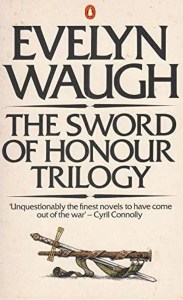
Sword of Honour, by Evelyn Waugh (Men at Arms; Officers and Gentlemen; Unconditional Surrender)

Summary: Waugh’s war, through a glass slightly smudged

In 1939 Guy Crouchback returns to Britain from Italy, where he has been nursing a broken heart since his wife, Virginia, left him. His intention is to play some part in the looming war against the totalitarian alliance of Nazi Germany and the Soviet Union. As he prepares to depart Italy he prays at the grave of a fallen knight, known locally as the “English Saint”, who on his way to Palestine to fight in the Crusades, was killed in a local squabble between Italian warlords.

Guy hopes that his war will not be as abject a failure as that. As it transpires his career substantially replicates that of Evelyn Waugh himself: involvement in a dangerous and confused raid on Vichy France at Dakar in Senegal; experience of retreat and defeat in Crete; years of desk jobs in Britain before posting as a liaison officer to the partisans in Yugoslavia.

Along the way he encounters an array of colourful comic characters including Richie Hook, a psychopathic old officer; Trimmer, a charlatan and chancer who the army decide would make a useful national hero; and, almost inevitably, Virginia, his ex-wife, still beautiful but falling on increasingly hard times.

Waugh’s account of all of this is frequently extremely funny, but always shot through with a profound melancholy, as the compromises of war and realpolitik lead to a growing realisation that this is not the glorious crusade that Guy had hoped for. But then neither were the Crusades.

Throughout it all though, Guy remains a sympathetic, almost tragic, protagonist. His courage is rarely acknowledged and never rewarded with responsibility. Nevertheless, his Catholic faith, as his father reminds him, is about something eternal. This he tries to stay true to it by being a decent man even though, as he discovers, he lives in a world in which decency, as easily as callousness, is something that can get people killed.

Waugh’s Sword of Honour trilogy is not so much about the horror of war as of the disillusionment of politics. It is an exquisite work: a classic for a reason.

The Restless Republic, by Anna Keay

Summary: a fine and elegantly written, though overwhelmingly Anglo-centric, account of Cromwell’s dictatorship

In the 2001 film, Rat Race, one family participating in the race stumble upon a “Barbie Museum”. It turns out this does not house a collection of the beloved children’s toy, but rather is a homage to the Nazi war criminal, Klaus Barbie. As one of the deranged guides tell them, “People don’t remember just what a wonderful ballroom dancer he was.”

I thought of that movie while reading Anna Keay’s rather affectionate portrait of Oliver Cromwell in the Restless Republic. He may have overseen the massacres of thousands of people, soldiers and civilians alike, children, women and men, in his racist campaigning in Ireland – something that is mentioned rather than described in any detail in this book. But “Oliver” loved music and could be moved to tears at the accomplishments of his beloved children.

The planned wholesale theft of Irish land by the Cromwellian government and the planned complete ethnic cleansing of Catholics from eastern Ireland required remarkable technical organisation and unprecedented accomplishments in land surveying. This Keay does describe in admiring detail. But eventually, before it could reach its genocidal climax, this “ugly episode in Irish history” was brought to an end. Obviously, as Irish history, it is not something that the English need feel too much responsibility for.

Keay choses to tell the story of the short-lived English republic through the eyes of a range of characters, almost exclusively English, but including both Royalist and Parliamentarian perspectives. It is an imaginative approach and engagingly done, with a strong narrative drive. For example, towards the end, her account of Monck and Fairfax’s machinations to bring about the restoration of the monarchy is quite gripping.

Overall, the Restless Republic is an illuminating and elegantly written work of history. But, appropriate to the theocratic monstrosity of which Keay writes, and to the spirit of Brexit Britain too, I suppose, it is written with negligible empathy for the aspirations and experiences of those non-English people who bore, and continue to bear, the brunt of the English Parliament’s ignorance and crass prejudices.

Caesar, by JFC Fuller

Summary: a concise biography, particularly insightful on the military aspects of Caesar’s career.

JFC Fuller was a military theorist, highly influential, in particular, on the Wehrmacht’s use of armoured warfare. However, as a man with pronounced fascist leanings he was excluded from allied military command during the Second World War.

So, instead he wrote.

Among his oeuvre then is this biography of Caesar. Perhaps Fuller was drawn to the subject because of his far-Right leanings: Mussolini also loved Caesar and thought himself his bloated successor.

Given Fuller’s professional interests there is a strong focus on the military aspects of Caesar’s career. But additional entertainment is to be had from Fuller’s waspish sense of humour: how terrible it would be, Fuller muses, if some newly discovered piece of papyrus were to suggest that one of history’s most erotic scenes – the delivery of Cleopatra to Caesar’s bedchamber in a laundry basket – was a myth? Or, discussing Caesar’s prospects in his unrealised plans to invade Parthia, Fuller reckons that Caesar would likely have been routed by the arrows of the Parthians, just as Crassus had been earlier, and Antony would be later: So the Ides of March was probably the luckiest thing that could have happened to Caesar: at least his military reputation survived.

There is an interesting duality to Caesar’s military career: throughout his life, from the Cataline conspiracy to the civil wars, Caesar showed a marked reluctance to shed Roman blood. By contrast Caesar’s conduct of the Gallic Wars, and his later campaigns in Spain, were practically genocidal in their ferocity, and they provided the slaves whose trafficking ensured Caesar’s fortune. For Caesar, it seems, like the British and French imperialists of later centuries, war was merely the logical extension of racism.

A sub theme in this book is Caesar’s relationship with Decimus Brutus, cousin of the more famous, Marcus. It was Decimus Brutus, who convinced Caesar to attend the Senate on the Ides of March. He has been a close lieutenant to Caesar during the Gallic and Civil Wars, and Caesar adopted him alongside Octavian in his will. And yet as every reader of Shakespeare will know Decimus also put a knife into Caesar on the Ides. So, it seems likely, as Robert Harris suggested in his Cicero novels, that Caesar’s last, plaintive cry, “You too, my son?” related to Decimus rather than Marcus.

Overall, not as good as Adrian Goldsworthy’s account of Caesar’s life, but not without merit.

My Father’s House, by Joseph O’Connor

Summary: an outstanding historical thriller of Europeans united against the Nazis

Philippe Sands once wrote a very fine book on the origins of the international law on crimes against humanity and genocide, East-West Street. This does not in my mind absolve him of writing The Ratline: a pointless, rambling wastrel of a book, undertaken, it seems at the behest of the son of a Nazi, who believed his father was, nevertheless, a good man.

He wasn’t.

The Ratline in question in the book’s title was a bit of a Godot character. It never really shows up. The Nazi in question could not stump up the cash to pay the venal and corrupt Vatican officials who were offering Nazis a way of escape from the allies’ dragnet to South America and Southern Africa.

Despite his high profile role in the Vatican Hugh O’Flaherty doesn’t show up in Sands’ Ratline either. Not that this committed anti-Nazi Irishman would have had anything to do with it. But he is an altogether more interesting character, with a much more interesting story to tell of a single night than Sands found to tell in the years he covers before, during and after the war in The Ratline.

O’Flaherty was the head of one of the key Italian resistance networks of the Second World War, run vastly more effectively and altruistically out of the Vatican than the later Ratline. With his pan-European group of Irish, Italian, Dutch and British friends he kept thousands of Jews and escaped prisoners safe as the Gestapo grip on the city tightened.

My Father’s House is a wonderful historical thriller that, by focussing on a single mission by the group introduces us to its various personalities. These take turns narrating the events of the mission. This is an elegant and compelling way to explain to the readers their previous lives before the horrors of the Nazi occupation forced heroism upon them. One scene, in which the British ambassador to Rome, a member of O’Flaherty’s group, encounters O’Flaherty and his deputy, British officer Sam Derry, in the Vatican gardens is particularly chilling. Derry is rehearsing the false names and addresses he will give up under torture if captured.

It is a wholly gripping and deeply moving story of love and friendship in the face of adversity, and asserts a position for O’Flaherty’s alongside Casement as one of the great Irish humanitarians of the Twentieth Century.

Hitler, by Ian Kershaw

Summary: an exceptional work of historical biography

With the instincts of a high-stakes gambler, and a remarkable gift for public speaking – but with absolutely no other discernible gifts or redeeming qualities – Hitler managed in the chaotic aftermath of the First World War to parlay his modest skills into the dictatorship of Germany, and then from that office to unleash the most cataclysmic conflict that Europe has yet seen.

Kershaw’s account of this career was widely praised when first published and rightly so. It remains a gripping, elegantly written portrait of the pathetic monster and a succinct account of much of the suffering he caused.

For me the piece de resistance of this remarkable book is, appropriately enough, the account of Operation Valkyrie, Staffenberg’s doomed attempt to overthrow the monster and grasp some flicker of redemption for Germany. The chapter is as gripping as the best thriller and a reminder that, in the midst of the horror, heroism was still possible.

Like so many of his minions, Hitler was a study in the banality of evil. But, as we have already seen in the 21st Century, sad, narcissistic little men with delusions of grandeur can still wreak terrible devastation.

Consequently this book deserves continued study, so that humanity never completely forgets that.