The setting of the sun on the British Empire: Alex Von Tunzelmann’s Indian Summer

imageSummary: a lucid and witty addition to the literature on the British Empire, its greed, incompetence and atrocities… though Edwina and Dickie were decent enough old sticks

The sub-title of this book, “The secret history of the end of an empire” is probably a bit misleading. It seems to derive from the author’s very sympathetic exploration of the not very secret menage à trois that developed between Edwina Mountbatten, Nehru, and Edwina’s husband Louis, the last Viceroy. Rather than a secret history this is a fine narrative history of the coming of Indian and Pakistani independence and the bloody aftermath. Nehru and Edwina Mountbatten are the author’s particular heroes, though she also seems to have a healthy respect for Jinnah and Gandhi, and a soft spot for Lord Louis “Dickie” Mountbatten who, for all his limitations, comes across as a very likeable and fundamentally decent chap.

There is much else to admire in the book, not least the author’s portrayal of the true awfulness of the carnage that erupted with partition and her assessment of controversies, such as the origins of the Kashmir conflict, I found fair-minded and careful. Personally I was left with a much more negative opinion of Gandhi as a result of reading this book: He was unquestionably a brave and principled man of considerable moral courage, but his calling a halt to the campaign for the British to quit India in the 1920s seemed to have meant the loss of an opportunity for Indian independence unsullied by partition, and the holocaust that entailed. Others may prefer to emphasize the failures of twentieth century British policy towards India, up to and including the management of their departure. However given Gandhi’s retrogressive position on caste it is probably time for a more sober reassessment of the man’s life and achievements.

As a bonus the author also has a lovely gift for humour and the narrative is peppered with some excellent jokes that emerge naturally from her account, rather than being shoe-horned into it. The result is an elegantly written and erudrite popular history of run up to Indian independence and the bloody chaos of the sub-continent’s partitioning.

“Its a midnight run for crissake!”… (not)

I remember watching the Robert DeNiro/Charles Grodin movie Midnight Run when it first came out and looking at my watch after about an hour and a half and thinking: “Fantastic! There is another hour to go!”

I had a similar reaction after about 200 pages of this book: “Great! There is another 100 pages to go!”

Screwed is the second in Eoin Colfer’s series about the misadventures of ex-Irish Army sergeant Daniel McEvoy on the fringes of the New Jersey criminal underworld. In this novel Dan is required to deliver a package to a criminal in New York in order to part-pay a debt to another local crime lord. Nobody says “Its a midnight run, for crissake!” but you know, because this is Dan’s world, that the rest of the book is going to chart a couple of days for Dan similarly fraught to the ones Grodin and DeNiro endured all those years ago. Indeed, nothing is ever as straightforward as Dan would like it to be and the novel charts Dan’s subsequent antics hoping from frying pans to fires and back again.

The series seems to be finding its feet with this novel: its funny, exciting, and with a welcome reduction on some of the wise cracking of the previous novel even if Dan does tend rather too often to “with one bound” free himself from some terrifying situations. Still the novel is knowing enough to forgive this and leaves one looking forward to the next installment.

Challenges and lessons learnt in combating contemporary forms of slavery: my address to slavery side event to UN Human Rights Council, 13 Sept 2013

First of all it is as always a pleasure and privilege to be here. And I would like to take the opportunity to congratulate Gulnara Shahinian on her tenure as Special Rapporteur on Slavery. In her term Gulnara has raised the profile of slavery in the UN and made crucial interventions on on particularly reprehensible forms of slavery such as bonded labour, domestic servitude and servile marriage. Her interventions have helped move forward understanding of and action on these issues.

I am also grateful to have the opportunity to pay tribute directly to the UK ambassador for the role of the UK in establishing this mandate. In doing this the UK keeps faith with the historical tradition of British leadership in the international struggle against slavery since the time of the great British abolitionists such as Clarkson and Equiano.

Anti-Slavery International also can trace our origin back to the end of the 18th Century when Thomas Clarkson was my most illustrious predecessor. As the oldest international human rights organization in the world we have a longer, historical, perspective on the issue than most and also a broader, geographical perspective than many.

So in considering the challenges in combating contemporary forms of slavery there are a couple of matters we would particularly highlight.

First through the history of the struggle against slavery there has been an erroneous belief in “silver bullets”. That is there has been a belief that we just need one particular thing to end the problem, whether that is ending the trans-Atlantic Slave Trade or making slavery itself illegal. Each of these achievements has confined slavery further and further to the margins of society, but none of them have completely managed to eradicate slavery in any single country let alone the world. This is simply because slavery evolves faster than the systems hitherto established to eradicate it. What is needed is a more dynamic and permanent set of processes that will aim to progressively reduce the scope of slavery and contribute to the empowerment of those vulnerable to slavery.

Slavery is a diverse matter. The term slavery may describe situations as varied as that of a young woman in domestic servitude in a diplomatic household in London, to a family born into chattel slavery in Mauritania, to the young women and girls who are kept in forced labour in India,  the world’s largest democracy, to produce garments for the high streets of Europe and North America.

Each of these diverse situations requires a different set of response to ameliorate it.

But if we look more closely at these various forms of slavery as we have in Anti-Slavery over the years through both qualitative research and programmatic work we can see that slavery emerges at the conjunction of three broad factors: individual vulnerability usually this is poverty but it can simply be about physical weakness; social exclusion; and failure of government and the rule of law. 

The issue of social exclusion and with it discrimination is a fundamental one in slavery: In Latin America today many in forced labour are indigenous people. In Western Europe most people in slavery are migrants workers. In South Asia most people in slavery are Dalits or from other scheduled castes or minority groups.

This is important for a variety of reasons, not least that it inhibits the issue from becoming a political one: if this is being inflicted upon groups and individuals who the wider society simply does not like, then that wider community is more likely to tolerate the abuses if they see them and not raise their voice to demand that governments do their jobs to stop the problem.

And slavery is very much a failure of government and the rule of law. Child labourers enslaved in the garment workshops of Delhi tell how when the workshop owners fail to pay bribes to the police, the police come, arrest the children and hold them hostage, stopping work, until the bribes are paid. The appalling lack of capacity of Indian courts exacerbates further these factors. Generally Indian courts rule progressively when slavery cases come to trial. But the backlog of cases in those courts means that few do come to trial, effectively making a nonsense of the promises of that country’s laws and constitution.

So a central  front in the struggle to end slavery must relate to building the capacity of states to effect rule of law. There must be sufficient judges properly trained in human rights in general and in anti-slavery rights in particular to ensure that rule of law pertains within the states borders for all its citizens. And beyond those borders states should ensure that they deploy labour attaches to every country that their citizens travel to for work to press for the respecting of their rights and the building of the rule of law where their citizens seek decent work.

Of course there remains a huge lacuna with regards to international rule of law and this is the  question of how, in this globalising political economy, international businesses and individual business executives can be held to account on human rights issues in their supply chains. This is a central requirement in the struggle against contemporary slavery, particularly as they extend their operations into countries where extant evidence shows slavery is rife and regularly pollutes business supply chains.

The UK just last week became the first country to publish an action plan on the Ruggie principles. We would urge other Governments to follow this lead, and to introduce extra-territorial legislation to establish legal accountability of international business entities and their executives in relation to slavery in their supply chains. If history shows us one thing it is that a request for voluntary initiatives to respond to systemic abuses such as slavery do little to dent the system. What is needed is a change in the system such as that which the UK has pioneered on bribery.

The second major challenge that I wanted to consider was the comforting myth that slavery is a thing of the past. Such a belief is perhaps forgivable for the mass of ordinary people who live their lives beyond the challenges of reducing poverty and advancing human rights. But this myth is bought into by the mass of major humanitarian and development actors and here it is unacceptable because it threatens to fatally undermine the stated aspirations of those very actors. As development and anti-poverty work is currently practiced it is blind to the continuing atrocity of a minimum of 21 million people in slavery. Hence development practices often threaten to either absolutely or relatively worsen the situations of those in slavery. For example in 2005 during the west African famine our colleagues in the  organization Timidria noticed that slaves were being used in food for work programmes: they were being sent to these schemes by their masters who would then confiscate the ration card they received for their labour. In other words an important and well meaning humanitarian programme was contributing to the absolute worsening of their lives.

This is not an isolated case. Hence the imperative of reducing slavery needs to become a central focus of the entire international development sector. This can be obtained by two principle means. First slavery eradication must be made a post 2015 development goal recognising the fundamental constraint that slavery is on poverty reduction as well as the continuing human rights atrocity that it is. Second, and to advance this development goal, all aid actors must be required to state how their programmes address the challenges of slavery and non-gender based discrimination in their operations. It should be an acceptable response to say that it will have no impact, some programmes will necessarily respond to other priorities. But the requirement should be that at least they consider this matter in the same way as they are now rightly required to consider gender in programming.

Slavery is a human institution and like all human institutions it can be changed by human action. But we must stop just tinkering at its edges and instead aim to destroy it utterly. 

Citizen philosophers and a dimwit go to war for Old Ireland: my review of Insurrection by Liam O’Flaherty

imageLiam O’Flaherty’s 1950 novel is an account of a small group of rebels progress through Easter Week 1916, starting with the storming of the General Post Office, through an action clearly based on the intense fighting around Mount Street Bridge, to the final hours around the GPO leading up to the surrender.

As in his books Skerrit and The Informer, O’Flaherty’s principle protagonist is a pretty dim one, in this case a Connemara man Bartley Madden, who is transformed, though not intellectually, by his experiences during the novel. How much you enjoy having a Stage Irishman at the centre of the novel you are reading is probably a matter of personal taste, but I could have done without it. Such a device seems to have been chosen by O’Flaherty in order to explore his political and philosophical ideas, and it is these more than the fighting that are central to his concerns in this novel.

And, unfortunately this makes for a rather unbelievable and clumsy novel. Pages are taken up with philosophical and cod-philosophical discourse. Perhaps this is how soldiers, most particularly citizen-soldiers, spend their time in battle. But even if it rings true I found many of their conversations uninteresting and the view of O’Flaherty, who had been a combatant in both the first world war and the struggles around Irish independence, bleak.

Those who know a little about the 1916 rising will recognise that O’Flaherty is generally faithful to the course of events and the geography of Dublin. However if one is searching for a gripping introduction to the 1916 rebellion, Charles Townsend’s historical account is both more informative and, for me, much more exciting.

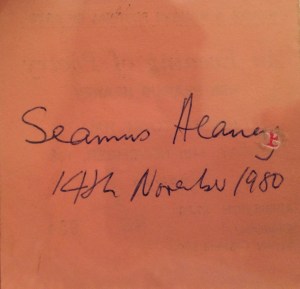
Seamus Heaney

imageI remember sitting in the back of Newry Town Hall in November 1980 when Seamus Heaney came to give a poetry reading. It was a revelation to my teenage self who had not once been out of the island of Ireland at that point.

Heaney represented something that was identifiably Irish in his reflections on life, the countryside and the horrors of the Troubles. But he was also a voice that refused to be provincial showing how we shared the same hopes and tragedies that ordinary people from England to Greece, Italy and America had suffered over the centuries.

The universality of that voice is one of the reasons that his death has so resonated across the world. His poetry spoke to people in their diverse individual lives.

But it was also clearly the voice of one of the world’s great gentlemen, someone whose graciousness was evident in even the most cursory meetings.

imageThe world has been enriched by his life’s work. But that must be little consolation to his wife and family now. I am sure the country’s hearts go out to them in their grieving.

The world is a bit smaller without him, but his poetry, even before he wrote the words himself, helped inspire many, myself included, to try to do a little bit to encourage that “longed-for tidal wave of justice” to “rise up, and [make] hope and history rhyme.”

A Second Century Karadzic: My review of Frank McLynn’s Marcus Aurelius


 I was looking forward to this book having enjoyed Frank McLynn’s previous superb joint biography of Villa and Zapata. However while the focus of the Villa and Zapata study was on explaining the significance of the two men in the context of their times and places, in this instance Frank McLynn attempts to argue for the significance of Marcus to all ages.

This leads to two problems with the book. On one hand a tendency to compare Marcus with later leaders which seems a bit anachronistic. Second, despite estabilishing Marcus’ responsibility for a ferocious persecution of Christians during his reign, which included many deliberately sadistic executions in contravention of Roman law, and despite Marcus’ genocidal tendencies in his wars against the German tribes, the author is determined to convince the reader of Marcus’s inate humaneness and philosophical significance.

Thought is important as the origin of action. But no matter how novel or insightful Marcus’s philosophy may be, something that is a central concern of this book, it does not absolve transgressions. And judged by his actions Marcus was a ruthless and bloody man who, in addition to his personal crimes, bequeathed the Roman empire its worst emperor, his son Commodus. Consequently McLynn’s argument of the importance of Marcus as one of the great people of all time seems overstretched and internally contradictory. As I read the book the figure I was most reminded of was not Churchill, Grant or Smuts, who McLynn discusses, but rather the Bosnian Serb war criminal Radovan Karadzic – a learned but pretentious man who showed his true face as a bloody warlord and debased his learning in war crimes and the persecution of minorities.

Overall the book feels like it could have done with a more robust editing, both to challenge the sort of fundamental problems suggested above, but also to discipline McLynn’s language and tendencies to show off his own erudition: for his next book Frank McLynn should be reminded that less is more.

Nice guys don’t always come last: Doris Kearns Goodwin’s Team of Rivals

 Since its publication Doris Kearns Goodwin’s biography of Lincoln has rightly become regarded as a modern classic. It is an exquisitely written account of Lincoln’s life from his birth in poverty in Kentucky, through a period in child slavery (by the modern definition of that human rights abuse), to self education and success as a lawyer, politician and President during the worst constitutional crisis in US history, to his death in the Petersen boarding house in Washington DC.

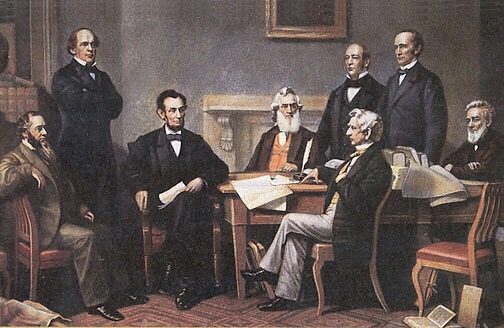
Tolstoy described Lincoln as a “humanitarian as broad as the world” and Kearns Goodwin’s approach to demonstrating the truth of this judgement is to focus on the relationships between Lincoln and his cabinet ministers, particularly Seward, his Secretary of State, Stanton his Secretary of War, Chase his Treasury Secretary, and to a lesser extent Welles his Navy Secretary, Bates his Attorney General and Blair his Postmaster General. Seward, Chase, and Bates were Lincoln’s principle rivals for the Republican nomination in 1860 and it was unprecedented for a President to bring such rivals into his “political family” as Lincoln did. But, such was the crisis that the nation was facing with the threat of secession from the slave states in response to the election of even a “moderate” anti-slavery candidate such as Lincoln, Lincoln felt that he had to have the most capable men for his cabinet. That some of them, particularly Chase, felt that Lincoln was an unworthy candidate and unqualified to be President added to the challenge that Lincoln faced.

Lincoln’s genius as a visionary, writer and speaker are well understood and well demonstrated in this biography. The book details his evolving thinking on the issue of slavery from a “moderate” anti-slavery position to an increasingly radical one as a result of contact with the anti-slavery struggle itself and with the likes of Fredrick Douglass and the ordinary black soldiers who were risking their lives to defend the Union: “There have been men base enough to propose to me to return to slavery the black warriors of Port Hudson and Olustee, and thus win the respect of the masters they fought. Should I do so, I should deserve to be damned in time and eternity”, he said at one stage.

In addition Kearns Goodwin book illustrates Lincoln’s managerial genius, arguing convincingly that it emerged from his enormous decency and magnanimity, and that it was fundamental in ensuring that such a disparate group as his cabinet acted together in the national interest in time of an unprecedented national crisis.

Lincoln’s lovely gift of humour and intense like-ability shine through the biography and consequently the devastating tragedy of his assassination still resonates down the centuries. This book is a fitting tribute to the greatest figure of the 19th century and one of the greatest figures of all world history.

“Stop and we’ll fight them”: Collins’ tactics at Beal na mBlath

Beal na mBlath

Beal na mBlath

Summary: Collins’ response to the Beal na mBlath attack may have been more astute than he is usually given credit for. 

Professor Joe Lee in his peerless work “Ireland, 1912- 1985: Politics and Society” passes a rather brutal judgement on Michael Collins last and fatal tour of Cork in 1922: that in embarking on it Collins was behaving like a “cowboy” rather than as the head of government that he had become following the death of Arthur Griffith.

This journey will always be shrouded in controversy. Coogan provides some evidence that suggests that he had a peace initiative in mind. Others, drawing I believe on testimony from Desmond Fitzgerald, argue that Collins was seeking to secure funds from War of Independence days, which, if they fell into anti-treaty hands, could have spelt out a truly protracted Civil War.

However whatever the justification or otherwise of the tour of Cork Collins has I think been unfairly criticised, not least by Emmet Dalton, a senior Free State general and his touring car companion, for his decision to halt his convoy in Beal na mBlath once he came under fire rather than try to run the ambush.

Dalton was a decent, brave and shrewd man, clearly devastated by Collins death, which, most ignobly, several of the attacking party tried to blame him for in succeeding years[1].  Perhaps some of this clouded his subsequent judgement of the events of that day.

Dalton was an experienced soldier from the battlefields of France in the First World War. He also fought in the 1916 Rebellion – on the side of the British. After the First World War he joined the IRA and fought in the independence war in Dublin, perhaps most notably in the effort to break Sean McEoin out of Mountjoy prison. In the Civil War he was instrumental in the suppression of anti-treaty forces in Dublin and the planning of taking Cork from the sea which led to the anti-treaty collapse in Munster.

By any measure Dalton had vastly more combat experience than Collins whose principal experience of battle before Beal na mBlath was Dublin during Easter Week 1916. However Dalton probably had less experience of the sort of guerrilla operations conceived by Collins and Richard Mulcahy during their time in prison in Frongoch and executed by them in their respective roles as Director of Organisation and Chief of Staff of the IRA.

One of the principle trainers of volunteers in the early days of the independence struggle was Dick McKee, Collins’ close friend. The sort of tactics they espoused were outlined by the likes of Ernie O’Malley and Tom Barry in their memoirs of the period.

At Beal na mBlath, using tactics typical of the War of Independence, the road was blocked with a brewer’s dray and the road strewn with broken bottles[2]. A mine was also set in the road and Coogan notes that Tom Hales, who commanded the anti-treaty unit, only lifted this a few minutes before Collins’ convoy arrived.

It is not credible to presume that Collins had no knowledge of the sort of tactics that McKee was training or that Tom Hales, his pre-Civil War friend, would typically employ. In other words he must have believed that keeping moving towards the road block at Beal na mBlath would put the convoy in greater danger than halting and using the superior firepower of the convoy’s armoured car to drive off the attackers and buy them space to clear the roadblocks.

The choice cost him his life, but perhaps his life would have been lost anyway along with several of his party had he followed Dalton’s advice and proceeded through the ambush under fire and with the tyres of the vehicles shredded.

Conclusions

Collins remains a compelling historical figure in my view not just because of his historical achievements but also because he was something rare in military leaders. Like, for example, General Bill Slim of the British 14th Army in Burma during the Second World War, or the US Civil War Generals George Thomas and Joshua Chamberlain, he jumps from the pages of history books as a decent and generous human being, and as such his loss still resonates. But, in spite of some impressive scholarship in recent years, his career still, perhaps, has some secrets to give up.


[1] See “The Shadow of Beal na mBlath”

[2] See the documentary “Imfamous Assassinations: The assassination of Michael Collins”, by Nugus/Martin Productions Ltd for BBC Worldwide Ltd. This contains interviews with survivors of Collins convoy describing the nature of the roadblock.

The (most senior) Spy in the Castle? the role of Sir James McMahon in Collins intelligence operation

In his magisterial biography of Collins Tim Pat Coogan tells the story about how one day in late 1918 or early 1919, Collins’ cousin Nancy O’Brien, then an employee of the Post Office, was summoned to the office of Sir James MacMahon. MacMahon had himself been taken from the Post Office and made Under-Secretary of State for Ireland, thus becoming the most senior Catholic civil servant in the Castle. Coogan records how MacMahon told Nancy that, “in view of the worsening situation it was imperative that the Castle’s most secret coded messages be in safe hands and that he was putting her in charge of handling these messages for him! Collins first reaction on hearing of his cousin’s new job was to exclaim, ‘In the name of Jasus how did these people ever get an empire?”[1]  (p.82)

It is an amusing anecdote about an apparent British blunder putting some of the most secret British military communications into the hands of one of Collins’s most trusted agents.  However the presumption of this as a blunder may be misconceived. Because, if you are a patriotic Irish person in the service of the BritishState, how else do you change sides in time of war?

T Ryle Dwyer describes how Ned Broy achieved just such a change of sides at the beginning of the War of Independence, when such a manoeuvre, even an honestly intended one – and there were many which were not – could result in you getting shot.

Broy, a confidential typist in the Detective Division at Great Brunswick Street was assigned “to type up the lists of Sinn Fein members who the crown police intended to round up… He gave a copy of the list to his cousin, Patrick Tracy… Tracy passed on the complete list to Harry O’Hanrahan… who’s brother, Michael, was one of the leaders executed for the Easter Rebellion”.[2]

Here it is clear that Broy made the switch which led to him becoming one of Collins most valued agents, by making an oblique approach to the Irish authorities with high quality intelligence through mutually trusted channels. It appears a strong possibility to me that MacMahon was doing the same thing.

The few references to MacMahon in the Bureau of Military History Archives show him to have been a man with extensive contacts in, and strong sympathies with, the nationalist community. A statement by Monsignor Curran to the Bureau[3] on Sean T O’Kelly’s efforts to obtain a passport to attend the Paris Peace Conference notes that it was almost certainly MacMahon who advised the aspirant Irish delegate that the British military were delaying the issuance of his passport. Another account by Kevin Barry’s sister describes that MacMahon contacted their mother on the eve of execution advising her to appeal directly to King George V for mercy – something she refused to do because she felt it would have lost the sympathy of the republican movement[4].

These accounts are suggestive of a man who had significant contacts in the nationalist community, and was highly knowledgeable of who was who in that community. Hence it seems unlikely that he would blunder thoughtlessly into handing British military secrets over to a person who, particularly in the relatively small community of the Post Office and in the aftermath of 1916 must have been well known to be a second cousin and close friend of Michael Collins.

Nancy O’Brien told her son that in the conversation MacMahon told her that he had made enquiries about her to find out if she could be trusted[5]. On the face of it, viewing the matter as a blunder one might presume that he had made enquiries of her in the civil service and heard only good things about her. Or he may, one Sunday morning after Mass in Blackrock, have buttonholed a person he knew well from their membership of the same confraternity of St Vincent DePaul, a certain Eamon deValera[6], and asked him about people in the civil service that Sinn Fein trusted, who might help him to prove where his true allegiance lay?

George Chester Duggan, Assistant to the Under-Secretary for Ireland while MacMahon was Under-Secretary noted that during the War of Independence period, “James MacMahon … had become almost a figurehead at this juncture for being a Roman Catholic and a friend of some members of the Hierarchy[;] he was regarded by [Assistant Under Secretary Sir John] Taylor as suspect, a person to be disregarded where questions of policy arose and policy affected not only the criminal law but matters of finance.”[7]

But distrust by others is not positive evidence of disloyalty, and primary evidence in support of the theory of MacMahon as an active agent is considerably thinner than that of him as a sympathetic nationalist in senior Castle employ. Probably the strongest supportive evidence is a statement given by Colonel Dan Bryan to the Irish Bureau of Military History[8]. Col Bryan noted that

“In 1921 I was acting and frequently Assistant I[ntelligence] O[fficer] of the 4th Battalion, Dublin Brigade. James Dwyer of Rathmines, who became a Deputy [in Dail Eireann] some time about this period, was then the most prominent and active person in Sinn Féin and other civil activities, not merely in Rathmines, but in large areas of County Dublin.

At the same time he was a member of the Volunteers and was I.O.[Intelligence Officer] of “G” Company, 4th Battalion… In addition, however, he had special sources of intelligence in wider fields, such as the political, and in connection with those he dealt directly with Director of Intelligence – Michael Collins.

I was usually aware of his special activities in this respect but did not bother about the details. Some time, I should say in the late Spring or early Summer of 1921, he showed me at least one copy of a report which he was sending to the Director of Intelligence [Collins] on a discussion he had had with Sir James McMahon, the then Under-Secretary for Ireland. Strangely enough, the only item in this report that I can now recollect was one on Sir Henry Robinson, the then British Chief of Local Government in Ireland, which was to the effect that McMahon regretted – having to admit that Robinson, whom he previously regarded as a decent man, had now gone completely over to the side of the extreme military clique or crowd in the Castle. I assume, but do not recollect, that the report generally dealt with information given by McMahon on the political condition of the British Government in Ireland and related subjects.

I have a very definite, but not an absolute recollection that Dwyer had at least two interviews with McMahon. I do not know how the contact between Dwyer and McMahon was made but Dwyer and all his family had been in Blackrock College where McMahon had been educated. This may have provided some contact.”

The only other suggestion of MacMahon as an agent that I could find in the Bureau of Military History records was a mention by Michael McDunphy, himself from 1947 a Director of the Bureau[9]. McDunphy describes meeting Collins for the first time in May 1921 to convey a message to him from a certain Brother Joachim, a lay brother of the Dominican Order. Joachim had “learned from the Hon. James MacMahon … that the British Government were about to make final overtures for peace, with the accompanying threat that if they were not succ[essful] they would proceed ruthlessly to destroy the I.R.A. and the country with them.

“I brought Brother Joachim’s news to Michael Collins… [He] listened to my message, and I gathered that the news did not come to him as a surprise. His comment on James MacMahon was pithy-” that white-livered coward”!”

This account along with Dan Bryan’s and Nancy O’Bryan’s recollection begins to suggest a pattern of contacts between MacMahon and Collins through mutually trusted contacts. The substance of the contacts seems to have been in the main political intelligence, though Nancy O’Brien’s account suggests he also facilitated the passing of military material. There certainly appears to have been at least enough contact between MacMahon and Collins for Collins to have formed a distinct opinion of MacMahon, but whether that opinion was a result of MacMahon having failed to meet Collins expectations, or to provide cover to MacMahon because of his importance is a matter for conjecture.

The presence of someone like MacMahon as a senior agent in the Castle makes more sense of how Lloyd George’s representative Andy Cope was able to conduct his apparent mission to establish a “back channel” between the Irish and British Governments both with success and without getting shot.

Tim Pat Coogan notes that Cope is once recorded, pre-Truce in 1921, as boasting that he met Michael Collins “every night“. While undoubtedly an exaggeration, there may well have been some truth it. Charles J. MacAuley, a former 1916 volunteer and a civilian doctor who provided support to IRA activities during the War of Independence, in his statement to the BMH describes at one point, “Shortly before the Truce, at James MacNeill’s [brother of Eoin MacNeill, Dail Minister of Industries] request, a secret meeting was held in my house, 22 Lower Fitzwilliam Street. To the best of my knowledge, in addition to James MacNeill, [Andy] Cope and James MacMahon were there. They were closeted together for some time. I could only guess at the subject for discussion, which I took to be some form of secret peace negotiations.”[10]

Coogan notes the importance of MacMahon’s contacts in the nationalist community to Cope’s mission. However it seems at least a strong possibility to me that that by the time Cope and MacMahon met that MacMahon had more than good contacts. Rather at this stage, given his knowledge of British machinations and having proven himself trustworthy to Collins, he was able to vouch for Cope efforts to set up clandestine talks in a way that would not have been earned by mere sympathy to Irish national aspirations.

Coogan also notes  that there was significant talk in Sinn Fein pre-Truce that Cope had met and become friends with Collins. Collins denied this, probably for political reasons, because this sort of talk was used post-Treaty by its opponents as evidence that Collins was in the thrall of the British. But intelligence concerns may also have been a factor: in denying he met with Cope before the Truce he may have been deliberately trying to obscure also his relationship with the person who would have been the probable facilitator: Sir James MacMahon.

It should be noted that Col Bryan, himself a Director of Intelligence for the National Army during the Second World War, considered and discounted the possibility that MacMahon was an agent: “Turning over in my mind … I have come to the conclusion that it might be assumed that the Dwyer-McMahon contact was an intelligence one and that McMahon was prepared to give information which could be used… against the British. Looking back on the matter since I do not think this was so. McMahon presumably had no reasons for knowing and believing that Dwyer was involved in the military side of the movement… Dwyer presumably was known to McMahon as a sensible, shrewd man, who was very prominent in the Sinn Féin organisation and in the political activities of the period. I assume… that McMahon was merely anxious to discuss the general situation with a man who was both a member of Dail Eireann and a driving force in the Sinn Féin and related organisations.” However there is no evidence that Bryan knew of the other channels between Collins and McMahon which may have caused him to alter his opinion.

Dwyer himself, a pro-treaty TD who was shot dead in his home by armed men in 1922 never left an account of the nature of the relationship with MacMahon. So unless at some stage Sir James MacMahon’s own memoirs come to light the level of his involvement in Collins’ intelligence operation will remain a matter for speculation. However at the very least it appears to me a considerably more complex relationship than first meets the eye.


[1] Page 82, Michael Collins by Tim Pat Coogan

[2] Page 10, The Squad and the intelligence operations of Michael Collins, by T Ryle Dwyer

[3] Bureau of Military History, DOCUMENT NO. W.S. 687 (section 1) Witness: Right Rev. Monsignor M. Curran, P.P.

[4] Bureau of Military History, DOCUMENT NO. W.S. 731, Witness: Mrs. Katherine Barry-Maloney

[5] See the documentary “The Shadow of Beal na mBlath”, by Colm Connolly

[6] See Tim Pat Coogan’s Michael Collins

[7] Bureau of Military History, DOCUMENT NO. W.S. 1,099, Witness: George Chester Duggan

[8] Bureau of Military History, DOCUMENT NO. W.S. 947, Witness: Colonel Dan Bryan,

[9] Bureau of Military History, DOCUMENT NO. W.S. 498, Witness: Michael McDunphy,

[10] Bureau of Military History, DOCUMENT NO. W.S. 735, Witness: Charles J. MacAuley,

Michael Collins by Tim Pat Coogan

Michael Collins could lay reasonable claim to be both the father of modern guerrilla warfare and one of the principle founders of Irish democracy. The fact that he achieved so much before his tragically early death at the age of 31 makes his story all the more remarkable.

IMG_1286I first read this book shortly after it was published in the 1990s. Rereading it in 2012 I was struck by the breathtaking scale of the achievement in the writing: drawing on the accounts of members of Collins’ Intelligence operation Coogan provides a detailed and compelling account of the intelligence war. In addition he provides a gripping account of the peace initiatives that led to the Truce and a facinating description of the negotiations that led to the Treaty. Probably the piece de resistance of a book that is overflowing with extraordinary detail is his account of Collins’ Northern policy: here Coogan wields a wealth of evidence to present a powerful argument that when other so called Republicans were preoccupied with silly disputes over the presence of the Oath of Allegience to the Crown in the Treaty, Collins was, for good and ill, marshalling all his political, diplomatic and military skills in a desperate effort to achieve a united Ireland.

In this book Coogan draws on a wealth of published and unpublished sources and interviews with participants in the War of Independence and Civil War, many personally known to him in his distinguished career as a journalist and editor, to produce the outstanding extant biography of Collins that catches both his personal humanity and historic achievements. In the process he also produces one of the best single volume introductions to this period of Irish history: a gripping narrative relating to how Collins, with a small group of committed revolutionists and patriots, initiates a guerrilla war, breaks the power of British secret service in Dublin and then, at enormous personal cost, turns the military victory into the political achievement of a democratic Irish state.

Collins remains a compelling figure because of both his historical achievements and legacy, and because, in spite of his engagement in some brutal warfare, he remains a recognisably sympathetic and humane person through it all. This book demonstrates all of this and illuminates some of the the great controversies of Irish and British history in the process. The result is quite simply one the best historical biographies available about anyone. It is a veritable tour de force, stunning in the breadth and depth of its scope and utterly gripping.

A masterpiece.