
Summary: books that it would be criminal to overlook!
I once met a woman who had given her newborn daughter the second name of “Danger” just so when she was older she would be able to say, like the heroine of a 1930s movie, “Danger is my middle name!”,
There is a strong hint of such movie heroines in Lauren, the investigative journalist protagonist of Louise Minchin’s Isolation Island.

Minchin uses her experience of journalism and having been a contestant on the storm ravaged set of “I’m a Celebrity, get me out of here!” to craft a fun, Agatha Christie inspired, tale of murder amongst game show contestants.
Minchin brings a lovely devilment to her tale, fattening up the despicable before despatching them while Lauren desperately tries to unearth the evil genius behind the mayhem.
Minchin has described her heroine as being braver than herself. That may or may not be true – Minchin is also a triathlete and having done one myself I can attest that those are daunting things. But, perhaps as importantly Lauren is driven by a sense of journalistic ethics and a conviction of the importance of truth, which must be Minchin’s own.
In a time of in which even genocide is being made undiscussable, it is important to be reminded that some truths, no matter how inconvenient, must be spoken.
On the opening page of The Trials of Lila Dalton, the titular Lila, a barrister it seems, stands up in court with no knowledge of how she got there, but with a client to defend. LJ Shepherd, the author, a barrister herself, describes her book as an “ontological mystery”. That is, not only does her protagonist have to get to the bottom of the facts of her case – the defence of a man accused of a bombing atrocity – but also work out who the hell she is and what she is doing there.

Shepherd’s is an entertaining and intriguing story. I am not sure that it really required the reality questioning elements as the issues she deals with – the importance of the right to a defence in a criminal trial no matter how seemingly heinous the accused, and the question of how democratic societies protect themselves from violent assaults by those who do not share their values – are important enough.
These quibbles aside, the quality of Shepherd’s writing is exceptional, particularly when describing the treating of casualties in the aftermath of an explosion: these recalled for me some of the accounts of the survivors of the Rana Plaza collapse in Bangladesh. In this Shepherd does that most difficult of things: she forces the reader to empathise with victims that they may prefer not to think of.
In Long Time Dead, an extra body shows up in a grave and it is identified as a man suspected of murdering a cop and grievously injuring a bystander seven years earlier. The investigation eventually falls to Detective Inspector Sheridan Holler.
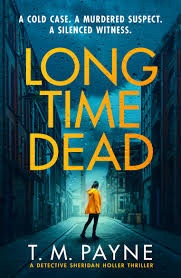
It was Chandler, I think, who conceived of his tales of gumshoes as updated versions of the stories of Knights Errant from Arthurian legend. So, whatever else was unclear in his mysteries, no matter how corrupt the world in which they ventured, one thing you could count on was that his shamus would endeavour to do the right thing, protecting the innocent and unmasking the guilty.
TM Payne’s peeler protagonist in Long Time Dead is an inheritor of that tradition. While she may find the sort of defence barrister of which LJ Shepherd writes somewhat distasteful, she is still fundamentally decent and committed to the finding the truth.
There is an echo of Payne’s book in Catriona King’s A Limited Justice. Like it, it is a police procedural – a type of crime novel for which I have a particular affection.

Both have the bonus of being written by writers who know what they are talking about: Payne is a former cop; King has worked as a police forensic medical examiner. Both eschew the brooding detective for sympathetic professionals – the sort of people who you might actually like to work with.
A Limited Justice begins with King’s investigator, Marco Craig, opening a probe into a particularly grisly killing on a Belfast garage forecourt. As with many of the Sherlock Holmes stories, as the investigation unfolds the story of the perpetrator and their motivation becomes as important as that of the investigators. Consequently, King is able to use her story to explore not just the crime itself, but contemporary Northern Ireland. As is typical of Northern Ireland the story is replete with black humour.
Both King and Payne have founded book series based on their protagonists. It is easy to see why: both are appealing companions on the mean streets of the imagination, and King and Payne, like Minchin and Shepherd, are both very gifted writers.


 aidanjmcquade