Summary: Elphaba on some disturbing new trends in the Sudanese conflict
We are constantly learning how this obsene tit-for-tat war goes between groups who care nothing for the folks in the middle. Towns fall to one side and then are re-taken, new weaponry allows for new tactics in an unclear strategy.
So it is that drones this week hit Singa taking out the power supply and with it the water. I imagine a person many miles away with a computer programme and some coordinates playing an online game with lives. Of course on the ground there has been a rounding up of people suspected of guiding the missiles to their targets.
There is a deep weariness as people say: “Ah so we’re back to that again” and for how long?My family member, Ax, says they came in the middle of the night Wednesday and it took several attempts to hit their target. The noise sent people scurrying outside. Some left Singa again, crossing the river as they were revisited by the trauma and fear of last year. He kept the family indoors more worried about the risk of falling debris than immediate re-occupation. But that grim possibility is never fully out of mind.
The scaling up of threats from RSF (they hit the airport that the government was boasting they would re-open soon, they claimed to have taken Fasher, they threatened cities beyond Sudan that support the Govt) and counter attacks from the government (they killed the leadership of communities in Kordofan as they met last week) seems to be in preparation for talks in the US – talks that although reported are hotly denied in Sudan. Even talking about them is risky.
Meanwhile Ax and I mused on the differences between towns in England and Sudan: a mini tale of two cities. Where in dying town-centres in UK the shops all seem to be nail-bars, second-hand clothes shops and takeaways, in Singa every shop is a pharmacy, mini-clinic or something medical related.
We are hoping this latest wont lead to something more serious.
This led me to check again what Lammy had said when announcing the suspension of some arms licences to Israel in September 2024. Then he said, “There are a number of export licences that we have assessed are not for military use in the current conflict and therefore do not require suspension. They include items that are not being used by the Israel Defence Forces in the current conflict, such as trainer aircraft or other naval equipment. They also include export licences for civilian use, covering a range of products such as food-testing chemicals, telecoms, and data equipment.”
Sophistry – the use of clever sounding arguments to deceive – is, of course, stock in trade of politicians. There is the stench of such sophistry in Lammy’s pronouncements on Israel, which remains a valued ally of the UK in spite of the extraordinary genocide that it has wrought on Gaza in plain view of the world.
In September 2024 Lammy asserted that, “There is no equivalence between Hamas terrorists… and Israel’s democratic Government”. To which one can only conclude that Lammy, desperate for high office, has, in the words of Orwell, submitted to the Party’s final most essential command: that he reject the evidence of his own eyes and ears.
On 2 August, the Guardian reported that Lammy “calls shooting civilians waiting for aid ‘grotesque’, ‘sick’; demands ‘accountability’ from the Israeli side. He says things are ‘desperate for people on the ground, desperate for the hostages in Gaza’, that the world is ‘desperate for a ceasefire, for the suffering to come to an end’”.
It is possible that Lammy and the rest of the British government may finally be becoming squeamish at the level of killing in Gaza. But that does not absolve them of past complicity. Netanyahu and the rest of those that they have allied with have not changed. As a lawyer Lammy “ought to have known” that his allies were just going to do exactly what they said they were going to do at the start of the butchery.
Given the weakness of international institutions that the British and other Western Governments have contributed to through their complicity in Israel’s war crimes, Lammy and his colleagues in policy may yet avoid a criminal reckoning. But they will always have to answer to their consciences on whether the perks of high office were actually worth the price of their souls.
Summary: calls for humanitarian aid are being used by pusillanimous politicians to distract from their failures to directly address the causes of humanitarian crisis in Gaza, most specifically Israel’s genocidal assault.
For over five years in the late 1990s I worked, mostly for Oxfam GB, organizing assistance, including water supply and sanitation, for the civilian victims of the civil war in Angola.
So, humanitarian response is a subject area I know a little about. As students of management and leadership will be aware, a problem with a bit of expertise is that you can presume that everyone understands the fundamentals as well as you do. This is called taken-for-grantedness in the literature.
I have been taking-for-granted that David Lammy and Keir Starmer – human rights lawyers after all, as they like to tell us, and therefore smarter than everyone else, as they like to imply – would understand the fundamentals of humanitarianism. After all, they have been pontificating on it since the start of Israel’s murderous assault on Gaza in 2023.
But maybe they don’t. Maybe it is possible that they are not the craven accomplices to war crimes that their ongoing military and diplomatic support of Israel suggests. Perhaps they are just pig ignorant of the vitally important stuff that successful humanitarian response requires.
So, here are a couple of the most basic lessons of humanitarianism for their edification.
The technical term for this position in relation to humanitarian response is “Oxford Union debating horseshite”. It is part of an approach to politics that values a plausible sounding point to win an immediate argument over the concrete measures necessary to resolve the actual causes of the crisis that the argument is about. Food assistance, vital as it is, does not protect from the other forms of collective punishment, such as the cutting of power and water that Keir Starmer advocated Israel doing, let alone the mass burning alive of children that Israel has routinised in Gaza since the outset of its violence.
2. If a belligerent nation is using famine as a weapon of war, then they are not going to permit humanitarian assistance unless put under robust pressure to do so. Robust pressure, not expressions of sadness or concern: Boycotts. Divestments. Sanctions. Criminal accounting.
The British government used to like to depict itself as a world leader against slavery. But there has been a deafening silence from that government, and indeed much of the anti-slavery community, on this matter.
6. If you have soldiers in place to machine gun aid recipients, then the purpose of an aid distribution is not humanitarian. It is war crimes.
7. If you are materially supporting a political regime that has publicly stated its war aims are ethnic cleansing, then no amount of humanitarian assistance will mitigate that. You too are practicing genocide, even if you are also offering the doomed their meagre last meals.
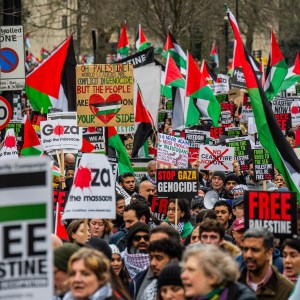
Maybe these ideas are new to Starmer, Lammy and the rest of their government. But they are not hard. Indeed, tens of thousands of ordinary British people demonstrate that they grasp these most fundamental points already as, month in, month out, they gather in protests across the country to indict their own government for its abject moral collapse.
Summary: Huck and Jim try to flee their woes, stalked by the malevolent figure of Tom Sawyer.
Dith Pran, the Cambodian journalist made famous by the movie, The Killing Fields, wrote that the most terrifying of the Khmer Rouge were the child soldiers. They had no sense of either mortality or conscience and would kill with no compunction and little excuse.
In his writings on Vietnam, Tim O’Brien also describes this phenomenon amongst American troops, themselves little more than children. O’Brien describes the results when they are unleashed, as the dogs of war inevitably are, on a substantially defenceless civilian population whose pleas for mercy the Americans never understand.
The literary archetype for this monstrousness is perhaps Tom Sawyer. While not the main focus of this book, his presence when he appears inevitably causes mayhem, anguish and a threat to life for any with the misfortune to cross this dangerous clown’s path.
Huckleberry Finn is one of the great novels of America. In it Huck, a free-spirited kid who has grown up in the woods, and Jim, an escaped slave, both flee to the Mississippi River to seek the freedom to pursue their different ideals of happiness.
Along the way they have comic and comic-dreadful encounters with con men, blood feuds, and slave catchers who threaten to undermine their plans. But perhaps the most sinister threat comes from Tom Sawyer, Huck’s supposed friend.
In the book Tom seems to embody not the ideal of personal freedom cherished by Huck and Jim, but another American ideal still very much at large: that of the virtue of overweening self interest. Nothing matters to Tom but his own amusement and he has no concern if the modest hopes of people he regards as lesser, particularly Jim, are torn apart in the service of his gratification.
Huckleberry Finn is a charming and very funny reflection on the American Dream. But it knows there is an American nightmare too, and it stares deep into that void left by the absence of American conscience.
Summary: Netanyhu’s war is racism and should be condemned as such
Perhaps I have missed it, but I have not seen many anti-slavery organisations condemning the mounting slaughter of civilians in Gaza, and now Lebanon, over the past year.
I wonder about anti-slavery organizations more than other specialist NGOs or human rights issues because, for the past 20 years this has been my principal area of professional practice and so is a sector with which I have some familiarity.
Perhaps some anti-slavery organization feel that something like Gaza is not part of their mandate and so would be inappropriate for them to raise their voices. Perhaps others are afraid of upsetting donors by raising question about another specialist area – human rights in war – and losing funding for other important work. Maybe others are afraid of annoying the governments of the US, UK and Germany, or certain parts of the EU Commission, who may be complicit with the policies of Netanyahu’s cabal and so losing precious access and the occasional invitation to convivial cocktail parties.
The thing is this: if we survey the realities of slavery through history right up to the present day we see very clearly that it is rooted in racism and the dehumanisation of others. Hence, anti-slavery organisations must be anti-racist if they are at all serious about tackling the causes and consequences of enslavement. If they fail in that fundamental then they are not truly anti-slavery. They are merely performative distractions.
Each of these examples, and there are many more, is a naked expression of racism against a whole people. Racism is at the root of every atrocity that is committed by Netanyahu and his cronies.
The continued acquiescence of US, UK and Germany in this, up to and including the provision of money, material and intelligence to sustain the Israeli offensives, in spite of overwhelming concerns regarding both their morality and legality, has dealt a grievous blow to international rule of law. It has also done something that would have seemed unbelievable a mere 18 months ago. It has established a credible case that there is no moral difference between the foreign policies of Biden’s America, and Putin’s Russia. Both appear ready to shred law and the most basic principles of human rights when it is convenient for them.
It is upon meaningful rule of law and a common adherence to the fundamental principles of human rights that the cause of anti-racism, and anti-slavery, have been advanced. Now, however, if campaigners challenge transgressing governments that their policies are in breach of human rights many will laugh and point to Gaza and Ukraine and say that the US and the UK, Germany, Israel, and Russia have demonstrated that the only right is might.
So, every anti-racist organisation on this planet, and that includes all anti-slavery organisations that are worthy of the name, and every organisation that derives its mandate from the Universal Declaration of Human Rights, must add their voices to the international condemnation of the Netanyahu government’s racist wars. If they do not then they will seem as hypocritical as the western governments who facilitate these wars in spite of the mounting evidence that the bloodshed that Israel perpetrates is foul murder.
As the Irish anti-slavery campaigner Roger Casement put it, “we all on earth have a commission and a right to defend the weak against the strong and to protest brutality in every shape and form.”
That commission was never more urgent than it is today as we daily bear witness to Netanyhu’s unfolding policy of genocide.
Summary: those who have lost their moral compass will never understand that protest is leadership
Rule of international double standards
Today, it appears that many Western political leaders apply multiple caveats to the principle of the universality of human rights. The result is that rather than rule of international law we seem increasingly to have rule of international double standards.
The moral black hole at the heart of Western policy towards Israel
British, American and German policy on Gaza appears to be underpinned by a view that Palestinian lives are not equal to Israeli lives and so unworthy of comparable protection. Hence those three governments seem to have decided that it is better to arm and provide diplomatic cover for the far-Right Netanyahu government rather than to uphold the most basic principles of human rights and international humanitarian law.
In the face of the considerable evidence of genocide these governments are deaf to the international protests of conscience, and to the demands of Palestinian and Israeli voices for peace. Instead, they work to maintain the murderous Israeli Defence Forces supply lines at all costs.
I have heard some try to justify this human rights double standard in relation to Israel by responding to protests with patronising reference to the need for realism, for a “realpolitik” approach to the conflict. This is, perhaps, a notion they may imagine that the protesters do not have the sophistication to properly understand. However, many will know that “realpolitik” is a term that has considerable previous, notably in the hands of Henry Kissinger, as a euphemism for moral vacuity and acquiescence in crimes against humanity.
Given this many will remain unconvinced that “realpolitik” really is a sufficient justification for the mounting horrors in Gaza and the West Bank. So, why are the US, the UK and Germany so steadfast in their support of a far-Right Israeli government pursuing such a horrendous campaign of violence?
It is worth remembering that Germany was genocidal in Namibia well before the Nazis ever came to power. While relatively democratic, Britain and the United States were also genocidal in the 19th and 20th centuries in relation to, amongst others, Native Americans, Ireland and South Asia. It was democratically elected governments in the US that launched the invasion of Vietnam and the destruction of Cambodia. It was democratically elected governments in the US and UK that unlawfully invaded Iraq. Today it is democratically elected governments in the US, UK and Germany that have facilitated the far-Right in Israel in their indiscriminate slaughter of Gazan civilians.
So, if we take even a medium-term historical view on these countries, it seems that there is a strain of thinking in those nations’ political cultures stretching from Left to Right that still view war crimes and genocide not as appalling and even unforgivable aberrations, but as legitimate policy options when it is convenient for them or those, however unsavoury, that they deem allies.
But it is the protests of which they are so contemptuous that so often change cultures and countries in the ways in which corrupt politicians can only dream. This is because protest is moral leadership that seeks to make the world a better place by demanding that it become so.
It is because of protesters that women have the vote, that apartheid has been ended in South Africa, that civil rights have been advanced in the US and the North of Ireland. When many governments have sought to merely manage the status quo – the “realpolitik” – protesters have asserted that this is not good enough and demanded better.
Today protesters understand, as the Irish patriot and human rights activist Roger Casement once put it, that “… we all on earth have a commission and a right to defend the weak against the strong, and to protest against brutality in any shape or form”.
So, at the end of the day, as Israel’s allies become ever more deeply mired in the murder of children, it is the protesters they disdain who will perhaps contribute most substantially to an end to apartheid in Israel/Palestine and thereby save the souls of their own countries.




 aidanjmcquade