“A (hu)man must have a code”: ethical leadership and saving the world.

The recent People Management article, “Codes of ethics: does every company need one?” raised a number of interesting questions.

The article revealed that only 54% of FTSE 250 have published codes of ethics, according to research by the Institute of Business Ethics. Of these only 57% are considered as “good”.

As Ms McConville, my English teacher at school in Newry, used to regularly ask in her efforts to coax more lucid writing from even her most inarticulate pupils, “What does ‘good’ even mean?”

Milton Friedman would have said that “good” meant making a profit for shareholders within the law. This is a moral perspective that is still widely prevalent in government and business. I have met more than one business executive who has been admiring of such guidance as an amoral underpinning to their strategic approaches. But such amorality is also wholly inadequate for dealing with the existential challenges facing humanity in the 21st Century. Each of those challenges – from climate change to contemporary slavery – is already a product of thousands of business and political leaders thinking that such things are somebody else’s problem.

The People Management article quotes Ian Peters, director of the Institute of Business Ethics, with another perspective on “good”. He says, “A code of ethics should be the cornerstone for any organisation, ensuring it’s doing the right thing for the right reasons.”

This organisational focus on ethics is one that I am strongly in agreement with, though this also begs the question, “What is ‘right’?” It is further striking that others quoted in the article instead emphasise only personal conduct in the workplace and whistle-blowing duties and protections.

These are, of course, important issues. No one should have to endure fear and bullying in any workplace. But in my view ethics is a yet more fundamental thing. It is, at heart, a strategic question and, consequently a leadership one.

In my book, Ethical Leadership: moral decision making under pressure, I define ethical leadership as the effort “to optimize life-affirming choices that seek to protect human rights and advance ecological restoration irrespective of how inhospitable the political, social or professional environment.

Sometimes this requires dissent or “whistle-blowing”: protest is often, after all, just another name for leadership.

But ethical leadership is also about strategic choice making. For example, a business executive who, decides to source from a textile, electronics or fisheries supply chain in Asia or Africa that they know to be highly destructive of the environment and rife with exploitative labour practices, will often be behaving completely legally. They may also be acting in the spirit of a code of conduct that emphasises legal compliance. But there is, nevertheless, the sulphurous whiff of the banality of evil in such choices.

A recent leading article in the Economist reported that researchers estimate a 5% risk that the current development of Artificial Intelligence systems may result in something “extremely bad (eg, human extinction).” So, I for one am concerned that the executives leading the development of this technology are thinking about ethical standards beyond mere compliance with law, particularly given that so much of the necessary law to constrain dangerous AI development does not yet exist.

Perhaps they are actively thinking about these risks. But as some of them at least also seem untroubled with the manipulation of information systems that was a major factor in instigating the genocide against the Rohingya people in Myanmar in 2016, I would not want to bet my life on it.

But, like the rest of us, I may be forced to. The current precariousness of continued human existence on this planet is a result of so many political and business leaders not looking beyond the short-term questions of immediate profit rather than the long-term question of sustainability or, for that matter, human survival.

For humanity to have a chance requires now that business executives and politicians focus on promoting choices that protect human rights and restore the environment, not just those that comply with the law and obtain short-term financial gains.

So, all businesses, indeed all leaders, need ethical codes of conduct that will compel them to make life-affirming choices the core of their business and economic strategies.

Rome, by Robert Hughes

Summary: a shoddy swan song

You pick up a book by as renowned an art historian as Robert Hughes you think you can be confident in his erudition. With Rome, you will be disappointed.

I would not class myself as an expert on ancient Rome, but I have read a few books by proper authorities. Which seems to be more than can be said for Hughes. Perhaps he did once. But if he did, he did not bother checking any details and instead consigned his misrememberings to the page with gay abandon.

Rome was Hughes last published book. It put me in mind of John Keegan’s The American Civil War, and Christopher Hibbert’s The Borgias: shoddy final books by authors who had quite properly earned distinguished reputations for earlier work.

I read a review of this book by Mary Beard who suggested skipping the first five chapters – the ones that deal with her area of specialism, ancient Rome – so riddled with errors are they. But even if he is less slapdash with the facts in later chapters, presumably the ones that were closer to his professional specialism, I still found it is difficult to trust an author who doesn’t know the difference between architecture and engineering, and despite being a product of Australian Catholic schools, doesn’t seem to understand some of the most basic tenets of Christianity either.

Caesar, by JFC Fuller

Summary: a concise biography, particularly insightful on the military aspects of Caesar’s career.

JFC Fuller was a military theorist, highly influential, in particular, on the Wehrmacht’s use of armoured warfare. However, as a man with pronounced fascist leanings he was excluded from allied military command during the Second World War.

So, instead he wrote.

Among his oeuvre then is this biography of Caesar. Perhaps Fuller was drawn to the subject because of his far-Right leanings: Mussolini also loved Caesar and thought himself his bloated successor.

Given Fuller’s professional interests there is a strong focus on the military aspects of Caesar’s career. But additional entertainment is to be had from Fuller’s waspish sense of humour: how terrible it would be, Fuller muses, if some newly discovered piece of papyrus were to suggest that one of history’s most erotic scenes – the delivery of Cleopatra to Caesar’s bedchamber in a laundry basket – was a myth? Or, discussing Caesar’s prospects in his unrealised plans to invade Parthia, Fuller reckons that Caesar would likely have been routed by the arrows of the Parthians, just as Crassus had been earlier, and Antony would be later: So the Ides of March was probably the luckiest thing that could have happened to Caesar: at least his military reputation survived.

There is an interesting duality to Caesar’s military career: throughout his life, from the Cataline conspiracy to the civil wars, Caesar showed a marked reluctance to shed Roman blood. By contrast Caesar’s conduct of the Gallic Wars, and his later campaigns in Spain, were practically genocidal in their ferocity, and they provided the slaves whose trafficking ensured Caesar’s fortune. For Caesar, it seems, like the British and French imperialists of later centuries, war was merely the logical extension of racism.

A sub theme in this book is Caesar’s relationship with Decimus Brutus, cousin of the more famous, Marcus. It was Decimus Brutus, who convinced Caesar to attend the Senate on the Ides of March. He has been a close lieutenant to Caesar during the Gallic and Civil Wars, and Caesar adopted him alongside Octavian in his will. And yet as every reader of Shakespeare will know Decimus also put a knife into Caesar on the Ides. So, it seems likely, as Robert Harris suggested in his Cicero novels, that Caesar’s last, plaintive cry, “You too, my son?” related to Decimus rather than Marcus.

Overall, not as good as Adrian Goldsworthy’s account of Caesar’s life, but not without merit.

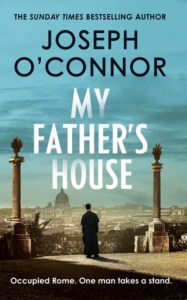
My Father’s House, by Joseph O’Connor

Summary: an outstanding historical thriller of Europeans united against the Nazis

Philippe Sands once wrote a very fine book on the origins of the international law on crimes against humanity and genocide, East-West Street. This does not in my mind absolve him of writing The Ratline: a pointless, rambling wastrel of a book, undertaken, it seems at the behest of the son of a Nazi, who believed his father was, nevertheless, a good man.

He wasn’t.

The Ratline in question in the book’s title was a bit of a Godot character. It never really shows up. The Nazi in question could not stump up the cash to pay the venal and corrupt Vatican officials who were offering Nazis a way of escape from the allies’ dragnet to South America and Southern Africa.

Despite his high profile role in the Vatican Hugh O’Flaherty doesn’t show up in Sands’ Ratline either. Not that this committed anti-Nazi Irishman would have had anything to do with it. But he is an altogether more interesting character, with a much more interesting story to tell of a single night than Sands found to tell in the years he covers before, during and after the war in The Ratline.

O’Flaherty was the head of one of the key Italian resistance networks of the Second World War, run vastly more effectively and altruistically out of the Vatican than the later Ratline. With his pan-European group of Irish, Italian, Dutch and British friends he kept thousands of Jews and escaped prisoners safe as the Gestapo grip on the city tightened.

My Father’s House is a wonderful historical thriller that, by focussing on a single mission by the group introduces us to its various personalities. These take turns narrating the events of the mission. This is an elegant and compelling way to explain to the readers their previous lives before the horrors of the Nazi occupation forced heroism upon them. One scene, in which the British ambassador to Rome, a member of O’Flaherty’s group, encounters O’Flaherty and his deputy, British officer Sam Derry, in the Vatican gardens is particularly chilling. Derry is rehearsing the false names and addresses he will give up under torture if captured.

It is a wholly gripping and deeply moving story of love and friendship in the face of adversity, and asserts a position for O’Flaherty’s alongside Casement as one of the great Irish humanitarians of the Twentieth Century.

Hitler, by Ian Kershaw

Summary: an exceptional work of historical biography

With the instincts of a high-stakes gambler, and a remarkable gift for public speaking – but with absolutely no other discernible gifts or redeeming qualities – Hitler managed in the chaotic aftermath of the First World War to parlay his modest skills into the dictatorship of Germany, and then from that office to unleash the most cataclysmic conflict that Europe has yet seen.

Kershaw’s account of this career was widely praised when first published and rightly so. It remains a gripping, elegantly written portrait of the pathetic monster and a succinct account of much of the suffering he caused.

For me the piece de resistance of this remarkable book is, appropriately enough, the account of Operation Valkyrie, Staffenberg’s doomed attempt to overthrow the monster and grasp some flicker of redemption for Germany. The chapter is as gripping as the best thriller and a reminder that, in the midst of the horror, heroism was still possible.

Like so many of his minions, Hitler was a study in the banality of evil. But, as we have already seen in the 21st Century, sad, narcissistic little men with delusions of grandeur can still wreak terrible devastation.

Consequently this book deserves continued study, so that humanity never completely forgets that.

My books of the year for 2022

Summary: For what it is worth, particularly if you are looking for gift or reading ideas, these are my top 10 reads for 2022, with links to longer reviews, in chronological reading order:

The Devil that Danced on the Water, by Aminitta Forna: Forna’s remarkable memoir of Sierra Leone and her father, a former finance minister for Sierra Leone, judicially assassinated by the country’s corrupt government.

Shadow Cast by Mountains, by Patrick Howse: a powerful collection of poetry by an Irish journalist who has seen the horrific face of war up close.

The Sunken Road, by Ciaran McMenamin: a very fine novel of war, alternating between the Western Front in France, and the Battle of Beleeks and Pettigo in 1922.

Country, by Michael Hughes: a brilliantly original retelling of the Iliad, transposed to the mountains of South Armagh during the Troubles.

Do Not Disturb: the story of a political murder and an African regime gone bad, by Michael Wrong: Wrong’s furious expose of the violence and corruption at the heart of the UK government’s favourite dictatorship, modern Rwanda.

Great Hatred; the assassination of Field Marshal Sir Henry Wilson MP, by Ronan McGreevy: not only a gripping account of the assassination, but a insightful history of the Irish diaspora in London and the London IRA’s involvement in the struggle for Irish Freedom.

Fake Law, by the Secret Barrister: a justly angry account of how the very concept of rule of law is under assault in the contemporary UK by its corrupt and venal government.

Apeirogon, by Colum McCann – a desperately sad perspective on the illegal occupation of Palestine viewed through the eyes of two bereaved friends, one Palestinian, the other Israeli.

Act of Oblivion, by Robert Harris – a fine historical thriller set in the aftermath of the English Civil war, that shows how the maxim of an eye for an eye tends to leave everyone blind.

Small Things Like These, by Claire Keegan – an intense, exquisite meditation on the heroism of an ordinary man in the Ireland of 1985.

Small Things Like These, by Claire Keegan

Summary: already a modern classic

In the middle 1980s, Bill Furlong is a fuel merchant in the town of New Ross in the South-East of Ireland. He is doing alright in difficult financial times. But on the verge of middle age, this father of five daughters is beset with the usual worries, about money, about the future of this daughters, about getting them into the good school in town. Perhaps, he feels these worries more keenly than others because, this is the only family he has, his mother having died when he was a child and never knowing his father.

In the run up to Christmas, Furlong’s work brings him all sorts of places, including to the laundry that the nuns run, where they take care of girls who have become pregnant out of wedlock. This was a fate Bill’s mother avoided because of the kindness of her employer, a Protestant woman farmer who made sure this didn’t happen.

Small Things Like These is a very small book about an enormous thing. It is a beautifully written and intensely moving story of an ordinary man in an ordinary place, finding the courage to do something properly heroic. There are books fifty times the length of this one that have less to say, less memorably.

This book is sure to achieve the status of a modern classic and justly so. It is an outstanding piece of work, utterly exquisite.

The Man Who Died Twice, by Richard Osman

Summary: Highly entertaining soft-core Brexity fantasy

The second book in Richard Osman’s Thursday Murder Club series, The Man Who Died Twice returns to the genteel environs of its predecessor.

Like many second books in series, from Denis Lehane to JK Rowling, one can feel Osman getting into his stride, having established his universe and now able to concentrate more on the evolving story rather than scene-setting.

The Man Who Died Twice is a more overtly right-wing work than its predecessor. In it roughish-diamond coppers think nothing of fitting up suspects they just know are guilty, and the book’s pensioner heroes take the law into their own hands with the casual disdain for due process of the most knuckle headed of authoritarians.

Doubtless this will play well with the Daily Mail readers who are a core demographic in this book’s audience. But even so, it would have been nice if Osman showed the slightest knowledge of the brutal realities of child slavery in “county lines” and the operation of the British drugs economy if he is going to include such things in his books.

But that would probably upset the soft-core fantasy for Brexity readers. Instead this is a world with few complexities and no bad language, in which foreigns know their place, and plucky have-a-go British heroes with bulldog spirit always triumph over the baddies and are home in time for cocoa.

In spite of its politics, The Man Who Died Twice is a highly entertaining affair, with plenty of good jokes and a twisty plot. Even without the unicorns, it’s a vision of sunlit uplands that is as close as the English are ever going to get to the Brexit they thought they voted for. So it’s hard to grudge them their fairytales, particularly when they are as elegantly written as this.

Summer Loving; and A Recipe for Love, by Nicola Yaeger

Summary: rom-coms that show us how the world can be a better place

Once, many years ago, when he was still “The Joan Collins’ Fan Club”, I went to see a performance by Julian Clary. Large chunks of his material were old jokes, deliberately chosen, and with charm and elegance he would imbue every other line with salacious double entendres. I don’t think I laughed as much that whole year… but it was Belfast in the middle of the Troubles when it rained all the time. So there was that.

I was reminded of that Julian Clary show reading Nicola Yaeger’s books: they are unashamed romantic comedies, so you know pretty much what the plot is going to be from the first page. That is the nature of romantic comedies – apart from The Love Letter: man that is the bleakest romantic comedy I have ever sat through. Don’t watch it if you are feeling fragile. Try something more light-hearted like Calvary instead.

Because sometimes the joyful assurance of the romantic comedy is exactly what you need: when I worked in Angola during the civil war there I used to hire a pile of romantic comedy movies every weekend just to have something to remind me that there were kinder places and people than the warlords who plagued one of the most beautiful countries on earth.

But I digress. Much as Ms Yaeger occasionally does in her wonderfully entertaining books. Read these and you’ll learn about art, Eastern European tall tales, surfing, and cooking in such a way as to make you want to book a surfing lesson or buy a new book about French cuisine.

Nicola Yaeger is a charming and extremely funny writer, the sort who rarely bothers with the double bit of the entendre. Like Julian Clary at his best, like all of literature if we are being honest, she retells old stories in elegant, new ways, reminding us there are kinder places and people out there, people who will make you laugh and care about your well-being.

In a world full of complete feckers who are busy brexiting up our fragile planet for all they are worth, it is good to be reminded of this sometimes. And Nicola Yeager does that in glorious fashion.

Confidence Man: The Making of Donald Trump and the Breaking of America, by Maggie Haberman

Summary: portrait of a fascist as a fat man

The character of Biff Tannen in Back to the Future is based on Donald Trump: bullying, lazy, greedy, misogynistic. Confidence Man traces the original Biff’s career from the corrupt world of New York real estate to the American presidency.

It is a depressing story, but, in hindsight, seems almost inevitable now. Because, enabled by his overweening sense of entitlement and his daddy’s money, Trump has one talent that Biff lacked. As the title of Haberman’s absorbing book suggests, Trump has the instincts of a grifter. Like Giovanni Ribisi’s character in the short lived, but highly entertaining, series, Sneaky Pete, it is Trump’s instinct every time he is caught in one lie to double down with another, to meet every attack with a counter attack, and, where possible, to get his retaliation in first. 

According to Haberman Trump was once told, “You’re really very shallow.” “Yes” he agreed, “that is my strength.”

Everything is a transaction to Trump in a zero sum game. For him to win there must be a loser. Love, selflessness, compassion, empathy are meaningless to him. Haberman reports Former White House chief of staff, retired Marine General John Kelly, describing Trump as “the most flawed person” he had ever known. 

Yet enough Americans confuse Trump’s brand of sociopathic narcissism with strength to vote to award this revolting human being with the Presidency.

Not that Trump ever understood the role he had won in a constitutional system. Again and again in this book he is described as unable to comprehend why he is not permitted to do the unlawful. How he yearns for the unconstrained power of a Putin or a Hitler. Nevertheless even corralled by the law and the constitution, Trump and his acolytes still managed to do more damage to the concept of “government of the people, by the people and for the people”, than the entire Confederate army.

Haberman’s fine book is not just an explanation of Trump but also a warning: given the chance again this bloated fascist will reek further chaos.