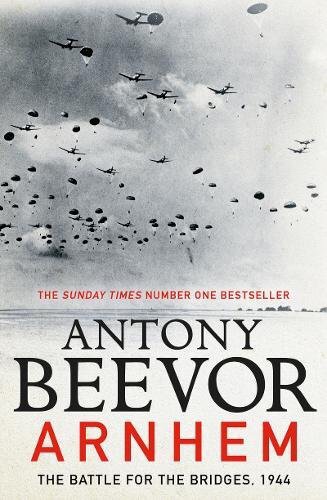
Arnhem: the battle for the bridges, 1944, by Antony Beevor

Summary: a thorough, and thoroughly bleak, account of what happens when Europe is divided
Much like XXX Corps in this book I stalled on the Neder Rijn: I must confess to finding this account of the infamous Allied defeat in the Netherlands so bleak that I had to set it aside for a couple of months before finishing it.

Nevertheless there is much to recommend in this book. First, in its ability to make a more critical assessment of the main protagonists in the battle, it has a more rounded view of them than could be obtained from either Cornelius Ryan’s gripping account, A Bridge Too Far, or Richard Attenborough’s celebrated film of the same name.

Second, both these depictions of the battle obtain their narrative drive by focussing on the efforts to relieve the paratroopers in Arnhem. But, in truth, as Stephen Ambrose discerned when writing Band of Brothers, and as Beevor also shows here, the entire plan was woefully conceived as it was almost impossible to secure the road against German counter-attacks to ensure sufficient support and supply to the advancing armour to ever make the seizure of a bridgehead across the Rhine, the objective of the operation, a realistic objective. That the advance got as far as it did was in spite of the plan, not because of it.

American general Jim Gavin saw this from the outset but kept his mouth shut and distinguished himself during the battle as arguably the most gifted commander. Polish general Stanislaw Sosabowski, in a vain effort to save lives, made the mistake of pointing out to the British what a dumb, stupid plan this was. Hence, in spite of the courage he and his men showed in the fighting, including in rearguard, he was scapegoated by British generals Browning and Horrocks when their incompetence became apparent. (It is clearly a tradition in British public life for incompetents to blame the perspicacious, particularly when foreign, for their own inadequacies).

The book also pays tribute to the courage of Dutch Resistance and civilians in the course of the battle and notes how they bore the brunt of German fury after the Allies had been forced to withdraw.

For my money Antony Beevor’s best book is the Battle for Spain. But this book is a timely reminder of the shocking brutalities of European civil war that the establishment of the European Union finally rendered obsolete.

Vietnam: an epic tragedy 1945 – 1975, by Max Hastings

img_1577Summary: an elegant account of the cruelty of the Vietnam war

A recurrent theme of Max Hastings history books is the pity of war. He returns to that theme again with this work, a fine complement to Ken Burns’ extraordinary television history of the conflict.

Where other military historians – for example Hew Strachan – treat war as a near bloodless continental-scale chess match, or – a flaw with Fergal Keane’s Road of Bones – sometimes lose the reader in the extended descriptions of the squalid killings that make up a battle, Hastings manages the balance between the strategic overview of war and the horrific experiences of the combatants such that each illuminates the other. He is also careful to balance his account with not only French and American perspectives, but also with Vietnamese witnesses from both North and South.

The result is a fine account of the wars in Vietnam from 1945 when nationalist struggles against the French turned bloody, to 1975 and the fall of Saigon and with that the reunification of North and South Vietnam. This includes careful consideration of the most famous battles, including Dien Bien Phu and the Tet Offensive of 1968. But it also includes less well known, sometimes shockingly brutal, episodes. These include the guerrilla offensives by the Viet Cong in the early years of the war – in which communist cadres often assassinated their targets by burying them alive so as not to “waste” a bullet – and the final battles between North and South once the American left. Aspects of the war, such as the weapons and field craft of the combatants, the experiences of US prisoners, and the air war, are treated more thematically giving deeper insight into the ghastliness of what those who experienced it had to endure.

Hastings is particularly scathing about Nixon and Kissinger who cynically used the Vietnam war to further their own political agendas utterly unconcerned about the cost in both Vietnamese and American lives that this entailed. Indeed Ken Burns showed that Nixon went so far as to sabotage Johnson’s efforts to obtain a ceasefire in 1968 to increase his chances of winning the presidential election against his Democratic rival. That Nixon was not impeached for high treason is a matter of historical injustice. Kissinger remains an unindicted war criminal and does not deserve the fawning praise that everyone from Hilary Clinton to Niall Ferguson seems to heap upon this blood-soaked man’s head.

In the context of the US sponsored terrorism of the Phoenix programme, Hastings delivers a damning assessment of former Democratic US Senator Bob Kerrey’s war service. Kerrey lost a leg and won a Congressional Medal of Honour in Vietnam. But the balance of evidence suggests that he achieved little more than the butchery of civilians, including women and children, something that he has subsequently only partially acknowledged.

However Hasting is perhaps less objective in this book than in some of his other history work. He was, after all, a young journalist in Vietnam himself. Many of his generation came to the view that because South Vietnam and the US deserved to lose the war, North Vietnam must deserve to win it. This is a view he now believes to be deeply wrong. While not overlooking the cynicism, bumbling and atrocities of the US and the South, Hastings is careful to note that these were matched, such as in the massacres in Hue during the 1968 Tet Offensive, by the North, and that the brutal totalitarianism of the North compared poorly with the relatively open society that existed in the South.

Perhaps, Hastings notes, if South Vietnam had survived, it would have transformed, as South Korea did, from corrupt dictatorship to vibrant democracy. However it is difficult to see how this could ever have happened. North Vietnam in this account has some of the aspect of Rome during the Punic Wars, such was its implacable determination to win irrespective of the costs.

Hence, Hastings acknowledges, while the young anti-war campaigners in the US and elsewhere were naive in thinking Ho Chi Minh a moral paragon, they were right strategically and ultimately, morally: the war was unwinnable and it is wrong to waste lives on such a struggle. As he notes in the last sentence of the book, if only US and British policy makers had remembered the lessons of this war before blundering into Iraq.

The Fall of the Stone City, by Ismail Kadare

Summary: a dream-like account of the nightmare of totalitarianism

In 1943 the German army approaches the Albanian city of Gjiorkaster, planning a brutal reprisal for an ineffectual Albanian ambush on the column. However the city is home to a close university friend of the German commander, and at a dinner between the two the salvation of the city is negotiated.

Or maybe not. What actually happened at the dinner is a source of much speculation, not least by the Communists who take power after the Germans. They begin to wonder is this actually evidence of some existential threat to their system.

This is a novel of the competing rumours that emerge from this dinner, each as haunting as the dark folk tales that swirl around the city and that these rumours echo. It is a book about the history and culture of Albania, and how the myths of the past cast their bloody influence across time right up to the present day.

It is a strange and haunting story, beautifully written and elegantly translated..

The Spy and the Traitor, by Ben McIntyre

2E971371-2167-4B7D-AD62-DA061BC69D1ASummary: gripping account of a small portion of the Cold War that gives considerable insight into some of the wider issues

Sub-titled, “The Greatest Espionage Story of the Cold War” McIntyre’s account of the career of Oleg Gordievsky does make for fascinating reading. 

Gordievsky came from a KGB family – both his father and brother had been officers. But, Gordievsky says, he lost the faith. Disgust at the Soviet system, particularly the crushing of the Prague Spring, led to a momentous decision: in 1972, while posted in Copenhagen, he became a double-agent for MI6.

He described his choice as an act of dissidence, in the spirit of great Russian dissidents like Solzhenitsyn. But where Solzhenitsyn could protest through art Gordievsky could only protest with the information and secrets that were his stock in trade.

McIntyre credits Gordievsky with a number of decisive interventions in the Cold War. Most importantly, he argues that warnings from Gordievsky led to Nato changing military exercises that the Soviet leadership had come to believe were cover for an actual nuclear assault on the Warsaw Pact, thus averting the most dangerous moment in world history since the Cuban Missiles Crisis. Gordievsky also played a key role, the book argues, in the developing of good working relationships between Thatcher and Gorbachev, and the US decision to escalate military spending in the belief that this would eventually bankrupt the Soviet Union and lead to its collapse,

Eventually, in spite of MI6’s best efforts to guard Gordievsky’s identity, he was betrayed by a traitor in the CIA, recalled to Moscow and investigated by Soviet counter-intelligence. Convinced that his days were numbered if he did nothing he triggered an MI6 plan to exfiltrate him. The unfolding of this operation, led by future Liberal Democrat peer, Ray Asquith – called Roy Ascot in this book – at the time head of the MI6 station in Moscow, provides a gripping climax to this wholly satisfying account of Cold War combatants.

Oh – and Donald Trump is almost certainly a KGB asset since the 1980s.

Devil in the White City, by Erik Larson

102B1280-1D11-4621-BBAA-F47CE042B218Summary: the gripping interwoven tales of an architect and a murderer in 1890s Chicago

The largely now forgotten World Fair in Chicago in 1892 changed the world. Amongst other things it gave us the first large scale testing of electric lighting from alternating current, a vision of how beautiful cities could be instead of the squalid, dirty things they often were, and the Ferris wheel. 

Devil in the White City is a compelling account of how the Head of Works for the Fair, Frank Burnham, a Chicago architect, marshalled the resources of the city to overcome an overwhelming set of organisational, technical and bureaucratic obstacles to deliver this world changing event.

If the book were only about Burnham and the World Fair it would be a compelling, though perhaps niche interest, work. Everyone who was anyone, except Mark Twain, seems to have been involved somehow with the Fair: President Grover Cleveland opened it. Buffalo Bill Cody put on a show there attended by Susan B Anthony; Theodore Dreiser escorted a party of schoolteachers who had won their trip from his newspaper. And amidst the crush of new visitors to Chicago, a doctor and pharmacist by the name of Herman Webster Mudgett, murdered and robbed dozens of innocent men, women and children, unbeknownst to the Chicago Police Department.

Devil in the White City is a combination of social and architectural history interwoven with a tragic and horrific story of a murderer and his desperately sad, trusting victims.  It is an extraordinary work quite unlike anything else I have ever read. 

Postscript: It was only on reading David Blight’s outstanding biography of Frederick Douglass that I discovered the deliberate exclusion of African-American experiences from the World’s Fair and the important protests that Douglass and Ida B Welles raised in the face of this institutional racism. The absence of any discussion of this from The Devil in the White City is an astonishing lacuna from the book, and leads me to think altogether less of it.

Apollo 8: the mission that change everything, by Martin W Sandler

Summary: up close to the raggedy edge of human exploration

In 1968 a rocket blasted off from Cape Canaveral in Florida. Its crew were tasked with testing if Jack Kennedy’s ambition of putting a human on the moon before the end of the decade was at all feasible. So untried was the technology they were using and so enormous was the task they had been set, no one was quite sure if everyone on board was going to come back alive.

Human beings at the cutting edge of exploration is a recurrent theme of Marty Sandler’s work, and Apollo 8 is a gripping addition to his oeuvre. It tells the story of the first humans to break the ties of Earth and travel to the orbit of another planet. It is, as one might imagine, filled with incredible drama. But it is also, as Sandler very convincingly argues, a journey which changed the course of human history.

For many space programmes, such as Apollo, seem extravagant wastes of money given the challenges of hunger and poverty that face so many on Earth. Jack Kennedy’s own brother Edward made this very observation in the early 1970s. But, as they orbited the moon the crew of Apollo 8, Frank Borman, Jim Lovell and Bill Anders, became the first humans in history to witness the Earth rising over the horizon of the moon. The photos they took of this captured the public imagination and conveyed in a way that words could not, the fragility of human existence in the vastness of the universe. Consequently it became an impetus for the environmental movement.

Apollo 8 tells the whole story of this extraordinary journey and its implications in Sandler snappy prose style. And the photographs that accompany the text are glorious.

The Things They Carried, by Tim O’Brien

Summary: a profoundly moving American meditation on the war in Vietnam, rightly regarded as a classic
The Things They Carried is an extraordinary book. An exquisitely written, deeply moving, sometimes extremely funny, sometimes simply horrifying, collection of linked short stories revolving around the soldiers in “Alpha Company”, including one called Tim O’Brien, who after the war becomes the author of this book.

The Vietnamese are generally only minor characters in this book. But while the book is a tender portrait of American troops in Vietnam, it does nothing to glorify the US engagement in that war, which is clearly seen as pointless and immoral. O’Brien’s first encounter with a dead Vietnamese is with an old man killed by an indiscriminate air bomardment of a village called in reprisal for a brief and ineffective sniper attack on O’Brien’s own platoon.

The terrorism that the Americans practice upon the Vietnamese is so routinised that it is almost unremarked upon, frequently considered by the troops as little more than youthful hi-jinks. O’Brien reminds the reader that those doing this, the American GIs, are just kids, mostly conscripts barely out of high school, unleashed from the bounds of civilisation and morality, desperate just to survive and unconcerned about those who die in order to ensure their survival.

But of course not all survive. Vietnamese action repeatedly bleeds the Americans, and vice versa. In one chapter O’Brien meditates on the humanity of a dead Vietnamese soldier, killed in his ambush, and, like his killers, someone who probably wished he was somewhere else, living his own young life rather than being involved in ending the young lives of others.

The Things They Carried, since its publication, has come to be regarded as a classic of American literature and O’Brien as one of the finest writers of his generation. The accolades are deserved.

Turbulence, by Giles Fodden

Summary: Weather as a metaphor for war as a metaphor for weather
It’s 1944 and the Allies are preparing for the largest amphibious assault ever mounted to retake Europe from Nazi tyranny. What might thwart their cunning plans though, even more than the Germans, is the weather. A sufficient period of decent weather is essential to land all the troops and equipment necessary to establish a robust beachhead on the coast of North-Western France. Hence inordinate pressure falls upon the weather forecasters to provide the necessary information to the generals to make a decision upon which the lives of untold thousands and the future of Europe itself depends.

Giles Fodden’s novel follows, in flashback, a brief portion of the career of its fictional protagonist, Henry Meadows. Meadows a physicist turned metrologist in wartime service, is sent to Scotland to try to extract the secret to a more accurate forecasting method from a brilliant reclusive, and pacifist, metrologist, opposed to giving any assistance to the war effort.

Meadows, an intellectually brilliant but socially naïve character, is our guide through both the complexities of the science and the chaos of the war. It’s an engaging read, even though some of the discussions of weather forecasting can be confusing. It conveys the awful weight that the planners of the D-Day landings had to bear and how in brutal ways the randomness of war echoes the randomness of the weather.

Inglorious Empire: what the British did to India, by Shashi Tharoor


World’s Best Taoiseach

Summary: a scathing reminder that treating people with racism and brutality does not generally make a country many friends

A while ago I had a conversation with a South Asian friend about Leo Varadkar, the Irish Prime Minister. “It’s noticeable”, my friend said, “how Leo is being much tougher with the British than his predecessor. Do you know why that is?”

“Why?” I asked.

“It’s because Leo is also Indian,” which indeed he is – his father is from Mumbai. “So when he talks about famine, he is not just thinking of the Irish Famine but also of the British manufactured famines though the history of the Raj, including the appalling one in East Bengal in 1943. When he talks about partition, he is not just thinking of Irish partition, but the much, much, much bloodier British engineered division of the sub-continent into India and Pakistan.”

img_1463

Refugees during the Partition of India

Whether or not Leo is thinking about these things as he tries to negotiate with an increasingly disfunctional British government unfettered by reality, Shashi Tharoor, an Indian politician and intellectual certainly is. He details all these atrocities, and more, in his book Inglorious Empire, based upon a celebrated speech to the Oxford Union that he gave in 2015, in which he exposed some of the fundamental truths of Empire that the British conspire so aggressively to forget.

At the time at which the British first began their invasion, India represented over one-quarter of the global economy, dwarfing the UK. Over the subsequent centuries Britain reversed this through systematic transfer of India’s wealth to Britain through an undisguised looting of the sub-continent (“loot” being an Indian word). Violent theft and punitive taxation were the order of the day. Britain also employed an aggressive policy of deindustrialisation, destroying the competition from, among others, India’s shipping, textile and metallurgy industries which, at the beginning of the 18th Century were the most advanced in the world.

Tharoor does acknowledge certain benefits of British colonialism: “tea, cricket, and the English language.” But otherwise his book is a forthright repudiation of the deceitful arguments of hard-Right ideologues such as Niall Fergusson who seeks to recast the brutal, racist project of colonialism as some sort of philanthropic endeavour.

This book must also be a warning to the fantasists of the Brexit movement whose warm fuzzy beliefs about the British Empire are unconstrained by facts or any imaginative understanding of what it meant to those subjugated by its depredations. In the years to come, as Britain becomes the sort of third-rate power that its exit from the European Union entails, ordinary Britons can only hope that, now the boot is on the other foot, India will act towards Britain in future trade and others dealings with a measure of justice that Britain never showed India.

img_1465

Bengal famine, 1943

Brexit, Trump and Vladimir Putin’s assault on European and US democracy: The Road to Unfreedom, by Timothy Snyder

img_1459Summary: A terrifying and convincing account of the assault of Russian fascists and their useful idiots upon Western democracy 

Timothy Snyder’s Bloodlands, like Ron Chernow’s biography of Alexander Hamilton, is a book that makes you fundamentally rethink your understanding of history. With The Road to Unfreedom Snyder makes us fundamentally rethink our understanding of the present.

The recent political success of far Right elements in the UK, Poland, Hungary and the US are not mere fluctuations in normal politics, Snyder argues. Nor are they solely a product of domestic political turmoil. They are also a consequence of a deliberate and aggressive foreign policy pursued by Vladimir Putin in order to undermine the systems of rule of law that underpin the democracies of the US and the European Union.

Synder argues that since 2010 Vladimir Putin has embraced a particularly Russian brand of fascism, with its pronounced homophobia, as a way in which to entrench in Russian society the kleptocracy over which he presides. Richard Evans, the distinguished British historian takes some issue with this, noting that Putin’s favorite thinker, Ivan Illyin, was a conservative ultra-nationalist rather than a fascist.  However the authoritarianism that Putin has established, like fascist regimes of the past, defines itself by its enemies, and for enemies Putin has chosen the European Union and the United States. Snyder notes that this is not because of anything that these have done, but rather because of what they are. The EU in particular stands as a telling contrast to the Russian Federation. Russia’s thieving oligarchs have made it the most unequal country on earth. On the other hand the EU has provided a better standard of living for its people within the frameworks of human rights and the rule of law, ideas anathema to Russian fascism.

Authoritarianism arrives, Synder notes, “not because people say that they want it, but because they lose the ability to distinguish between facts and desires.” Hence much of Putin’s assault has been in the realm of cyber-space: weaponising systems like Facebook to direct focused, usually fictional, racist, homophobic and anti-democratic propaganda to the users in a way that distorts their perceptions and bolsters their prejudices; or surreptitiously hacking vital information systems, such as those underpinning the US and Ukrainian electoral systems. These cyber-warfare processes are assisted by an array of corrupt “assets” and “useful idiots” who publicly advocate Russia’s desired outcomes even while Putin is attacking their own countries. These include former Ukrainian President Viktor Yanukovych, the Czech President Milos Zeman, former Polish Defence minister Antonio Macierewicz, Marin le Pen, the French Far Right leader, Nigel Farage, the disgusting former leader of the UKIP, Seumus Milne, Jeremy Corbyn’s current communications and strategy director, and, of course, Donald Trump and many of his inner circle.

7AD36993-D93D-423A-8524-7BAA1F3D2603

Putin and his boy

The success of Russian disinformation can be seen in the pages of even the Guardian, which has published puff-pieces for Putin by supposedly Left-wing journalists such as Milne and John Pilger, whose opinions have been untroubled by actual reporting. It is enabled further by the refusal of British and US Republican political leaders to acknowledge the effectiveness of Putin’s undermining of their democracy.

Carol Cadwalladr’s investigations for the Guardian have turned up probable corrupt links between, in particular, the Brexit establishment and Russia. Robert Mueller‘ s investigation in the US hints at exposing further, perhaps treasonous, criminality. But, Synder notes, much of the information about Putin’s web of influence, and his destructive intent is publicly available. Putin has not made his embrace of fascism a secret, frequently citing Ilyin in his speeches, passing aggressive homophobic laws, trampling roughshod over rule of international law with this invasion of Ukraine, and his sneering attitude toward the corruption of the US election.

The invasion of Ukraine is something of a pivotal event in this book. The Russian processes of disinformation and cyber warfare that corrupted both the Brexit vote and the 2016 US elections, bringing the neo-fascist Trump to power in spite of the popular vote against him, may have come into sharp focus with Mueller’s and Cadwalladr’s investigations. But the warning signs were there to be seen with the Russian invasion of Ukraine – a warning that most of Europe and the US failed to heed.

That so much of this has been missed and mis-reported must arise from a lack of proper journalism commissioned by editors with sufficient international awareness to understand emergent trends and geo-politics, and conducted on the ground by investigative journalists fluent in the languages of the countries they are reporting on. Synder dedicates this book to reporters, and it is the investigative journalists of Russia, Ukraine, Poland and elsewhere who have provided much of the raw material upon which Synder constructs this vital history of our times.