Anatomy of a Moment, by Javier Cercas

ub_tejero_coup_etatSummary: The lad battle of the Spanish Civil War?

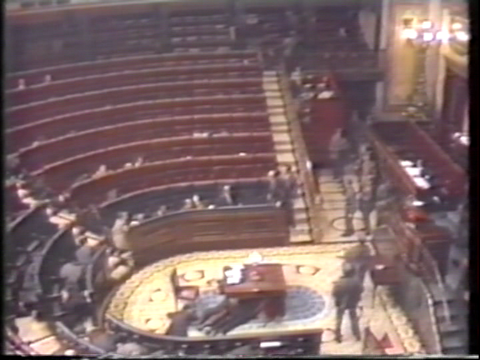
Following his unconvincing meditation on American atrocities in the Vietnam war in “The speed of light” Javier Cercas returns to his own country’s history for his latest work. “The anatomy of a moment” revisits the theme of the Spanish Civil War and its consequences that Cercas so brilliantly explored in “Soldiers of Salamis”. However in his new book he eschews fiction, even the “post-modern” variety that he practices, which blurs the distinction between the real and the imaginary. Instead he employs a part philosophical, part journalistic meditation on the 1981 attempted coup to overthrow Spanish democracy.

“The anatomy of a moment” focuses on the three parliamentarians who refused to duck when the Civil Guard who invaded the Cortes opened fire. They were Gutteriez Mellado, a former Francoist general now deputy Prime Minister, Santiago Carillo, head of the Spanish Communist party, and Adolfo Suarez, the outgoing Prime Minister. Suarez is above all the hero of the book – in Cercas account a Francoist functionary and “provincial non-entity” who grew into the architect of democracy and a giant of Spanish history. The author returns again and again to the image of Suarez sitting alone on the prime minister’s bench as the bullets fly around him, one of only three people prepared to risk their necks while those with more impecible democratic credentials cower behind their desks, as most of the rest of us would naturally and rationally have done in similar circumstances.

Parts of the book are difficult – the author talks to the reader as if they are already au fait with the history and politics of Spain. This leads, I thought, to a richer experience than books which spoonfeed the reader the historical background: in the end you feel you have earned the understanding you have achieved.

In places the book has the characteristics of a non-fiction thriller as the details of both the coup, led by senior elements in the army, and the countercoup, led by the King, are plotted. The book is also very moving, particularly regarding the travails of Suarez in later life, and a deeply affecting coda when the author reflects upon the life and politics of his own father.

The book is also deeply political, rejecting a current view prevalent in Spain that the rupture between Francoism and democracy was false and that Suarez ensured that those who had power under the dictatorship retained it under the constitutional monarchy. Cercas argues instead that the rupture was real and that Suarez was a “hero of the retreat” from dictatorship. That the author is prepared to set out such forthright opinions on this and other aspects of the coup add to the pleasure of the book: it is widely researched, deeply opinionated history, provocative, but not gratuitously controversialist. It demands the reader thinks while keeping them entertained.

A great book.

Empire of the Summer Moon – Quanah Parker and the Rise and Fall of the Comanches by S.C. Gwynne

PortraiSummary: Brilliant, but not the whole story

This book is a fascinating look at the rise and fall of the Commanche nation. Its intensely exciting and sympathetic to Native Americans in general and the Commanche in particular. However it is also intensely violent, taking a clear sighted, almost forensic, look at the practices of Commanche war-making, particularly their routine use of rape and torture.

(Speaking as a Celt myself) the author draws a not unreasonable comparison of Comanche warfare to Celtic warfare of a bygone era to undermine any racist presumptions about the origins of warriors cruelty. He also notes the intensely political purpose behind Comanche terrorism on settlers and buffalo hunters, and that Texan warfare was itself brutal and racist. However while he spends time describing Comanche violence in some detail, he frequently skates across comparable white violence – explicitly avoiding a deep discussion of the Sand Creek massacre for example.

The author appears to like and admire Quanah, particularly the Quanah of later years who struggled to lead his people in peace after years of violence. Quanah described himself as having been a “bad man” but in later life he appears to have become a warm and generous one with little animosity to whites. However the author’s real hero in this book seems to be the enigmatic Col MacKenzie, Quanah’s nemesis, rather than Quanah himself. One should be grateful to the author for bringing this fascinating man and his role in the violence of the era to greater public attention: for all his crankiness he stands in a much more positive light that the strange, and more infamous, figure of Custer.

For those interested in Hollywood history the author notes how the story of Cynthia Ann Parker, Quanah’s mother, was the inspiration for arguably John Ford’s second greatest Western (after The Man Who Shot Liberty Valance), The Searchers. However he doesn’t mention that MacKenzie seems to have been Ford’s model for Lt Col Kirby Yorke in Rio Grande, another one of John Wayne’s classic roles: the climax of that film – the Colonel leading his troopers into Mexico to attack the Apache on Sheridan’s orders – is something that the author mentions MacKenzie actually did when not fighting the Comanche.

It is a book that can comfortably sit alongside Dee Brown’s classic “Bury my heart at Wounded Knee” and which complements it, providing greater detail to some aspects of that book and a deeper understanding of the politics and attitudes of white America to Native Americans in the course of their conquest.

The setting of the sun on the British Empire: Alex Von Tunzelmann’s Indian Summer

imageSummary: a lucid and witty addition to the literature on the British Empire, its greed, incompetence and atrocities… though Edwina and Dickie were decent enough old sticks

The sub-title of this book, “The secret history of the end of an empire” is probably a bit misleading. It seems to derive from the author’s very sympathetic exploration of the not very secret menage à trois that developed between Edwina Mountbatten, Nehru, and Edwina’s husband Louis, the last Viceroy. Rather than a secret history this is a fine narrative history of the coming of Indian and Pakistani independence and the bloody aftermath. Nehru and Edwina Mountbatten are the author’s particular heroes, though she also seems to have a healthy respect for Jinnah and Gandhi, and a soft spot for Lord Louis “Dickie” Mountbatten who, for all his limitations, comes across as a very likeable and fundamentally decent chap.

There is much else to admire in the book, not least the author’s portrayal of the true awfulness of the carnage that erupted with partition and her assessment of controversies, such as the origins of the Kashmir conflict, I found fair-minded and careful. Personally I was left with a much more negative opinion of Gandhi as a result of reading this book: He was unquestionably a brave and principled man of considerable moral courage, but his calling a halt to the campaign for the British to quit India in the 1920s seemed to have meant the loss of an opportunity for Indian independence unsullied by partition, and the holocaust that entailed. Others may prefer to emphasize the failures of twentieth century British policy towards India, up to and including the management of their departure. However given Gandhi’s retrogressive position on caste it is probably time for a more sober reassessment of the man’s life and achievements.

As a bonus the author also has a lovely gift for humour and the narrative is peppered with some excellent jokes that emerge naturally from her account, rather than being shoe-horned into it. The result is an elegantly written and erudrite popular history of run up to Indian independence and the bloody chaos of the sub-continent’s partitioning.

Citizen philosophers and a dimwit go to war for Old Ireland: my review of Insurrection by Liam O’Flaherty

imageLiam O’Flaherty’s 1950 novel is an account of a small group of rebels progress through Easter Week 1916, starting with the storming of the General Post Office, through an action clearly based on the intense fighting around Mount Street Bridge, to the final hours around the GPO leading up to the surrender.
As in his books Skerrit and The Informer, O’Flaherty’s principle protagonist is a pretty dim one, in this case a Connemara man Bartley Madden, who is transformed, though not intellectually, by his experiences during the novel. How much you enjoy having a Stage Irishman at the centre of the novel you are reading is probably a matter of personal taste, but I could have done without it. Such a device seems to have been chosen by O’Flaherty in order to explore his political and philosophical ideas, and it is these more than the fighting that are central to his concerns in this novel.

And, unfortunately this makes for a rather unbelievable and clumsy novel. Pages are taken up with philosophical and cod-philosophical discourse. Perhaps this is how soldiers, most particularly citizen-soldiers, spend their time in battle. But even if it rings true I found many of their conversations uninteresting and the view of O’Flaherty, who had been a combatant in both the first world war and the struggles around Irish independence, bleak.

Those who know a little about the 1916 rising will recognise that O’Flaherty is generally faithful to the course of events and the geography of Dublin. However if one is searching for a gripping introduction to the 1916 rebellion, Charles Townsend’s historical account is both more informative and, for me, much more exciting.

A Second Century Karadzic: My review of Frank McLynn’s Marcus Aurelius


 I was looking forward to this book having enjoyed Frank McLynn’s previous superb joint biography of Villa and Zapata. However while the focus of the Villa and Zapata study was on explaining the significance of the two men in the context of their times and places, in this instance Frank McLynn attempts to argue for the significance of Marcus to all ages.

This leads to two problems with the book. On one hand a tendency to compare Marcus with later leaders which seems a bit anachronistic. Second, despite estabilishing Marcus’ responsibility for a ferocious persecution of Christians during his reign, which included many deliberately sadistic executions in contravention of Roman law, and despite Marcus’ genocidal tendencies in his wars against the German tribes, the author is determined to convince the reader of Marcus’s inate humaneness and philosophical significance.

Thought is important as the origin of action. But no matter how novel or insightful Marcus’s philosophy may be, something that is a central concern of this book, it does not absolve transgressions. And judged by his actions Marcus was a ruthless and bloody man who, in addition to his personal crimes, bequeathed the Roman empire its worst emperor, his son Commodus. Consequently McLynn’s argument of the importance of Marcus as one of the great people of all time seems overstretched and internally contradictory. As I read the book the figure I was most reminded of was not Churchill, Grant or Smuts, who McLynn discusses, but rather the Bosnian Serb war criminal Radovan Karadzic – a learned but pretentious man who showed his true face as a bloody warlord and debased his learning in war crimes and the persecution of minorities.

Overall the book feels like it could have done with a more robust editing, both to challenge the sort of fundamental problems suggested above, but also to discipline McLynn’s language and tendencies to show off his own erudition: for his next book Frank McLynn should be reminded that less is more.

Nice guys don’t always come last: Doris Kearns Goodwin’s Team of Rivals

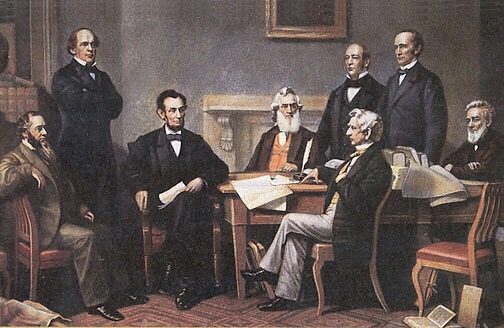
 Since its publication Doris Kearns Goodwin’s biography of Lincoln has rightly become regarded as a modern classic. It is an exquisitely written account of Lincoln’s life from his birth in poverty in Kentucky, through a period in child slavery (by the modern definition of that human rights abuse), to self education and success as a lawyer, politician and President during the worst constitutional crisis in US history, to his death in the Petersen boarding house in Washington DC.

Tolstoy described Lincoln as a “humanitarian as broad as the world” and Kearns Goodwin’s approach to demonstrating the truth of this judgement is to focus on the relationships between Lincoln and his cabinet ministers, particularly Seward, his Secretary of State, Stanton his Secretary of War, Chase his Treasury Secretary, and to a lesser extent Welles his Navy Secretary, Bates his Attorney General and Blair his Postmaster General. Seward, Chase, and Bates were Lincoln’s principle rivals for the Republican nomination in 1860 and it was unprecedented for a President to bring such rivals into his “political family” as Lincoln did. But, such was the crisis that the nation was facing with the threat of secession from the slave states in response to the election of even a “moderate” anti-slavery candidate such as Lincoln, Lincoln felt that he had to have the most capable men for his cabinet. That some of them, particularly Chase, felt that Lincoln was an unworthy candidate and unqualified to be President added to the challenge that Lincoln faced.

Lincoln’s genius as a visionary, writer and speaker are well understood and well demonstrated in this biography. The book details his evolving thinking on the issue of slavery from a “moderate” anti-slavery position to an increasingly radical one as a result of contact with the anti-slavery struggle itself and with the likes of Fredrick Douglass and the ordinary black soldiers who were risking their lives to defend the Union: “There have been men base enough to propose to me to return to slavery the black warriors of Port Hudson and Olustee, and thus win the respect of the masters they fought. Should I do so, I should deserve to be damned in time and eternity”, he said at one stage.

In addition Kearns Goodwin book illustrates Lincoln’s managerial genius, arguing convincingly that it emerged from his enormous decency and magnanimity, and that it was fundamental in ensuring that such a disparate group as his cabinet acted together in the national interest in time of an unprecedented national crisis.

Lincoln’s lovely gift of humour and intense like-ability shine through the biography and consequently the devastating tragedy of his assassination still resonates down the centuries. This book is a fitting tribute to the greatest figure of the 19th century and one of the greatest figures of all world history.

Michael Collins by Tim Pat Coogan

Michael Collins could lay reasonable claim to be both the father of modern guerrilla warfare and one of the principle founders of Irish democracy. The fact that he achieved so much before his tragically early death at the age of 31 makes his story all the more remarkable.

IMG_1286I first read this book shortly after it was published in the 1990s. Rereading it in 2012 I was struck by the breathtaking scale of the achievement in the writing: drawing on the accounts of members of Collins’ Intelligence operation Coogan provides a detailed and compelling account of the intelligence war. In addition he provides a gripping account of the peace initiatives that led to the Truce and a facinating description of the negotiations that led to the Treaty. Probably the piece de resistance of a book that is overflowing with extraordinary detail is his account of Collins’ Northern policy: here Coogan wields a wealth of evidence to present a powerful argument that when other so called Republicans were preoccupied with silly disputes over the presence of the Oath of Allegience to the Crown in the Treaty, Collins was, for good and ill, marshalling all his political, diplomatic and military skills in a desperate effort to achieve a united Ireland.
In this book Coogan draws on a wealth of published and unpublished sources and interviews with participants in the War of Independence and Civil War, many personally known to him in his distinguished career as a journalist and editor, to produce the outstanding extant biography of Collins that catches both his personal humanity and historic achievements. In the process he also produces one of the best single volume introductions to this period of Irish history: a gripping narrative relating to how Collins, with a small group of committed revolutionists and patriots, initiates a guerrilla war, breaks the power of British secret service in Dublin and then, at enormous personal cost, turns the military victory into the political achievement of a democratic Irish state.

Collins remains a compelling figure because of both his historical achievements and legacy, and because, in spite of his engagement in some brutal warfare, he remains a recognisably sympathetic and humane person through it all. This book demonstrates all of this and illuminates some of the the great controversies of Irish and British history in the process. The result is quite simply one the best historical biographies available about anyone. It is a veritable tour de force, stunning in the breadth and depth of its scope and utterly gripping.

A masterpiece.

Bloody routine of a war in the shadows: The Squad, by T Ryle Dwyer

Image

The Squad is an account of the intelligence war waged principally in Dublin, by Michael Collins and the IRA from January 1919 to the Truce in 1921. It is based on a series of interviews given by participants to the Irish Bureau of Military History on the proviso, for many, that they would only be released after the interviewee’s death.

The author does not spend much time contextualising the violence in the politics of the time clearly having decided that, as there are many other books which provide such context, he has little additional to offer. This means that one is pitched almost straight away into the minuatae of intelligence operations with a bewildering array of characters.

However patience with this approach pays dividends: the book conveys the mammoth scale of the intelligence operation Collins undertook and hence the centrality of this in undermining Britain’s capacity to hold Ireland. The book also provides insight into how the ruthlessness and secrecy of the operations led to the moral erosion of some of the Squad members whose subsequent military and democratic conduct was far short of the ideals initially outlined by Collins for them.

Collins insisted that revenge was never to be part of the conduct of the Squad, leading many of the shooters to presume that killings such as that of Lee-Wilson, who had maltreated Tom Clarke after the 1916 Rising, was principally an act of military necessity, rather than an act of revenge. However as generally the shooters were simply given orders to kill not the reasons for the killings there is little substantive illumination on the reasons for some of Collins’ more controversial killings.

Certainly as the war wore on into late 1920 and early 1921 there is a sense that the routinisation of killing led to a toleration of revenge and reprisal comparable to that shown by Lloyd George and his Cabinet in their conduct of the war: Todd Andrews, later a distinguished Irish public servant, who participated in a support role to the Squad in the Bloody Sunday operation in late 1920, noted how the behaviour of some of his comrades resembled that of the Black and Tans.

And, however justifiable was this campaign, the author does not allow the reader to lose sight of the fact that it resulted in the killing, often brutal, of other human beings: in the Squad’s first assasination, of a political detective Patrick Smyth, they used .38 calibre weapons, which they discovered could not dependably put a man down – Smyth struggled on in pain and fear for a long while after the first bullets hit; the assasination of 22 year old District Inspector Phillip O’Sullivan in front of his fiancee, clearly bothered his killers so much in later life that they could not bring themselves to speak of it.

Nevertheless, in spite of the sense of excess towards the end of the war, the book does confirm a general tendency of restraint and growing democratic sensibility by Collins that compares favourably with many of his contemporaries in British or American politics. The experience of the pity of war seems to have been a major factor in Collins’ own growth as a statesman. His loss continues to cast a long shadow on twentieth century Irish history.

The risks and rewards of meglomania: The 12 Caesars by Mathew Dennison

Image

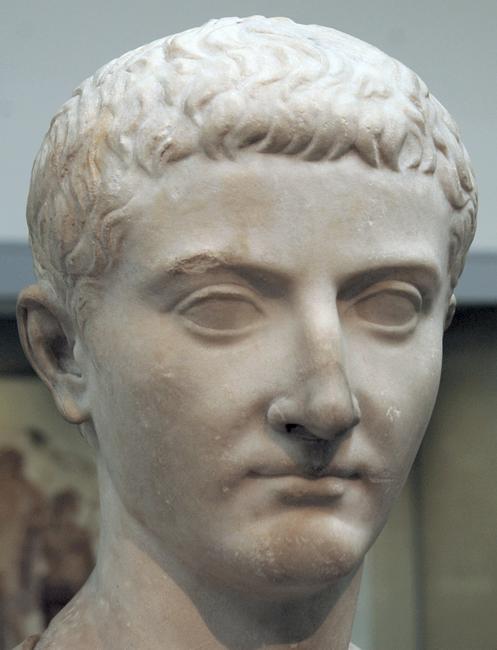
Tiberius (the “T” in “James T. Kirk”!)

This is a very enjoyable account of Roman history through the prism of the careers of the first 12 Caesars. These were not nice people. Even the “good” emperors were bloody men slaughtering guilty and innocent alike: Titus, for example, celebrated his father’s and brother’s birthdays by putting to death thousands of prisoners from the Jewish Revolt. The bad ones, like Caligula and Nero, were even more murderous lunatics.

The book takes as its starting point Suetonius account of the lives but develops its own themes and opinions based on other primary and secondary sources. It does seem to presume significant background knowledge of the lives but I found it entertaining and informative even with limited knowledge of many of the lives.

An international perspective on an American tragedy: Amanda Foreman’s A World on Fire

A World on Fire is a remarkable achievement. It is a history of the American Civil War taken from the novel perspective of the relationship between Britain and the US during the war. Hence the principal characters are Lord Lyons, the British representative to the US, Charles Francis Adams, the US minister to London, and Seward the US Secretary of State with a host of other political and diplomatic figures in support.

This approach illuminates aspects of the war little touched upon by more conventional US histories, notably the real risk to Union victory posed by recognition of the South by the European powers, and the closeness to war between the US and Britain on a number of occasions. Consequently this book provides a more critical portrayal of Seward than, say, Doris Kearns Goodwin’s masterful biography of Lincoln, Team of Rivals.

css_alabama_vs_hatteras_ptgby Patrick O'brienThis diplomatic history of the war is told within the framework of a more conventional political and military narrative of the course of the war. Here a perspective on the fighting is offered by, principally, the letters and memoirs of the British and Irish volunteers who fought for both North and South.

At times it is difficult to keep up with the astonishing cast of characters that Foreman has assembled, but it is well worth the effort for the startlingly fresh perspective that this book puts on the American Civil War.