Summary: Georgian-Soviet tensions coming to a bloody reckoning in the last European battle of the Second World War
In their various books both Timothy Synder and Max Hastings have endeavoured to demonstrate how the good versus evil myth so beloved of British Second World War nostalgists, rings very hollow for the peoples of central and eastern Europe. For countries like Poland and Ukraine, for example, the experience was rather to be caught between the monstrous regimes of two of the Twentieth century’s greatest murderers: Stalin and Hitler.
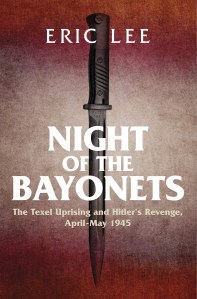
With Night of the Bayonets, Eric Lee focuses in on one small but hugely illuminating example of this bleak reality.
In the early hours of 5 April 1945, Georgian soldiers serving with the Wehrmacht on the Dutch island of Texel rose up against their German comrades, butchering many of them with knives and bayonets as they slept.
As Eric Lee explains, the Georgians may not have been enthusiastic Soviets, Georgian independence and democracy having been strangled in the cradle by the Bolsheviks. However, they were unlikely to have been enthusiastic Nazis either. Politics was probably less a factor in them turning their coats than survival. Having been captured by the Germans earlier in the war, donning the German uniform seemed one of their few chances of survival, the alternative being death by a swift bullet or by starvation and disease in a prison camp.
With the approaching end of war however, the Georgians were pitched onto the horns of another dilemma: how would they be received back in Stalin’s USSR having served in German uniforms. Stalin had already declared surrendering Red Army solders to be traitors. The Georgians must have been aware that if they returned to the Soviet Union they would likely end up liquidated or in a Gulag.
So, insurrection must have seemed a reasonable gamble, demonstrating their continued loyalty to the Allied cause, and by allying themselves with Dutch communists, with the cause of the Soviet Union.
It was only after battle was joined that the Georgians found out what other resistance fighters, from Warsaw to Prague to rural France, also discovered: that they were expendable as far as the Allied high commands were concerned. As in Warsaw the Germans also realised this, and so they decided to take their time in exacting revenge on Georgian fighters and Dutch civilians alike. It was not until late May, long after VE day, that Canadian forces landed on Texel, ending the battle.
Other books – most famously Cornelius Ryan’s description of the fall of Berlin, or Stephen Harding’s account of the extraordinary action at the Schloss Itter in Austria – have claimed to be accounts of the “last” battle of the Second World War in Europe. However, Lee’s account of this “last battle” is important not as a historical curiosity, but because it also illuminates so much of contemporary Europe, not least in explaining something of the origins of the ongoing tensions between Georgia and Russia.
Night of the Bayonets is an elegantly written and important work of history, In providing a non-Anglo-American perspective on the Second World War in Europe, it may usefully punctures some of the contemporary myths of the Second World War that still pervade attitudes in the UK. For this, and for much else, it deserves a wide readership.