The Wonga Coup, by Adam Roberts

img_1101Summary: A book about an unpleasant bunch of mercenaries, and the even more obnoxious Mark Thatcher coming a-cropper at the insolent hands of Johnny Foreigner

In March 2004 a group of mercenaries led by a former British officer, Simon Mann, attempted to undertake a coup in Equatorial Guinea, one of the nastiest dictatorships in Africa. Of course the motivation of Mann and his cronies was not in the least humanitarian, but rather a hope of getting their greedy hands on the country’s considerable oil wealth.

They had form as “soldiers of fortune”. Mann and co were behind Executive Outcomes, a mercenary operation that stiffened the Angolan army’s campaign against the UNITA rebels during that country’s civil war. Those escapades helped Mann become a millionaire.

However while Mann may have had some considerable tactical skills that could contribute to the winning of battles, his talents as an organiser of coups were much less impressive. The plan was bedevilled from the outset by difficulties with logistics and supply, not least of weapons. In the end the amateurishness of their efforts, particularly in the organisers’ inability to keep their plans secret, meant that the coup was easily rolled up by Zimbabwean, South African and Equatorial Guinean intelligence services before a shot was fired. Many of the plotters spent years in dreadful prisons in Zimbabwe and Equatorial Guinea.

In addition to a forensic detailing of the twists and turns of the plot The Wonga Coup has a number of interesting revelations. For a start Mann’s plot wasn’t the first to threaten the Equatorial Guinea dictatorship. The novelist Fredrick Forsyth, it seems, had tried to organise the same thing in the 1970s to install as president his friend, Odumegwu Emeka Ojukwu, the former head of Nigeria’s Katanga secessionists. He failed, but the experience provided him with the detailed research for a novel, The Dogs of War.

The Wonga Coup also details the involvement in the coup of Mark Thatcher, repellant son of the vile former British Prime Minister. Thatcher comes across as just as unpleasant as you might imagine and the account of his downfall at the hands of the South African justice system and its anti-mercenary laws is probably the most deeply satisfying part of the book.

Overall The Wonga Coup is a carefully researched and elegantly written account of a bunch of wealthy, grasping thieves’ efforts to enrich themselves further, and brought down by the extent of their own overweening arrogance that rendered them capable of overlooking even their own incompetence.

Jefferson, Hamilton and moral courage in the struggle against slavery.

Excerpt from a lecture to Gresham College, London, 23 Feb 2017

To this day political figures across the globe covet the title “the new Wilberforce”, in recognition of the towering role that he played in efforts to bring the trans-Atlantic slave trade to an end. This, perhaps, shouldn’t be too surprising. In any given age there are no shortage of people who feel that slavery is wrong.

But, as Batman teaches us, it is not what we feel, but what we do, that defines us. So, anyone who dips their toe into the slavery debate today with dreams of future glory should be aware, that if they lack the necessary moral and political courage, they may become merely “a new Jefferson” rather than a “new Wilberforce”.

thomas-jefferson-9353715-1-402

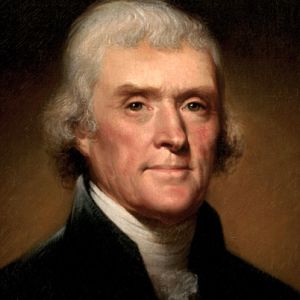
Thomas Jefferson

Thomas Jefferson was one of the great geniuses of his age and a declared opponent of slavery. Some of his writings on the subject were described by contemporaries such as John Adams, the United States’ second president, as being more valuable than diamonds in the anti-slavery cause. And yet the vision of the American Republic that he offered was impossible without slavery, and as President he did nothing to end slavery save for a mealy mouthed assertion that it was a task for later generations.

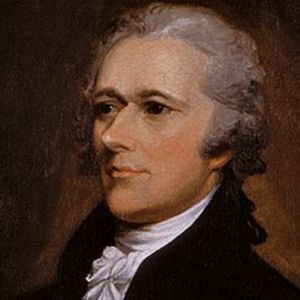
That argument may have comforted him as he sat in his study on his Monticello plantation in Virginia overseeing his own enslaved children. But it was not an argument which impressed Jefferson’s contemporary Alexander Hamilton, who sought, as the United States’ first treasury secretary, to put his anti-slavery convictions into practice by establishing an economic system that would reward free labour over slavery in the hope that that would erode the slave economy and hence end the brutal system.

alexander-hamilton-9326481-1-401

Alexander Hamilton

While that did not directly bring an end to slavery in the United States the economic system Hamilton put in place did ultimately provide the North, under Lincoln, with the economic capacity to crush the South and obtain the legal abolition of slavery half a century after Hamilton’s own death: So if Lincoln is the Father of Emancipation in the United States, I would argue that Hamilton is its Grandfather.

And in spite of his incredible gifts Jefferson did not confront the fundamental systems and institutions of slavery when he had the most power to do so. And across the world we see that still.

It will perhaps be a matter for comment by some future historians that at this shameful period of European history some of the most vocal European leaders on the issue of slavery have been noticeably negative with regard to the formulation of an effective pan-European response to the refugee crisis.  It is the absence of this, more than anything else, which has contributed so much to increasing the risks of human trafficking to Europe from the wars of the Middle East. Furthermore the xenophobia and prejudice that have been allowed to poison the political environment against migrants have further betrayed the struggle against slavery by increasing the opportunities for violence and exploitation.

It is a hard lesson of history, that when the moral courage of political leaders fails in the face of prejudice and vested interests, it is almost always the vulnerable who are the ones to pay in the bloody routine of violence that ensues. And, as was true in the days of Jefferson, it is not rhetoric but moral courage that defines leadership and shapes the history of the times.

‘The Irish Abroad’ – how does Ireland ensure that Irish companies respect human rights when operating overseas?

Shane Darcy's avatarBusiness & Human Rights in Ireland

One of the recurring issues that has come up on the blog has been the extent to which Ireland acts to ensure that Irish companies are not complicit in human rights violations when operating abroad (see here, here and here). How companies that are connected with such violations might be liable to litigation in Ireland will be considered at a forthcoming conference at NUI Galway organised by the Irish Centre for Human Rights. In advance of the conference, I intend to run a series of posts highlighting some current examples of where it is claimed that Irish companies are involved in rights violations overseas.

The situation in Western Sahara and the activities of an Irish oil company have previously been mentioned here, and last week in the Dáil, Maureen Sullivan raised the issue again with the Minister of Foreign Affairs and Trade, Charlie Flanagan. He was asked to explain…

View original post 466 more words

Prisoners of Geography: Ten maps that tell you everything you need to know about global politics, by Tim Marshall

Summary: We’re all trapped, and since Trump inveigled his way into the Oval Office, probably going to die

Recently I was at a meeting with a pro-Brexit member of the British parliament who, six months after the referendum on Britain’s future in Europe, still did not understand the difference between the European Court of Justice and the European Court of Human Rights. Not everyone has to know that of course. But when the person in question is taking decisions that they promise will lead to a better tomorrow, one does expect them to have a firm grasp of the basic facts of today.

Prisoners of Geography is about some of those key and immutable facts. It is about the imperatives that are imposed upon political leaders by the geography within which they find their countries and how they feel compelled to respond.

For example Russia needs a warm water port for its navy. This allows it to project its military power across the oceans and be recognised as a world power. So, when Ukraine displayed a desire to move towards the European Union and Nato it did what it felt was necessary and reclaimed the Crimea and with that Sevastopol, the only warm water port available to it.

Similarly the historical Russian habit of extending its empire into Eastern Europe as far as the borders of Germany is explained by the vulnerability of Moscow to attack from the West across the Northern European Plain. Occupying Poland where the plain is at its narrowest, as it has frequently done, therefore increases Russia’s security from attack.

Another area of potential risk is the artic where Russia’s wish to control the energy sources there could put it on course for a clash with Nato.

Reading this book in the aftermath of 2016 US presidential election was a sobering experience. Marshall reminds us that the United States has a treaty with Taiwan which requires it to go to war if Taiwan is invaded. Something that would spark an invasion by China would be formal recognition by the US of Taiwan as an independent country. Fortunately “there is no sign of that”. Or at least there wasn’t until the US’s gerrymandered electoral system put a narcissist with a disinterest in facts and a xenophobia about China into the Oval Office.

Prisoners of Geography is illuminating not just on these contemporary geopolitical issues, but also on a range of developmental issues: why have Africa and South America developed, or failed to develop, as they have; how geography shaped European history and why the peace the continent has experienced over the past 70 years is not inevitable but the result of conscious political choice in the shape of the European Union. It also throws light on contemporary conflicts in the Middle East, between India and Pakistan, and in the Korean Peninsula.

I was mildly disappointed that there was no chapter on the geopolitics of Britain and Ireland, particularly as Brexit threatens to dangerously reshape the relations between the two islands once again. But, as Brexit also shows, as so much of the UK population and political class is utterly disinterested in reality at this moment in history perhaps there is no point.

Prisoners of Geography is a lucidly written and compelling book. It reminds us why the world is still a dangerous place. It is more dangerous still when power is put into the hands of the intellectually lazy, utterly disinterested in the facts.

La La Land

Seb is a struggling musician… and a bit of a jerk. Mia is an aspiring actress who looks exactly like Emma Stone and is just as lovely. After a couple of inauspicious encounters they finally get to know each other and fall in love. Each encourages the other to pursue their dreams. But unfortunately the very pursuit of those dreams threatens to tear them apart.

The story may be slight, but the way La La Land tells it is nothing short of exquisite. It revives the Hollywood musical format in a way not seen in decades – particularly if one overlooks, as one should, the execrable movie version of Chicago. Emma Stone and Ryan Gosling are as lovely a central couple as have ever graced the silver screen. But there is something that seems grounded about their characters, almost ordinary, that makes them easy to relate to.

Like Singing in the Rain, La La Land is a movie about the makers of art. But there is something perhaps more universal to it. As well as the enormous joie de vivre of the film’s comedic exchanges and its glorious song and dance the movie takes seriously Beckett’s admonition: “Ever try? Ever fail? No matter. Try again. Fail again. Fail better.”

I am generally not one for musicals, but I left the cinema wondering if La La Land had just stolen a place in my all time movie top 10. It is a lovely tonic in these bleak times, celebrating art and artists just as the storm clouds gather again on Europe and the United States. Just like the Women’s Marches across the world in the aftermath of Trump’s inauguration, La La Land reminds us of the importance of getting up after getting knocked down. It is perhaps the perfect movie for our times.

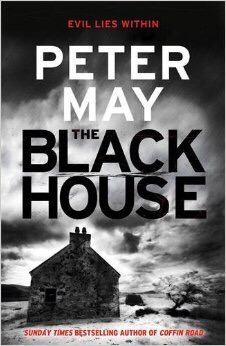
The Black House, by Peter May

A man is found murdered on Lewis, in the Scottish islands. The modus operandi of the killer is similar to that of a case that Fin McLeod, a Lewis native now a Detective Inspector, is investigating in Edinburgh. So Fin is sent North, returning home for the first time in 18 years, to see if he can be of any assistance to the police team investigating the Lewis case. What he finds reawakens a whole series of long suppressed memories. 

The Black House starts routinely (“There’s been a MURDER!”) enough as that classic trope: a police procedural with a flawed, troubled detective at its centre. But it quickly turns into something else. In significant part the book is about growing up, and a major portion of the book is told in the first person as Fin reminisces on his childhood, and the days leading up to his departure to university in Glasgow. This reminded me a lot of Seamus Deane’s sublime novel of childhood, family, politics and war in post-partition Derry, Reading in the Dark.   
Interspersed with this is the procedural part of the book, in the “present”, which is told in the third person. It is not at all clear until close to the end of the book just how these two parts relate to each other. But they ultimately merge very elegantly.

The Black House is the first part of a trilogy, and it is a hugely entertaining novel of life and crime, with a strikingly unusual setting in the Western Islands. I look forward to the rest of the series.

The Great Siege: Malta 1565, by Ernle Bradford

img_1080In 1564 the Ottoman Sultan, Suleiman the Magnificent, decided to try to put paid, once and for all, to the religious-fanaticism tinged piracy on Turkish shipping of the Knights of St John. To do this he aimed to capture their base on the island of Malta. By early summer 1565 he had put his plan in motion and managed to land a force of over 30,000 crack troops on the island to confront the ten thousand or so knights and men-at-arms under the command of the Order.

So began the first great siege of Malta, and it was an extraordinarily vicious and bloody affair.

Ernle Bradford (1922-86), the author, was a participant in the second great siege of Malta, during the Second World War, as a navigator on a Royal Navy destroyer. So he brings to this account of the battle a strong sense of what it means to wage war on this island.

Bradford is a generous and fair-minded chronicler of the battle, recognising the extraordinary courage of both Christian and Ottoman forces, and the extraordinary barbarism with which they fought each other. For example frequently the Ottomans would execute their prisoners by means of bastinado. Or, following the Turkish capture of one of the Knights’ forts, St Elmo, La Valletta, the Grand Master of the Knights, ordered the Ottoman positions to be bombarded with the heads of murdered Turkish prisoners of war. Such courage and barbarism had the same roots: a belief in the evil of their opponents and a conviction that death in the Holy War in which they fought was the noblest thing, and that it would lead to immediate transportation to paradise.

The outcome of the battle shaped decisively the course of European and Ottoman history. But more than that, the conduct of the battle remains vitally relevant. It gives an insight into the frightening violence that can emerge when human beings believe themselves in possession of so absolute a truth that it not only allows them, but requires them, to be the judge of others.

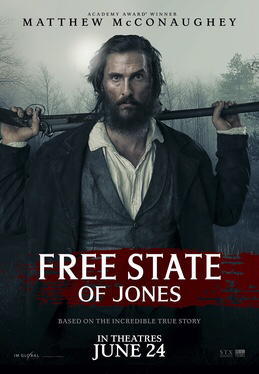
Free State of Jones: film review

Free State of Jones, got rather mixed reviews when it was released. Having finally watched it I cannot really understand why that should be. Perhaps, paradoxically, because it is a serious movie which tells an important story that eschews many of the normal Hollywood cliches?

The movie focuses on a little known aspect of the American Civil War in which a guerrilla army of former slaves and deserters, drove the Confederacy out of a portion of Mississippi. Matthew McConaughey plays the guerrilla leader, Newton Knight, a Confederate deserter disgusted by the pointless brutality of the civil war who decides he is no longer going to fight for a system that he does not believe in. What begins initially as a flight from the authorities in which he finds refuge with a small group of runaway slaves slowly grows into a rebellion against the brutal and corrupt Confederacy as Knight begins to transform his small group of fugitives into an increasingly potent army.

The climax of their military campaign, as depicted in the film, was the capture of the town of Ellisville, after which they haul down the flag of the racist Confederacy that is flying over the Jones County courthouse, and raise the Stars and Stripes instead. That’s the bit that made me cry. I found it a particularly poignant moment given the intent of so many of Donald Trump’s acolytes to figuratively and literally replace the US flag with the Stars and Bars of the Confederacy instead.

One would normally expect the movie to end there on that triumphant note. But it does not. Instead it follows the characters through the post Civil War betrayals of their dreams of justice, and the resurgence, through Ku Klux Klan terrorism and federal government failures, of the systems of segregation which replaced the systems of slavery.

It might be the most honest movie yet about the Civil War and its aftermath. In short it is a sombre and downbeat movie about the betrayal of brave patriots who deserved much better from those they fought for.

But for all that the movie is not without hope: the love and friendship between the central characters played with great subtlety and conviction by McConaughey, the always sublime Gugu Mbatha-Raw, Mahershala Ali and Keri Russell, is something, the film asserts, that the world will finally recognise as shaming the the corrupt and the racist.

It is a fine movie that deserves to be recognised as an important one and seen by many more people. Whether that happens or not it will remain a rich credit to everyone involved in its making.

The Other Side of Silence, by Philip Kerr

It’s 1956 and Bernie Gunther, social democratic Berlin detective, and former whipping boy of Heydrich and Goebels, is living incognito on the French Rivera, working as a hotel consierge with only a regular bridge game by way of diversion. However, as usual, trouble, in the form of a former Gestapo acquaintance intent on blackmailing the English novelist, Somerset Maugham, finds Bernie.

While the main action in this novel relates to the Cold War, significant parts of what happens find their origin much deeper, in Nazi era Germany, and in particular the 1945 Battle of Königsberg that has featured in other novels of the series, in which Bernie was captured by the Soviets. For Bernie “the past is not dead, it is not even past,” as William Faulkner put it elsewhere.

The same can also be said for the character of Somerset Maugham in this novel, whose clandestine life as a British agent and as a homosexual comes back to haunt him.

The Bernie Gunther series is a particularly rich and wry meditation on history. This instalment is no exception, and as always Bernie remains an engaging guide though Europe’s shameful past. True he has become morally diminished by years of war and bloodshed, but he still struggles to hold on to a sense of humour and some modicum of basic human decency in the midst of it all. And that, sometimes, may be the best any of us can hope for.

The violence of slavery: how businesses can respond to forced and child labour in their supply chains

Remarks to conflict minerals supply chain compliance and transparency conference, Berlin, 30 Nov 2016

Investigations into conflict minerals, such as diamonds and oil, over the past twenty years have shown how international markets and northern hemisphere business executives have wittingly and unwittingly contributed to the financing of war affecting poor people in the global South.

There has been some notable progress of course. But recent investigations, such as into cobalt mining in central Africa, shows that much still needs to be done.

Conflict, particularly if it affects places which supply scarce commodities, poses a considerable challenge for businesses wishing to operate ethically. Many of the most basic protections that we take for granted are absent and rule of law, if it ever existed, can become a distant memory. Over 2,000 years ago Cicero noted that, “In times of war, the laws are silent,” because of the damage that war does to the institutions of state, and because war breaks the bonds of human restraint, as Shakespeare recognised, letting slip the dogs.

Consequently conflict creates the conditions in which exploitation and enslavement can be perpetrated to extract minerals for international markets that finance the conflict that in turn perpetuates the conditions in which exploitation and enslavement can continue. It is a vicious circle that I came to loathe during the long and bloody war in Angola, where I worked for five years, trying to ensure basic provision of water and sanitation in the midst of the devastation created by the oil and diamond financed war machines of the antagonists.

Slavery has long been part of war. Caesar enriched himself by the trafficking of millions of prisoners captured in his conquest of Gaul. Islamic State and Boko Haram, drawing on the jurisprudence of Saudi Arabia, seem to have a similar attitude towards those they conquer and subjugate. But the risks of trafficking and enslavement do not end at the edges of the theatres of war. Those who successfully flee the killing fields can find themselves subject to renewed risks if the seeking of refuge leaves them impoverished and without permission to seek decent work legitimately.

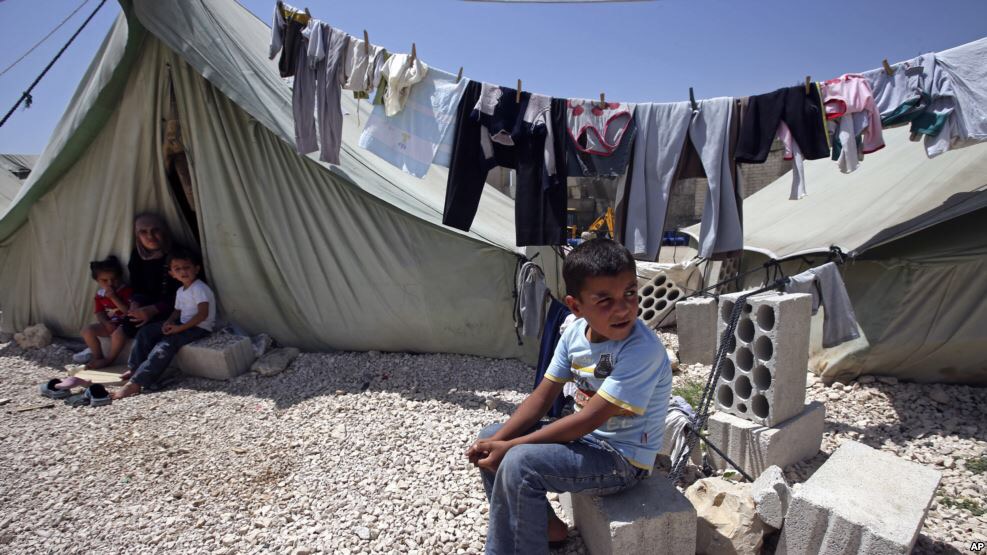
I have spoken to humanitarian workers who have found in the refugee camps of the Middle East increased trafficking of children for forced marriage and other forms of sexual exploitation, and of trafficking for forced child labour in agriculture and other forms of production. We may feel shocked when we understand how parents are involved in handing their children over for exploitation, but for many the trafficking of their children into slavery now may seem like a lesser evil than allowing them to starve. Those refugees who have been fortunate enough to make it into Europe may find their troubles are not ended if they also do not have permission to seek work legitimately. They also may find themselves at increased risk of exploitation and enslavement if they seek work in the informal or grey economy.

Put another way, Europe’s political response to the refugee crisis in the Mediterranean has been a direct contributor not only to the carnage at sea, but to increased risks of trafficking on land. For businesses this means that supply chains that had been hitherto thought safe from human rights violations are now considerably less so.

Considering all of this I think it is perhaps more useful at this point in time to take a much broader perspective of the risks that conflict poses to supply chains more generally, rather than those associated only with scarce minerals or other commodities. Because one of the commodities that war and conflict produce in such abundance is forced labour, and that can get into all sorts of places. And even where conflicts are less overt or where societies are ostensibly at peace, human trafficking cannot occur without violence.

For example the enslavement of Dalits and Adavasi across south Asia is one manifestation of the violence that emerges from the discrimination that prevails against them across that sub-continent due to the failure to establish effective rule of law that protects the rights of all citizens equally. A consequence of that are endemic levels of slavery in agriculture, quarrying, including mica, brick kilns, and many other manufacturing sectors including garments.

Consider also, for a moment, North Korea. North Korean exports in 2013 were estimated as being in the region of USD 7 billion. In 2015 the UN special rapporteur on human rights in North Korea estimated that the trafficking by the state of its own citizens for forced labour in other countries, including the building sites of Qatar and farms and factories in Poland and Malta, was worth in excess of USD 2 billion. In other words the repressive apparatus of the North Korean dictatorship and the threat to international peace that its nuclear weapons programme poses is sustained insignificant part by international complicity in the trafficking of North Korean citizens.

Some of this may seem daunting, and business leaders may feel powerless in the face of the social and political systems that underpin contemporary forms of slavery and child labour. It one be foolish for anyone to expect any business to be able to solve all such problems, even only in their own supply chains. The United Nations Guiding Principles on Business and Human Rights recognise this, stating that it is the responsibility of businesses to respect the human rights of workers, and it is the responsibility of governments to protect those rights. And within this framework I believe that businesses can do more.

The first thing that businesses can and should do is to commit to use whatever power is at their disposal to end the problems that they can end. This will not be everything, but by ensuring transparency in supply chains businesses will not only be able to identify what are the risks of human rights abuses that they face in these supply chains, but understand why these risks exist. In Malaysia, for example, the forced labour of migrants is a particular problem in part because of the tied visa regulations that give employers considerable powers over workers. Ensuring that workers have all the necessary paperwork from day one of their employment to ensure they can leave that employment of their own volition if they so wish would reduce the risks of exploitation. Similarly businesses should refuse to work with labour providers who charge workers fees, often of such exorbitance that they effectively render the workers in bondage.

Second businesses must recognise that the challenges of human rights in supply chains are pre-competitive. No business should be seeking a competitive advantage based on lowering their labour costs to close to zero by effectively enslaving workers. I say no business should do this but of course many do. But likewise no business should be seeking commercial advantage based on simply ensuring that the workers in their supply chain are treated as human beings. That should be the common starting point for all. But in the absence of this there is considerable risk that those who see a commercial advantage in an ethical reputation may be tempted to cover up information about abuses in the supply chains rather than confront and rectify the abuses.

Third businesses should be prepared to recognise when a problem is beyond their power and speak publicly about that. The slavery that exists within the Thai and Irish fishing fleets is in part due to poor regulation and inspection of these sectors. Those are governmental responsibilities. Similarly the child labour that is so endemic in the West African agricultural sector is in part due to the fact that there are too few schools and often these schools are of a poor quality. Again this is a matter that governments should rectify.

Which brings me to my fourth point. Businesses must not be coy about their political voice. Politicians tend to pay more attention to business leaders than to those of non-governmental organisation such as myself. And I get the impression that business leaders are not shy about speaking on a range of what might be called traditional business- political matters, such as tax or trade policy.

But with the globalisation of the international political economy it is important to recognise that human rights and development policy can also have commercial and legal implications for businesses, The US Trade Enforcement and Facilitation Act empowers the US Customs Service to exclude from US markets goods tainted with forced or child labour. The UK’s Modern Slavery Act requires businesses to state what they are doing to eliminate slavery from their supply chains. As I said businesses should commit to doing what is in their power to end slavery in their supply chains, and sometimes the most important power that they should exercise is that of demanding appropriate action from governments.

In the final analysis slavery is a human institution. It can be changed by human action. The great strides that we have seen in against slavery in the course of human history have occurred when businesses have joined with governments, trades unions and civil society to reject this form of violence against vulnerable human beings. You know this yourselves. When we act together, we can overcome.