My speech to the Third Global Conference on Child labour
Video
Reply

First of all many thanks for the opportunity to speak here.
We are meeting here, as everyone is aware, as the ILO are engaged in a process of standard setting in relation to ILO 29, the 1930 forced labour convention. This is an important process because, as many of the interventions here have indicated, forced labour has moved on considerably since that convention was first drafted.
It is also appropriate that we meet here at the European Economic and Social Council because, as Mrs Myria Vassiliadou, the EU Anti-Trafficking Coordinator, remarks indicated there is much that that this process can and should learn from the EU, and most particularly from the EU anti-trafficking directive, on the struggle against forced labour.
I would like in particular to highlight the strong emphasis in the Directive on the reduction of “demand that fosters all forms of exploitation” and the Directive encouragement to Member States to enact “measures to reduce the risk of people becoming victims of trafficking in human beings.”
In contemporary Europe the “legal persons”, to use the language of the Directive, most responsible for the demand for trafficked people are some of our transnational businesses.
For example as we speak today European clothes retailers are transacting deals with clothing manufacturers in southern India where the use of the forced labour of girls and young women is routinized. Indeed many of these enslaved young women will be spinning into thread cotton that has been gathered by forced labour and child slavery in Uzbekistan while, for all intents and purposes, the EU stands idly by while these abuses go on on our doorstep. Ongoing research by Anti-Slavery also finds that forced labour of vulnerable migrants in SE Asia is a huge and systematic feature of the export orientated industries of Thailand many of which find lucrative markets in Europe perhaps most notoriously the fisheries that keep us supplied with prawns.
If history shows us one thing it is that voluntary measures are woefully inadequate as a means to address systemic problems. The most popular voluntary measure of the moment is that of social or ethical auditing. Frankly we should recognise that this approach has not brought any notable change to labour rights abuses in supply chains. Rather it is used as a fig leaf by companies to indicate social concern without involving any of those companies in the necessary scale of appropriate social and political action to end the problems. Indeed in many instances the purpose of ethical auditing is to find nothing: repeatedly we see the failings of ethical auditing exposed in Bangladesh by lethal fires which have previously been given clean bills of ethical health.
Hence a binding Protocol to ILO 29 is essential. The EU directive is an excellent example of an effort to obtain pan-European systematic response. Yet as Mrs Vassiliadou’s remarks indicated also the implementation of the Directive by member states still leaves much to be desired – I would highlight in particular the failures of member states to introduce extraterritorial measures to hold to account their “legal persons”, their businesses, who recklessly endanger vulnerable workers to forced labour in their supply chains.
One of the reasons for the failure of member states to fully implement the EU directive is because of the fragmentary nature of the government of many member states: for example in the UK it is the Home Office which has primacy on the EU directive, but some of the measures that the Directive advocates do not fall within the remit of that ministry, but rather should be undertaken by the aid and trade ministries.
Replication of key measures from the EU Directive in a binding Protocol to the forced labour convention, particularly those related to the supply chains of “legal persons”, would help address this question of fragmentation by requiring other currently negligent ministries to pay attention to their obligations in the struggle against forced labour internationally. It would also promote good practice more internationally, which is also in Europe’s interest by extending rule of international law to prevent other regions of the world from deriving unfair competitive advantage from the enslavement of vulnerable workers.
Forced labour and the trafficking of human beings requires an international response. Too many countries, including member states of the EU, feel that their domestic law will provide sufficient response to the challenges of forced labour. Such an attitude shows little more than a profound lack of understanding of the realities of forced labour and trafficking in a globalising political economy. But this complacent attitude is prevalent in many government ministries across Europe and it must be challenged.
The EU Directive rightly emphasises the gendered aspects of human trafficking. There are additional factors that render people vulnerable to trafficking for different forms of enslavement. These include prejudice against caste, ethnicity or age, vulnerability through poverty, relative physical weakness or limited access to education, failures in the rule of law as a result of limited resources, corruption or both, and failure of governments to protect and support their citizens at home or abroad.
In citing this list I do not want to make the struggle to prevent human trafficking sound as if it is an unwinnable one. Each one of these problems was created by human beings and like all human constructions they can be changed by human action.
Simply put we can begin to address the challenge of preventing human trafficking by aligning justice policy with aid, trade and diplomacy. Currently national policies across Europe and the rest of the world march to their own tunes with little consideration of how they may contribute to the reduction of trafficking.
Trade policy is a particularly important example of this. As I mentioned the cotton harvest of our trading partner Uzbekistan is routinely gathered through forced labour and child slavery. This is a dreadful indictment of EU trade policy. Increased challenges from Europe as a whole and from Member States on the sufficiency of the law and policy of trading partners in protecting their own citizens from forced labour abuses should also be an important component of trade diplomacy.
Aid policy is also an area where there is surprisingly little consideration on how to reduce the supply of vulnerable workers to traffickers. Increased focus of aid policies on communities vulnerable to forced labour and trafficking would, quite simply, reduce trafficking. For example increased attention on education, including business and vocational education, for low-caste, “Dalit”, girls in South Asia would remove considerable risks of trafficking from their lives. Increasingly our private and governmental aid agencies should be asked to consider how their work contributes to the prevention of trafficking: There needs to be a wider engagement by these organisations with developing solutions to these problems if there is ever to be an optimal response by human society to this human rights abuse.
As an aside I feel strongly that there will never be a solution to poverty until there is an end to slavery and so this should be made an explicit Development Goal.
I hope all of you here will recognise that that none of the tripartite parties responsibilities end at the borders of national territory. Businesses have responsibilities in their global supply chains. Unions also have interests, for example in ensuring decent work in those same supply chains. And governments responsibilities for their citizens do not end at national borders.
So I hope you will support the idea that a new binding instrument should recognise the realities that many of the risks of forced labour in the contemporary world emerge from the gaps in national practice and international rule of law in the globalising economy. If a new instrument can provide clear direction on how to respond to these risks, for example in the ways I have just described, then it will be well worth the effort.
From a speech to the Management and Leadership Network (MLN) Belfast, 27th Feb 2014
There is a story from French history of a populist leader sitting in a café one afternoon and spotting a passing mob on their way to some unknown destination for some unknown purpose. So he jumps up after them shouting “There go the people. I must follow them, for I am their leader.”[1]
That story may well be apocryphal but it does paradoxically represent an aspect of leadership, but only one aspect. And if this is the only aspect of leadership displayed by someone then that person is not truly a leader. Instead they are a mere panderer to popular sentiment, something to which the most craven of politicians are prone, as we know in this part of the world to our cost.
I’d call what our French friend was at maintenance of legitimacy. This is something that all leaders have to do whether that is upward management to a superior or a board, or in the case of a political figure like this French chap, to a constituency.
But there are two other components to leadership. First there is staff development and with that the attendance to the key management functions that drive an organisation. Then there is strategic choice.
Strategy is one of those terms, a bit like leadership, which a lot of people use but meaning sometimes quite wildly different things. So just to be clear about what I mean by strategic choice it is about the allocation of resources to priorities in order to obtain immediate term survival or long-term success of an organisation.
One of the other things I’ve noticed over the years is that it is immensely difficult to do all three well over a given period. I’m not quite sure if that is a matter of personal aptitude, lack of time, or difficulty of circumstances.
When I was working in Angola at the end of the Civil War there I felt I did two of the three well. I made the right strategic choices to build the operation to provide humanitarian assistance to over a quarter of a million people and I helped mentor and train a cadre of staff who have become, in my opinion, outstanding leaders in their own right.
But I was poor at upward management in large part because of distance from head office, changing personnel there and the simple stress of working in wartime. This meant that when I left many of the achievements, particularly in relation to learning and management, which we had made were insecure and many of them eroded quite quickly afterwards.
I beat myself up a lot over that for some years but began to forgive myself a little when I read a biography of Hannibal a few years ago and found that he was pretty lousy at upward management too: a significant reason why Rome not Carthage won the Punic Wars was because Hannibal was so alienated from the Carthaginian Senate that they refused to reinforce him at a crucial moment and so his Italian campaign failed.
That brings me to another point I wanted to make:
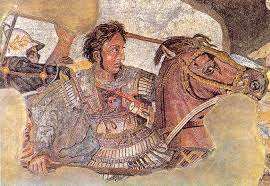
In Western Europe Alexander, the Macedonian king who conquered so much of the known world, is usually known as “the Great”. But in Iran he is known to this day as “Alexander the Accursed” because there he is remembered for devastating one of the great flowerings of Persian civilisation.
I told a Greek friend once about this dichotomy and she got very angry, shouting about how no one could say that, it wasn’t true: Alexander was the greatest of men.
I said “But why are you getting angry? He wasn’t even Greek!” and our relationship never really recovered.
Now I tend to have more sympathy for the Iranian rather than the Greek, or Macedonian, view of Alexander. But my point here is that it is intrinsic to leadership to have enemies. This is obvious when you think about political or military figures from Alexander to Theresa May. But this polarisation of opinion is also inevitable in other leadership environments. This is because strategic choice – the allocation of resources to priorities – is such a fundamental aspect of leadership. In such choices there will always be winners and losers and this will bred resentment.
Lincoln is today regarded as the greatest president in US history. But Shelby Foote, a historian of the American Civil War, told the story of how when he was writing his Magnus Opus, he contacted a descendent of the vile Nathan Bedford Forest, the most brilliant Confederate cavalry general of the Civil War, and subsequent founder of the Klu Klux Klan.
Foote told her that he regarded Lincoln and Forest as the only two authentic geniuses to emerge from the war. “Well”, she replied, “my family never cared much for Mr Lincoln”.
That sentiment was widespread in Lincoln’s lifetime. One gets a sense of this from the film Lincoln. He was vilified in Congress and by large swathes of the Northern press let alone the Southern. His treasury secretary, Salmon Chase, plotted what was in essence a coup d’état against him. Most of his cabinet colleagues thought they were much more qualified than him to be president.
In her book Doris Kearns Goodwin makes a strong argument that Lincoln’s niceness was a fundamental factor in enabling him to lead and manage though the crisis of the Civil War. I think that is important to remember when all the tales of hard-nosed management are told and management ideals are presented to us on television who are clearly selfish, self-serving and obnoxious individuals. Lincoln was able to hold together his fractious cabinet in part because of his warmth, humour and generosity of spirit, something that still echoes down the ages.
But I think there was something deeper too which was Lincoln was a person of immense moral courage. By this I mean he had that uncommon capacity to take personal responsibility for hard, sometimes terrifying, decisions, through the consideration of mature and selfless personal principles in interaction with the leadership challenge he found himself presented with. And he was open to the growth and evolution of his principles and values from experience.
Just how uncommon that capacity is is starkly indicated by consideration of one of the most shameful episodes of human history. Christopher Browning in his book Ordinary Men noted how only a relatively few members of the SS murder squads operating in eastern Poland during the Second World War relished their work. The majority disliked it intensely and went along with the protracted routine of murder, even of children and infants, for reasons of unit loyalty and belief in the legitimacy of their orders.
Only a very few, maybe 10% refused to participate in massacre. Pre-war politics was no predictor: German Social Democrats and Communists participated in slaughter along with Christian Democrats and Nazis. And some Nazis like Oscar Schindler and John Rabe were spectacularly heroic in their rescue efforts during the war.
Christopher Browning makes the chilling observation in his book that anyone who wasn’t in the same situation who says they would not have participated in the killing had they been there is simply saying one thing: that they do not know what they are talking about.
I think there is considerable truth in that assessment but I don’t agree with it entirely. Hugh Thompson Jr was an American helicopter pilot in Vietnam who intervened in the My Lai massacre because prior to ever seeing Vietnam and all through his time there he had engaged in mature reflection on what, literally, it meant to be a Christian soldier in such a war: what was acceptable and what was unacceptable. So when he saw fellow Americans involved in the butchery of unarmed civilians, much as SS troops and police had done 25 years before, he interposed is helicopter between them and the civilians and told the American troops bluntly that if they went any further he and his crew would personally kill them all. His moral courage enabled him to save the lives of 11 civilians.
You don’t have to be a Christian like Hugh Thompson to demonstrate moral courage. And even if you are a Christian, or any religion or none, it is no guarantee that you will ever have it. What you do need is ownership of your beliefs and principles.
Given the scarcity of moral courage even in the face of the most incontrovertible and horrific instances of human history this is clearly an uncommon phenomenon. And without deliberate consideration it is much less likely to be achieved in the face of, by those measures, the relatively trivial cases that so many of us more routinely face in the course of our lives as professional leaders.
Lincoln showed his profound moral courage in the most dramatic terms in preserving the Union and abolishing slavery. Collins showed it in signing the Treaty, something he knew at the time was likely to be his “own death warrant”.
It is this quality I believe more than anything else that is the most fundamental qualification for leadership: that stark moment of social isolation where you are prepared to raise your voice against the prevailing orthodoxy and vested interests to assert a different way irrespective of the personal cost.
I remember in my first or second year at Queen’s studying civil engineering one of my lecturers, Harry Ferguson, giving a lecture on professional practice. One of the things that he said which had a perhaps surprisingly profound impact on me was “A professional will always sign his or her name to their reports”. It seems like a relatively mundane thing but it is a good indicator, though not a universal rule: if you are not prepared to put your name to something, if instead you seek the anonymity of a crowd – or a mob – you should first question your professionalism in the matter and then your moral courage in relation to your leadership.
Lincoln putting his signature to the Emancipation Proclamation, Collins to the Treaty are among the starkest examples of moral courage and I am sure that each of you can think of additional examples from history, or personal or professional experience.
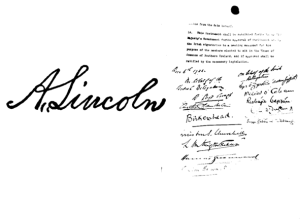
Abraham Lincoln’s signature, and those of the signatories to the Anglo-Irish Treaty of 1922, including Michael Collins
The leadership challenges that we face are unlikely to cost most of us our lives. But how we respond to them is still an important measure of our conscience and soul. And the quality of life of others, and sometimes their very lives, depends upon them, sometimes more than we care to remember. Bear in mind that in this contemporary globalising economy with business’s perpetual search for cheap production and rare commodities we are often ensnared in unjust systems such as the ongoing atrocities of contemporary slavery. This makes us accomplices whether we want to be or not to things such as the enslavement of vulnerable workers in Thai fisheries, to make sure we have cheap prawns in our supermarkets, the enslavement of girls and young women in the garment factories of Southern India to provide cheap clothes for our high streets, and the child slavery used for the excavation of the minerals cobalt and coltan for our mobile phones.
It is true that these practices by business, particularly international business, are enabled by the failure of governments to act to protect vulnerable workers across the world. But they can also be a very real expression of failure of leadership by individual human beings – business executives and politicians – who may pay lip service to ideals of leadership and the memory of people like Lincoln but fail utterly to emulate even a modicum of his moral courage.
For that reason it is important for each of us to reflect on the sort of leader we want to be and the sort of moral courage and selfless principle we want to bring to the task.
It is often a thankless and generally a painful process. But it matters: very often the first step on the path to transforming the world is transforming ourselves. Then if some of us, at some time, maybe even tomorrow, find ourselves in a situation where we have the power to reform and emancipate rather than simply acquiesce in injustice, we may find we have the courage to grasp that opportunity and change a moment of history for vulnerable people across the world.
[1] Attributed to Alexandre Auguste Ledru-Rollin 1807-74
First of all, I’ve got to say what an overwhelming and totally unexpected privilege it is for me, a long time movie fan, to be here this evening to receive this award on behalf of Steve McQueen someone I regard as one of the greatest directors of his generation, for a movie that I believe will be regarded as an all-time masterpiece.
With 12 Years A Slave Steve has stripped away all the comforting myths that are still sometimes peddled about US slavery and exposed that system for the archipelago of concentration camps that it was, maintained through violence and racism for the purpose of the dehumanisation and exploitation of other human beings.
I’m deeply proud that Steve has agreed to become a patron of Anti-Slavery International because he recognises that that slavery archipelago which he so forensically exposes is still with us
Today a minimum of 21 million people across the globe are subject to the violence of slavery: from the mines of Congo which enslave children to excavate coltan for our mobile phones, to the garment factories of South Asia which enslave girls and young women to produce clothes in such volumes for the global North that each of us here tonight is probably wearing a garment tainted by such slavery, to the World Cup building sites of Qatar, to the private homes of Europe where vulnerable migrant domestic workers often toil in servitude in the midst of our cities.
Slavery is still with us, trapping and brutalising vulnerable people who have sought nothing but decent work. And that blunt fact indicts us all. Poverty will not be ended until slavery is ended, and yet the international community fails to recognise slavery eradication as a fundamental development goal. All our ideals of human rights are challenged by our failure to complete the first great human rights struggle, that to end slavery.
Today across the world there are 21 million Solomon Northrups still struggling for freedom: if those of us who already have that right will only fulfil our responsibility to stand with them then truly, finally we can
overcome.
Thank you.
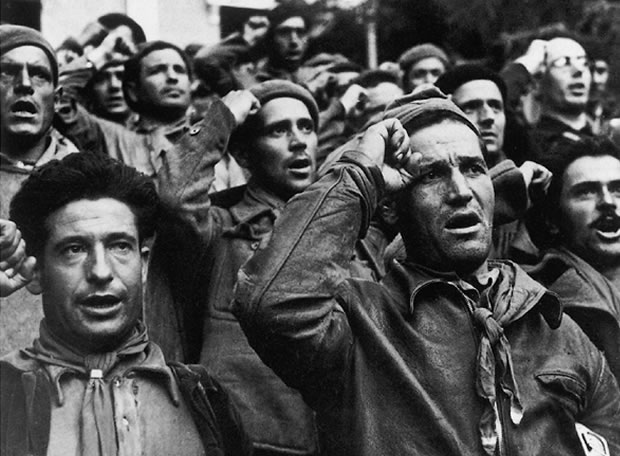
Antony Beevor has written fine accounts of the battles of Stalingrad, Berlin and Normandy. However this book must rank as his masterpiece. It is a gripping narrative history of the Spanish Civil War, updated from an earlier account he wrote, with new material from former Soviet and other sources. At just over 450 pages (excluding references and notes) it is a substantial volume, but still only half the length of the Spanish language version of the work.
The author is clearly sympathetic to the cause of the Spanish Republic, but this does not stop him from being scathing about its failings, particularly its military ones. He is clear-sighted also about the atrocities of the Republicans but these pale in comparison with those of the Francoists, which were systematic and often chilling in their brutality. In one instance an American journalist was present when a fascist officer handed over to his troops two young girls. The officer “told him calmly that they would not survive more than four hours” (p. 92).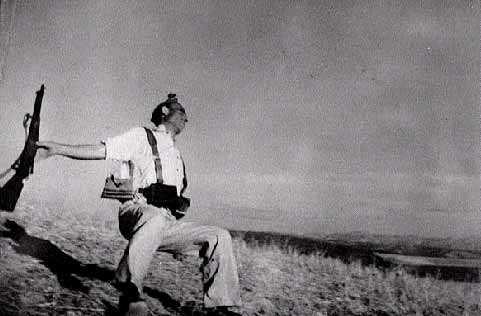
The Spanish Civil War prefigured the cataclysmic struggle of the Second World War, both in terms of the ideological conflicts and as well as the pitiless violence. Yet it is also a conflict which is important to understand in its own terms and for its influence on contemporary Spain and Europe. This is something that Beevor manages seemingly effortlessly. It is a great work of narrative history.
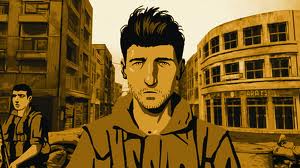
Ari Folman in Beirut, from Waltz with Bashir
Twenty years after the Israeli invasion of Lebanon, of which he was a participant, the writer and director Ari Folman realized that he had little memory of his time there. This included being stationed a few hundred metres from the Palestinian refugee camps of Sabra and Shatila during the three days in which the Phalangist militia massacred the population there.
Waltz with Bashir recounts how, with the help of others who had been there, including fellow soldiers, he began to recover his memory of the events. The result is this extraordinary “animated documentary”,
Palestinians and Lebanese have no voice in this film. Nevertheless it still represents some of the best impulses in Israeli society, documenting how an ordinary Israeli faces the truth of a particularly vile episode in his nation’s history in which he himself was directly implicated.
The massacre in Sabra and Shatila has echoes through history: one Israeli journalist, Ron Ben-Yishai a distinguished war correspondent who was the first journalist to witness and report on the massacre, and personally informed the then Israeli defense minister Ariel Sharon of the massacre as it was occurring in a bid to get it stopped, recounts how the scene in the camps reminded him of the images of the Warsaw Ghetto.
There are other echoes in Middle Eastern history. One not mentioned in the film is how in 1268, on capturing the city of Antioch, the Sultan Baybars immediately locked the city gates to stop the escape of any of the town’s inhabitants as he proceeded to massacre them. Folman argues with this film that the role of the Israeli army during the massacre was the equivalent to Baybars’ locking of the gates. This allowed Israel’s Phalangist allies, Israeli-equipped and in the full knowledge of the highest Israeli military commanders, security to carry out the slaughter, safe in the knowledge that the civilians they were killing could not escape through Israeli lines. While the film may provide only a narrow perspective on the Lebanese invasion, it is a startlingly brave and humane one, showing how an ordinary individual human can take responsibility for himself and the best ideals of his country even in the face of racist atrocity and overwhelming historical events.

Lucrezia Borgia
This is a startlingly dull biography of one of history’s most infamous families, its limitations perhaps a product of the fact that Christopher Hibbert was working on this towards the end of his life.
There is a welcome focus in the book on the unfairly maligned Lucrezia, and the author illustrates how she was a pawn in the power-plays of her pope father, Rodrigo, and brother, Cesare. The book details her many horrific experiences, including the murder of her husband, probably by her brother Cesare, and effectively refutes the myth of her monstrousness
Cesare was no more dastardly than his contemporaries, and in many ways more effective, as Machevelli’s account indicates. But he was still a pretty nasty character. He was a murderer and a rapist, keeping, for example, Caterina Sforza-Riario, ruler of Imola and Forli, as a sexual slave for weeks after sacking her cities. Tiring of her after a while he consigned her to the dungeons. Hibbert treats the coarse humoured contemporary accounts of the “willingness” of Caterina at face value, rather than consider in any great depth the invidious nature of Caterina’s position, and what this says about Cesare.
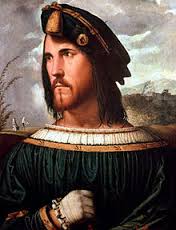
Casere Borgia
Time and again Hibbert seems more interested the clothes that the Borgias wore rather than the psychology of the family and the politics, papal and secular, that drove them. On the positive side it is a short book and does provide a relatively concise overview of the careers of this family. Still considering the potential of the source material it is a disappointing book, and probably unrepresentative of the author.
 Simon Armitage follows up his exquisite translation of Sir Gawain and the Green Knight with this translation of the Alliterative Morte d’Arthur. Again, as Heaney also did so brilliantly with Beowulf, he manages to render into contemporary language the poem while remaining true to the original’s spirit and content. The almost monotonous relentlessness of the violence in this poem however makes it a somewhat less satifying work that those other two, but it is still an entertaining excursion to the Dark Ages.
The story begins with envoys of the Roman Emperor showing up in Arthur’s court demanding tribute. Arthur responds by declaring war on Rome and setting off on a campaign to assert his own rights in Europe. Behind him, in Britain, he leaves his nephew Mordred as regent… a bad mistake.
Much blood and internal organs are graphically shed as Arthur fights his way across Europe, with Gawain, the greatest of his champions, in the thick of the fighting. Armitage notes in the book’s introduction, that this is an older, more seasoned Gawain than the one we encountered in the Green Knight, but he remains, in his chivilrous concerns, recognisably the same character even in the midst of some very sanguinary battles.
One other thing that struck me about this poem: in it Britain is very much a nation at the heart of Europe, a Celtic kingdom that extends from southern Scotland to central France. Arthur is explicitly represented amongst the Nine Worthies as pre-figuring the unmistakeably pan-European Charlemange and Godfrey of Bouillon, a leader of the First Crusade. Hence he is more entitled to the throne of the Roman empire than the man who has demanded tribute of him. It is Ireland and the Scottish Highlands that are the place apart, the uncivilised Atlantic fringes beyond the European mainstream. How times change.
Overall this is a fine, compelling piece of work by one of the most interesting and entertaining of English poets, one who is also currently working at the top of his game

A street in Roque Santeiro market, Luanda, Angola
The Bottom Billion is well worth reading for presenting some very powerful insights into the causes of conflict and poverty from some imaginative economic analysis. However Prof Collier does rather overegg his argument with the tiresome use of straw men: assigning to his imagined opponents views which almost no one holds. For example how many leftist political scientists would regard the Lord’s Resistance Army as anything other than a manifestation of murderous craziness? Prof Collier suggests at one point that there is some latent sympathy for them in vast swathes of academia.
He also asserts support for his analysis from some dubious historical examples: for example he argues that UNITA’s welcome demise in Angola arose from the imposition of effective measures against blood diamonds, which reduced UNITA’s natural resource wealth.
I worked in Angola when some of these measures were put in place and certainly was a vocal supporter of such sanctions as a means of reducing UNITA’s capacity to kill. But I think most people who know a little of the Angolan conflict would feel that the provision of American intelligence to the Angolan Armed Forces had more of an impact on the destruction of UNITA’s armed insurrection, leading ultimately to the killing of their psychotic leader Jonas Savimbi.
So overall a book worth reading for the important insights drawn from fine research, but requiring of something of a strong stomach to get over Prof Collier’s irritating tendency in this book to suggest that he is the only wise thinker on conflict in the world.
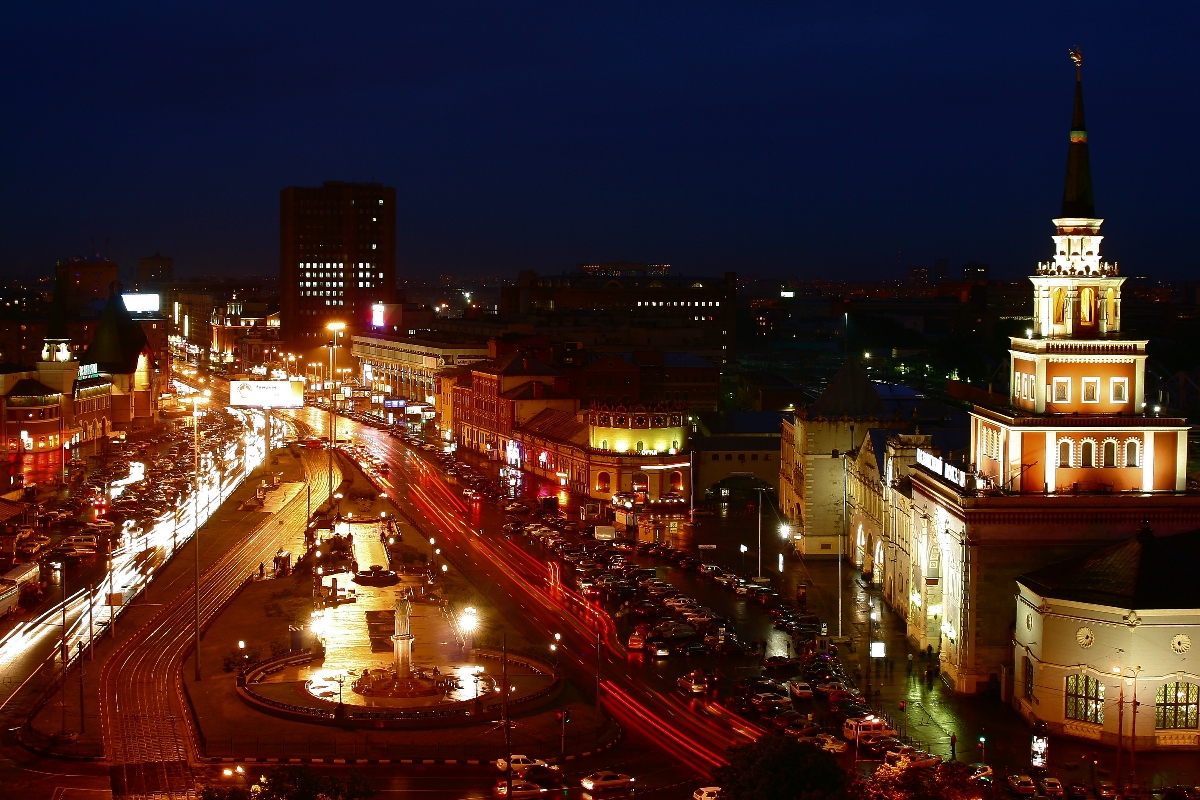
Komsomolskaya (Three Stations) Square
In the years since Investigator Arkady Renko’s first appearance in Gorky Park his fortunes have waxed and waned with the politics of Russia. This has brought him threat of execution, exile on a factory ship as a political undesirable, and rehabilitation in Yeltsin’s Russia.
In Three Stations Renko is once more out of favour with the powers that be. In spite of this he begins to ask awkward questions relating to the dead body of a young woman found with no obvious injuries. Elsewhere Renko’s young friend Zhenya takes it upon himself to try to help a young girl who’s baby has been stolen, also in Three Stations. Their investigations bring them into contact with the excesses of Russia’s contemporary oligarchs and the desperation of the abandoned children who live at the margins of Moscow society.
Renko must rate as one of the nicest detectives in modern crime fiction: the tragedies of his life, his deeply regretted, but very useful, capacity for violence and the mundane horrors of his work never undermines his inate decency, wry humour, and unfailing politeness. In many ways he’s like Inspector Morse but without the grumpiness in a bloodier Russian milieu.
While there is little of the shock of the new that came with Gorky Park’s exploration of Soviet bureaucracy this book is still a cracking thriller, and a return to form of a great series that has lagged somewhat of late. As always Renko is like the most dependable of old friends, a compelling guide and knight errant in the midst of a brutal labyrinth.
 aidanjmcquade
