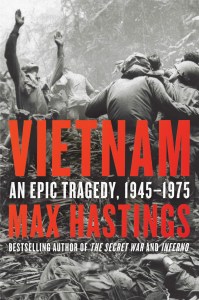
Vietnam: an epic tragedy 1945 – 1975, by Max Hastings

img_1577Summary: an elegant account of the cruelty of the Vietnam war

A recurrent theme of Max Hastings history books is the pity of war. He returns to that theme again with this work, a fine complement to Ken Burns’ extraordinary television history of the conflict.

Where other military historians – for example Hew Strachan – treat war as a near bloodless continental-scale chess match, or – a flaw with Fergal Keane’s Road of Bones – sometimes lose the reader in the extended descriptions of the squalid killings that make up a battle, Hastings manages the balance between the strategic overview of war and the horrific experiences of the combatants such that each illuminates the other. He is also careful to balance his account with not only French and American perspectives, but also with Vietnamese witnesses from both North and South.

The result is a fine account of the wars in Vietnam from 1945 when nationalist struggles against the French turned bloody, to 1975 and the fall of Saigon and with that the reunification of North and South Vietnam. This includes careful consideration of the most famous battles, including Dien Bien Phu and the Tet Offensive of 1968. But it also includes less well known, sometimes shockingly brutal, episodes. These include the guerrilla offensives by the Viet Cong in the early years of the war – in which communist cadres often assassinated their targets by burying them alive so as not to “waste” a bullet – and the final battles between North and South once the American left. Aspects of the war, such as the weapons and field craft of the combatants, the experiences of US prisoners, and the air war, are treated more thematically giving deeper insight into the ghastliness of what those who experienced it had to endure.

Hastings is particularly scathing about Nixon and Kissinger who cynically used the Vietnam war to further their own political agendas utterly unconcerned about the cost in both Vietnamese and American lives that this entailed. Indeed Ken Burns showed that Nixon went so far as to sabotage Johnson’s efforts to obtain a ceasefire in 1968 to increase his chances of winning the presidential election against his Democratic rival. That Nixon was not impeached for high treason is a matter of historical injustice. Kissinger remains an unindicted war criminal and does not deserve the fawning praise that everyone from Hilary Clinton to Niall Ferguson seems to heap upon this blood-soaked man’s head.

In the context of the US sponsored terrorism of the Phoenix programme, Hastings delivers a damning assessment of former Democratic US Senator Bob Kerrey’s war service. Kerrey lost a leg and won a Congressional Medal of Honour in Vietnam. But the balance of evidence suggests that he achieved little more than the butchery of civilians, including women and children, something that he has subsequently only partially acknowledged.

However Hasting is perhaps less objective in this book than in some of his other history work. He was, after all, a young journalist in Vietnam himself. Many of his generation came to the view that because South Vietnam and the US deserved to lose the war, North Vietnam must deserve to win it. This is a view he now believes to be deeply wrong. While not overlooking the cynicism, bumbling and atrocities of the US and the South, Hastings is careful to note that these were matched, such as in the massacres in Hue during the 1968 Tet Offensive, by the North, and that the brutal totalitarianism of the North compared poorly with the relatively open society that existed in the South.

Perhaps, Hastings notes, if South Vietnam had survived, it would have transformed, as South Korea did, from corrupt dictatorship to vibrant democracy. However it is difficult to see how this could ever have happened. North Vietnam in this account has some of the aspect of Rome during the Punic Wars, such was its implacable determination to win irrespective of the costs.

Hence, Hastings acknowledges, while the young anti-war campaigners in the US and elsewhere were naive in thinking Ho Chi Minh a moral paragon, they were right strategically and ultimately, morally: the war was unwinnable and it is wrong to waste lives on such a struggle. As he notes in the last sentence of the book, if only US and British policy makers had remembered the lessons of this war before blundering into Iraq.

The Fall of the Stone City, by Ismail Kadare

Summary: a dream-like account of the nightmare of totalitarianism

In 1943 the German army approaches the Albanian city of Gjiorkaster, planning a brutal reprisal for an ineffectual Albanian ambush on the column. However the city is home to a close university friend of the German commander, and at a dinner between the two the salvation of the city is negotiated.

Or maybe not. What actually happened at the dinner is a source of much speculation, not least by the Communists who take power after the Germans. They begin to wonder is this actually evidence of some existential threat to their system.

This is a novel of the competing rumours that emerge from this dinner, each as haunting as the dark folk tales that swirl around the city and that these rumours echo. It is a book about the history and culture of Albania, and how the myths of the past cast their bloody influence across time right up to the present day.

It is a strange and haunting story, beautifully written and elegantly translated..

The Border: the legacy of a century of Anglo-Irish politics, by Diarmaid Ferriter

Summary: an elegantly written but blunt introduction to the politics of the British border in Ireland, and the threats to peace that British blundering poses

C66EED07-C7FF-4BF8-9689-5C51CD075777This is a very short book. Doubtless a historian of the calibre of Diarmaid Ferriter could have written a considerably longer one. But with a short book there is the hope, however forlorn, that at least some English people might deign to read it.

Because as this book elegantly demonstrates, it is English ignorance of Ireland that has, in the aftermath of Brexit, done so much to threaten Ireland’s fragile peace.

Margaret Thatcher once infamously stated that Northern Ireland was as British as her own constituency, Finchley. This was, of course, nonsense, as this book shows, and, as Ferriter also shows, something she herself did not even believe. It was only when its particularities and differences within the UK were finally publicly recognised by the British government, that a constitutional settlement could be hammered out, within the context of Ireland and the UK’s common membership fo the European Union, which effectively removed the contentious border in Ireland. This new settlement encompassed, in John Hume’s words, the “totality of the relationships” – within Northern Ireland, between north and south, and between Britain and Ireland. This was then enshrined in an international treaty: the Good Friday Agreement.

With Brexit, and Theresa May’s reliance on the far Right to maintain her premiership, the imperial nostalgists in the Conservative Party and the Protestant Supremacists of the Democratic Unionist Party, who always opposed the Good Friday Agreement, have seized upon this as an opportunity to wreck it. Theresa May herself, never a fan of the rule of international law, has been happy to be steered by their atavistic will into the frontiers of unlawful behaviour, threatening to renege on the UK’s commitments under the Good Friday Agreement, as she seeks to satisfy their fantastical demands.

I’m writing this the morning after the senseless murder of a young journalist, Lyra McKee, on the streets of Derry. Dangerous passions have already been stirred up by British incompetence. But we can be confident this tragedy will not encroach on the consciences of Boris or Stanley Johnson, Jacob Rees-Mogg, David Davis, self-styled “Brexit hardman” Steve Baker, disgraced former Defence Secretary Liam Fox, or neo-fascist leader Nigel Farage. For them the lives and hopes of the Irish are of no consequence. They will never be bothered to read even this short book.

But any English person who dreams of their country being something more than an intolerant vassal of the United States, should read this. Those who are ignorant of history are already blundering into its bloody repetition.

The Spy and the Traitor, by Ben McIntyre

2E971371-2167-4B7D-AD62-DA061BC69D1ASummary: gripping account of a small portion of the Cold War that gives considerable insight into some of the wider issues

Sub-titled, “The Greatest Espionage Story of the Cold War” McIntyre’s account of the career of Oleg Gordievsky does make for fascinating reading. 

Gordievsky came from a KGB family – both his father and brother had been officers. But, Gordievsky says, he lost the faith. Disgust at the Soviet system, particularly the crushing of the Prague Spring, led to a momentous decision: in 1972, while posted in Copenhagen, he became a double-agent for MI6.

He described his choice as an act of dissidence, in the spirit of great Russian dissidents like Solzhenitsyn. But where Solzhenitsyn could protest through art Gordievsky could only protest with the information and secrets that were his stock in trade.

McIntyre credits Gordievsky with a number of decisive interventions in the Cold War. Most importantly, he argues that warnings from Gordievsky led to Nato changing military exercises that the Soviet leadership had come to believe were cover for an actual nuclear assault on the Warsaw Pact, thus averting the most dangerous moment in world history since the Cuban Missiles Crisis. Gordievsky also played a key role, the book argues, in the developing of good working relationships between Thatcher and Gorbachev, and the US decision to escalate military spending in the belief that this would eventually bankrupt the Soviet Union and lead to its collapse,

Eventually, in spite of MI6’s best efforts to guard Gordievsky’s identity, he was betrayed by a traitor in the CIA, recalled to Moscow and investigated by Soviet counter-intelligence. Convinced that his days were numbered if he did nothing he triggered an MI6 plan to exfiltrate him. The unfolding of this operation, led by future Liberal Democrat peer, Ray Asquith – called Roy Ascot in this book – at the time head of the MI6 station in Moscow, provides a gripping climax to this wholly satisfying account of Cold War combatants.

Oh – and Donald Trump is almost certainly a KGB asset since the 1980s.

The Future of the SDLP

img_1542The Social Democratic and Labour Party (SDLP) of the North of Ireland has always been a coalition. There are folk in the SDLP who, if they were living in Dublin or Cork or Galway, would be in Fianna Fáil, or Fine Gael, or Labour. But, faced with an existential challenge around the issues of civil rights and peace, they coalesced into a movement that sought to advance the ideals of social and liberal democracy in the face of horrific violence and sectarianism. Such coalitions are significant in history: Both the African National Congress in South Africa, and Congress in India drew together similar diverse elements in the common cause of liberation.

For myself, if I was living in the south of Ireland I would be Labour. But that does not mean I have any less respect for comrades and compatriots from different political traditions who have, with empty hands, faced down the authoritarianism of both the Provos and the British Government to create a peace process out of the nothingness of thought and compassion. It is they, more than anyone, who have, on the streets of Belfast and Derry and Newry and every other town and village in between, brought about the peace process when so many others turned their faces away from the fratricidal bloodshed.

Many southern leaders have also made extraordinary contributions to this struggle for peace and civil rights in the North of Ireland. Sean Lemass, Justin Keating, Garret Fitzgerald, Peter Barry, Dick Spring, Albert Reynolds, Bertie Aherne, Enda Kenny, Leo Varadkar, and Simon Coveney are amongst the most prominent of these leaders and I believe and hope they will be properly honoured by history.

But all of these apart, perhaps, from Sean Lemass, have been guided by the collective wisdom and experience of the SDLP. The SDLP, while consciously standing aside from the political disputes of the 26 counties, have forced the ideal of a new Ireland – one uniting Catholic, Protestant and Dissenter within the framework of an united Europe – back onto the political agenda of the whole island even in the bloodiest and most sectarian moments of our recent history.

This remains a vital and unfulfilled ideal.

There may be a time in the future when the SDLP should break up into the different Irish traditions of Fianna Fáil, Fine Gael and Labour, or, preferably, contribute to a fundamental realignment of these elements into clearer conservative and progressive formations.

But today, with Brexit and the disfunction of the British state again threatening war in Ireland, is not the day for that reckoning.

The SDLP is a vital independent voice for social democracy in the islands of Ireland and Britain. It must remain so.

Brexit: just when you think things can’t get any worse, they can

Common sense does not always prevail. Situations and circumstances can take on their own momentum leading to disastrous outcomes.

Take the case of the First World War. Nobody in the chancelleries of the Great Powers wanted or foresaw war when news of Gavrilo Princip’s bloody action in Sarajevo was first heard. Very quickly however imperial bellicosity, diplomatic ineptitude,  and the demands that railway timetables imposed on the movement of German troops led to a conflagration that engulfed all of Europe.

For those who think such things couldn’t happen again it is worth looking at Bob Woodward’s exploration of the decision-making leading up to George W Bush’s invasion of Iraq. This describes how an initial request for a contingency plan quickly ballooned, as part of the planning process, into troops and armour in the desert and with that a overwhelming pressure for invasion and war. The consequences of the resultant chaos is with us still.

“Events, dear boy, events” still, as they have always, drive decision makers to places they do not necessarily want to go. And, as certain as that, is that whenever there is a Big Red Button that should never be pushed there is always a Father Dougal there to push it no matter how catastrophic the consequences.

I suspect that is where we are with Brexit now. Every – EVERY – credible report and study shows it will be a disaster. Logic alone suggests that cutting your country from its closest allies at the behest of Donald Trump and Vladimir Putin is a poor idea. The consequence may be a relatively small disaster, as in the case of Theresa May’s vile, xenophobic deal. Or it may be a disaster comparable to a small war, as in the case of a “no-deal” Brexit. But whatever shape Brexit ultimately takes there will be one commonality – it will be a disaster.

There are assurances from parliamentarians that parliament will not countenance a “no-deal” situation. But to avoid such an outcome requires rational thought and moral courage. That is in spectacularly limited supply amongst the current membership of the House of Commons. From the sinister, such as Jacob Rees-Mogg and Kate Hoey, to the cravenly self-serving, such as Boris Johnson and Theresa May, to the simply stupid, such as David Davis, Andrea Leadsom, Priti Patel, Steve Baker, Nadine Dories, to the Lexit fantasists like Jeremy Corbyn, there is a such a plethora of clowns and charlatans lining up to press that Big Red Button, that it is a brave person who will bet that sanity will triumph.

That so much of the media is still treating this gallery of eejits and gobshites as credible and serious-minded leaders foretells a future reckoning for the Fourth Estate. Truly this has not been their finest hour.

In the course of its long and blood-stained history England, aside from a few brief episodes, has managed to avoid the deprivations it has inflicted on so much of the rest of the world. This has led to a considerable sense of exceptionalism that still pertains: “What has happened to others cannot happen to us.” Why? “Because we’re English, that’s why.”

But the English are as human as the rest of us and cursed with the same flaws and fears that have driven disasters in so many other parts of the world. Having placed their trust in the array of shysters that now infests the Palace of Westminster, it may simply now be their turn, and Brexit their reckoning.

However it may be some small consolation for those who will suffer Brexit’s bitterest consequences that those who have led them to this juncture will not share in their suffering. Rees-Mogg, Johnson, Davis et al will remain ensconced in wealth and privilege no matter how deep the economic downturn, and those who can least afford to pay will bear the brunt. In the century since the lions were first led by the donkeys to the slaughter of the First World War the donkeys will finally be unequivocally in charge again. And God help us all when that happens.


Devil in the White City, by Erik Larson

102B1280-1D11-4621-BBAA-F47CE042B218Summary: the gripping interwoven tales of an architect and a murderer in 1890s Chicago

The largely now forgotten World Fair in Chicago in 1892 changed the world. Amongst other things it gave us the first large scale testing of electric lighting from alternating current, a vision of how beautiful cities could be instead of the squalid, dirty things they often were, and the Ferris wheel. 

Devil in the White City is a compelling account of how the Head of Works for the Fair, Frank Burnham, a Chicago architect, marshalled the resources of the city to overcome an overwhelming set of organisational, technical and bureaucratic obstacles to deliver this world changing event.

If the book were only about Burnham and the World Fair it would be a compelling, though perhaps niche interest, work. Everyone who was anyone, except Mark Twain, seems to have been involved somehow with the Fair: President Grover Cleveland opened it. Buffalo Bill Cody put on a show there attended by Susan B Anthony; Theodore Dreiser escorted a party of schoolteachers who had won their trip from his newspaper. And amidst the crush of new visitors to Chicago, a doctor and pharmacist by the name of Herman Webster Mudgett, murdered and robbed dozens of innocent men, women and children, unbeknownst to the Chicago Police Department.

Devil in the White City is a combination of social and architectural history interwoven with a tragic and horrific story of a murderer and his desperately sad, trusting victims.  It is an extraordinary work quite unlike anything else I have ever read. 

Postscript: It was only on reading David Blight’s outstanding biography of Frederick Douglass that I discovered the deliberate exclusion of African-American experiences from the World’s Fair and the important protests that Douglass and Ida B Welles raised in the face of this institutional racism. The absence of any discussion of this from The Devil in the White City is an astonishing lacuna from the book, and leads me to think altogether less of it.

Apollo 8: the mission that change everything, by Martin W Sandler

Summary: up close to the raggedy edge of human exploration

In 1968 a rocket blasted off from Cape Canaveral in Florida. Its crew were tasked with testing if Jack Kennedy’s ambition of putting a human on the moon before the end of the decade was at all feasible. So untried was the technology they were using and so enormous was the task they had been set, no one was quite sure if everyone on board was going to come back alive.

Human beings at the cutting edge of exploration is a recurrent theme of Marty Sandler’s work, and Apollo 8 is a gripping addition to his oeuvre. It tells the story of the first humans to break the ties of Earth and travel to the orbit of another planet. It is, as one might imagine, filled with incredible drama. But it is also, as Sandler very convincingly argues, a journey which changed the course of human history.

For many space programmes, such as Apollo, seem extravagant wastes of money given the challenges of hunger and poverty that face so many on Earth. Jack Kennedy’s own brother Edward made this very observation in the early 1970s. But, as they orbited the moon the crew of Apollo 8, Frank Borman, Jim Lovell and Bill Anders, became the first humans in history to witness the Earth rising over the horizon of the moon. The photos they took of this captured the public imagination and conveyed in a way that words could not, the fragility of human existence in the vastness of the universe. Consequently it became an impetus for the environmental movement.

Apollo 8 tells the whole story of this extraordinary journey and its implications in Sandler snappy prose style. And the photographs that accompany the text are glorious.

The Things They Carried, by Tim O’Brien

Summary: a profoundly moving American meditation on the war in Vietnam, rightly regarded as a classic
The Things They Carried is an extraordinary book. An exquisitely written, deeply moving, sometimes extremely funny, sometimes simply horrifying, collection of linked short stories revolving around the soldiers in “Alpha Company”, including one called Tim O’Brien, who after the war becomes the author of this book.

The Vietnamese are generally only minor characters in this book. But while the book is a tender portrait of American troops in Vietnam, it does nothing to glorify the US engagement in that war, which is clearly seen as pointless and immoral. O’Brien’s first encounter with a dead Vietnamese is with an old man killed by an indiscriminate air bomardment of a village called in reprisal for a brief and ineffective sniper attack on O’Brien’s own platoon.

The terrorism that the Americans practice upon the Vietnamese is so routinised that it is almost unremarked upon, frequently considered by the troops as little more than youthful hi-jinks. O’Brien reminds the reader that those doing this, the American GIs, are just kids, mostly conscripts barely out of high school, unleashed from the bounds of civilisation and morality, desperate just to survive and unconcerned about those who die in order to ensure their survival.

But of course not all survive. Vietnamese action repeatedly bleeds the Americans, and vice versa. In one chapter O’Brien meditates on the humanity of a dead Vietnamese soldier, killed in his ambush, and, like his killers, someone who probably wished he was somewhere else, living his own young life rather than being involved in ending the young lives of others.

The Things They Carried, since its publication, has come to be regarded as a classic of American literature and O’Brien as one of the finest writers of his generation. The accolades are deserved.

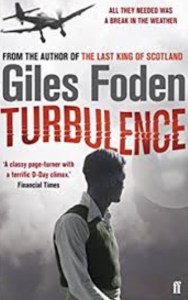
Turbulence, by Giles Fodden

Summary: Weather as a metaphor for war as a metaphor for weather

It’s 1944 and the Allies are preparing for the largest amphibious assault ever mounted to retake Europe from Nazi tyranny. What might thwart their cunning plans though, even more than the Germans, is the weather. A sufficient period of decent weather is essential to land all the troops and equipment necessary to establish a robust beachhead on the coast of North-Western France. Hence inordinate pressure falls upon the weather forecasters to provide the necessary information to the generals to make a decision upon which the lives of untold thousands and the future of Europe itself depends.

Giles Fodden’s novel follows, in flashback, a brief portion of the career of its fictional protagonist, Henry Meadows. Meadows a physicist turned metrologist in wartime service, is sent to Scotland to try to extract the secret to a more accurate forecasting method from a brilliant reclusive, and pacifist, metrologist, opposed to giving any assistance to the war effort.

Meadows, an intellectually brilliant but socially naïve character, is our guide through both the complexities of the science and the chaos of the war. It’s an engaging read, even though some of the discussions of weather forecasting can be confusing. It conveys the awful weight that the planners of the D-Day landings had to bear and how in brutal ways the randomness of war echoes the randomness of the weather.