Bishop finds some novel perspectives on the story through recounting the experiences of JD Salinger and Ernest Hemmingway in the fighting in France. Bishop is also much less generous to the German commander of the Paris garrison, von Choltitz, than were Collins and Lapierre: That von Cholititz did not set Paris ablaze had little to do with his moral qualms and much more to do with the logistical difficulties of such an act of terrorism. Bishop is also rightly caustic about how the grossly collaborationist French police switched sides when they discerned how the tide of the war was turning.
The Paris uprising in 1944 was possibly the luckiest such insurrection in occupied Europe. Elsewhere resisters were encouraged with considerable cynicism by the Allied high command to give battle to the Germans to draw off forces from the main allied armies. But Paris was one of the few places where the allied armies moved to support the uprisings before the Germans had time to massacre them. The relief of Paris by a Free French armored division was something of which the Home Army in Warsaw, or the Maquis on the French Vercors massif could only dream.
It is a compelling story no matter how it is served up, and Bishop does this with quite some style.
Summary: trying to see “higher than the ditches that break up the canvas of the land”.
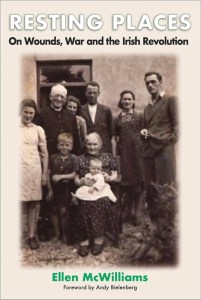
There is an echo of Martin Doyle’s book, Dirty Linen, in Ellen McWilliams’ Resting Places. Like Doyle, McWilliams also uses the literature of Ireland and Britain, experiences from her professional career, and the local history of her home place, in County Cork rather than in County Down, to reflect on wider issues of Irish history and Anglo-Irish relations.
But McWilliams doesn’t stop there. Resting Places is also a remarkably personal work. Her insights on the “big” themes are also prompted by the most domestic ones: by reflections on her relationships with family – both the Cork ones and the English lot – and from her experiences of her own body in her most private moments as a lover and as a mother.
This is apposite: Women and girls were, as McWilliams reminds us, the subject of institutionalised systems of abuse and enslavement, including the Magdalene Laundries and the Mother and Baby Homes, for much of the 20th Century in Ireland. In writing of her own body with such candour she reminds the reader of the strength and fragility of human flesh and how this can be so easily desecrated by bigotry masquerading as righteousness.
By pondering these very intimate aspects of life McWilliams also comes to some of her most important historical insights, ones that can be lost or overlooked in more traditional narrative or political histories. Because so many of the dynamics of war, and particularly of war-crimes, in revolutionary and civil wars have their sources in the domestic sphere: around hearths and kitchen tables, in whispered conversations the memories of ancient ills – of land expropriations, of scorched earth and famine – are kept alive.
And it is one atrocity that perhaps grew from such conversations, the Dunmanway massacre, that lurks at the heart of this book. The country was meant to be at Truce when these killings occurred. But there is no truce on bitter memories.
Between 26 and 28 April 1922, fourteen Protestant men and boys were killed or disappeared around Dunmanway and the Bandon Valley, in the very roads and fields around which McWilliams grew up. These were the families of neighbours killed by the families of neighbours, and indeed the comrades of her own family, which was deeply involved in the struggle for Irish independence.
The fate of two 16 year old boys, Robert Nagle and Alexander McKinley, are particularly difficult for McWilliams to contemplate. A new mother when writing this book, she writes of these boys with an agony of empathy, knowing what it is to carry a child for nine months, tend to him as he grows into his own little person, and to worry that something awful might happen to him. For these boys’ mothers, they awakened to that nightmare.
Perhaps there are still whispered conversations telling new generations why these murders “had to be done.” But McWilliams remembering how Greek tragedy reminds us that crimes that stay buried poison the water of the living, shows true patriotism in confronting this vile aspect of the Irish revolution.
McWilliams is an exquisite writer, warm and frequently very funny. At one point she muses if, in marrying an English scholar of the English civil war, she has actually ended up – at some psychic or metaphorical level – marrying Cromwell himself.
On the evidence of her book, I think the answer is a resounding “NO”. I can’t imagine Cromwell ever fretting over the recipe for soda bread, which her lovely-sounding husband does. Feeding other people is antipathetic to genocide. Cromwell would have hated him.
McWilliams book is an incredibly rich one, fizzing with more ideas that any review can do proper justice to. Read it!
But perhaps we are fascinated by it because, paradoxically, the Romans also remind us so much of ourselves in our contemporary world: we see echoes of Nero in buffoons like Boris Johnson and Donald Trump; the genocidal campaigns of the legions in Gaul and Germany echo with the depredations of the Israeli Defence Force in Gaza, and the Russians in Ukraine; the fanaticism of Hamas has resonance with that of the Sicarii defenders of Masada.
For whatever reasons, historians of other eras must envy those who have stuck to Rome and the seemingly insatiable appetite of readers for new takes on these old stories.
Palatine, by Peter Stothard, Emperor of Rome, by Mary Beard, and Pax, by Tom Holland are amongst the most recent offerings of publishers to meet this ravening demand.
Of these three highly enjoyable books, Holland’s is perhaps the most straightforward: a narrative chronicle from the downfall of Nero in 69 AD, “the Year of the Four Emperors”, through the Flavian dynasty to Trajan. This may be subtitled “Rome’s Golden Age,” but these things are relative. For example, the campaigns by Vespasian and his son Titus against the Jewish revolt in Palestine, which led to the destruction of the Temple and the mass crucifixion of much of the civilian population of Jerusalem, are a particularly chilling example of performative cruelty in the service of mass murder.
Nevertheless, Vespasian and Titus are still remembered as “good” emperors. Which is to say they were good for Romans… in the same way as – that contemporary echo again – the British Conservative Party is “good” for rich people, and the British Labour Party wants to be “good” for some English ones.
Palatine is something of a prequel to Holland’s book. It deals with the first Roman emperors from the perspective of the courtiers of the Palatine – the hill in Rome on which the emperor dwelt and which gives its name to the word “palace”.
The Pantheon
In particular Stothard focuses on the Vitellius family. Heard of them? Well one of them was one of the emperors whose brief reigns in 69 AD, and comic-dreadful ends, were prologue to Vespasian’s more enduring tenure.
Stothard affects a highly entertaining gossipy style for this. In doing so he gives a sense of the court’s preoccupations through the reigns of Tiberius, Caligula, Claudius and Nero. These ranged from the apparently trivial – seating, décor, banqueting, rumoured love affairs – to the sinister – the growth of Sejanus’ power, the casual cruelties of Caligula.
What all these subjects had in common were, like an ancient world Kremlinology, they indicated where power lay, who was in favour and who was out. These were questions of life and death on the Palatine. So, the creatures of court paid attention – much as today’s political correspondents claim to do to the gossip and self-serving off-the-record briefings of power-insiders.
Mary Beard covers similar ground to Stothard, but slightly differently. As with her book SPQR her subject is perhaps histography rather than history. That is, rather than delivering a simple narrative, she presents us with the evidence, discusses what it might mean, and hence what conclusions we may be able to draw.
In doing this Beard gives us intriguing factoids, such as that the first representation of the crucifixion of Jesus was in a piece of anti-Christian graffiti found in the slaves’ quarters on the Palatine. But, drawing on diverse sources, including grave inscriptions, she also gives us some more insight on the way those denizens of the Palatine once thought when contemplating their place in the pecking order and what it might mean for their life prospects.
In other words, Emperor of Rome is a fine work for anyone who wishes to develop their critical thinking skills, not just in relation to history, but in relation to life.
Rome may still offer us circuses to distract from the awfulness of the present. But we can also learn from it how to recognise the ways that power corrupts fools and the cruelty that arrogance breeds. Those will remain important skills and responsibilities for citizens for as long as human society continues to exist.
Summary: a fascinating exploration of the dark side of British history and culture through the spooky stories of one museum
When I was a student in Belfast in the 1980s I used to feel a cold chill every time I walked past one spot, particularly at night-time. I mentioned this to a friend. “You would,” he said. “There was a young fella murdered there earlier in the Troubles.”
Noah Angell gets similar feelings in almost every gallery in the British Museum. But then, the whole place is essentially a crime scene.
So much of the stuff there, from the Parthenon Marbles to the Benin Bronzes to much of the Egyptian collection was stolen in the course of Britain’s bloody colonial plunder of the planet. Angell wonders in this book if the murders that accompanied that pillage still echo in the trophies of conquest that the British Museum now houses.
This fascinating book grew out of Angell, an American in London, noticing at a social gathering that former employees of the British Museum had a lot of freaky stories to tell. So, he began gathering them: diverse tales of the uneasy ghosts that still seem to lurk in every corner of the Museum. These include the moving mummies in some of the, frankly creepy, Egyptian galleries; the hauntings of the old reading room by the shades of forlorn former employees; the ongoing religious wars between the ghosts of Christian and Islamic warriors around rooms containing the Sutton Hoo hoard; the feelings of Museum staff that certain American and Asian artefacts emanate a sense of demonic possession.
As Angell notes, the British Museum likes to present itself as one of the key places on the planet which protects and preserves world heritage for all humanity. However, only about 1 per cent of the Museum’s collection is ever on display. So, it really is a place in which much world heritage is disappeared rather than displayed.
At least the thieves were acting in the spirit of the Museum itself, which is fundamentally a repository of stolen goods. Angell wonders if the key lesson that hordes of schoolkids draw from their visits to the Museum is that stealing is really okay if you can just get away with it… which is, if truth be told, a very British idea.
In its refusal to return stolen artefacts to their rightful owners the UK, and hence the British Museum, stands at odds with most enlightened thinking about the ethical curation of world heritage. Angell does report that George Osbourne, chair of the Museum’s trustee board, proposed transferring the Parthenon Marbles back to Athens as a loan. This, understandably, the Greek government has rejected: how can you take a loan of something that is rightfully yours? But this did make me feel rather more sympathetic to Osbourne: British law forbids the British Museum from returning much of their stolen loot. So Osbourne, it seems, was trying to come up with some path towards resolving this historical injustice.
As anyone who has visited the British Museum will know, it can do fascinating work exploring and explaining aspects of history. But, even if you don’t believe in ghosts, this absorbing book provides a compelling insight into the dark side of the institution’s own history, a microcosm of the country in which it is based. It is a shameful past that the British Museum, and all of British society, must squarely face if they are ever going to rehabilitate themselves.
Summary: An outstanding portrait of the pity of war
Margaret Yeaman has never seen her grandchildren. She lost her sight on 15 March 1982 when a no-warning car bomb exploded close to her workplace in Banbridge, County Down, causing splintering glass to lacerate her face.
Margaret’s story, of being in the “wrong place at the wrong time” is just one amongst many that Martin Doyle explores in his book, Dirty Linen. The book also takes exception to that “wrong place, wrong time,” line. So many of the people whose stories Doyle recounts were just doing their jobs, providing for family and community, or just trying to have a bit of craic. It was the paramilitaries who were in the wrong place at the wrong time for these ordinary people.
Some will still argue that atrocities such as the ones recounted in this book were necessary to advance justice in the North of Ireland. But as Margaret and people like her tell their stories of how their families were devastated by violence, these should bring shame to that notion: as if the British government was ever going to be moved to change policy by Paddies butchering Paddies on the country roads of Ireland. It’s why they introduced “Ulsterisation” to begin with.
Dirty Linen is, in part a memoir, and Doyle gives an honest accounting of his experiences coming of age amidst such carnage, including the miserable abuse he sometimes suffered as a young Catholic in that religiously mixed part of County Down.
This book could also act as something of an introduction to the art of the North of Ireland. As literary editor of the Irish Times, Doyle is able to draw upon the work of so many writers and artists, from Seamus Heaney to F E McWilliams and Colin Davidson, to help him give voice to the depth of the human tragedy that the Troubles represented.
But, as a result of Doyle’s sensitive interviews with Margaret and people like her, his book is also an exemplary work of journalism and a deeply important contribution to understanding the history of the Troubles. It offers an unflinching portrait of the pity of war by exploring the trauma and courage of the victims of both loyalist and “republican” paramilitaries.
Some of those victims whose stories Doyle explores also became perpetrators, or at least sympathetic to the idea of revenge. But so many more refused to become as twisted as those who mutilated them and their families. Instead. they often begged for no retaliation and strove for forgiveness, or at least toleration. Theirs are stories that are so much more heroic than anything that could ever be written about the paramilitaries who pressed the triggers or planted the bombs.
If this was all that Doyle did, then the book would be a marvel. But his painstaking accumulation of detail across the book also builds a picture of the pervasiveness of collusion between British state forces and the loyalist Glenanne gang. Perhaps other writers and researchers have done similar work. But I have not read such a convincing indictment of the breadth of British collusion anywhere else. So, if you want to understand why the British government is so keen to stop Troubles era criminal investigations, read this book.
At a time when the Troubles seem to be giving rise to some exemplary non-fiction, Doyle’s book could well stand out as a classic.
Summary: sure what are a few dead human beings when you consider cultural influence?
Undoubtedly the greatest of Peter Seller’s Inspector Clouseau films is A Shot in the Dark. In it Clouseau falls in love with a murder suspect, housemaid Maria Gambrelli, played by the luminous Elke Sommer. Even when apprehended holding a set of bloody hedge clippers that have been used to kill yet another victim, Maria drifts through the film with an ethereal innocence, somehow untouched by the squalidness and violence that surrounds her.
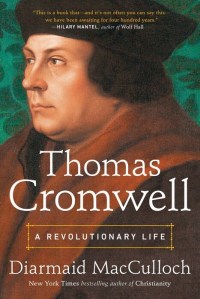
Perhaps bizarrely, it was Maria Gambrelli that I was most reminded of by Diarmaid MacCulloch’s portrait of Thomas Cromwell, such is the sympathy and indulgence that MacCulloch affords him. Maria, of course, was not a murderer, whereas Cromwell was. But for MacCulloch, this is not the most important thing about him.
Rather it was Cromwell’s role in the establishment of Anglicanism that for MacCulloch is the most significant thing about his career. For this, he almost forgives the occasional burning of a Protestant heretic or the public dismemberment of a Catholic, and such killings are skated over with considerable blink-and-you’ll-miss-them rapidity.
MacCulloch argues that Cromwell’s Protestant convictions were genuine. Hence his role in the dissolution of the monasteries, a vast act of cultural vandalism amongst other things, was not just the legalised theft of their property for the crown. It was also an effort to advance the reform of religion in which he truly believed. In this vein, for MacCulloch Cromwell’s greatest lasting achievement was obtaining an authorised translation of the bible into English.
MacCulloch makes a case that Cromwell was a complex figure, and that the depth of this complexity is obscured by an absence of sources: many of his papers were likely destroyed by his servants when he was arrested. So, Cromwell was not wholly the monster that some of his actions might suggest. Government in Tudor times, for which Cromwell had a prodigious flair, was, after all, a bloody business and, Cromwell’s sainted Catholic antagonist, Thomas More, did not have clean hands either.
But there is a danger of whataboutery here. Just because everyone else was doing it, we should not casually excuse the horror in which a person was implicated. Amongst other atrocities, Cromwell played a pivotal role in the judicial murder of Anne Boleyn and those falsely accused of being her lovers.
Dozens of other Catholics and “heretics” – Protestants who Henry VIII and Cromwell regarded as too extreme – followed. MacCulloch reckons that Cromwell’s introduction of parish registers to record baptisms, deaths and marriages was a way of identifying Anabaptist “extremists”. This was part of a broader intelligence system in which the theocratic government of which Cromwell was a central part, monitored and condemned people for crimes of conscience alone.
Cromwell’s bloody trail continued right up to his own judicial murder. This was engineered by high officials jealous of his influence. They were empowered to act against him by the king’s fury at his role in arranging Henry’s fourth marriage to Anne of Cleves. For some reason, the diseased and festering Henry found that he could not manage to have sex with her. So, fortunately for Anne the marriage was never consummated, and a quiet annulment was arranged.
Taken in their totality, when considering Cromwell’s achievements in government and religion he must be seen as a major figure in British history. But there is a saying in the Talmud: “He who saves one life, saves the world entire.” In recognising the scale of his influence, for good and ill, in the making of the modern world, it is remiss to downplay the countless little domestic worlds that Cromwell helped condemn to the fires of fanaticism in the course of Henry’s monstrous reign.
Summary: an elegantly written exploration of the contemporary impact of the British Empire on the world.
Empireworld, Sathnam Sanghera’s follow up to his brilliant, Empireland, expands on the theme of that earlier work, exploring the impact of the British Empire beyond Britain’s shores.
Sanghera does not cover everything. If he did he would still be writing. But also, as he acknowledges, there are some subjects which have been so comprehensively dealt with that he feels he has little new to add.
The history he does recount here is a mixture of the thematic – for example, the role of botany in Empire, and the imperial and anti-imperial history of British NGOs – and geographic – for example, Nigeria and Mauritius. His discussion of anti-slavery is a mixture of the two, with a principle focus on Barbados and the West Indies.
Across the book Sanghera shows how every idea carries with it the seed of its own opposite: racism and slavery generated anti-slavery and anti-racism; imperialism gave rise to anti-imperialism. This leads to a very complex history, allowing the discernment in some places of many positive legacies of Empire – rule of law, parliamentary democracy, tea – alongside many negatives – partition, civil war, corruption, impoverishment.
This complexity leads Sanghera to be careful in his conclusions, seeking with this book to promote nuance, understanding, and dialogue, rather than judgement.
This is a hugely laudable objective, particularly for a country that needs to recognise, as Sanghera rightly notes, that other peoples’ – foreigners! – perspectives on Empire are vital for a proper understanding.
One such foreign perspective that Empireworld put me in mind of, was the 1916 speech from the dock by the great Irish anti-slavery activist and anti-imperialist, Roger Casement, who observed, “For [the English Establishment], there is only “England”; there is no Ireland; there is only the law of England, no right of Ireland; the liberty of Ireland and of an Irishman is to be judged by the power of England.“
For Ireland, one could substitute the name of any country of Empire. Empire was positive for subject peoples if it was in England’s interest. If it was not, then, as Sanghera describes, they could be starved, enslaved, shot with dum-dum bullets or subject to any other expedient or abuse that the British government chose to mete out.
This principle remains true to this day, it seems to me, for Scotland and the North of Ireland, the last vestiges of Empire.
Sanghera does not discuss Ireland, or Scotland, much in this book. But he does not have to. There are plenty of others who have and continue to do so. Instead, Empireworld is another superb study of frequently unacknowledged and unexplored history. A visit to Kew is never going to be the same again.
Summary: an important insight into American war-making
Before 9/11, Martin Pengelly, with his amateur English rugby team, played against West Point in a friendly game when they toured the UK. Pengelly’s team won. In subsequent West Point legend Pengelly’s team was described as “semi-professional”. They were not.
Rugby in West Point is something of an outsiders’ sport. So, the West Point rugby team was populated by students who, by and large, were not quite good enough to get on the American football team. Still, some disadvantages turn out to be advantages by introducing these young men to a much finer sport.
Over twenty years since his on-pitch encounter with these young men Pengelly revisits them and explores how they fared in the subsequent “9/11wars” in which they fought.
The book is an interesting study of a subculture – rugby – of a subculture – West Point, and of American officers’ experiences in twenty-first century war and counter insurgency.
It is perhaps churlish to note that there is negligible consideration of the impact of these wars on Iraqi and Afghan civilians. Pengelly was not a combatant and the politics and humanitarian consequences of US policy, whether astute or blundering, does not seem to be at the forefront of the minds of any of those whose story he is telling. So, there is little of the sort of empathy and soul searching that Tim O’Brien, for example, brought to his writings on Vietnam.
Still, it would take a heart of stone not to be moved by the waste of life, in training and in combat, that Pengelly describes his subjects enduring.
Overall, this is an elegantly written book, and an important insight into what goes into the make-up of a revered portion of American society, one that will continue to exert its influence nationally and internationally into the foreseeable future.
Summary: a lucid and gripping account of an important aspect of the Troubles.
On 24 November 1983, Don Tidey, a supermarket executive, was kidnapped from outside his home by a unit of the Provisional IRA. Twenty-three days later, on 16 December, he was rescued in Derrida Wood, County Leitrim, by a joint operation of the Irish Army and the Garda. In the course of the rescue the IRA unit killed two people: 23 year-old Garda recruit Gary Sheehan, and Private Patrick Kelly of the Irish Army.
The authors trace the origins of this tragedy to the early 1980s when the IRA came up with a new fundraising strategy: kidnapping for ransom. It began with the legendary racehorse, Shergar. Seemingly temperamental stallions do not submit to the same sort of intimidation techniques that the IRA found worked so well on innocent German factory managers and single mothers from Divis Flats. So, unable to keep the horse placid, they killed and disappeared the beast before moving on to vulnerable human targets. Conlon and McGreevy recount the series of kidnapping and extortion operations that followed before the abduction of Tidey.
It is sometimes easy for a Northerner like myself to forget the dreadful impact that the Troubles had upon the South. With this book the authors seek to redress this historical amnesia. Both Leitrim men, they also expose the prejudices that other parts of Ireland, with their crass ignorance of what it means to have a significant paramilitary presence in one’s community, developed against their county.
There is a palpable and justifiable thread of disgust at the paramilitaries’ attitudes and actions running through this book. At one point the authors quote John Hume who observed that many Provos seemed to regard Irish citizens who did not support their bloody campaign as lesser beings.That may well have eased their qualms about pressing triggers on people like Gary Sheehan and Paddy Kelly who were doing nothing more than trying to protect the innocent. Conlon and McGreevy also trace the devastation wreaked by the trauma of those deaths on their surviving families. Meanwhile the probable killers continue to be feted in Sinn Fein circles, and those they killed ignored.
The Kidnapping is a superb book that helps strip away any romantic hue forming around the Troubles and helps all Ireland face up to another vital piece in the totality of our history.
Summary: insight on the Troubles through the prism of a gripping account of one bloody incident
Patrick Magee did not kill Thatcher when the bomb he planted in the Grand Hotel, Brighton exploded. She emerged from the wreckage with her reputation burnished by an extraordinary display of courage and self-possession for one who had just survived an assassination attempt.
Magee did kill Jeanne Shattock, Anthony Berry, Eric Taylor, Muriel Maclean and Roberta Wakeham. Most were sleeping when the bomb exploded but were not killed instantly. Instead they suffocated, terrified and alone, in the rubble that scythed through the hotel, unleashed by the explosion. Others were grievously injured, including former nurse, Margaret Tebbitt, who was left quadriplegic. More would probably have died were it not for the startling courage of the firefighters who attended the scene and broke protocol by insisting on searching for survivors before the building was declared free of explosives.
Killing Thatcher is Rory Carroll’s gripping narrative of the events leading up to this 1984 bombing and the subsequent hunt for the bombers. Its principal focus is on Magee, but it is also an account of the others, from Magee’s victims to the bomb disposal experts and cops who he came into interaction with during the course of his involvement in the IRA’s often vicious campaign in England.
Magee is in many respects a hugely impressive individual. After release from prison, in which he earned a PhD, he showed considerable moral courage in meeting and subsequently working with Anthony Berry’s amazing daughter, Jo. This initial meeting, he admitted, was the first time he realised that he had been responsible for the death of a fine person. But in spite of his apparently genuine regrets, he continues to insist that the Brighton bombing was a legitimate act of war.
Following her callous handling of the 1981 hunger strikes, Thatcher was a hate figure in much of Ireland. So, the Brighton bombing was principally an act of revenge rather than a strategic move coolly calculated to advance war aims. Justice in Ireland was instead advanced by the diplomacy of Taoiseach Garret Fitzgerald, who convinced Thatcher to sign the Anglo-Irish agreement the year after the bombing. This laid the foundations for the Good Friday Agreement of 1998.
Reading this book as thousands of women, children and men are suffocating to death in the bombed out rubble of Gaza, I imagine that, like Magee before he met Jo Berry, Netanyahu, Hamas and their cheerleaders in the British parliament and American Congress do not trouble themselves to think of the dying as fine human beings. But I doubt that any of them would have the integrity of the likes of Patrick Magee to face their victims, or of Thatcher to put in the groundwork for a political solution, in spite of personal feelings.
So, for all that is repellent about British and IRA policy and actions during the Troubles, Magee and Thatcher appear now as moral paragons by comparison with many contemporary political figures with their weasel words in defence of war crimes.





 aidanjmcquade