Thomas Cromwell: a revolutionary life, by Diarmaid MacCulloch

Summary: sure what are a few dead human beings when you consider cultural influence?

Undoubtedly the greatest of Peter Seller’s Inspector Clouseau films is A Shot in the Dark. In it Clouseau falls in love with a murder suspect, housemaid Maria Gambrelli, played by the luminous Elke Sommer. Even when apprehended holding a set of bloody hedge clippers that have been used to kill yet another victim, Maria drifts through the film with an ethereal innocence, somehow untouched by the squalidness and violence that surrounds her. 

Perhaps bizarrely, it was Maria Gambrelli that I was most reminded of by Diarmaid MacCulloch’s portrait of Thomas Cromwell, such is the sympathy and indulgence that MacCulloch affords him. Maria, of course, was not a murderer, whereas Cromwell was. But for MacCulloch, this is not the most important thing about him.
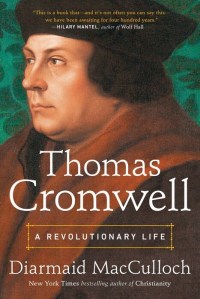
Rather it was Cromwell’s role in the establishment of Anglicanism that for MacCulloch is the most significant thing about his career. For this, he almost forgives the occasional burning of a Protestant heretic or the public dismemberment of a Catholic, and such killings are skated over with considerable blink-and-you’ll-miss-them rapidity.

MacCulloch argues that Cromwell’s Protestant convictions were genuine. Hence his role in the dissolution of the monasteries, a vast act of cultural vandalism amongst other things, was not just the legalised theft of their property for the crown. It was also an effort to advance the reform of religion in which he truly believed. In this vein, for MacCulloch Cromwell’s greatest lasting achievement was obtaining an authorised translation of the bible into English. 

MacCulloch makes a case that Cromwell was a complex figure, and that the depth of this complexity is obscured by an absence of sources: many of his papers were likely destroyed by his servants when he was arrested.  So, Cromwell was not wholly the monster that some of his actions might suggest. Government in Tudor times, for which Cromwell had a prodigious flair, was, after all, a bloody business and, Cromwell’s sainted Catholic antagonist, Thomas More, did not have clean hands either.

But there is a danger of whataboutery here. Just because everyone else was doing it, we should not casually excuse the horror in which a person was implicated. Amongst other atrocities, Cromwell played a pivotal role in the judicial murder of Anne Boleyn and those falsely accused of being her lovers. 

Dozens of other Catholics and “heretics” – Protestants who Henry VIII and Cromwell regarded as too extreme – followed. MacCulloch reckons that Cromwell’s introduction of parish registers to record baptisms, deaths and marriages was a way of identifying Anabaptist “extremists”. This was part of a broader intelligence system in which the theocratic government of which Cromwell was a central part, monitored and condemned people for crimes of conscience alone. 

Cromwell’s bloody trail continued right up to his own judicial murder. This was engineered by high officials jealous of his influence. They were empowered to act against him by the king’s fury at his role in arranging Henry’s fourth marriage to Anne of Cleves. For some reason, the diseased and festering Henry found that he could not manage to have sex with her. So, fortunately for Anne the marriage was never consummated, and a quiet annulment was arranged.

Taken in their totality, when considering Cromwell’s achievements in government and religion he must be seen as a major figure in British history. But there is a saying in the Talmud: “He who saves one life, saves the world entire.” In recognising the scale of his influence, for good and ill, in the making of the modern world, it is remiss to downplay the countless little domestic worlds that Cromwell helped condemn to the fires of fanaticism in the course of Henry’s monstrous reign. 
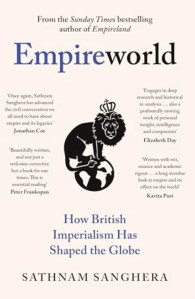
Empireworld, by Sathnam Sanghera

Summary: an elegantly written exploration of the contemporary impact of the British Empire on the world.

Empireworld, Sathnam Sanghera’s follow up to his brilliant, Empireland, expands on the theme of that earlier work, exploring the impact of the British Empire beyond Britain’s shores. 

Sanghera does not cover everything. If he did he would still be writing. But also, as he acknowledges, there are some subjects which have been so comprehensively dealt with that he feels he has little new to add.

The history he does recount here is a mixture of the thematic – for example, the role of botany in Empire, and the imperial and anti-imperial history of British NGOs – and geographic – for example, Nigeria and Mauritius. His discussion of anti-slavery is a mixture of the two, with a principle focus on Barbados and the West Indies.

The result is engrossing, illuminating, and on occasion engagingly contentious: For example, is the anti-slavery image “Am I not a man/woman and a brother/sister?” so clearly a patronising and racist one as he seems to conclude? The anti-racist sports people who have adopted the pose in recent years have shown it can be now, as many interpreted it at the end of the 18th Century, a sign of fraternity rather than subservience.

Across the book Sanghera shows how every idea carries with it the seed of its own opposite: racism and slavery generated anti-slavery and anti-racism; imperialism gave rise to anti-imperialism. This leads to a very complex history, allowing the discernment in some places of many positive legacies of Empire – rule of law, parliamentary democracy, tea – alongside many negatives – partition, civil war, corruption, impoverishment. 

This complexity leads Sanghera to be careful in his conclusions, seeking with this book to promote nuance, understanding, and dialogue, rather than judgement. 

This is a hugely laudable objective, particularly for a country that needs to recognise, as Sanghera rightly notes, that other peoples’ – foreigners! – perspectives on Empire are vital for a proper understanding. 

One such foreign perspective that Empireworld put me in mind of, was the 1916 speech from the dock by the great Irish anti-slavery activist and anti-imperialist, Roger Casement, who observed, “For [the English Establishment], there is only “England”; there is no Ireland; there is only the law of England, no right of Ireland; the liberty of Ireland and of an Irishman is to be judged by the power of England.

For Ireland, one could substitute the name of any country of Empire. Empire was positive for subject peoples if it was in England’s interest. If it was not, then, as Sanghera describes, they could be starved, enslaved, shot with dum-dum bullets or subject to any other expedient or abuse that the British government chose to mete out.

This principle remains true to this day, it seems to me, for Scotland and the North of Ireland, the last vestiges of Empire.

Sanghera does not discuss Ireland, or Scotland, much in this book. But he does not have to. There are plenty of others who have and continue to do so. Instead, Empireworld is another superb study of frequently unacknowledged and unexplored history. A visit to Kew is never going to be the same again. 

Brotherhood: when West Point rugby went to war, by Martin Pengelly

Summary: an important insight into American war-making

Before 9/11, Martin Pengelly, with his amateur English rugby team, played against West Point in a friendly game when they toured the UK. Pengelly’s team won. In subsequent West Point legend Pengelly’s team was described as “semi-professional”. They were not.

Rugby in West Point is something of an outsiders’ sport. So, the West Point rugby team was populated by students who, by and large, were not quite good enough to get on the American football team. Still, some disadvantages turn out to be advantages by introducing these young men to a much finer sport.

Over twenty years since his on-pitch encounter with these young men Pengelly revisits them and explores how they fared in the subsequent “9/11wars” in which they fought.

The book is an interesting study of a subculture – rugby – of a subculture – West Point, and of American officers’ experiences in twenty-first century war and counter insurgency.

It is perhaps churlish to note that there is negligible consideration of the impact of these wars on Iraqi and Afghan civilians. Pengelly was not a combatant and the politics and humanitarian consequences of US policy, whether astute or blundering, does not seem to be at the forefront of the minds of any of those whose story he is telling. So, there is little of the sort of empathy and soul searching that Tim O’Brien, for example, brought to his writings on Vietnam.

Still, it would take a heart of stone not to be moved by the waste of life, in training and in combat, that Pengelly describes his subjects enduring.

Overall, this is an elegantly written book, and an important insight into what goes into the make-up of a revered portion of American society, one that will continue to exert its influence nationally and internationally into the foreseeable future.

The Kidnapping: A hostage, a desperate manhunt and a bloody rescue that shocked Ireland, by Tommy Conlon and Ronan McGreevy

Summary: a lucid and gripping account of an important aspect of the Troubles.

On 24 November 1983, Don Tidey, a supermarket executive, was kidnapped from outside his home by a unit of the Provisional IRA. Twenty-three days later, on 16 December, he was rescued in Derrida Wood, County Leitrim, by a joint operation of the Irish Army and the Garda. In the course of the rescue the IRA unit killed two people: 23 year-old Garda recruit Gary Sheehan, and Private Patrick Kelly of the Irish Army.

The authors trace the origins of this tragedy to the early 1980s when the IRA came up with a new fundraising strategy: kidnapping for ransom. It began with the legendary racehorse, Shergar. Seemingly temperamental stallions do not submit to the same sort of intimidation techniques that the IRA found worked so well on innocent German factory managers and single mothers from Divis Flats. So, unable to keep the horse placid, they killed and disappeared the beast before moving on to vulnerable human targets. Conlon and McGreevy recount the series of kidnapping and extortion operations that followed before the abduction of Tidey.

It is sometimes easy for a Northerner like myself to forget the dreadful impact that the Troubles had upon the South. With this book the authors seek to redress this historical amnesia. Both Leitrim men, they also expose the prejudices that other parts of Ireland, with their crass ignorance of what it means to have a significant paramilitary presence in one’s community, developed against their county.

There is a palpable and justifiable thread of disgust at the paramilitaries’ attitudes and actions running through this book. At one point the authors quote John Hume who observed that many Provos seemed to regard Irish citizens who did not support their bloody campaign as lesser beings.That may well have eased their qualms about pressing triggers on people like Gary Sheehan and Paddy Kelly who were doing nothing more than trying to protect the innocent. Conlon and McGreevy also trace the devastation wreaked by the trauma of those deaths on their surviving families. Meanwhile the probable killers continue to be feted in Sinn Fein circles, and those they killed ignored.

The Kidnapping is a superb book that helps strip away any romantic hue forming around the Troubles and helps all Ireland face up to another vital piece in the totality of our history.

Killing Thatcher: the IRA, the manhunt, and the long war on the Crown, by Rory Carroll

Summary: insight on the Troubles through the prism of a gripping account of one bloody incident

Patrick Magee did not kill Thatcher when the bomb he planted in the Grand Hotel, Brighton exploded. She emerged from the wreckage with her reputation burnished by an extraordinary display of courage and self-possession for one who had just survived an assassination attempt.

Magee did kill Jeanne Shattock, Anthony Berry, Eric Taylor, Muriel Maclean and Roberta Wakeham. Most were sleeping when the bomb exploded but were not killed instantly. Instead they suffocated, terrified and alone, in the rubble that scythed through the hotel, unleashed by the explosion. Others were grievously injured, including former nurse, Margaret Tebbitt, who was left quadriplegic. More would probably have died were it not for the startling courage of the firefighters who attended the scene and broke protocol by insisting on searching for survivors before the building was declared free of explosives.

Killing Thatcher is Rory Carroll’s gripping narrative of the events leading up to this 1984 bombing and the subsequent hunt for the bombers. Its principal focus is on Magee, but it is also an account of the others, from Magee’s victims to the bomb disposal experts and cops who he came into interaction with during the course of his involvement in the IRA’s often vicious campaign in England.

Magee is in many respects a hugely impressive individual. After release from prison, in which he earned a PhD, he showed considerable moral courage in meeting and subsequently working with Anthony Berry’s amazing daughter, Jo. This initial meeting, he admitted, was the first time he realised that he had been responsible for the death of a fine person. But in spite of his apparently genuine regrets, he continues to insist that the Brighton bombing was a legitimate act of war.

Following her callous handling of the 1981 hunger strikes, Thatcher was a hate figure in much of Ireland. So, the Brighton bombing was principally an act of revenge rather than a strategic move coolly calculated to advance war aims. Justice in Ireland was instead advanced by the diplomacy of Taoiseach Garret Fitzgerald, who convinced Thatcher to sign the Anglo-Irish agreement the year after the bombing. This laid the foundations for the Good Friday Agreement of 1998.

Reading this book as thousands of women, children and men are suffocating to death in the bombed out rubble of Gaza, I imagine that, like Magee before he met Jo Berry, Netanyahu, Hamas and their cheerleaders in the British parliament and American Congress do not trouble themselves to think of the dying as fine human beings. But I doubt that any of them would have the integrity of the likes of Patrick Magee to face their victims, or of Thatcher to put in the groundwork for a political solution, in spite of personal feelings.

So, for all that is repellent about British and IRA policy and actions during the Troubles, Magee and Thatcher appear now as moral paragons by comparison with many contemporary political figures with their weasel words in defence of war crimes.

A History of Water, by Edward Wilson-Lee

Summary: a fine exploration of attitudes at the outset of Europe’s colonial plunder of the global South

In A History of Water, Edward Wilson-Lee notes how towards the end of his life, Leonardo da Vinci continued to find excuses for not painting by researching the shifting patterns of cascading water. By the thinking of the day, this represented the ultimate waste of time as received wisdom was that the Platonic ideal of the fixed and unchanging metaphysical world was the only thing that was knowable.

But human society is itself as fluid and tumultuous as water. And, with A History of Water, Wilson-Lee offers accounts of two people who tried to understand the different patterns of its flux.

The people in question are Damião de Góis, a cosmopolitan Portuguese envoy and latterly chief archivist of Lisbon’s Torre do Tombo (Tower of Records), and the much more proletarian Luís de Camões, Portugal’s greatest poet, author of the Lusiads, a romanticised account of Portuguese exploration.

Both men were travellers around the same time, when Portugal began Europe’s imperial pillage of the global South. De Gois’ journeys around Europe made him witness to the stirrings of the religious wars that disfigured Europe in 16th and 17th Centuries. De Camoes travelled much further afield, into Asia, and so was a more direct witness of Europe’s disfiguring of the rest of the world.

However, the two mens’ reactions to their experiences and encounters are tellingly different. De Gois, recognising the humanity of others, sought to build understanding and diminish conflict where he could. Of course, this brought him to the menacing attention of the Inquisition which, in truth, did not approve of Jesus’ admonition to love and not judge others.

De Camoes’ on the other hand, drawing on his experiences in South and East Asia, made Vasco de Gama the hero of the Lusiads.

Just one thing about Vasco de Gama: On his second voyage to India he captured a ship called the Meri bearing some 400 Muslims pilgrims to Mecca. This he set alight and kept burning for four days, deaf to all pleas for pity, until every man and woman aboard was dead. Twenty children were spared and forcibly converted to Christianity, according to some accounts, due to ransoms offered by their desperate mothers.

In this, de Camoes is perhaps the prototype of hundreds of other imperial propagandists who spent the colonial era elevating thieves, rapists and war criminals to the level of national archetypes. It happens still.

A History of Water is a fascinating book that offers a novel aspect of early modern European history and the origins of colonial conquest.

But the book also has contemporary resonances.

All societies have a sort of duality between imperial and democratic tendencies, between the Establishments and the dispossessed, between the chums of the elites on one hand and the human rights protesters on the other.

Edward Wilson-Lee’s exploration of an earlier manifestation of this duality is a stark warning of what can happen when recognition of our common humanity is suppressed by chauvinistic myths of superiority. 

It is an outstanding book and rightly acclaimed as one of the best works of history of recent years.   

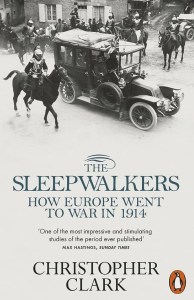
The Sleepwalkers: how Europe went to war in 1914, by Christopher Clark

Summary: So… it was everyone’s fault… but mostly Serbia.

The historian AJP Taylor in his celebrated BBC lectures, How Wars Begin, stated that everyone knows why the Second World War began, but not when, and everyone knows when the First World War began, but not why.

The Sleepwalkers, Christopher Clark’s detailed examination of the origins of the First World War clears up some of that “why” question, but not in any simple way. He describes an interconnected system of “great” European powers – and Serbia – who all took for granted their right to interfere in the affairs of other nations and which developed enormously complex systems of alliances and interests to allow them to do so.

Bizarre imperial attitudes to other countries were not the only strange notions to infest the chancelleries of Europe pre-1914. Many of the denizens of these corridors of power talked seriously of the idea of “preventative war”, which remains, to put it crudely, as much a contradiction in terms as the idea of fucking for virginity.

Hence at the outset of the 20th Century, Europe represented not so much a house of cards destined to collapse sooner rather than later, but a tangle of explosive devices being randomly hit with hammers by supercilious poshos with Napoleonic delusions.

The spark that finally triggered to conflagration was, of course, the assassination of Archduke Franz Ferdinand and his wife, Sophie, in Sarajevo, by the young Serbian nationalist Gavrilo Principe. This was done at the behest of elements in the Serbian government which feared Franz Ferdinand’s intent to increase Slavic representation in the Austro-Hungarian empire. This, Belgrade felt, threatened their dream of a greater Serbia. Franz Ferdinand’s assassination also removed one of the most pacific members of the Austro-Hungarian government and made their impetus towards a war of vengeance all the more assured. From the rubble, of course, Yugoslavia was fashioned, so maybe some Serbs felt the price was worth paying. And didn’t that turn out well.

Some of the dangerously fanciful notions that sparked the cataclysm may have dissipated from Europe, particularly since the rise of the European Union, which was fashioned to make war “not only unthinkable but materially impossible.” However, Clark notes that other dangerous impulses are still at play. Referencing the Euro crisis of 2009/10, Clark describes how, just as in 1914, some countries were prepared in negotiations to use the risk of catastrophic failure for all to advance local interests for some. Similar short-term, selfish interests threaten progress on the climate crisis, which may yet dwarf the carnage of the First World War.

So, a bleak book, but an engaging and thought provoking one, snappily written and frequently gripping.

In search of the Dark Ages, by Michael Wood

Summary: a fine introduction to pre-Norman English history

Over the past 40 years Michael Wood has become known for his highly engaging television documentaries. Some of the books that this has prompted, such as The Story of India, are essentially travel books. Others, such as In Search of Shakespeare, are much more substantial affairs.

Fortunately, In Search of the Dark Ages falls into the latter category. It is a fine history of England from the departure of the Roman Legions to the Norman conquest. Along the way Wood throws out a range of interesting observations and asides, including a judgement that, based on what he wrote in his Confessions, St Patrick was probably from Carlisle.

In the latest edition of this book, Wood has added material on hitherto neglected figures and issues, including Aethelflaed (Millie Brady’s character in the Last Kingdom), who Wood judges to be comparable to her father Alfred in the making of a country called England, and Theodore of Tarsus and Hadrian the African who together established a school teaching the classics in Canterbury during the 7th Century. Just as is the case today, women and immigrants have contributed more to English society than many would like to acknowledge.

Overall then, a fine and entertaining work of English history before William the Bastard showed up in 1066 and helped make stealing other people’s countries the defining trait of the country he stole himself.

Empireland, by Sathnam Sanghera

Summary: a gripping and elegantly written survey of the bloody British empire and its echoes in the present day

Between 1845 and 1854 the population of Ireland was halved through starvation – over a million people died – and forced emigration. The English like to refer to this horrendous period as the “Irish Potato Famine”. This suggests the blame for the cataclysm lies with Irish people’s bizarre and somewhat comical taste for spuds, rather than upon callous government policy that thought the death of hundreds of thousands of Irish people a price worth paying for British profits in the agricultural free market.

Paradoxically Sathnam Sanghera sticks with this nomenclature in his exceptional book Empireland. This book both elucidates many of the other atrocities upon which the British Empire was built, and explores the imprint that sustained bloody exercise in pillage still leaves upon contemporary British society. The term “potato famine” is part of that imprint.

There is an echo in this book of Tom Holland’s Dominion, which explores how Christian thought – such as the ideas of human rights and secularism – has so fundamentally shaped European civilisation that the origins are now generally unknown and almost unnoticed.

The British empire brought nothing so positive as human rights to the UK let alone the rest of the world. Rather it became, for much of the world a byword for bloodshed and impoverishment. But the British – in marked contrast to those societies that were on the receiving end of their colonial project – are startlingly ignorant of what Empire entailed or of its repercussions through time. Few British people now have heard of the murderous British suppression of the Sepoy rebellion of 1857, let alone of the sacking of Tibet in 1903 – even though some of the extremely valuable loot once showed up the BBC’s Flog It while Sanghera was writing this book.

And yet the consequences of all that bloodshed is with us at every turn. The British Museum is stuffed with art treasures, such as the Benin bronzes, stolen in the name of Empire. London’s position as a major financial centre is a consequence of the preferential trade terms and punitive tax regimes that the Empire imposed on subject peoples. British xenophobia towards migrants is a contemporary manifestation of the racism of Empire. The presumption of the British ruling class that the rules – whether relating to human rights, trade or public health lockdowns – that apply to others should not apply to them are also echoes of the political economy of the Empire.

Indeed, Brexit may be regarded as the inevitable consequence of the racist logic that underpinned the British Empire: having no more colonies to pillage, the British Establishment instead decided to loot the UK.

Sanghera’s book is a superb and important introduction to this inglorious period of British history and its reverberations into the present. It is elegantly written, accessible, and vital for anyone who wants to understand better why Britain finds itself in its current morass.

I just which he would quit it with his talk of “potato famines”.

The Restless Republic, by Anna Keay

Summary: a fine and elegantly written, though overwhelmingly Anglo-centric, account of Cromwell’s dictatorship

In the 2001 film, Rat Race, one family participating in the race stumble upon a “Barbie Museum”. It turns out this does not house a collection of the beloved children’s toy, but rather is a homage to the Nazi war criminal, Klaus Barbie. As one of the deranged guides tell them, “People don’t remember just what a wonderful ballroom dancer he was.”

I thought of that movie while reading Anna Keay’s rather affectionate portrait of Oliver Cromwell in the Restless Republic. He may have overseen the massacres of thousands of people, soldiers and civilians alike, children, women and men, in his racist campaigning in Ireland – something that is mentioned rather than described in any detail in this book. But “Oliver” loved music and could be moved to tears at the accomplishments of his beloved children.

The planned wholesale theft of Irish land by the Cromwellian government and the planned complete ethnic cleansing of Catholics from eastern Ireland required remarkable technical organisation and unprecedented accomplishments in land surveying. This Keay does describe in admiring detail. But eventually, before it could reach its genocidal climax, this “ugly episode in Irish history” was brought to an end. Obviously, as Irish history, it is not something that the English need feel too much responsibility for.

Keay choses to tell the story of the short-lived English republic through the eyes of a range of characters, almost exclusively English, but including both Royalist and Parliamentarian perspectives. It is an imaginative approach and engagingly done, with a strong narrative drive. For example, towards the end, her account of Monck and Fairfax’s machinations to bring about the restoration of the monarchy is quite gripping.

Overall, the Restless Republic is an illuminating and elegantly written work of history. But, appropriate to the theocratic monstrosity of which Keay writes, and to the spirit of Brexit Britain too, I suppose, it is written with negligible empathy for the aspirations and experiences of those non-English people who bore, and continue to bear, the brunt of the English Parliament’s ignorance and crass prejudices.