Rome, by Robert Hughes

Summary: a shoddy swan song

You pick up a book by as renowned an art historian as Robert Hughes you think you can be confident in his erudition. With Rome, you will be disappointed.

I would not class myself as an expert on ancient Rome, but I have read a few books by proper authorities. Which seems to be more than can be said for Hughes. Perhaps he did once. But if he did, he did not bother checking any details and instead consigned his misrememberings to the page with gay abandon.

Rome was Hughes last published book. It put me in mind of John Keegan’s The American Civil War, and Christopher Hibbert’s The Borgias: shoddy final books by authors who had quite properly earned distinguished reputations for earlier work.

I read a review of this book by Mary Beard who suggested skipping the first five chapters – the ones that deal with her area of specialism, ancient Rome – so riddled with errors are they. But even if he is less slapdash with the facts in later chapters, presumably the ones that were closer to his professional specialism, I still found it is difficult to trust an author who doesn’t know the difference between architecture and engineering, and despite being a product of Australian Catholic schools, doesn’t seem to understand some of the most basic tenets of Christianity either.

Caesar, by JFC Fuller

Summary: a concise biography, particularly insightful on the military aspects of Caesar’s career.

JFC Fuller was a military theorist, highly influential, in particular, on the Wehrmacht’s use of armoured warfare. However, as a man with pronounced fascist leanings he was excluded from allied military command during the Second World War.

So, instead he wrote.

Among his oeuvre then is this biography of Caesar. Perhaps Fuller was drawn to the subject because of his far-Right leanings: Mussolini also loved Caesar and thought himself his bloated successor.

Given Fuller’s professional interests there is a strong focus on the military aspects of Caesar’s career. But additional entertainment is to be had from Fuller’s waspish sense of humour: how terrible it would be, Fuller muses, if some newly discovered piece of papyrus were to suggest that one of history’s most erotic scenes – the delivery of Cleopatra to Caesar’s bedchamber in a laundry basket – was a myth? Or, discussing Caesar’s prospects in his unrealised plans to invade Parthia, Fuller reckons that Caesar would likely have been routed by the arrows of the Parthians, just as Crassus had been earlier, and Antony would be later: So the Ides of March was probably the luckiest thing that could have happened to Caesar: at least his military reputation survived.

There is an interesting duality to Caesar’s military career: throughout his life, from the Cataline conspiracy to the civil wars, Caesar showed a marked reluctance to shed Roman blood. By contrast Caesar’s conduct of the Gallic Wars, and his later campaigns in Spain, were practically genocidal in their ferocity, and they provided the slaves whose trafficking ensured Caesar’s fortune. For Caesar, it seems, like the British and French imperialists of later centuries, war was merely the logical extension of racism.

A sub theme in this book is Caesar’s relationship with Decimus Brutus, cousin of the more famous, Marcus. It was Decimus Brutus, who convinced Caesar to attend the Senate on the Ides of March. He has been a close lieutenant to Caesar during the Gallic and Civil Wars, and Caesar adopted him alongside Octavian in his will. And yet as every reader of Shakespeare will know Decimus also put a knife into Caesar on the Ides. So, it seems likely, as Robert Harris suggested in his Cicero novels, that Caesar’s last, plaintive cry, “You too, my son?” related to Decimus rather than Marcus.

Overall, not as good as Adrian Goldsworthy’s account of Caesar’s life, but not without merit.

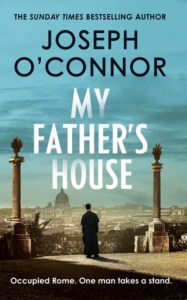
My Father’s House, by Joseph O’Connor

Summary: an outstanding historical thriller of Europeans united against the Nazis

Philippe Sands once wrote a very fine book on the origins of the international law on crimes against humanity and genocide, East-West Street. This does not in my mind absolve him of writing The Ratline: a pointless, rambling wastrel of a book, undertaken, it seems at the behest of the son of a Nazi, who believed his father was, nevertheless, a good man.

He wasn’t.

The Ratline in question in the book’s title was a bit of a Godot character. It never really shows up. The Nazi in question could not stump up the cash to pay the venal and corrupt Vatican officials who were offering Nazis a way of escape from the allies’ dragnet to South America and Southern Africa.

Despite his high profile role in the Vatican Hugh O’Flaherty doesn’t show up in Sands’ Ratline either. Not that this committed anti-Nazi Irishman would have had anything to do with it. But he is an altogether more interesting character, with a much more interesting story to tell of a single night than Sands found to tell in the years he covers before, during and after the war in The Ratline.

O’Flaherty was the head of one of the key Italian resistance networks of the Second World War, run vastly more effectively and altruistically out of the Vatican than the later Ratline. With his pan-European group of Irish, Italian, Dutch and British friends he kept thousands of Jews and escaped prisoners safe as the Gestapo grip on the city tightened.

My Father’s House is a wonderful historical thriller that, by focussing on a single mission by the group introduces us to its various personalities. These take turns narrating the events of the mission. This is an elegant and compelling way to explain to the readers their previous lives before the horrors of the Nazi occupation forced heroism upon them. One scene, in which the British ambassador to Rome, a member of O’Flaherty’s group, encounters O’Flaherty and his deputy, British officer Sam Derry, in the Vatican gardens is particularly chilling. Derry is rehearsing the false names and addresses he will give up under torture if captured.

It is a wholly gripping and deeply moving story of love and friendship in the face of adversity, and asserts a position for O’Flaherty’s alongside Casement as one of the great Irish humanitarians of the Twentieth Century.

Hitler, by Ian Kershaw

Summary: an exceptional work of historical biography

With the instincts of a high-stakes gambler, and a remarkable gift for public speaking – but with absolutely no other discernible gifts or redeeming qualities – Hitler managed in the chaotic aftermath of the First World War to parlay his modest skills into the dictatorship of Germany, and then from that office to unleash the most cataclysmic conflict that Europe has yet seen.

Kershaw’s account of this career was widely praised when first published and rightly so. It remains a gripping, elegantly written portrait of the pathetic monster and a succinct account of much of the suffering he caused.

For me the piece de resistance of this remarkable book is, appropriately enough, the account of Operation Valkyrie, Staffenberg’s doomed attempt to overthrow the monster and grasp some flicker of redemption for Germany. The chapter is as gripping as the best thriller and a reminder that, in the midst of the horror, heroism was still possible.

Like so many of his minions, Hitler was a study in the banality of evil. But, as we have already seen in the 21st Century, sad, narcissistic little men with delusions of grandeur can still wreak terrible devastation.

Consequently this book deserves continued study, so that humanity never completely forgets that.

Confidence Man: The Making of Donald Trump and the Breaking of America, by Maggie Haberman

Summary: portrait of a fascist as a fat man

The character of Biff Tannen in Back to the Future is based on Donald Trump: bullying, lazy, greedy, misogynistic. Confidence Man traces the original Biff’s career from the corrupt world of New York real estate to the American presidency.

It is a depressing story, but, in hindsight, seems almost inevitable now. Because, enabled by his overweening sense of entitlement and his daddy’s money, Trump has one talent that Biff lacked. As the title of Haberman’s absorbing book suggests, Trump has the instincts of a grifter. Like Giovanni Ribisi’s character in the short lived, but highly entertaining, series, Sneaky Pete, it is Trump’s instinct every time he is caught in one lie to double down with another, to meet every attack with a counter attack, and, where possible, to get his retaliation in first. 

According to Haberman Trump was once told, “You’re really very shallow.” “Yes” he agreed, “that is my strength.”

Everything is a transaction to Trump in a zero sum game. For him to win there must be a loser. Love, selflessness, compassion, empathy are meaningless to him. Haberman reports Former White House chief of staff, retired Marine General John Kelly, describing Trump as “the most flawed person” he had ever known. 

Yet enough Americans confuse Trump’s brand of sociopathic narcissism with strength to vote to award this revolting human being with the Presidency.

Not that Trump ever understood the role he had won in a constitutional system. Again and again in this book he is described as unable to comprehend why he is not permitted to do the unlawful. How he yearns for the unconstrained power of a Putin or a Hitler. Nevertheless even corralled by the law and the constitution, Trump and his acolytes still managed to do more damage to the concept of “government of the people, by the people and for the people”, than the entire Confederate army.

Haberman’s fine book is not just an explanation of Trump but also a warning: given the chance again this bloated fascist will reek further chaos.

Apeirogon, by Colum McCann

Summary: a desperately sad but hopeful perspective on Israeli Apartheid and the illegal occupation of Palestine

Rami Ethanan, a graphic designer, and Bassam Aramin, a scholar, are friends. They have a lot in common. Both are smokers. Both are former combatants. Both understand the deep, moral corrosiveness of the Israeli occupation of the Palestinian territories. Both understand that peace requires people to talk to each other and try to understand each other’s point of view. Both are the fathers of murdered children: Rami’s daughter, Smadar, was murdered by Palestinian suicide bombers; Bassam’s daughter, Abir, was murdered by Israeli soldiers.

Apeirogon is the story of how, in particular, these two men have sought to advocate for peace by building mutual understanding. But it ranges even more widely, into the lives of their families, including their murdered daughters, and into the cultural and political history of Israel and Palestine.

(From the Guardian)

I finished this book just before Israel launched its latest series of child-killing attacks on Gaza. As usual, in such situations, American politicians are to be found on social media congratulating themselves for the US military support to Israel that allows its leadership to launch such attacks on Gaza with impunity. Such politicians find the slaughter of children with rockets, and American journalists with bullets, much more palatable than the murder of children by suicide bombers. But that is the logic of the US’s military alliance with what the Israeli human rights organisation, B’Tselem, has called an apartheid state.

The asymmetric nature of the warfare between Israelis and Palestinians is very much on display with the latest Israeli attack on Gaza. In prison, for throwing a dud grenade at an Israeli patrol, Bassam realised that responding to Israeli violence with violence, even if only stones, plays into the hands of those who want to sustain the occupation: it allows them to portray Israeli violence and theft as defensive, and the Palestinians as less than human. As a result of this realisation Bassam became committed to the ideal of non-violence.

Rami, recognising the common humanity of Palestinian and Israeli families who had suffered similar losses to his own, came to his own realisation that the status quo offered no real security for Israelis either. His wife, Nurit, a distinguished academic and peace activist, had understood this much earlier: with enormous courage she explicitly and publicly blamed the racist and militaristic policies of Israeli Prime Minister Benjamin Netanyahu for the death of her daughter.

Apeirogon reminds us that as well as the meat-headed terrorists in the high echelons of government and the military, Israel and Palestine also have thousands of people like Rami and Bassam: people committed to non-violence, human rights and dialogue as a path towards justice.

For success such activists need international support. Yet the US and Europe fail utterly to do this, privileging Israel with arms and trade rather than compelling the dialogue that is essential for any meaningful peace to be forged.

Apeirogon is an extraordinarily important book. It is a tribute to the thousands of (asymmetrically) marginalised Palestinians and Israelis who have sought to build peace and fraternity through dialogue and understanding rather than acquiesce in violence. How many more children will be slaughtered before their path is recognised as the only truly viable one?

Photo by Sarah Lee for the Guardian

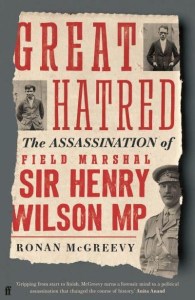
Great Hatred: the assassination of Field Marshal Sir Henry Wilson MP, by Ronan McGreevy

Summary: a fresh and gripping new perspective on the Irish war of independence in London

Great Hatred is a superb addition to the literature of the Irish revolution. Similar to Anita Anand’s, The Patient Assassin, McGreevy explores the lives of the killers and the killed. So Great Hatred provides a triple biography of Reggie Dunne, Joe O’Sullivan and their victim, Henry Wilson. The result is a book that is hugely illuminating on the conduct of the War of Independence in London and the experiences of the London Irish community during the First World War and in the fight for Irish freedom.

As Director of Intelligence of the IRA, Michael Collins had a central role in London operations, so he is also a major figure in this book. One thing that did niggle with me was the author’s apparent acceptance, along with many other fine historians, of Emmet Dalton’s criticism of Collins’ actions at Beal na mBlath, and the idea that the only rational option was to try to run the ambush rather than stop and fight into it. This seems to me to ignore the realities of IRA ambush practices which Collins would have been more familiar with than Dalton.

Like so many other books, this one also does not mention that the last Dail representative for South Armagh in Northern Ireland was Collins. This is emblematic of the depth of Collins’ emotional commitment to the North, and in exploring this McGreevy seems to have found the key to the enduring mystery of who gave the order for Wilson’s killing.

Great Hatred is a fresh, elegantly written and wholly gripping work. It is one of the best books on the Irish Revolution in many years.

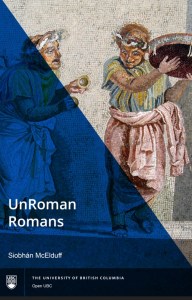
Silence Among The Weapons, by John Arden; and UnRoman Romans, by Siobhan McElduff

Summary: two wonderful books that in different ways remind the reader of the consequences of violent prejudice for ordinary folk

John Arden (1930 to 2012), a long-term resident in Galway, was a distinguished playwright, and an English member of Aosdana, the elite Irish artistic association. Silence Among the Weapons was his only novel, and was short-listed for the Booker when it was first published in 1982.

1982 was when I first tried to read the book, which I found difficult at the time and brought it back to the library once I had finished part one. This recounted events in Ephesus leading up to the arrival of the Roman general Sulla’s brutal army. 

Over the subsequent years I have often wondered what became of Ivory, the book’s principle narrator, and his lovers, Cuttlefish, an Ethiopian who has been enslaved since childhood, and Irene, an agent of the Persian King. So, I decided to track down a copy and finish what I started all those years ago. 

Like Arden himself, his principle characters are theatrical types. It is from their perspectives that the “great” events are viewed. These include the conflict between Sulla and Marius for mastery of Rome, and the ferocious Social War unleashed against the Italian allies of Rome who had the temerity to claim greater civil rights.  (One part of the book, dealing with Ivory’s adventures with pirates, I thought was probably an allusion to Hamlet who went on a similar jolly before turning Elsinore into a charnel house.)

Silence Among the Weapons led me to Siobhán McElduff’s wonderful book, UnRoman Romans. This is a reader of the ancient sources that she compiled with her students. It deals with the experiences of and attitudes towards people like Ivory and his friends: the slaves, the thespians, the dancers and the gladiators who “elite” Romans despised but upon whom their privilege depended.

I suspect the lives of Arden’s characters are based more upon his own experiences in the theatre than on the ancient texts. But one thing he seems to get very right: McElduff notes that “the Romans were frequently quite appalling in their treatment of those they considered outsiders or different, ” and this is something that Arden conveys starkly.

There is a clear intent in Arden’s writing to sound modern in spite of the ancient setting. Hence his references to “police” and theatre “green rooms” among other things. This is, I think, both to increase the reader’s empathy for his characters and their circumstances, and because, for Arden, Sulla, Marius and the Social War are mere examples of the colonial violence that has plagued the world for centuries. The second part of the book, for example, dealing with the eruption of the Social War makes very clear allusions to the beginnings of the Troubles in Derry: Arden even traces the beginning of his conflict to the reaction of the “City” to the reasonable demands of a “Civil Rights Association.”

I must say I still found portions of Silence Among the Weapons difficult: for one thing I would have expected a playwright to be able to present dialogue more clearly, but much seemed buried in long paragraphs. But the book is well worth persevering with. It is often funny, occasionally horrific, and the characters appealing. One hopes against hope that they can somehow escape the random carnage that is engulfing their world.

It is a great pity that, in spite of its remarkable success upon publication, that Silence Among the Weapons now appears to be out of print and in little demand. A book that asserts the importance of remembering ordinary people in the midst of the machinations of warlords should never be forgotten.

An Army At Dawn, by Rick Atkinson

Summary: a fine account of Operation Torch and the US army’s “European” baptism of fire

An Army at Dawn is an account of Operation Torch, the US army’s first engagement – in North Africa- against the European axis powers during the Second World War.

Atkinson notes that from the outset American generals argued that the only way to defeat Germany was a direct attack on its heart through France. The British, by contrast, having been unceremoniously evicted by the Germans from France, Norway and Greece, were altogether more circumspect about this approach. Instead they advocated a “peripheral” strategy, starting in North Africa”. This also had the advantage of maintaining access to the raw materials, including the cannon fodder, of their empire.

In spite of all the advice to the contrary Roosevelt eventually sided with the British and launched Torch, an invasion of French North Africa aimed at catching the Germans in a pincher with the British 8th Army.

By Atkinson’s account Roosevelt’s decision avoided disaster. In spite of great strategic acuity, the Americans had little senior experience of war-fighting: Patton and Marshall had been relatively junior officers in France during the First World War, Eisenhower had yet to hear a shot fired in anger. So some of their officers didn’t even know, for example, how to load a ship in “battle order” with the things they would need first going into the hold last, and the vice versa.

Consequently the US made initially heavy weather of the campaign, including the landings, in spite of the vast majority of the French forces ostensibly defending the coast wishing to defect to them.

After initial setbacks however the Americans learned their craft well in brutal fighting in the Atlas Mountains. Consequently Patton, Bradley and particularly Eisenhower went on to shape the strategy of the Western European theatre, informed by the operational lessons they learned in North Africa.

A minor theme running through the book relates to the racism displayed against the local Arab population by the Allied combatants. This dimly echoes Bonaparte’s atrocity strewn campaign in Egypt and Palestine and prefigures the post war independence movements to come.

An Army at Dawn is a fine, lucid account of this North African campaign. It is a refreshing alternative perspective on the English national religion that the Second World War has become.

The Devil That Danced on the Water, by Aminatta Forna

Summary: a masterpiece of history, journalism and memoir

The Devil That Danced on the Water is something of a hybrid book. It is in part a memoir of Aminatta Forna’s childhood. As a daughter of a Scottish mother and a Sierra Leonean father she was a bit of an outsider in both paternal and maternal societies and, perhaps therefore, a keen observer of both.

But this book is also a memoir of Aminatta’s father, Mohamed, a post-independence finance minister of Sierra Leone and a champion of sustainable development. When he managed to obtain a budget surplus, and despite being a medical doctor himself, he advised the reinvestment of the surplus into primary education rather than health as the only viable basis for his country’s future development.

Unfortunately for Sierra Leone, Forna’s Prime Minister, Siaka Stevens, had other ideas and squandered the money on patronage and corruption. Soon Mohamed was out of government but remained a focal point for democratic opposition.

Forna’s narrative is framed by an account of Mohamed’s final years following his arrest on trumped up treason charges. In describing his judicial murder by the Sierra Leonean kleptocracy, Aminatta charts the roots of the country’s appalling descent into bloody chaos in the latter part of the 20th Century.

Forna’s illustrates how, like all violence, that meted out to her father rippled across her whole family. She details her extraordinary step-mother’s struggles to take care of her and her siblings while desperately trying to also save Mohammed’s life in the face of the brutal stupidity of the Sierra Leone dictatorship. That she knew that Mohamed was being unfaithful to her at the time of his arrest never seems to have caused her to waver for a moment in either of these efforts.

Forna is an exquisite writer and a brave reporter, summoning incredible reserves of moral courage to interview many of those involved in her father’s assassination in order to gain a deeper understanding of just what happened. The story she has to tell is a deeply moving and hugely illuminating one. The Devil That Danced on the Water is, quite simply, a masterpiece.